Microlearning works when short lessons are designed like training reps, not like smaller entertainment.
A five-minute lesson can be powerful. It can also be useless. The difference is technique. If you only skim a short video, nod once, and move on, your brain treats it like disposable content. If you learn one clear idea, retrieve it from memory, apply it once, and see it again later, the same five minutes can become a real learning event.
This guide is not another definition of microlearning. We already covered that in What Is Microlearning?. This is the practical layer: the specific microlearning techniques that make short learning sessions actually work.
1. Use Atomic Lessons
An atomic lesson teaches one thing. Not one chapter. Not one theme. One usable idea.
Bad microlearning tries to compress a whole course into a small screen. Good microlearning narrows the scope until the learner can answer one question: what can I do, explain, notice, or decide after this session?
Examples: one Excel formula, one negotiation question, one cognitive bias, one Spanish verb pattern, one public speaking move, one concept in machine learning.
If a lesson needs more than one objective, split it. The smaller the unit, the easier it is to remember and apply.
2. Start With the Outcome
Every microlearning session should begin with the outcome, not the topic. A topic says: learn active listening. An outcome says: after this lesson, you can ask one follow-up question that proves you listened.
This matters because short sessions do not have room for wandering. The learner needs to know what success looks like before the lesson begins.
3. Use Active Recall
Active recall means pulling the answer out of memory instead of looking at it again. It feels harder than rereading because it is harder. That difficulty is the point.
After a lesson, close it and ask: what was the key idea? What example proves it? When would I use it? If you cannot answer without looking, you recognized the idea but did not learn it yet.
This is why quizzes belong in microlearning. Not because tests are fun, but because retrieval strengthens memory.
4. Add Spaced Repetition
Learning once is fragile. Reviewing after a delay is where memory becomes more durable.
Spaced repetition works especially well with microlearning because the units are small enough to revisit without friction. You can review yesterday's concept in one minute, then move into today's lesson.
A simple schedule works: review after one day, three days, one week, and one month. Apps can automate this, but the principle is simple: meet the idea again before it disappears.
5. Turn Every Lesson Into One Tiny Action
The biggest mistake in microlearning is stopping at understanding. Understanding is useful, but skills need behavior.
After each lesson, ask: what is the smallest real action I can take with this? If the lesson is about writing clearer emails, rewrite one sentence. If it is about leadership, use one better question in a meeting. If it is about science, explain the idea to someone in plain language.
One tiny action beats ten saved lessons.
6. Use the Feynman Explain-Back
The Feynman technique is simple: explain the idea like you are teaching it to someone smart but new to the topic.
In microlearning, keep the explain-back short. Three sentences are enough: what is it, why does it matter, what is one example?
If your explanation becomes vague, you found the gap. Go back, fix the gap, then explain it again.
7. Stack Learning Onto an Existing Habit
Most learning habits fail because people try to create new time. It is easier to attach learning to something already stable.
Examples: after coffee, do one lesson. During the commute, listen to one short explanation. Before opening a feed, answer one quiz. After lunch, review one concept.
This is habit stacking. It makes microlearning feel like part of the day instead of another task fighting for space.
8. Use Just-in-Time Learning
Just-in-time learning means learning something at the moment it becomes useful.
Before a difficult conversation, learn one de-escalation move. Before a spreadsheet task, learn one formula. Before a presentation, learn one opening technique. The closer the lesson is to the moment of use, the more likely you are to pay attention and apply it.
9. Mix Related Topics With Interleaving
Interleaving means mixing related skills instead of drilling one thing in isolation forever.
For example, a communication learner might rotate between listening, concise writing, feedback, and meeting facilitation. A coding learner might rotate between loops, functions, debugging, and reading code.
This feels less smooth than blocking one topic, but it helps your brain learn when to use each idea.
10. Use Visual Summaries
A visual summary helps compress the lesson into a memorable shape: a diagram, comparison table, checklist, flow, or before-after example.
Visuals are not decoration. They are memory handles. A good visual lets you reconstruct the idea faster later.
11. Build Feedback Into the Loop
Feedback is what keeps microlearning honest. Without feedback, you may feel fluent while practicing the wrong thing.
Feedback can come from a quiz, a coach, an app, a manager, a peer, or the result of the task itself. Did the email get a clearer reply? Did the code run? Did the conversation improve? Did you remember the concept tomorrow?
Short lessons need short feedback loops.
12. Protect the Streak, But Measure Application
Streaks are useful because they make consistency visible. But a streak is not the final goal. The real goal is repeated useful action.
Track two things: did I show up, and did I use one idea? Showing up builds identity. Applying the idea builds skill.
A Simple 7-Day Microlearning Plan
Day 1: Choose one topic and learn one atomic idea. Day 2: Recall it and learn the next idea. Day 3: Apply one idea in a real context. Day 4: Review both ideas and quiz yourself. Day 5: add a visual summary. Day 6: explain one concept out loud. Day 7: choose what to repeat, drop, or deepen next week.
This is not dramatic. That is why it works. The session is small enough to repeat, and the repetition is what creates progress.
Common Mistakes
The first mistake is making lessons short but passive. The second is trying to learn too many topics at once. The third is confusing completion with competence. The fourth is skipping review. The fifth is never applying the idea outside the app.
Microlearning is not magic. It is a delivery format. The techniques above are what turn the format into learning.
How to Choose the Right Technique
You do not need all twelve techniques in every session. The right technique depends on what is failing. If you cannot start, use habit stacking and atomic lessons. If you start but forget, use active recall and spaced repetition. If you remember but cannot perform, use tiny application and feedback. If learning feels boring, use just-in-time learning so the lesson is tied to a real situation.
This is where many learners waste effort. They add more content when they actually need more retrieval. They add more motivation when they need a smaller starting trigger. They buy another course when they need one real practice rep. Microlearning works best when you diagnose the bottleneck before adding more lessons.
| Problem | Use this technique | Why it helps |
|---|---|---|
| You keep postponing learning | Habit stacking | The trigger is already in your day. |
| You forget what you learned | Active recall plus spaced repetition | You force retrieval and revisit before memory fades. |
| You understand but do not improve | One tiny action | The idea becomes behavior instead of theory. |
| You cannot tell if you are improving | Feedback loop | You get evidence instead of vibes. |
| You jump between topics | One outcome for seven days | You build continuity before adding variety. |
What a Strong Five-Minute Session Looks Like
A strong session does not need to feel dramatic. It should feel complete. Start with one question: what do I want to be able to do after this? Then learn the smallest concept that supports that outcome. Then close the lesson and retrieve the answer. Then apply it in one tiny way.
For example, imagine you want to become better at explaining trade-offs at work. A weak session would watch a random video about communication and save a few tips. A strong microlearning session would learn one sentence frame: "The upside is X, the trade-off is Y, and my recommendation is Z." Then you would recall the frame without looking. Then you would rewrite one real Slack update using it.
That is not a huge achievement. It is better than huge. It is repeatable.
Technique Stacks for Common Goals
For career growth
Use atomic lessons, just-in-time learning, and tiny application. Career skills are behavior-heavy. You need to use ideas in meetings, messages, decisions, and feedback conversations. A five-minute lesson on leadership only matters if it changes one thing you do at work this week.
For exam prep
Use active recall, spaced repetition, interleaving, and error tracking. Exam learning is less about feeling familiar with notes and more about retrieving under pressure. Short quizzes, mixed topics, and repeated weak-point review are more valuable than rereading highlighted pages.
For social confidence
Use one tiny action, explain-back, and feedback. Learn one question, one listening move, or one way to enter a conversation. Then test it gently. Social confidence grows from evidence. Your brain trusts repeated small wins more than motivational advice.
For general knowledge
Use visual summaries, explain-back, and spaced review. The goal is not to become an expert in every topic. The goal is to build a mental library wide enough that ideas connect. A short lesson becomes useful when you can explain it simply and connect it to something else you know.
How NerdSip Fits Without Making This Complicated
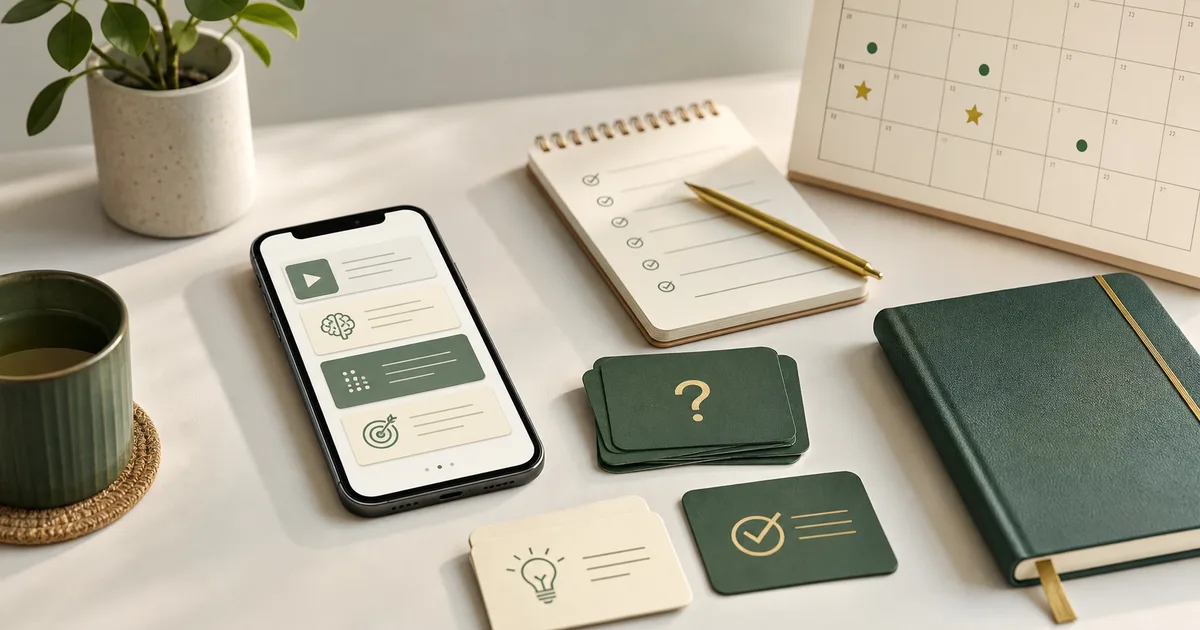
You can run these techniques manually with notes, calendars, flashcards, and discipline. The problem is that the admin work often becomes bigger than the lesson. You have to choose the topic, break it down, create questions, remember to review, and track whether you applied anything.
NerdSip is useful when you want the loop without building the system yourself. You choose a topic, get short lessons, answer quizzes, keep a streak, and turn spare phone moments into learning reps. The important part is not that an app exists. The important part is that the app makes the good technique easier than the bad habit.
A Simple Self-Audit
At the end of a week, ask five questions. What did I learn? What can I recall without looking? What did I apply? What did I forget? What should come back next week?
If you can answer those questions, your microlearning is working. If all you can say is that you completed seven lessons, you may have built a streak but not yet built knowledge. Streaks are useful. Evidence is better.
Reader Scenarios: Which Technique Fits?
If you are the person who saves everything and finishes nothing, start with atomic lessons and a seven-day constraint. Your problem is not intelligence. It is too much open-ended possibility. Choose one outcome and make every lesson serve it for a week.
If you are the person who learns but blanks later, stop adding more input. Add active recall. After every lesson, write three lines from memory. If you cannot, the next step is not a new lesson. It is another retrieval attempt.
If you are the person who understands theory but does not change, force one tiny action. Use the concept in one email, one conversation, one calculation, one note, or one decision. Learning should leave a footprint.
If you are the person who gets bored, keep the structure stable but vary the topics. A stable learning loop does not mean a boring content diet. You can learn communication on Monday, finance on Tuesday, and science on Wednesday if each session still includes recall and application.
What to Track Besides a Streak
A streak tells you that you returned. That matters. But it does not tell you whether the knowledge is becoming useful. Add three lightweight measures: one idea I can explain, one place I used it, and one question I still have.
This takes less than a minute, but it changes the quality of the habit. You stop measuring learning as attendance and start measuring it as usable understanding.
The Bottom Line
The best microlearning technique is the loop: learn one idea, recall it, apply it, get feedback, and repeat after a delay.
If you want the broader science, read What Is Microlearning?. If you want the skill loop, read The Best Method to Learn New Skills. If you want to start now, pick one idea and give it five focused minutes.
These techniques apply directly to breadth as well as skills. The daily version is in how to improve your general knowledge.
Frequently Asked Questions
What are microlearning techniques?
Microlearning techniques are methods that make short lessons effective: atomic topics, active recall, spaced repetition, tiny practice, feedback, and habit triggers.
Is microlearning just watching short videos?
No. Short videos can be part of microlearning, but effective microlearning includes retrieval, application, and repetition. Passive watching alone rarely creates durable learning.
How long should a microlearning session be?
Most useful microlearning sessions are 3 to 10 minutes long. The better rule is one clear idea per session, not an exact minute count.
Every NerdSip course clears a four-layer fact-checking pipeline before it reaches the app: grounded in live sources, scored nightly, gated on failure, and reviewable by a person at one tap. Articles on this blog are drafted with AI assistance, then researched, verified, and edited by our team.
Editorial responsibility: Philip S., ai51 UG (haftungsbeschränkt) — contact via imprint.
📚 Keep Learning
Explore the NerdSip learning hubs
The blog is our editorial layer. When you want to move from reading into doing, these hubs organize the rest of NerdSip by format, including the app itself and the press that has written about it.
Turn five minutes into a real learning rep
Use NerdSip to create short lessons on any topic, test yourself, and build a daily learning streak.