Microlearning is learning delivered in short, self-contained sessions, usually three to ten minutes, each built around a single objective you can act on immediately. It is not a long course chopped into pieces. The defining feature is that every unit stands alone and finishes a thought.
What Is Microlearning?
Microlearning is an instructional approach that delivers targeted, action-oriented content in bite-sized units, each aimed at one specific learning objective. A 2024 systematic review in Heliyon, which screened 3,613 publications and analyzed 40 studies, settled on close to that wording after finding the field had been using the term loosely for years.
Three things have to be true before something counts:
- Short. Usually three to ten minutes, rarely past fifteen.
- Single objective. One concept, one skill, one decision. If you need the word "and" to describe what a lesson teaches, it should be two lessons.
- Self-contained and actionable. You can finish it, use it, and walk away without the next unit.
That third point is what separates microlearning from chopped-up content. A 45 minute webinar sliced into nine five-minute clips is not microlearning. It is a webinar in pieces, and piece four still makes no sense without pieces one through three.
What Is an Example of Microlearning?
Concrete examples, all of which meet the three tests above:
- A three-minute lesson teaching one Excel formula, ending with a spreadsheet you fill in.
- A single flashcard round on twenty new Spanish words, scheduled by an algorithm.
- A 90-second safety refresher pushed to a warehouse worker's phone before a shift.
- A two-minute product update video for a sales team, with one quiz question at the end.
- A five-minute lesson on loss aversion that ends by asking where you saw it in your own spending this week.
- A tooltip walkthrough inside software, teaching one feature at the moment you need it.
What is not microlearning: a 40 minute recorded lecture, a 12 chapter PDF, a TikTok that happens to be interesting, or a webinar series. Length alone does not qualify content. Design does.
How Long Should a Microlearning Session Be?
Three to ten minutes for most content, with a hard ceiling around fifteen. Below three minutes you usually cannot teach a complete idea. Past fifteen you have lost the properties that make the format work: it stops fitting into the gaps in someone's day, and it stops being something people finish.
The better rule is not a number. A microlearning unit should be as long as one complete idea takes, and no longer. A safety reminder might need 45 seconds. A lesson on compound interest might need eight minutes. Padding a 45 second idea to hit a five minute target is exactly the failure mode microlearning was invented to avoid.
Why Does Microlearning Work?
Four mechanisms do most of the work, and only one of them is about convenience.
The forgetting curve
In the 1880s Hermann Ebbinghaus memorized lists of nonsense syllables and tracked how fast they left him. He lost more than half within an hour and roughly two thirds within a day. A 2015 replication by Murre and Dros reproduced the shape of the curve almost exactly, 130 years later.
One honest caveat that most articles skip: Ebbinghaus tested nonsense syllables on himself. Meaningful material you care about decays more slowly. The shape holds, the exact percentages do not transfer to everything you learn. What matters is the shape, because the shape is what microlearning is designed around. Information decays fastest right after you learn it, so the highest-value review happens soon and often, not in one block a month later. Chunks has a readable explainer of the forgetting curve, Ebbinghaus, and spaced review if you want the longer background.
Spaced repetition
Review material at increasing intervals and it sticks dramatically better than reviewing it all at once. This is the single best-evidenced finding in the whole field. Cepeda and colleagues synthesized 254 studies covering more than 14,000 participants and found spaced practice beat massed practice on final recall, roughly 47 percent against 37 percent, at identical total study time.
Microlearning does not automatically include spacing, but its short unit size is what makes spacing practical. You will do a five-minute review on a Tuesday. You will not do a 90-minute one.
Cognitive load
Working memory is small. George Miller's famous 1956 figure was seven items plus or minus two, but modern estimates are lower. Nelson Cowan's widely cited 2001 review put the real capacity closer to four chunks when you remove rehearsal and grouping tricks.
Either way the number is small, and a 60 minute lesson blows past it in the first ten. Content that exceeds working memory does not get stored more slowly. It does not get stored.
Attention
Gloria Mark, a professor of informatics at UC Irvine, has tracked knowledge workers' screen attention for two decades. In 2004 people averaged about two and a half minutes on a screen before switching. By 2012 it was 75 seconds. In her 2016 data it was 47 seconds, with a median of 40.
Read that number carefully, because it is widely mangled. It measures how long someone stays on one screen before switching in ordinary computer work. It does not mean humans are incapable of sustained focus. It does mean that designing a 50 minute mandatory training video for that environment is planning around a person who no longer exists.
Does Microlearning Actually Work? What the Evidence Shows
Duolingo co-founder Luis von Ahn makes the practical case for the format in the TED talk above. Here is the research case, and a warning about the numbers you will see quoted everywhere else.
The peer-reviewed picture is positive but modest in scope. The 2024 Heliyon systematic review by Monib, Qazi and Apong found consistent gains in knowledge retention, engagement and learner motivation across the studies it analyzed, and also found that the field still lacks an agreed definition and a shared instructional framework. Meta-analyses in higher education report meaningful effect sizes on learning outcomes. Most of these studies are small, short, and run in classrooms rather than workplaces.
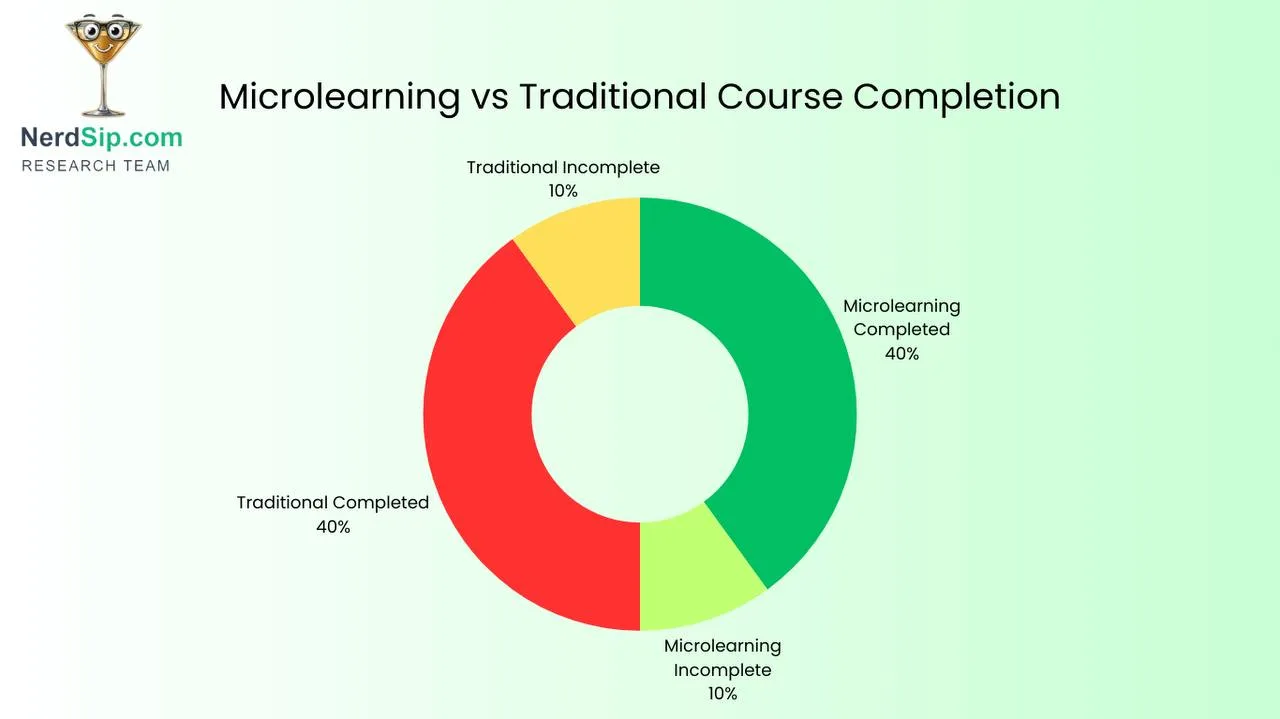
The numbers in most microlearning articles are not from studies. You will repeatedly see four figures: 80 percent completion rates against 20 percent for traditional courses, 50 percent better retention, 300 percent faster course development, and 50 percent lower training cost. These come from vendor surveys and industry blog posts that cite each other in a loop, and the original sources are usually untraceable. They are plausible directionally. Treat them as marketing claims, not evidence, and do not build a business case on them.
The short version
Microlearning has good evidence that short, spaced, single-objective units improve retention and completion versus long-form equivalents. It does not have good evidence for the precise percentages that circulate online. If someone quotes you "300 percent faster" without a citation, that is because there is not one.
What Is the Difference Between Microlearning and Traditional Learning?
| Aspect | Traditional learning | Microlearning |
|---|---|---|
| Duration | 30 minutes to several hours | 3 to 10 minutes |
| Focus | Multiple topics, broad coverage | One objective per unit |
| Format | Lectures, long video, textbooks | Short video, quizzes, cards, simulations |
| Access | Scheduled, needs a dedicated block | On demand, fits existing gaps |
| Best at | Depth, theory, sustained argument | Recall, procedures, reinforcement |
| Device | Often desktop first | Mobile first |
| Build time | Weeks to months | Days to weeks |
The related term you will see is macrolearning: the long-form, structured, deep study that microlearning is usually contrasted with. Degrees, certifications and apprenticeships are macrolearning. The two are not rivals. Macrolearning builds the mental model. Microlearning maintains it and fills the gaps. Trying to earn a nursing qualification through five-minute cards would be as misguided as running a monthly safety refresher as a three-hour seminar.
What Are the Most Common Microlearning Formats?
- Short video. The most used format in corporate programs. Two to five minutes works; ten does not.
- Interactive quizzes. The most underrated. Testing yourself is retrieval practice, which is one of only two study techniques the 2013 Dunlosky review rated high utility.
- Flashcards with spaced repetition. Anki and similar tools. Unbeatable for vocabulary, terminology and facts.
- Infographics. Good for processes, comparisons and anything with a shape.
- Audio lessons. The only format that works while walking, driving or cooking.
- Scenario simulations. Short decision exercises with immediate consequences. Best format for judgment and soft skills.
- In-product tooltips. Just-in-time teaching embedded where the task happens.
- Gamified lesson streaks. Points, streaks and leaderboards, used by NerdSip and Duolingo. Not gimmicks. They solve the actual failure mode of self-directed learning, which is not difficulty but attrition.
What Are the Disadvantages of Microlearning?
Microlearning has real limits, and the honest ones are rarely listed by companies selling it.
It struggles with depth. Subjects where understanding depends on holding many ideas in tension at once, philosophy, advanced mathematics, literary analysis, resist fragmentation. You can teach the components in small units. The synthesis needs a long, uninterrupted think.
It can produce fragmented knowledge. A learner who completes forty disconnected units may know forty facts and no structure. Without a deliberate map showing how the units connect, microlearning creates trivia rather than expertise. Good programs sequence units and revisit the connections. Most programs do not.
It does not replace practice. No number of five-minute lessons will teach you to play piano, run a meeting, or write well. Microlearning delivers the concept. The skill still needs hours.
It lives on the device that distracts you. Phone-delivered learning competes with every notification on the same screen. The format that makes learning available everywhere also makes quitting available everywhere.
It gets used as a checkbox. In corporate settings, short compliance modules are easy to complete without absorbing anything. High completion rates can measure clicking, not learning. If a program reports 90 percent completion and nobody's behavior changed, the completion number was the wrong thing to measure.
Is Microlearning the Same as Spaced Repetition?
No, and the two get conflated constantly.
Microlearning is about the size of the unit. It describes how content is packaged: short, single-objective, self-contained.
Spaced repetition is about the timing of review. It describes when you return to material: at expanding intervals, ideally just before you would forget it.
You can have one without the other. A daily five-minute lesson you never review is microlearning without spacing, and most of it will be gone in a month. An Anki deck reviewed on a perfect schedule is spacing applied to units that may not teach a complete idea.
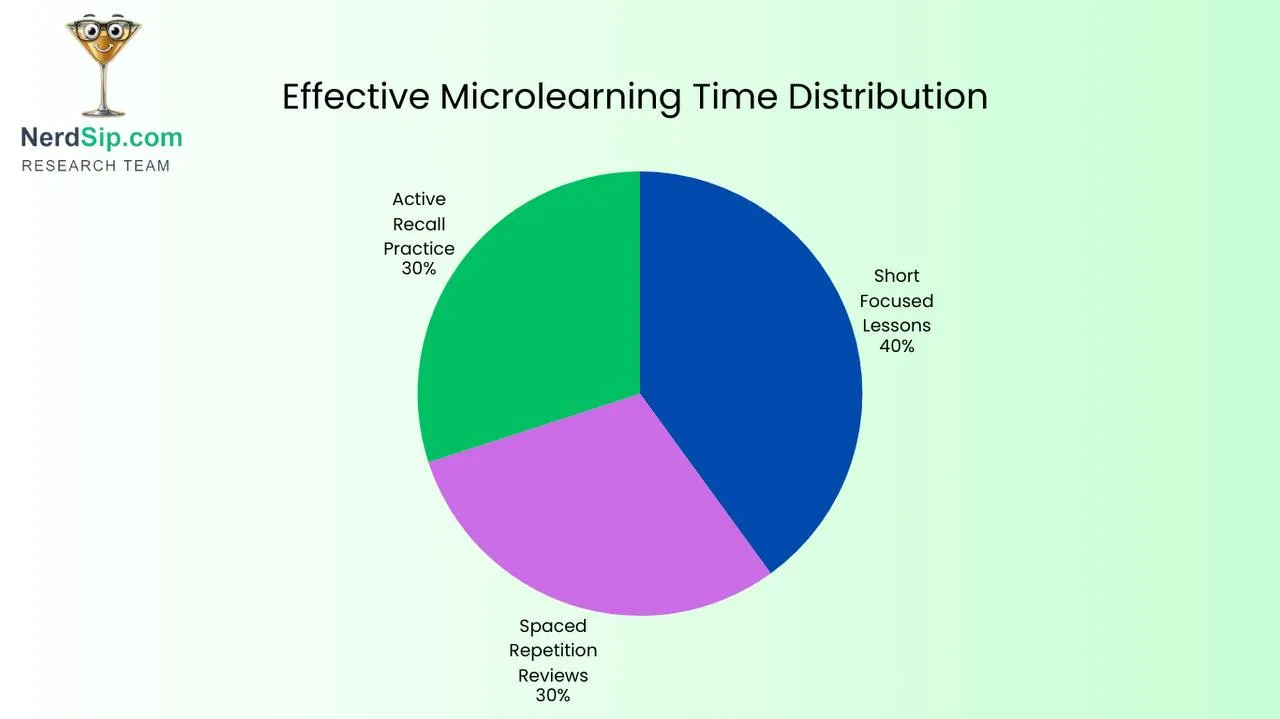
The combination is where the results are. Short units make daily review realistic; spacing makes the short units stick. If you are choosing a tool, the question worth asking is whether it does both, or only the first.
Where Does Microlearning Work Best?
Strong fit: compliance and safety refreshers, software and product training, language vocabulary, sales objection handling, customer service responses, onboarding follow-ups, professional development, and reinforcing anything already taught in long form.
Poor fit: deep theory, comprehensive certification as the sole method, skills built through extended physical practice, and creative work that depends on sustained flow.
The test: if the knowledge is modular and needs to be recalled accurately later, microlearning is probably right. If it needs to be understood as one connected whole, microlearning is a supplement rather than the method.
How Do You Implement Microlearning?
If you are building it for an organization
- Define one objective per unit. Write it as a verb the learner will perform. If you cannot state it in one sentence, the unit is too big.
- Cut to a single idea. The moment you write "and also," start a second unit.
- Keep it to five to seven minutes. Longer than that and you are building a course again.
- Make it active. Every unit ends with a question, a decision or a task. Passive watching produces recognition, not recall.
- Design for a phone. If it does not work one-handed on a small screen, it will not get used.
- Schedule the review. Teaching once is not a program. Build the return visits in at day one, day seven and day thirty.
- Measure behavior, not completion. Track whether people can do the thing. Completion rates measure clicking.
If you are using it for yourself
Pick one skill and stay on it for 90 days rather than starting four. Choose a tool that schedules review rather than one that only serves lessons. Attach the session to an existing habit, morning coffee or the commute, so you are not relying on remembering. Protect the streak once you have one. And set aside time weekly to actually use what you learned, because a lesson you never apply is a lesson you will lose.
What Are the Best Microlearning Apps?
The right app depends on what you are learning.
- Languages: Duolingo. Five-minute lessons, heavy gamification, the most proven consumer implementation of the format.
- Math and science: Brilliant. Interactive problem solving in 10 to 15 minute sessions.
- Memorization: Anki. Ugly, free, and the strongest spaced repetition scheduler available.
- Coding: Mimo for beginners, SoloLearn for breadth.
- Any topic: NerdSip. Type in what you want to learn and the AI generates a structured course of short lessons, which solves the format's oldest limitation: you were always restricted to the topics someone else decided to build. It also has a Repetition tab that assembles review sessions from courses you finished in the last 30 days, so the spacing happens without you maintaining a deck.
For a fuller breakdown, see our guide to the best microlearning apps, or the deeper comparison of microlearning versus spaced repetition versus active recall.
Where Did the Term Microlearning Come From?
The concept is older than the word. Ebbinghaus was studying spaced review in the 1880s, and the researchers who followed him refined it through the twentieth century. The term itself entered common use in the mid-2000s through European educational technology research, most notably a series of Microlearning conferences held in Innsbruck from 2005 and the work of Theo Hug and colleagues, who framed it as learning in short steps within a media-saturated environment.
It went mainstream about a decade later for an unglamorous reason: smartphones. Once everyone carried a screen into every spare moment, the constraint stopped being access to content and started being attention. Microlearning is the format that resulted.
Common Myths About Microlearning
"It is just making content shorter." No. Shortening without redesigning around a single objective produces fragments, not lessons. This is the most common implementation failure.
"It cannot teach complex topics." Partly wrong. Complex topics can be sequenced across units, but the synthesis step needs long-form thinking. Microlearning delivers the parts well and the whole poorly.
"It is only for young people." Wrong. Learners of every age report preferring shorter units. Time pressure and working memory limits are not generational.
"High completion rates mean it worked." Wrong, and expensively so. Completion measures whether someone reached the end of a screen. Ask what changed afterward.
The Bottom Line
Microlearning works because it accepts three things about how people actually are. Time is fragmented. Attention is short and getting shorter. Memory decays unless you come back to it.
It is not a replacement for deep study, and the industry's favorite statistics are largely unsourced. What survives scrutiny is the core mechanism: short, single-objective units, reviewed on a schedule, beat long sessions you never finish and never revisit.
The practical question is not whether the format works. It is what you would do with the ten-minute gaps you currently spend scrolling.
References & Further Reading
- Monib, W. K., Qazi, A. & Apong, R. A. (2024). Microlearning beyond boundaries: A systematic review and a novel framework for improving learning outcomes. Heliyon
- Cepeda, N. J. et al. (2006). Distributed Practice in Verbal Recall Tasks: A Review and Quantitative Synthesis. Psychological Bulletin
- Murre, J. M. J. & Dros, J. (2015). Replication and Analysis of Ebbinghaus' Forgetting Curve. PLOS ONE
- Dunlosky, J. et al. (2013). Improving Students' Learning With Effective Learning Techniques. Psychological Science in the Public Interest
- Mark, G. (2023). Research on declining screen attention span. University of California
- Cowan, N. (2001). The magical number 4 in short-term memory. Behavioral and Brain Sciences
Frequently Asked Questions
What is microlearning?
Microlearning is learning delivered in short, self-contained units, usually three to ten minutes, each built around a single objective the learner can act on immediately. The defining feature is not length but design: every unit stands alone and completes one idea. A long course cut into short clips is not microlearning, because the individual pieces do not make sense on their own.
What is an example of microlearning?
A three-minute lesson teaching one Excel formula, a 90-second safety refresher sent to a worker's phone before a shift, a flashcard round on twenty Spanish words, a two-minute product update with one quiz question, or a tooltip inside software that teaches one feature at the moment you need it. Each teaches one thing and finishes it.
How long should a microlearning session be?
Three to ten minutes for most content, with a practical ceiling around fifteen. The better rule is that a unit should be as long as one complete idea takes and no longer. A safety reminder may need 45 seconds; a lesson on compound interest may need eight minutes. Padding a short idea to hit a time target defeats the purpose.
Does microlearning actually work?
The peer-reviewed evidence is positive but narrower than marketing suggests. A 2024 systematic review in Heliyon, which screened 3,613 publications and analyzed 40 studies, found consistent gains in retention, engagement and motivation, while noting the field lacks an agreed definition. The widely quoted figures of 80 percent completion, 50 percent better retention and 300 percent faster development come from vendor surveys that cite each other, not from studies.
What are the disadvantages of microlearning?
It struggles with subjects where understanding depends on holding many ideas together at once, such as philosophy or advanced mathematics. It can produce fragmented knowledge if units are never connected. It does not replace the hours of practice that physical or creative skills require. It is delivered on the device that distracts you. And in corporate settings it is easy to complete without learning anything, which makes completion rates a misleading measure.
Is microlearning the same as spaced repetition?
No. Microlearning describes the size of the unit: short, single-objective, self-contained. Spaced repetition describes the timing of review: returning to material at expanding intervals. You can do either without the other, and short daily lessons you never review will still fade. The results come from combining them, because short units are what make daily review realistic.
What is the difference between microlearning and macrolearning?
Macrolearning is long-form, structured, deep study, such as a degree, a certification or an apprenticeship. Microlearning is short, modular reinforcement. They are complements rather than rivals: macrolearning builds the mental model, microlearning maintains it and fills the gaps. Neither substitutes for the other.
Can microlearning teach complex topics?
Partly. Complex subjects can be sequenced across many short units, and each component can be taught well that way. What microlearning handles poorly is synthesis, the step where separate ideas have to be held in tension and connected. That still requires long, uninterrupted thinking, so microlearning works best as the delivery layer with dedicated deep work on top.
What are the best microlearning apps?
Duolingo for languages, Brilliant for math and science, Anki for pure memorization with the strongest spaced repetition scheduler, Mimo or SoloLearn for coding, and NerdSip for any topic, since it generates a structured course of short lessons from whatever you type in and assembles review sessions from courses you finished in the last 30 days.
Where does the term microlearning come from?
The concept dates to Ebbinghaus's work on spaced review in the 1880s, but the term entered common use in the mid-2000s through European educational technology research, notably the Microlearning conferences held in Innsbruck from 2005 and the work of Theo Hug and colleagues. It went mainstream a decade later with smartphones, when the scarce resource shifted from access to content to attention.
Every NerdSip course clears a four-layer fact-checking pipeline before it reaches the app: grounded in live sources, scored nightly, gated on failure, and reviewable by a person at one tap. Articles on this blog are drafted with AI assistance, then researched, verified, and edited by our team.
Editorial responsibility: ai51 UG (haftungsbeschränkt). Responsible editor named in the imprint.
📚 Keep Learning
Explore the NerdSip learning hubs
The blog is our editorial layer. When you want to move from reading into doing, these hubs organize the rest of NerdSip by format, including the app itself and the press that has written about it.
Microlearning That Reviews Itself
NerdSip turns any topic into short lessons, then builds your review sessions automatically from what you finished in the last 30 days. Five minutes a day, spacing included.
4.7 stars from 380 reviews · 10,000+ learners