Most study advice is garbage.
For the bigger picture, including the myths worth dropping, see our guide to how to learn anything.
You've heard it all before: "Just study harder." "Read your notes three times." "Highlight the important parts."
None of that works. Research proves it.
The students getting top grades aren't studying longer, they're studying smarter. They use techniques backed by cognitive science that help their brains actually retain information instead of just recognizing it for 20 minutes.
Here are 10 study techniques that actually work, based on research and real results. No BS, no wishful thinking, just methods that help you learn faster and remember longer.
1. Active Recall: Stop Re-reading, Start Testing Yourself
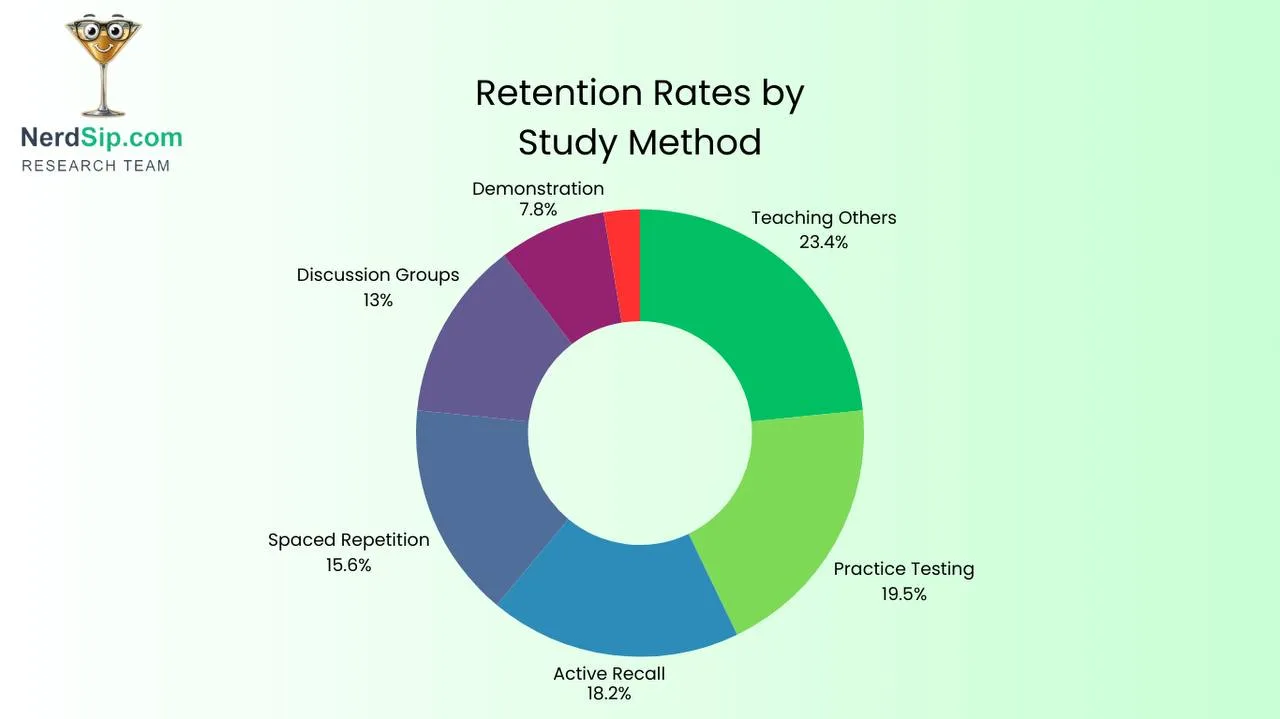
Re-reading your notes is the most popular study method. It's also one of the least effective. Recognition isn't the same as recall. On test day, you need to retrieve information from memory, not just recognize it when you see it.
Active recall forces your brain to retrieve information without looking at your notes.
- Read a section of your textbook or notes
- Close the book
- Write down everything you remember
- Check what you missed and focus on those gaps
Studies show you remember 90% of what you actively recall versus only 10% of what you passively read. For phone-based learning, apps like NerdSip use active recall by default.
2. Spaced Repetition: Review at the Right Intervals
Your brain forgets things on a predictable schedule (the "forgetting curve"). Spaced repetition works with this by reviewing information just before you would forget it.
Each successful recall strengthens the memory and extends how long until you forget it again. Students who use spaced repetition retain 60% more information long-term compared to those who cram.
3. The Feynman Technique: Teach It Like You're Explaining to a Child
If you can't explain something in simple terms, you don't really understand it. Teaching forces you to actually process information.
- Pick a concept you're trying to learn
- Explain it out loud as if teaching a 10-year-old
- When you get stuck, that's a gap in your knowledge
- Simplify your explanation until anyone could understand it
4. Interleaving: Mix Different Topics Instead of Blocking
Spending 2 hours on math, then 2 hours on history feels organized, but interleaving (mixing topics) is more effective. Mixing problem types forces your brain to actively identify which strategy to use for each problem, exactly what you need to do on exams.
5. The Pomodoro Technique: Work in Focused Bursts
Your brain can't focus for hours straight. The Pomodoro Technique breaks study time into focused 25-minute sessions with 5-minute breaks. This improves concentration and reduces burnout.
6. Practice Testing: Simulate Exam Conditions
Want to know the best predictor of exam performance? Taking practice exams. Students who take practice tests under timed conditions score 15-30% higher on actual exams than those who just study the material.
7. Dual Coding: Combine Words and Visuals
Dual coding means learning information through both text and visual representation. When you combine both, you create two memory traces instead of one. Well-designed learning apps combine text explanations with infographics, making dual coding automatic.
8. Elaborative Interrogation: Ask "Why" and "How"
Most students focus on "what", memorizing facts. Top students focus on "why" and "how". This deeper processing creates stronger, more connected memories. Check out our guide on how to learn faster for more on deep encoding.
9. The SQ3R Method: A Complete Reading Strategy
SQ3R stands for Survey, Question, Read, Recite, Review. This structured approach turns passive reading into an active learning process, improving retention by 40-60%.
10. Sleep and Memory Consolidation: Don't Skip This Step
Your brain consolidates memories during sleep. Students who sleep 7-9 hours retain 40% more than those sleeping 5-6 hours. Sacrificing sleep to study more is counterproductive. Read more about why sleep matters for cognitive performance.
The Bottom Line
Effective studying isn't about time, it's about technique. The most powerful combination is active recall, spaced repetition, elaborative interrogation, and adequate sleep.
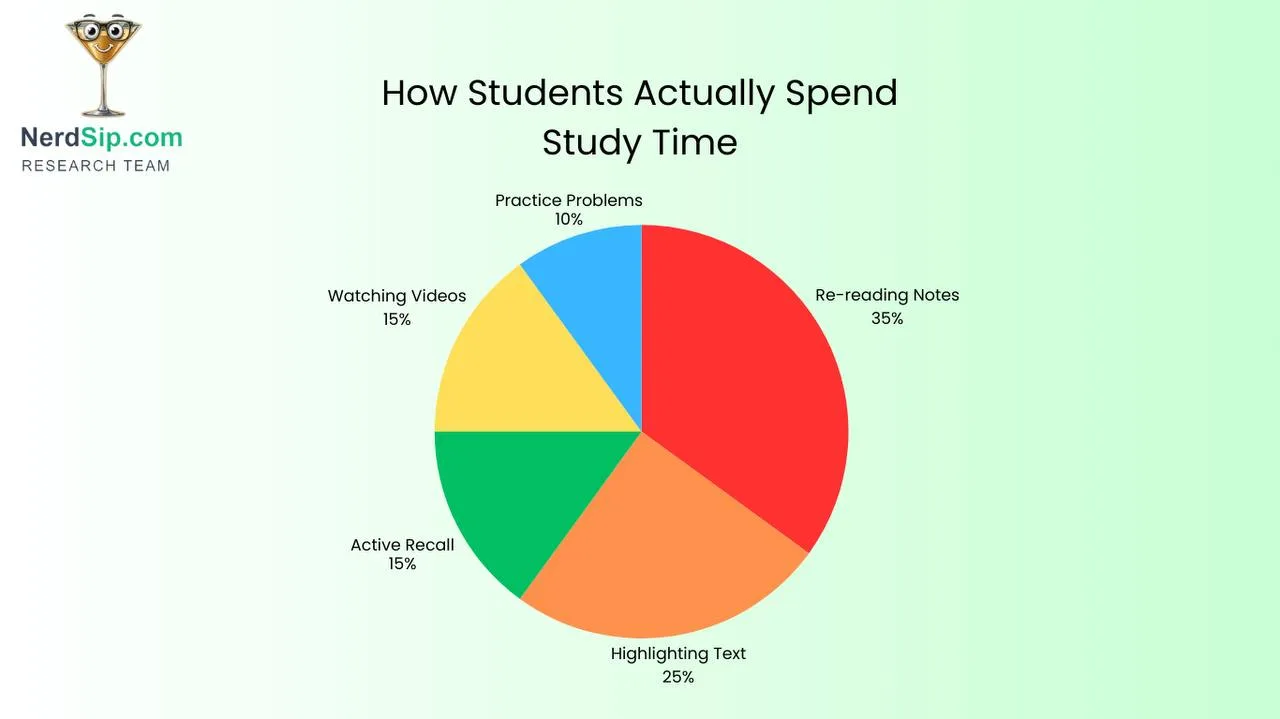
Start with one technique today. Test yourself on something instead of re-reading. Your future self will thank you.
Putting these to work for a test? The exam prep hub turns them into a plan, and if the clock is against you, see how to study for exams in a short time.
These techniques are not just for exams. Applied to ten minutes a day, they are also how you build general knowledge outside of any syllabus. And if you have met the claim that you retain 90 percent of what you teach, note that that number was never measured.
Frequently Asked Questions
What are the most effective study techniques?
The techniques with the strongest evidence are active recall (testing yourself from memory), spaced repetition (reviewing at increasing intervals), the Feynman technique (explaining a concept simply), interleaving (mixing topics), and practice testing under exam conditions. Adequate sleep then locks the learning in. Most other popular habits, like re-reading and highlighting, are far weaker.
Why doesn't re-reading work?
Re-reading builds recognition, not recall. The material looks familiar, which feels like knowing, but on test day you need to retrieve it from memory without the notes in front of you. Active recall trains that exact skill, which is why it consistently outperforms re-reading.
How do I start using these techniques?
Start with one. The next time you study, close your notes and write down everything you remember, then check the gaps. Add spaced repetition by reviewing that material again after a day, a week, and two weeks. Layer in the others once the first becomes a habit.
Which technique is best for exams specifically?
Practice testing, also called retrieval practice, is the strongest predictor of exam performance. Sitting timed practice papers under realistic conditions both strengthens memory and reveals exactly which topics still need work. Our exam prep hub shows how to build a plan around it.
Every NerdSip course clears a four-layer fact-checking pipeline before it reaches the app: grounded in live sources, scored nightly, gated on failure, and reviewable by a person at one tap. Articles on this blog are drafted with AI assistance, then researched, verified, and edited by our team.
Editorial responsibility: ai51 UG (haftungsbeschränkt). Responsible editor named in the imprint.
📚 Keep Learning
Explore the NerdSip learning hubs
The blog is our editorial layer. When you want to move from reading into doing, these hubs organize the rest of NerdSip by format, including the app itself and the press that has written about it.
Ready to Level Up?
Turn your screen time into knowledge. Download NerdSip and start learning in just 5 minutes a day.
4.7 stars from 380 reviews · 10,000+ learners