To learn faster, do three things in order: cut the topic down to the handful of ideas that carry most of the value, test yourself from memory instead of rereading, and spread your reviews across days instead of cramming them into one night. Retrieval practice and spaced repetition are the two study techniques cognitive psychologists rate most highly, and they work on almost any subject.
This guide is part of our series on how to learn. If remembering is your main problem rather than speed, start with how to improve memory instead.
How Do You Learn Faster?
Five steps. The whole loop takes about fifteen minutes a day.
- Find the core. Ask which three to five ideas everything else in the topic hangs on. Learn those before anything else.
- Pick one short resource. A five minute explanation of the core beats a two hour course you never finish.
- Close the source and recall it. Say the idea out loud, in your own words, with nothing in front of you. This is the step almost everyone skips.
- Review after a day, three days, a week, and a month. Each review takes minutes and resets the forgetting curve.
- Use it before you feel ready. Application exposes the gaps that recall alone hides.
That is the whole system. The rest of this guide explains what the research actually found, why each step works, and how to run it without turning learning into a second job.
Prefer to watch first? Neuroscientist Dr. Lila Landowski covers the biology behind most of this in her TEDxHobart talk:
Why You Think You Are Bad at Learning
You watched someone pick up a thing in an afternoon that took you a month, and you drew the obvious conclusion. Some people are wired for it. You are not one of them.
That conclusion is almost always wrong, and it is wrong in a specific way. The people who look fast are usually not processing information faster than you. They have seen a similar structure before, so the new material has somewhere to attach. Or they start before they feel ready and learn by doing. Or they are comfortable saying the thing out loud while still half wrong, which is the fastest form of practice there is.
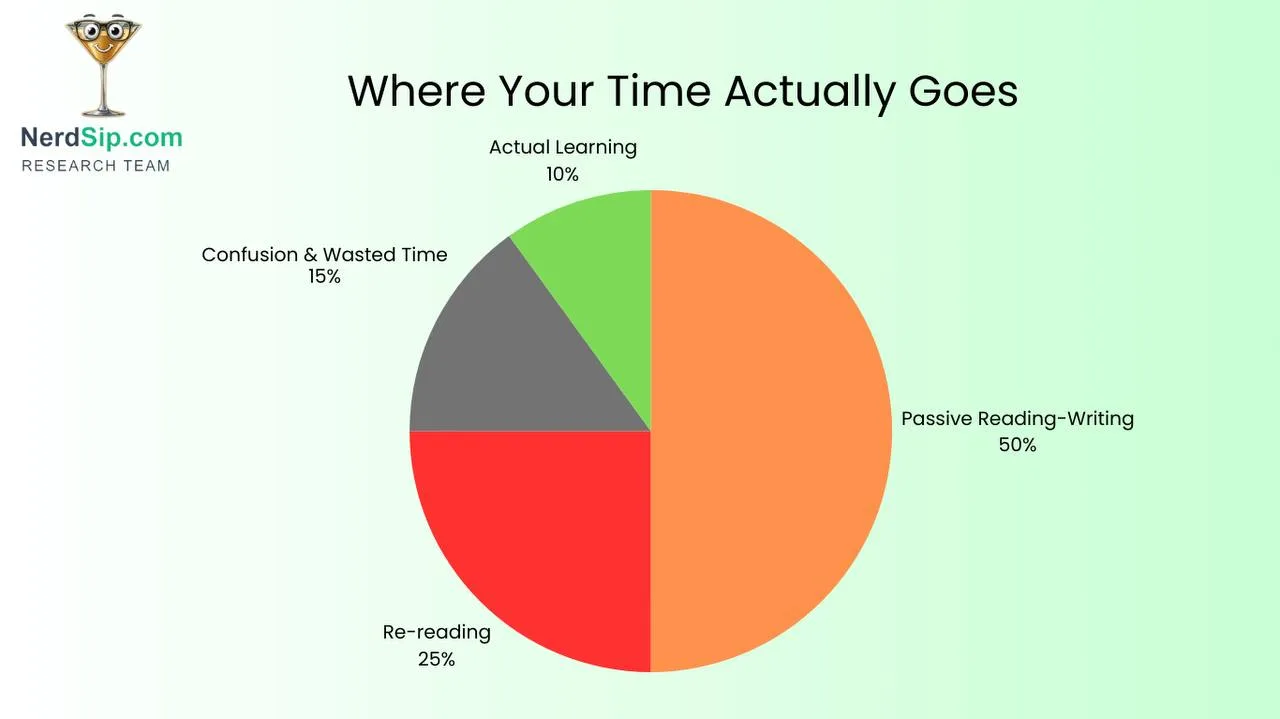
The real gap is method. School hands you content and grades you on it, but it rarely teaches the meta skill of how to acquire content efficiently. So most adults fall back on the defaults: read it once, watch a video, sit for three hours the night before and hope something sticks.
Those defaults are not slow because you are slow. They are slow because they work against the way memory is built.
What Are the Three Pillars of Fast Learning?
Fast learning rests on three things: knowing what to learn, pulling it back out of memory, and returning to it on a schedule. Skip any one of them and the other two lose most of their power.
1. Deconstruction: knowing what to learn
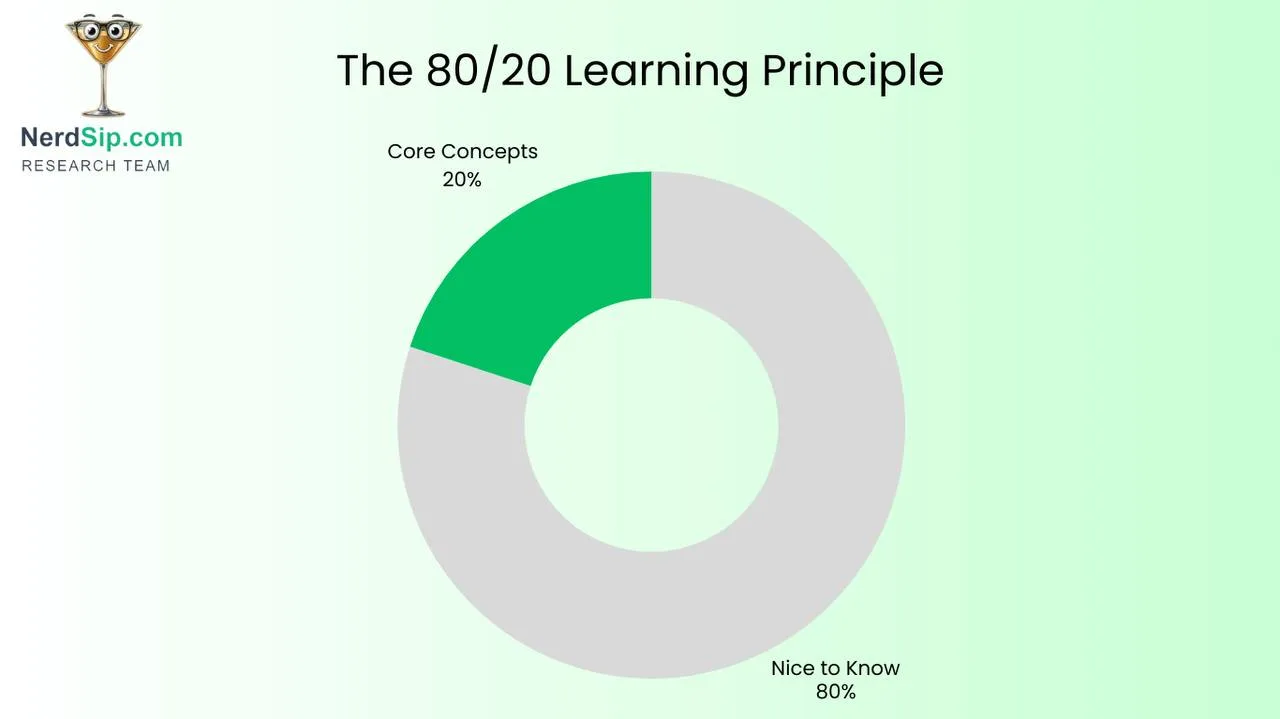
You cannot learn everything about a topic, and you do not need to. In most fields a small fraction of the material carries most of the useful outcome, so the first job is finding that fraction.
Writing is not a year of grammar rules. It is structure, clarity, and revision. A new language is not ten thousand words. Roughly the thousand most frequent words plus a set of stock phrases will carry most ordinary conversation. Chess is not memorizing openings at first. It is tactics.
The fastest way to find the core is to borrow it. Ask someone who is already good: what are the three things I actually need to understand here, and what can wait? Most experts answer that question in a sentence. Write the answer down. That list is your syllabus for the first two weeks, and everything not on it is deliberately postponed rather than forgotten.
2. Active recall: pulling it back out
Reading something again is the most popular study method and one of the least effective. In a 2013 review for Psychological Science in the Public Interest, Dunlosky and colleagues graded ten common techniques. Rereading and highlighting both landed in the low utility bracket. Practice testing and distributed practice were the only two rated high utility.
The reason is that recognition feels like knowledge and is not. When you reread a page, the words look familiar, and your brain reads that familiarity as mastery. Close the book and the feeling evaporates.
Retrieval does the opposite. In a well known 2006 experiment by Roediger and Karpicke, students who read a passage and then tested themselves recalled about 61 percent of it a week later. Students who simply reread the same passage recalled about 40 percent. Immediately after studying, the rereaders looked better. A week out, they had lost most of it.
3. Spaced repetition: returning on a schedule
Spaced repetition means reviewing material at increasing intervals rather than all at once. It is the difference between four short sessions across a month and one long session tonight, at identical total study time, and the spread version wins by a wide margin.
Hermann Ebbinghaus mapped why in the 1880s by memorizing nonsense syllables and tracking how fast they left him. He lost more than half of a list within an hour and roughly two thirds within a day. A 2015 replication by Murre and Dros reproduced the shape of that curve almost exactly; we take it apart in our guide to the forgetting curve. Each time you retrieve something before it fades, the curve flattens and the next gap can be longer.
The evidence base here is unusually solid. Cepeda and colleagues synthesized 254 studies covering more than 14,000 participants and found spaced practice beat massed practice on final recall, around 47 percent against 37 percent. Same material, same total minutes, different arrangement.
What Does the Research Actually Rate?
Here is the shortlist from the Dunlosky review, sorted by how much return each technique gives for the time it costs.
| Technique | Rating | What it does |
|---|---|---|
| Practice testing | High utility | Forces retrieval, which strengthens the path back to the memory |
| Distributed practice | High utility | Returns to material before it fades, flattening the forgetting curve |
| Elaborative interrogation | Moderate | Asking why a fact is true builds connections to what you know |
| Self explanation | Moderate | Explaining your reasoning exposes the gaps in it |
| Interleaved practice | Moderate | Mixing problem types teaches you to pick the right approach |
| Rereading | Low utility | Builds familiarity that feels like knowledge and is not |
| Highlighting | Low utility | Feels productive, changes retention very little on its own |
| Summarizing | Low utility | Works only if you are already skilled at writing summaries |
Note what is missing from the high utility rows: anything about talent, and anything that requires more hours. Both winners are about arrangement, not effort.
What Are the Best Spaced Repetition Intervals?
There is no single perfect schedule, and chasing one is a good way to never start. A simple expanding sequence captures most of the benefit.
| Review | When | Time | What it is for |
|---|---|---|---|
| 1 | 1 day later | 5 min | Catches what already slipped, while recovery is still cheap |
| 2 | 3 days later | 5 min | First real test of whether the idea took hold |
| 3 | 1 week later | 5 min | Moves the material toward durable memory |
| 4 | 1 month later | 5 min | Confirms it is yours, not just recent |
One rule matters more than the exact numbers: the review should be slightly hard. If recall comes instantly, you waited too little and the session did almost nothing. A small struggle is the signal that the review is working. Robert Bjork calls these desirable difficulties, and they are the reason easy study sessions produce so little.
Six More Techniques That Speed It Up
The three pillars do most of the work. These six compound on top of them. They share one idea that the psychologists Robert and Elizabeth Bjork call desirable difficulty: practice that feels slower and harder in the moment often produces much better learning later, while practice that feels smooth produces fast forgetting.
Mix topics instead of blocking them
Doing ten problems of one type, then ten of the next, feels fluent because you already know which method to use. Mixing them forces you to decide first, which is the real skill. In one study, students who practised maths problems in mixed order scored 63 percent on a test a week later, against 20 percent for students who practised in blocks (Rohrer & Taylor, 2007). In a study on learning painters' styles, mixing won again, and most learners still believed blocking had helped them more (Kornell & Bjork, 2008). Rotate between two or three related topics in one session.
Study as if you had to teach it
In a 2014 experiment, students who were told they would have to teach a passage recalled more of it, and more of its main points, than students who expected a test, even though everyone was tested in the end (Nestojko et al., 2014). Expecting to explain changes how you read: you hunt for structure. Then actually explain it in plain words, as the Feynman technique suggests. Every point where you reach for jargon marks the edge of your understanding.
Sleep after you learn
Sleep is when the brain files the day's learning into long-term memory. Skipping it does not just make you tired; it removes a step. After one night without sleep, people's ability to form new memories the next day was about 40 percent lower than in rested people (Yoo et al., 2007). Six hours of study and eight of sleep beat nine hours of study and five of sleep.
Chunk new material
Working memory holds only a handful of items, so experts cheat by grouping. Chess masters rebuilt real game positions from memory far better than beginners, but when pieces were placed at random their advantage mostly disappeared (Chase & Simon, 1973). They were not remembering more pieces, just fewer, bigger patterns. Before memorising anything, look for the structure that groups it.
Draw it, and guess before you look
Two cheap ways to turn input into output. Drawing a word, even badly and in seconds, roughly doubled later recall compared with writing it out several times (Wammes, Meade & Fernandes, 2016). And information you generate yourself sticks better than information you read, the generation effect (Slamecka & Graf, 1978). Sketch the process. Predict the answer before checking it.
One task at a time
The brain does not run two demanding tasks in parallel. It switches, and every switch has a cost (Rubinstein, Meyer & Evans, 2001). Put the phone in another room while you learn. If focus is the real bottleneck, our guide on how to improve attention span covers it.
One myth to drop: learning styles
People do have preferences for pictures, words or doing. But when Harold Pashler and colleagues reviewed the evidence, they found almost no properly designed studies showing that matching teaching to someone's preferred style improves learning, and the few good tests came out negative (Pashler et al., 2008). Match the format to the material instead: geography wants a map, a process wants a diagram, an argument wants prose. Curious how you like to learn anyway? Try our learning styles quiz, which is honest about exactly this.
Does NerdSip Include Spaced Repetition?
Yes. Spaced repetition is built into NerdSip as its own Repetition tab, and it runs on the courses you actually finished rather than on a deck you have to build and maintain yourself.
Open Repetition and the app looks at everything you completed in the last 30 days, then writes a fresh review session out of that material. It is called a Memory Mix. Each mix moves through five kinds of cards: a recall prompt, the key idea, a connection to something else you learned, a quick check quiz, and one thing to try in the real world. The recall prompt comes first, before any answer is shown, because retrieval is the part that builds the memory.
Anything used in a mix is then held back for a week. That gap is the point. Reviewing something the day after you last reviewed it feels productive and does very little, so the engine refuses to hand it back too early.
You can also aim it. Tap a Memory Domain to review science only, or history, or psychology. Build a custom mix from two to six specific courses when you have something particular coming up. Finishing a mix ticks your streak and pays XP, which is what gets people back on the days motivation is thin.
The honest version
NerdSip schedules review sessions, it does not grade every individual card the way a dedicated flashcard app does. If you want per card intervals tuned to the day, a flashcard tool will give you that, and you will maintain the deck. If you want the spacing to happen to material you already learned, without building anything, that is the trade NerdSip makes.
How Do You Apply This Today?
Step 1: Identify the core
Pick the skill or topic. Write down the three to five ideas everything else depends on. Not a syllabus. A shortlist. If you cannot name them yet, ask someone who can, or read one overview and extract them.
Step 2: Find one short resource
Do not spend a week choosing a course. Find something that explains your shortlist clearly and quickly. For a beginner, a five minute explanation beats a two hour deep dive, because the deep dive assumes a map you do not have yet. Short lessons are built for exactly this: one concept, no filler, done.
Step 3: Learn, then immediately test
The moment you finish reading or watching, close it and say the idea out loud. Explain it to someone, or to an empty room. Write it from memory. Answer a question about it. If you cannot, you have not learned it yet. You have met it.
Step 4: Review at expanding intervals
Tomorrow, then three days, then a week, then a month. Five minutes each. You are not relearning, you are retrieving. If you use an app that schedules this for you, let it. If not, put four calendar reminders in now, before you forget to.
Step 5: Apply it early
Speak the language badly on day three. Write the ugly first draft. Ship the small broken version. Applying before you feel ready is uncomfortable and it is the fastest feedback loop available, because reality tells you which parts you only think you know.
Two short courses that run this method for you
Supercharge Your Brain: Learn Faster covers the core of learning science in three lessons, short enough to finish in one sitting and come back to later.
Mastering the Memory Palace teaches the oldest working memory technique on record, applied to things you actually need to remember.
The 30 Day Fast Learning Challenge
If you want to feel the difference rather than read about it, run this for a month. One topic. Fifteen minutes a day, split five minutes learning and ten minutes recalling or applying.
| Week | Focus | What changes |
|---|---|---|
| 1 | The core shortlist | The topic stops feeling shapeless. You know what you are aiming at. |
| 2 | Recall plus first reviews | You can explain the basics without notes. This is where most people quit and where the compounding starts. |
| 3 | Application | You find the gaps recall hid. Uncomfortable and the most valuable week. |
| 4 | Spacing widens | Reviews drop to twice a week. The material holds anyway. |
By day seven you will know the topic better than a single all day session would have left you. By day thirty it will feel less like something you studied and more like something you know. Then pick the next thing and run it again.
Twelve of those in a year is twelve topics that stuck. The alternative, the one most of us actually live, is a year of half watched courses and saved links.
What Separates Fast Learners From Slow Ones?
Not intelligence, in most cases. Three habits:
- They know what to focus on, and they postpone the rest on purpose.
- They test themselves instead of rereading.
- They come back to material on a schedule rather than when they happen to think of it.
Add a fourth that is really the container for the other three: they show up in small doses, often. Fast learners do not cram. They do fifteen minutes, then fifteen minutes again tomorrow, and the compounding does the work that heroic sessions never do.
Every one of these is a method, not a trait. Which means the sentence you have been telling yourself is backwards. You are not bad at learning. You have been using the techniques researchers have rated as weak for decades. Change the technique and the speed changes with it.
Read next
References & Further Reading
- Dunlosky, J. et al. (2013). Improving Students' Learning With Effective Learning Techniques. Psychological Science in the Public Interest
- Roediger, H. L. & Karpicke, J. D. (2006). Test-Enhanced Learning. Psychological Science
- Cepeda, N. J. et al. (2006). Distributed Practice in Verbal Recall Tasks: A Review and Quantitative Synthesis. Psychological Bulletin
- Murre, J. M. J. & Dros, J. (2015). Replication and Analysis of Ebbinghaus' Forgetting Curve. PLOS ONE
- Landowski, L. (2021). Brain Hack: 6 Secrets to Learning Faster, Backed by Neuroscience. TEDxHobart
- Chase, W. G., & Simon, H. A. (1973). Perception in chess. Cognitive Psychology, 4(1), 55-81. doi:10.1016/0010-0285(73)90004-2
- Kornell, N., & Bjork, R. A. (2008). Learning concepts and categories: Is spacing the "enemy of induction"? Psychological Science, 19(6), 585-592. doi:10.1111/j.1467-9280.2008.02127.x
- Nestojko, J. F., Bui, D. C., Kornell, N., & Bjork, E. L. (2014). Expecting to teach enhances learning and organization of knowledge in free recall of text passages. Memory & Cognition, 42(7), 1038-1048. doi:10.3758/s13421-014-0416-z
- Pashler, H., McDaniel, M., Rohrer, D., & Bjork, R. (2008). Learning styles: Concepts and evidence. Psychological Science in the Public Interest, 9(3), 105-119. doi:10.1111/j.1539-6053.2009.01038.x
- Rohrer, D., & Taylor, K. (2007). The shuffling of mathematics problems improves learning. Instructional Science, 35(6), 481-498. doi:10.1007/s11251-007-9015-8
- Rubinstein, J. S., Meyer, D. E., & Evans, J. E. (2001). Executive control of cognitive processes in task switching. Journal of Experimental Psychology: Human Perception and Performance, 27(4), 763-797. doi:10.1037/0096-1523.27.4.763
- Slamecka, N. J., & Graf, P. (1978). The generation effect: Delineation of a phenomenon. Journal of Experimental Psychology: Human Learning and Memory, 4(6), 592-604. doi:10.1037/0278-7393.4.6.592
- Wammes, J. D., Meade, M. E., & Fernandes, M. A. (2016). The drawing effect: Evidence for reliable and robust memory benefits in free recall. Quarterly Journal of Experimental Psychology, 69(9), 1752-1776. doi:10.1080/17470218.2015.1094494
- Yoo, S.-S., Hu, P. T., Gujar, N., Jolesz, F. A., & Walker, M. P. (2007). A deficit in the ability to form new human memories without sleep. Nature Neuroscience, 10(3), 385-392. doi:10.1038/nn1851
Frequently Asked Questions
How can I learn faster?
Cut the topic down to the three to five ideas everything else depends on, learn them from one short resource, then close the source and recall the idea from memory. Review after a day, three days, a week, and a month. Retrieval practice and spaced repetition are the two techniques cognitive psychologists rate as high utility, and both work without adding study hours.
Does spaced repetition actually work?
Yes, and the evidence is unusually strong. Cepeda and colleagues synthesized 254 studies covering more than 14,000 participants and found spaced practice produced better final recall than massed practice, roughly 47 percent against 37 percent, at identical total study time. The gain comes from arrangement rather than effort.
Does NerdSip include spaced repetition?
Yes. NerdSip has a dedicated Repetition tab that builds a review session, called a Memory Mix, out of the courses you completed in the last 30 days. Each mix runs recall prompts, key ideas, connections, a quick quiz, and one thing to apply. Material used in a mix is held back for a week so the spacing gap does its work, and you can target a single Memory Domain or hand pick two to six courses for a custom mix.
What are the best spaced repetition intervals?
An expanding schedule of one day, three days, one week, and one month captures most of the benefit for general learning. The exact numbers matter less than one rule: the review should be slightly difficult. If recall is instant, you waited too little and the session did almost nothing.
Is rereading a waste of time?
Largely, yes. The 2013 Dunlosky review rated rereading and highlighting as low utility. Rereading builds familiarity, and familiarity feels like knowledge without being knowledge. In Roediger and Karpicke's 2006 study, students who tested themselves recalled about 61 percent of a passage after a week, against about 40 percent for students who reread it.
How long should I study in one sitting?
Short and frequent beats long and rare. Fifteen minutes a day, split between five minutes of new material and ten minutes of recall or application, will outperform a single multi hour session covering the same content. Long sessions also blur the spacing gaps that make review effective in the first place.
Can you really learn twice as fast?
For retention, the research supports gains of that order. Testing yourself instead of rereading roughly halved the amount forgotten after a week in Roediger and Karpicke's experiment. What no method does is compress the calendar time that skills requiring physical practice need. Method changes how much of your study time survives, not how many hours a violin takes.
What is the fastest way to learn a new skill?
Deconstruct it into the small set of subskills that produce most of the result, practice those in short daily sessions, test yourself from memory rather than reviewing notes, and start applying the skill before you feel ready. Application produces the feedback that reveals which parts you only think you know.
Why does mixing topics work better than studying one at a time?
Because blocked practice lets you apply the same method on autopilot, while mixed practice makes you first work out which method fits, which is the skill you need when problems are not labelled. In one study, students who practised maths problems in mixed order scored 63 percent a week later against 20 percent for blocked practice, even though blocking felt better during the session.
Are learning styles real?
Preferences are real, but matching teaching to them does not improve learning. A 2008 review by Pashler and colleagues found almost no properly designed studies supporting the idea, and the few adequate tests came out negative. Match the format to the material instead: a map for geography, a diagram for a process, prose for an argument.
Every NerdSip course clears a four-layer fact-checking pipeline before it reaches the app: grounded in live sources, scored nightly, gated on failure, and reviewable by a person at one tap. Articles on this blog are drafted with AI assistance, then researched, verified, and edited by our team.
Editorial responsibility: ai51 UG (haftungsbeschränkt). Responsible editor named in the imprint.
📚 Keep Learning
- How to Improve Memory: 10 Methods Backed by Science
- How to Retain 90% of What You Learn (And Why That Number Is Fake)
- The Forgetting Curve: What Ebbinghaus Really Found
- 10 Study Techniques That Actually Work (2026 Guide)
- How to Ace an Exam: 7 Science-Backed Study Strategies That Actually Work (2026 Guide)
Explore the NerdSip learning hubs
The blog is our editorial layer. When you want to move from reading into doing, these hubs organize the rest of NerdSip by format, including the app itself and the press that has written about it.
Let the Spacing Happen for You
NerdSip turns any topic into short lessons, then builds your review sessions automatically from what you finished in the last 30 days. Five minutes a day, and the forgetting curve works for you instead of against you.
4.7 stars from 380 reviews · 10,000+ learners