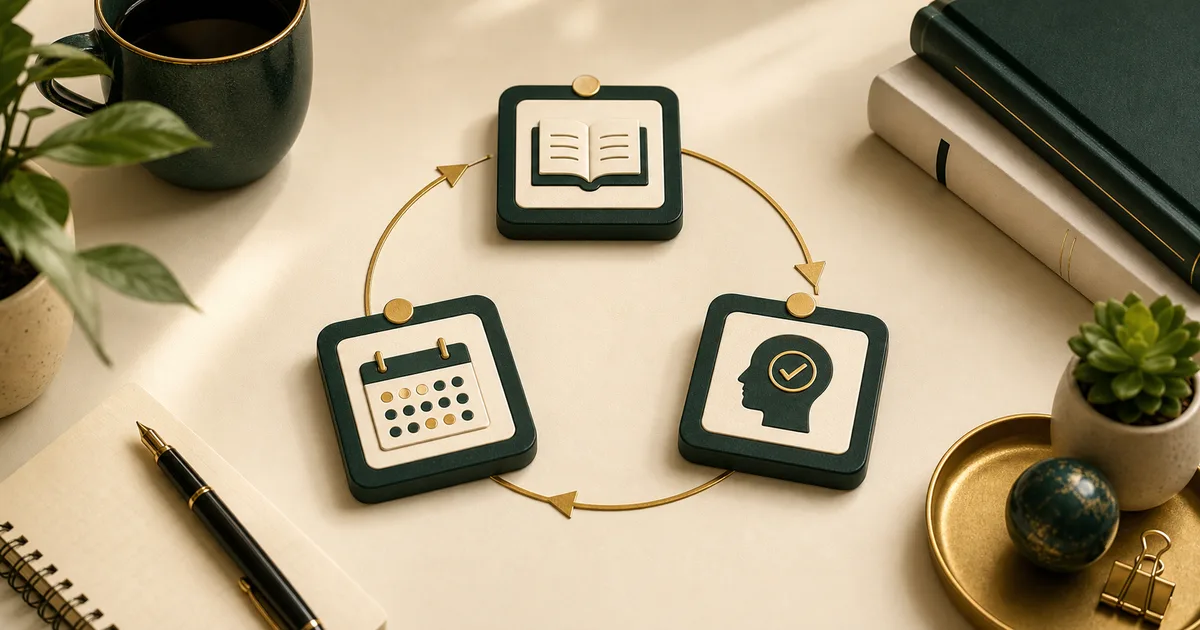
To improve your memory, change how you learn, not how hard you try. Test yourself instead of rereading (one-week recall rose from about 40% to about 61% in a classic experiment), space your reviews over days and weeks, link new facts to what you already know, and use a memory palace for lists and names. Then look after the hardware: sleep after learning, move your body, and pay full attention when it matters. What does not work is just as well documented: rereading, highlighting, brain-training games and ginkgo.
You meet someone at a party. Two minutes later their name is gone. You read something fascinating on Tuesday and by Thursday you cannot reconstruct a single sentence of it. You walk into the kitchen and stand there, wondering what you came for.
None of this means you have a bad memory. It means you have an untrained one, and that you are probably using the two study habits researchers rate as least effective. Memory turns out to be one of the most trainable things about you, and the research is unusually specific about how. This guide gives you the ten methods with real evidence behind them, the popular ones that fail, and a 30-day plan. It is part of our bigger guide on how to learn.
Get your baseline first
Take the free memory test before you start. It measures your digit span, the number of items you can hold in mind at once, in about two minutes. Then try the memory palace trainer once, before you read section 3, and once after. The difference is usually the most convincing argument on this page.
How memory works, in one minute
Every memory goes through three stages, and each one is a place where you can help or hurt it.
- Encoding: getting information in. This needs attention. If you were thinking about your phone while someone said their name, the name never really arrived.
- Consolidation: making it stick. Much of this happens while you sleep, when the brain replays the day and files it for the long term.
- Retrieval: getting it back out. Here is the surprise: every time you pull a memory out, you make it easier to find next time. Retrieval is not just a readout. It is training.
There is also a bottleneck at the front door. Working memory, the mental desk where you hold things while you use them, holds about four items, not the famous seven (Cowan, 2001). Everything you learn has to pass through that small doorway, which is why cramming twenty facts at once fails and why the methods below work.
And then there is forgetting. Hermann Ebbinghaus measured it on himself in the 1880s, and a 2015 replication reproduced his curve almost exactly (Murre & Dros, 2015). You lose the most in the first day, then the curve flattens. We take the full curve apart, with an interactive chart, in our guide to the forgetting curve. The short version: the first 24 hours are when a quick review buys you the most.
How to improve memory: 10 methods backed by science
The first four are the heavy lifters. If you only change one thing, make it method 1.
1. Test yourself instead of rereading
Here is the finding that surprises people most: the best way to remember more is not to study more. It is to quiz yourself more.
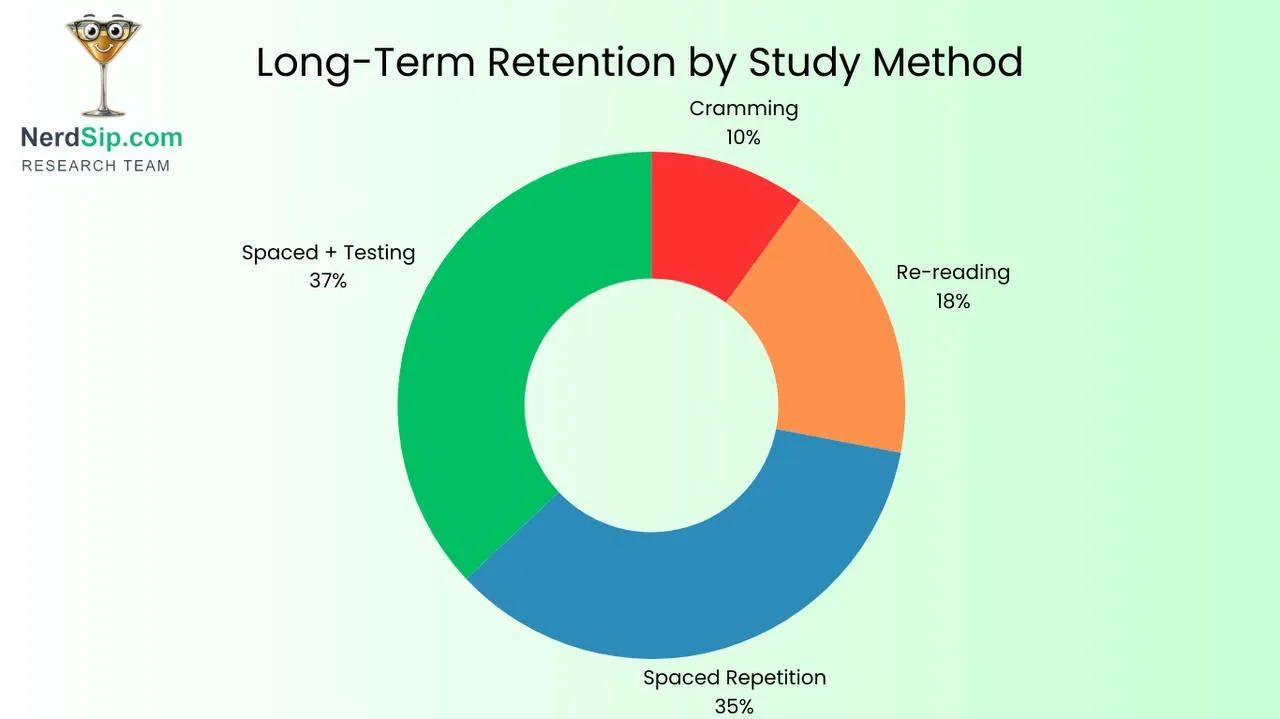
Henry Roediger and Jeffrey Karpicke had students read a short passage, then either reread it several times or read it once and practise recalling it. Five minutes later, the rereaders did slightly better. A week later the ranking flipped: the recall group remembered about 61% of the passage, the rereaders about 40% (Roediger & Karpicke, 2006). The rereaders had also predicted they would do better. Familiarity felt like knowledge. It was not.
This is not one lucky study. A meta-analysis of 61 studies found a solid, consistent advantage for testing over restudying (Rowland, 2014), and in a study published in Science, recall practice even beat building detailed concept maps, including on questions that required understanding rather than parroting (Karpicke & Blunt, 2011).
How to do it: after you read or watch something, close it and say or write what you remember. Then check, and relearn only the gaps. The step people skip is closing the source. Recall with the page still open is rereading in disguise.
2. Space your reviews
Spaced repetition means coming back to material at growing intervals instead of all at once. Nicholas Cepeda and colleagues pooled 254 studies with more than 14,000 participants and found that spaced study beat massed study at the same total time (Cepeda et al., 2006). Same hours, better memory, purely from how the hours were arranged.
A follow-up gave a rule of thumb: the best gap grows with how long you want to remember. Roughly, space reviews at 10 to 20% of the time you need to keep the information (Cepeda et al., 2008). For a talk next week, review after about a day. For something you want next year, the gaps stretch to weeks.
| Review | When | What it does |
|---|---|---|
| 1st | Same day, a few hours later | Catches the steepest part of the forgetting curve |
| 2nd | Next day | Turns a fragile trace into a durable one |
| 3rd | 3 days later | First real test of long-term storage |
| 4th | 1 week later | Gaps widen as the memory settles |
| 5th | 1 month later | Maintenance, not learning |
One rule matters more than the exact days: a review should feel slightly hard. If the answer pops up instantly, you came back too early. Methods 1 and 2 stack, too. Each review should be a recall attempt, not a reread. We compare the two head to head in microlearning vs spaced repetition vs active recall.
3. Build a memory palace
Roman orators had no note cards, so they built palaces. The method of loci works by placing what you want to remember at fixed spots along a route you already know, then walking that route in your mind to get it back.
It sounds like a party trick. It is not. In a 2017 study in Neuron, Martin Dresler's team gave people with ordinary memories 30 minutes of memory-palace training a day for six weeks. Before training they recalled about 26 words from a list of 72. Afterwards they recalled about 62. Four months later, with no further practice, they were still more than 22 words above where they started, and their brain scans had shifted toward the patterns seen in memory champions (Dresler et al., 2017).
- Pick a route you know cold. Your home, your walk to work, your childhood street.
- Fix ten stops along it, always in the same order: front door, coat hook, kitchen counter, sofa, and so on.
- Place one item at each stop, and make it absurd. Milk exploding across the front door. A whole chicken sitting in your armchair. Strange, big and moving beats neat every time.
- Walk the route to remember. Do not try to recall the list. Recall the walk, and the list comes with it.
You can try it right now in our memory palace trainer: pick a room, place ten items, walk back through and see your score. The honest limit: a palace is superb for ordered lists, names, numbers and speeches, and does little for understanding why something is true. That is what methods 4 and 5 are for. Two notes: the whole method leans on a mind's eye, so if pictures never come, our aphantasia test may explain why. And if you want a guided version, the short course Mastering the Memory Palace walks you through it.
4. Ask why: connect it or lose it
Isolated facts are the hardest thing your brain stores. Connected facts are the easiest, because every connection is another road back. So when you learn something, ask three questions:
- Why is this true? It pushes you past the surface statement.
- What does this remind me of? It hooks the new idea onto what you already know.
- Where would this break? It shows whether you understand the edges or just the headline.
When John Dunlosky and colleagues graded ten popular study techniques, this kind of "elaborative interrogation" earned a moderate rating, well above the habits most people rely on (Dunlosky et al., 2013):
| Technique | Rated utility |
|---|---|
| Practice testing | High |
| Spaced (distributed) practice | High |
| Asking "why is this true?" | Moderate |
| Explaining it to yourself | Moderate |
| Mixing topics (interleaving) | Moderate |
| Summarizing | Low |
| Highlighting and underlining | Low |
| Rereading | Low |
Highlighting and rereading are the two most popular study methods in the world, and both sit at the bottom. They are input. Memory is built by output. Explaining an idea out loud is the same principle, by the way. It is the real effect behind the "you retain 90% of what you teach" chart, whose number was never measured; we traced where it came from in how to retain what you learn.
5. Chunk it
You cannot widen the four-item doorway, but you can make each item bigger. Try holding these twelve digits: 1 4 9 2 1 7 7 6 1 9 6 9. Hard. Now read them as 1492, 1776, 1969: Columbus, American independence, the Moon landing. Three chunks, easy, because each one hooks into something you already know.
This is why experts seem to have better memories, but only in their field. In a classic study, chess masters rebuilt real game positions from memory far better than beginners. When the pieces were placed at random, the masters' advantage mostly vanished (Chase & Simon, 1973). They were not remembering more pieces. They were remembering fewer, larger patterns. When you learn something new, stop trying to hold twenty facts. Find the four or five ideas the twenty facts hang from.
6. Draw it or say it out loud
Two cheap tricks with good evidence. Drawing a word, even badly and in a few seconds, roughly doubled later recall compared with writing it out several times (Wammes, Meade & Fernandes, 2016). And words read aloud are remembered better than words read silently, a finding called the production effect (MacLeod et al., 2010). Both work for the same reason: you are producing something, not just receiving it. A quick sketch of a process, or muttering the key point to yourself, turns reading into doing.
7. Sleep on it
Learning does not finish when you close the book. It finishes overnight. During deep sleep, the hippocampus replays the day's memories and hands them over to the cortex for long-term storage. Björn Rasch and Jan Born reviewed decades of this work, and the direction is consistent: sleep after learning improves memory, and missing sleep before learning makes it harder to take new things in at all (Rasch & Born, 2013).
That makes the all-nighter the worst trade in learning. You buy a few hours and pay with the very process that would have made them stick. If falling asleep is the real problem, we covered what helps in why melatonin is not fixing your sleep.
8. Move your body
Most things sold as memory boosters do nothing. Aerobic exercise is the exception, and the evidence is anatomical. In a randomized trial, older adults who walked briskly three times a week for a year grew their hippocampus, the brain's filing clerk for new memories, by about 2%, roughly reversing one to two years of age-related shrinkage. The stretching-only group kept shrinking (Erickson et al., 2011). You can grow the part of your brain that stores memories by walking. That is still one of the more remarkable findings in neuroscience, and it is free.
9. Pay attention the first time
A lot of "bad memory" is really bad encoding. The name at the party did not fade; it never got in, because half your mind was on what to say next. When people learn while doing a second task, their later memory drops sharply, much more than when they are distracted while trying to remember (Craik et al., 1996). The fix is simple and unglamorous: one thing at a time when it matters. Say the name back ("Nice to meet you, Priya"), put the phone away while you read, and look at where you put your keys. If focus itself is the struggle, start with our guide on how to improve attention span.
10. Protect your brain for the long run
The methods above make your memory work better today. A few habits protect it for decades. The 2024 report of the Lancet Commission on dementia concluded that nearly half of dementia cases worldwide could, in theory, be prevented or delayed by tackling 14 risk factors across a lifetime. Two of the biggest in later life surprise most people: untreated hearing loss and high LDL cholesterol. Others on the list include high blood pressure, physical inactivity, smoking, heavy drinking, untreated vision loss, depression and social isolation (Livingston et al., 2024). So yes, getting a hearing test is a memory tip.
What does not work, and why it sells so well
Brain-training games. A large 2016 review found that these programs reliably improve performance on the trained game, show limited transfer to closely related tasks, and show little evidence of improving everyday memory or thinking (Simons et al., 2016). You get better at the game. That is where it stops. We tested the current crop in our review of brain training apps.
Ginkgo biloba. The Ginkgo Evaluation of Memory study followed 3,069 adults aged 75 and over for about six years. Ginkgo did not reduce dementia (DeKosky et al., 2008). Supplements can help when they fix a real deficiency, such as low vitamin B12, but no pill comes close to sleep, exercise and retrieval practice.
Rereading and highlighting. Covered above, and worth repeating because they are what almost everyone does by default. They feel productive because the material starts to look familiar. Familiar is not the same as remembered.
The new risk: letting AI do the remembering
When an assistant can retrieve, summarize and phrase anything on demand, the retrieval step that builds memory quietly disappears. An MIT Media Lab team tested this in 2025, tracking 54 people writing essays with an AI chatbot, with a search engine, or with nothing. The chatbot group showed the weakest brain connectivity, and in the first session most of them could not quote a single line from the essay they had just written (Kosmyna et al., 2025). It is a small preprint, not settled science, but it fits fifty years of retrieval research: if you never pull it out, you never put it in.
The answer is not to avoid AI. It is to decide what you want to own. Use it to find and organise information, then close it and rebuild the idea from memory before you move on.
Remembering what you read
Books are the most common complaint: you finish one and a month later you can barely say what it was about. The same methods apply, with a few reading-specific twists, like writing a three-sentence summary from memory when you close the book and choosing books that connect to each other. We cover that case in detail in how to remember everything you read.
How to improve your memory in 30 days
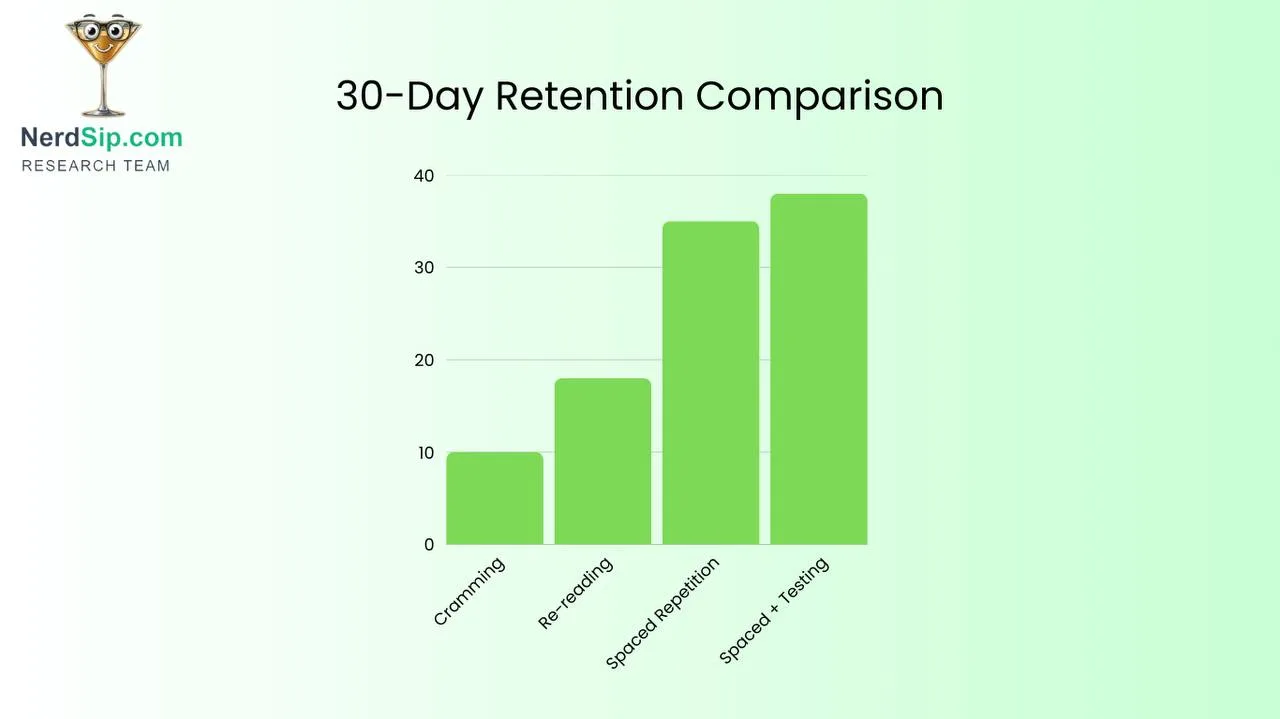
Techniques fail when you try ten of them on a Monday. Add one layer a week.
Week 1: Learn less, but recall it
Cut your material to one idea a day. After learning it, close everything and say it out loud from memory. Thirty seconds. That alone does more for retention than anything else on this list.
Week 2: Add spacing
Keep the daily recall, and before you learn today's idea, recall yesterday's. At the end of the week, do one pass over all seven from memory.
Week 3: Add connections and a palace
For each idea, answer "why is this true?" and "what does this remind me of?" in one sentence each. Separately, build one ten-stop memory palace and use it for something concrete, like a shopping list or the names of people you met.
Week 4: Fix the foundations
Protect your sleep on nights after you learn something that matters. Add three brisk walks a week. Put the phone away when someone tells you their name. These are not study techniques. They are the conditions under which study techniques work.
By day 30 you are running the full loop: small unit, immediate recall, spaced review, real connections, good sleep. None of it takes more time than you already spend. Retake the memory test and the memory palace trainer and compare.
Memory and age: what is normal, and when to see a doctor
Some slowing is a normal part of getting older. Taking longer to recall a name, misplacing your glasses, forgetting why you walked into a room: the US National Institute on Aging lists these as ordinary age-related forgetfulness (NIA). The good news is that the methods above do not expire with age. The walking study that grew the hippocampus was run with adults aged 55 to 80.
It is time to talk to a doctor if memory problems start to get in the way of daily life: asking the same questions again and again, getting lost in familiar places, struggling to follow a recipe or directions you know, or growing confused about time, people and places. Some causes are treatable, including medication side effects, vitamin B12 deficiency, thyroid problems and depression. We are not clinicians, and nothing on this page, including our memory test, can diagnose anything.
Where NerdSip fits
We build NerdSip, so take this with the salt it deserves. It is designed around methods 1 and 2. You type any topic and get a short course: three, five or ten lessons of about 200 words, so a short one takes about five minutes. Every lesson ends with a question you have to answer, which builds the recall step into the format instead of leaving it to willpower. Its spaced repetition system lives in the Repetition tab, which builds review rounds from courses you finished in the last 30 days and puts the ones you learned longest ago first (on paid plans).
What it does not do is grade every single fact on its own timetable, the way a flashcard app like Anki does. If you want strict per-card intervals, Anki is the honest recommendation, and everything in this article also works with paper index cards. The method matters more than the tool. What matters most is that the loop runs every day.
The bottom line
Memory is not a fixed amount you were handed at birth. It is a set of processes, and they respond to how you use them. Ordinary volunteers more than doubled their word recall in six weeks with a memory palace. Students remembered half again as much a week later by swapping rereading for self-testing. Older adults grew their hippocampus by walking.
None of that needs talent. It needs smaller chunks, recall instead of rereading, spaced reviews, real connections, good sleep and a body that moves. Do those, and the question stops being how to improve your memory and becomes what you want to fill it with.
Read next
References
- Cepeda, N. J., Pashler, H., Vul, E., Wixted, J. T., & Rohrer, D. (2006). Distributed practice in verbal recall tasks: A review and quantitative synthesis. Psychological Bulletin, 132(3), 354-380. doi:10.1037/0033-2909.132.3.354
- Cepeda, N. J., Vul, E., Rohrer, D., Wixted, J. T., & Pashler, H. (2008). Spacing effects in learning: A temporal ridgeline of optimal retention. Psychological Science, 19(11), 1095-1102. doi:10.1111/j.1467-9280.2008.02209.x
- Chase, W. G., & Simon, H. A. (1973). Perception in chess. Cognitive Psychology, 4(1), 55-81. doi:10.1016/0010-0285(73)90004-2
- Cowan, N. (2001). The magical number 4 in short-term memory: A reconsideration of mental storage capacity. Behavioral and Brain Sciences, 24(1), 87-114. doi:10.1017/S0140525X01003922
- Craik, F. I. M., Govoni, R., Naveh-Benjamin, M., & Anderson, N. D. (1996). The effects of divided attention on encoding and retrieval processes in human memory. Journal of Experimental Psychology: General, 125(2), 159-180. doi:10.1037/0096-3445.125.2.159
- DeKosky, S. T., et al. (2008). Ginkgo biloba for prevention of dementia: A randomized controlled trial. JAMA, 300(19), 2253-2262. doi:10.1001/jama.2008.683
- Dresler, M., et al. (2017). Mnemonic training reshapes brain networks to support superior memory. Neuron, 93(5), 1227-1235. doi:10.1016/j.neuron.2017.02.003
- Dunlosky, J., Rawson, K. A., Marsh, E. J., Nathan, M. J., & Willingham, D. T. (2013). Improving students' learning with effective learning techniques. Psychological Science in the Public Interest, 14(1), 4-58. doi:10.1177/1529100612453266
- Erickson, K. I., et al. (2011). Exercise training increases size of hippocampus and improves memory. PNAS, 108(7), 3017-3022. doi:10.1073/pnas.1015950108
- Karpicke, J. D., & Blunt, J. R. (2011). Retrieval practice produces more learning than elaborative studying with concept mapping. Science, 331(6018), 772-775. doi:10.1126/science.1199327
- Kosmyna, N., et al. (2025). Your brain on ChatGPT: Accumulation of cognitive debt when using an AI assistant for essay writing task. arXiv preprint. arXiv:2506.08872
- Livingston, G., et al. (2024). Dementia prevention, intervention, and care: 2024 report of the Lancet standing Commission. The Lancet, 404(10452), 572-628. doi:10.1016/S0140-6736(24)01296-0
- MacLeod, C. M., Gopie, N., Hourihan, K. L., Neary, K. R., & Ozubko, J. D. (2010). The production effect: Delineation of a phenomenon. Journal of Experimental Psychology: Learning, Memory, and Cognition, 36(3), 671-685. doi:10.1037/a0018785
- Murre, J. M. J., & Dros, J. (2015). Replication and analysis of Ebbinghaus' forgetting curve. PLOS ONE, 10(7), e0120644. doi:10.1371/journal.pone.0120644
- National Institute on Aging. Memory problems, forgetfulness, and aging. nia.nih.gov
- Rasch, B., & Born, J. (2013). About sleep's role in memory. Physiological Reviews, 93(2), 681-766. doi:10.1152/physrev.00032.2012
- Roediger, H. L., & Karpicke, J. D. (2006). Test-enhanced learning: Taking memory tests improves long-term retention. Psychological Science, 17(3), 249-255. doi:10.1111/j.1467-9280.2006.01693.x
- Rowland, C. A. (2014). The effect of testing versus restudy on retention: A meta-analytic review of the testing effect. Psychological Bulletin, 140(6), 1432-1463. doi:10.1037/a0037559
- Simons, D. J., et al. (2016). Do "brain-training" programs work? Psychological Science in the Public Interest, 17(3), 103-186. doi:10.1177/1529100616661983
- Wammes, J. D., Meade, M. E., & Fernandes, M. A. (2016). The drawing effect: Evidence for reliable and robust memory benefits in free recall. Quarterly Journal of Experimental Psychology, 69(9), 1752-1776. doi:10.1080/17470218.2015.1094494
Most of what happens above runs through one structure. See where the hippocampus sits inside the human brain and what the regions around it contribute.
Frequently Asked Questions
How can I improve my memory?
Change how you learn rather than how hard you try. Test yourself instead of rereading, review material at growing intervals over days and weeks, connect each new fact to something you already know, and use a memory palace for lists and names. Support it with sleep after learning, regular aerobic exercise and full attention when something matters. In one classic experiment, self-testing alone raised one-week recall from about 40% to about 61%.
Can you actually improve your memory, or is it fixed?
You can improve it, and the effects can be large. In a 2017 study in Neuron, people with ordinary memories trained with the memory palace for 30 minutes a day over six weeks and went from recalling about 26 words out of 72 to about 62. Four months later, with no further practice, they still recalled more than 22 words above their starting point.
What is the fastest way to improve your memory?
Replace rereading with self-testing. It is one change, costs no extra time and has the biggest immediate payoff. Close the book and reconstruct the idea from memory before you move on, then check what you missed. A meta-analysis of 61 studies confirmed that testing beats restudying for long-term retention.
How can I improve my memory naturally?
Sleep, exercise and attention are the natural foundation. Deep sleep after learning helps the brain store new memories, a year of brisk walking grew the hippocampus by about 2% in older adults, and memories you encode while distracted are much weaker. Add free techniques like self-testing, spaced review and the memory palace, and skip the supplements: the largest trial of ginkgo found no benefit.
Do brain training apps and games improve memory?
Largely no. A 2016 review in Psychological Science in the Public Interest found that brain-training programs improve performance on the trained games, show limited transfer to similar tasks and little evidence of improving everyday memory. You get better at the game, not at remembering names or facts.
How many things can working memory hold?
About four, not seven. Nelson Cowan's 2001 review revised George Miller's famous magical number seven down to roughly four items once rehearsal and grouping tricks are removed. You cannot raise that limit, but chunking lets you make each item bigger and more meaningful, which is why experts seem to remember more in their own field.
Why do I forget things so quickly?
Because forgetting is front-loaded, and because much of what you think you forgot never got in. Ebbinghaus's forgetting curve, replicated in 2015, drops fastest in the first day and then flattens, so a short review on day one buys more than any later review. Distraction while learning also weakens memories sharply, so give full attention to the things you need to keep.
Is forgetting things normal as you get older?
Some forgetfulness is a normal part of ageing, such as taking longer to recall a name, misplacing glasses or forgetting why you walked into a room. See a doctor if memory problems interfere with daily life, for example asking the same questions repeatedly, getting lost in familiar places or struggling to follow familiar directions. Some causes, like medication side effects, vitamin B12 deficiency, thyroid problems or depression, are treatable.
Does sleep affect memory?
Yes, substantially. During deep sleep the hippocampus replays the day's memories and hands them to the cortex for long-term storage. Sleep after learning improves retention, and sleep loss before learning makes it harder to take in new information at all. That makes the all-nighter a bad trade.
What is the best app for improving memory?
Judge apps by their mechanics: short units, a forced recall step and some way of bringing material back later. Anki is the standard for strict per-card spaced repetition if you are willing to build your own cards. NerdSip suits you if you want the material made for you: type any topic and it becomes a short course where every lesson ends in a question, and its Repetition tab builds review rounds from courses you finished in the last 30 days, oldest first, on paid plans.
Every NerdSip course clears a four-layer fact-checking pipeline before it reaches the app: grounded in live sources, scored nightly, gated on failure, and reviewable by a person at one tap. Articles on this blog are drafted with AI assistance, then researched, verified, and edited by our team.
Editorial responsibility: ai51 UG (haftungsbeschränkt). Responsible editor named in the imprint.
📚 Keep Learning
- The Forgetting Curve: What Ebbinghaus Really Found
- How to Remember Everything You Read (Science-Backed Methods)
- How to Retain 90% of What You Learn (And Why That Number Is Fake)
- How to Improve Attention Span: 10 Fixes That Work
- Microlearning vs Spaced Repetition vs Active Recall: What Actually Works?
- 10 Study Techniques That Actually Work (2026 Guide)
Explore the NerdSip learning hubs
The blog is our editorial layer. When you want to move from reading into doing, these hubs organize the rest of NerdSip by format, including the app itself and the press that has written about it.
Turn Reading Into Remembering
Type any topic and NerdSip builds a fact-checked 5-minute course where every lesson ends in a question, not a summary. Recall built in, and a reason to come back tomorrow.
Courses on this topic
4.7 stars from 380 reviews · 10,000+ learners