You finished a book last month. A good one. You remember enjoying it. You remember the cover. Maybe a vague theme. But if someone asked you to summarize the three core arguments right now, you would stall. The details have dissolved. The insights that felt electric on page 147 are gone.
Reading is one part of learning. For the rest, see our guide to how to learn anything, and if you want a baseline first, take the free reading speed test.
This is not a personal failing. It is the default outcome of how most people read. And the science behind why it happens is over a century old.
The good news: once you understand the mechanisms your brain uses to store and discard information, you can change the outcome entirely. Six research-backed techniques can turn reading from a pleasant but forgettable activity into a genuine engine of long-term knowledge.
The Forgetting Curve: Why Reading Feels Productive but Isn't
In 1885, Hermann Ebbinghaus conducted a deceptively simple experiment. He memorized lists of meaningless syllables, then measured how quickly he forgot them. The result, now called the forgetting curve, revealed something uncomfortable about human memory.
His numbers were savings scores, a measure of how much faster he could relearn a list. After 20 minutes, relearning took 58% less time than the first learning; after a day, 34% less; after a month, 21% less. The popular claim that 70% is gone within 24 hours is a misreading of that table (here is what he really found). The shape, though, is real: steep at first, then a long, slow tail. It applies whether you are reading philosophy or product documentation.
The critical finding, though, was not the forgetting. It was what stopped it. Each time Ebbinghaus actively reviewed material before it fully decayed, the curve flattened. The memory became more resistant to erosion. After three to four strategically timed reviews, information persisted for months.
This single discovery forms the foundation of every effective reading retention strategy that followed.
Why Passive Reading Fails You
Most people read in a way that feels productive but leaves almost no trace. You move through chapters, recognize ideas, nod along. The experience of understanding something in the moment creates a powerful illusion: you believe you have learned it.
Psychologists call this the fluency illusion. When text flows easily, your brain interprets that fluency as mastery. But recognition and recall are fundamentally different cognitive processes. You can recognize a face in a crowd without remembering the person's name. You can recognize an argument on the page without being able to reconstruct it from memory.
A landmark review by Dunlosky et al. (2013), published in Psychological Science in the Public Interest, evaluated ten popular study techniques across hundreds of studies. Their verdict on re-reading and highlighting was blunt: low utility. These methods produce minimal durable learning compared to techniques that force active engagement with the material.
The uncomfortable truth is that the ease of passive reading is precisely what makes it ineffective. Your memory systems activate most powerfully when retrieval is difficult, not when it is easy.
Six Science-Backed Methods to Remember What You Read
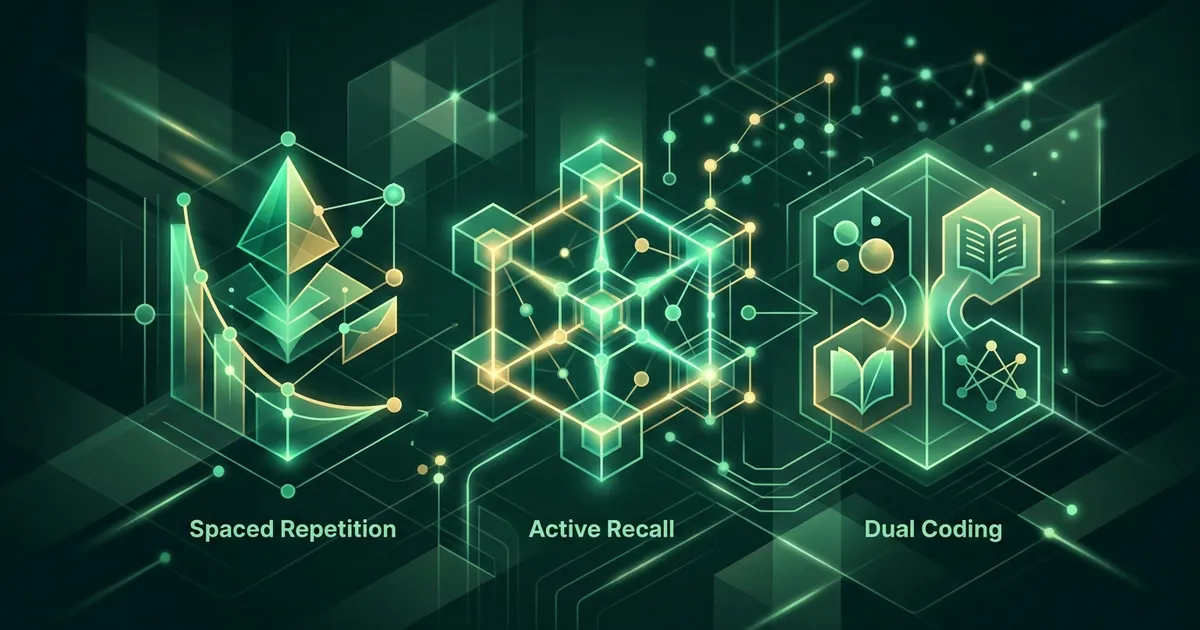
1. Spaced Repetition: The Forgetting Curve's Nemesis
Piotr Wozniak, a Polish researcher, spent the 1980s obsessed with a question: what is the mathematically optimal time to review a piece of information? His answer became SuperMemo, the first spaced repetition software, and it changed how we think about memory.
The principle is straightforward. Instead of reviewing everything in one sitting, you space reviews at increasing intervals. The first review happens within 24 hours. The second comes two to three days later. The third arrives after a week. Each successful recall pushes the next review further into the future.
Wozniak's algorithm, refined over decades, demonstrated that spaced repetition could achieve near-perfect retention with remarkably little total review time. A 2006 study by Cepeda et al. in Psychological Bulletin confirmed the effect across 254 studies: distributed practice consistently outperformed massed practice (cramming) for long-term retention.
For readers, this means one simple rule: never rely on a single reading session. Schedule brief revisits. Even five minutes of review at the right intervals can preserve what hours of initial reading built.
2. Active Recall: Close the Book, Then Think
Active recall is the most powerful single technique in learning science, and it requires nothing more than closing your book and asking yourself what you just read.
The mechanism is simple. When you force your brain to retrieve information from memory rather than passively re-read it, you strengthen the neural pathways associated with that information. The act of retrieval itself changes the memory, making it more durable and more accessible for future use.
Karpicke and Blunt (2011), in a study published in Science, found that students who practiced retrieval after reading retained 50% more material a week later than students who created detailed concept maps. The retrieval group spent less total time studying. They simply used that time to test themselves instead of review passively.
After every chapter, every article, every lesson: close the source. Write down, speak aloud, or mentally reconstruct the key ideas. Where you stumble reveals exactly where your understanding is thin. Keep the chunks small, because working memory holds only a few ideas at once; a quick free memory test shows how narrow that span really is.
3. The Testing Effect: Quizzes Build Memory, Not Just Measure It
Most people think of tests as measurement tools. You take a test to find out what you know. But decades of research have revealed something surprising: the act of being tested actually creates stronger memories.
This is the testing effect, and it is one of the most replicated findings in cognitive psychology. Roediger and Karpicke (2006) demonstrated that students who took a practice test after reading a passage remembered significantly more one week later than students who spent the same time re-studying. The testing group outperformed the re-study group even when the re-study group had more total exposure to the material.
The reason is neurological. Retrieving a memory under the mild stress of a test activates deeper encoding processes than passive review. Every successful retrieval is a repetition that strengthens the underlying memory trace. Every failed retrieval identifies a gap you can fill.
Practical application: after reading, write yourself three to five questions about the material. Answer them the next day without looking. This single habit can dramatically shift how much you retain.
4. Elaborative Interrogation: Ask "Why" Until It Sticks
Elaborative interrogation is a technique so simple it almost seems too obvious to work. After encountering a new fact or concept, you ask yourself: Why is this true? How does this connect to what I already know?
The power lies in what happens cognitively. When you generate explanations, you force your brain to integrate new information with existing knowledge structures. This creates richer, more interconnected memory traces that are easier to retrieve later. A fact stored in isolation is fragile. A fact woven into a web of related knowledge is resilient.
Dunlosky et al. (2013) rated elaborative interrogation as a moderate-to-high utility technique, noting that it reliably improves retention across a wide range of materials and learner ages. It works whether you are reading about cellular biology or Renaissance art.
Here is what this looks like in practice. You read that sleep deprivation impairs memory consolidation. Instead of moving to the next paragraph, you pause. Why would that be? What role does sleep play in memory? How does this connect to the forgetting curve? The thirty seconds you spend generating answers embeds the fact far deeper than another five minutes of reading would.
5. Dual Coding: Pair Words with Images
In the early 1970s, Allan Paivio proposed dual coding theory: the idea that your brain processes verbal information and visual information through separate channels, and that information encoded in both channels is remembered far better than information encoded in just one.
This has profound implications for reading retention. When you read a passage and also create a mental image, sketch a diagram, or visualize a scene, you are encoding the same information twice through independent systems. If one memory trace fades, the other can still trigger recall.
Research consistently supports this. Mayer's (2009) work on multimedia learning demonstrated that combining text with relevant visuals improved retention by 42% compared to text alone. The effect holds whether the visuals are provided externally or generated mentally by the reader.
Next time you read a key concept, pause and visualize it. Draw a quick sketch in the margin. Create a mental movie of the process being described. You are not wasting time. You are building a second retrieval pathway that your text-only memory can lean on when it weakens.
6. The Generation Effect: Predict Before You Read
Information you generate yourself is remembered better than information you receive passively. This is the generation effect, first described by Slamecka and Graf (1978), and it offers a powerful pre-reading strategy.
Before opening a chapter, spend sixty seconds predicting what it will contain. What do you already know about the topic? What questions do you expect the author to answer? What would you argue if you had to take a position?
This priming activates relevant knowledge structures in your brain, creating "hooks" that new information can attach to. When the text confirms or challenges your predictions, the resulting surprise or validation creates stronger encoding. Even wrong predictions help, because the contrast between what you expected and what you read creates a memorable cognitive event.
Why Most Reading Apps Miss the Point
Book summary apps, read-later tools, and digital libraries are optimized for one thing: consumption. Their metrics reward articles saved, summaries completed, and reading streaks maintained. None of these metrics correlate with actual retention.
You finish a 15-minute summary and feel a satisfying sense of accomplishment. But at no point were you asked to recall anything. At no point were you tested. At no point did the app schedule a follow-up review to intercept the forgetting curve before it erased your investment.
This is a structural problem, not a content problem. The information in these apps is often excellent. The delivery method simply ignores everything we know about how memory works.
How NerdSip Builds Retention Into the Reading Experience
NerdSip takes a different approach. Every AI-generated micro-lesson is followed immediately by a quiz, activating the testing effect while the material is fresh. Spaced repetition is built into the learning flow: the app resurfaces key concepts at optimal intervals so you review before you forget, not after.
Instead of reading a book and losing 90% within a week, you get daily five-minute sessions that cement knowledge into long-term memory. Gamification (XP, streaks, loot drops, leaderboards) solves the hardest part of spaced repetition: actually showing up consistently. The result is not just information consumed but knowledge retained and ready to use.
Testing yourself instead of rereading sits near the top of our list of things smart people do, for exactly the reasons above.
A Reading Retention System You Can Start Today
You do not need to overhaul your reading habits overnight. Three changes, applied consistently, can transform how much you retain.
- Before reading: Spend 60 seconds predicting what the material will cover. Activate the generation effect by writing down what you already know.
- During reading: Pause at the end of each section. Close the book. Reconstruct the key points from memory. Where you fail, reread that section only.
- After reading: Write three questions about the material. Answer them the next day without looking. Review again after a week.
These three steps take less than ten extra minutes per reading session. They leverage active recall, the testing effect, spaced repetition, and the generation effect simultaneously. The science behind each one is robust, replicated, and decades old.
The gap between people who read a lot and people who remember what they read is not intelligence. It is method. The techniques exist. The research is settled. The only variable left is whether you use them.
Sources & Further Reading
- Ebbinghaus, H. (1885). Memory: A Contribution to Experimental Psychology.
- Wozniak, P. A. (1990). Optimization of Learning: The SuperMemo Method. University of Technology in Poznan.
- Cepeda, N. J., et al. (2006). "Distributed practice in verbal recall tasks." Psychological Bulletin, 132(3), 354-380.
- Karpicke, J. D., & Blunt, J. R. (2011). "Retrieval practice produces more learning than elaborative studying with concept mapping." Science, 331(6018), 772-775.
- Roediger, H. L., & Karpicke, J. D. (2006). "Test-enhanced learning." Psychological Science, 17(3), 249-255.
- Dunlosky, J., et al. (2013). "Improving students' learning with effective learning techniques." Psychological Science in the Public Interest, 14(1), 4-58.
- Paivio, A. (1971). Imagery and Verbal Processes. Holt, Rinehart, and Winston.
- Mayer, R. E. (2009). Multimedia Learning (2nd ed.). Cambridge University Press.
- Slamecka, N. J., & Graf, P. (1978). "The generation effect." Journal of Experimental Psychology: Human Learning and Memory, 4(6), 592-604.
Frequently Asked Questions
Why do I forget what I read so quickly?
Your brain evolved to discard information it doesn't expect to need again. Hermann Ebbinghaus's forgetting curve shows that memory fades fastest in the first hours and days after learning, and keeps sliding if you never actively retrieve it. Passive reading, where your eyes move across the page without any self-testing or review, is the fastest path to forgetting.
What is the best technique to remember what you read?
Combining active recall with spaced repetition is the most effective approach supported by research. Active recall means closing the book and testing yourself from memory. Spaced repetition means reviewing at gradually increasing intervals. A 2011 study published in Science found that retrieval practice produced 50% better retention than concept mapping or re-reading.
Does highlighting and underlining help you remember what you read?
Very little. A comprehensive review by Dunlosky et al. (2013) rated highlighting and re-reading as low-utility study strategies. They create an illusion of familiarity without engaging the retrieval processes that build durable memory. Replacing highlighting with margin questions you answer from memory is far more effective.
How many times do you need to review something to remember it permanently?
Research suggests 4 to 5 well-timed reviews can move information into long-term memory for months or years. The key is timing: review within 24 hours, then after 3 days, then a week, then 2 to 3 weeks. Each successful recall extends the next interval. Spaced repetition apps automate this scheduling so you always review at the optimal moment.
Every NerdSip course clears a four-layer fact-checking pipeline before it reaches the app: grounded in live sources, scored nightly, gated on failure, and reviewable by a person at one tap. Articles on this blog are drafted with AI assistance, then researched, verified, and edited by our team.
Editorial responsibility: ai51 UG (haftungsbeschränkt). Responsible editor named in the imprint.
📚 Keep Learning
Explore the NerdSip learning hubs
The blog is our editorial layer. When you want to move from reading into doing, these hubs organize the rest of NerdSip by format, including the app itself and the press that has written about it.
Ready to Remember What You Learn?
NerdSip builds spaced repetition and active recall directly into every lesson. No willpower required. Download free and start retaining more in 5 minutes a day.
Courses on this topic
4.7 stars from 380 reviews · 10,000+ learners