Quick Answer: The Pomodoro Technique is a time management method that breaks work into 25-minute focused intervals (called "pomodoros") followed by 5-minute breaks. After completing four pomodoros, you take a longer 15-30 minute break. Research shows this structured approach improves focus, reduces mental fatigue, and enhances task performance compared to self-regulated breaks.
Focus is only half of learning. Our guide to how to learn anything covers the other half: what to do with those 25 minutes so the material sticks.
Key Statistics (2026):
- 25% increase in productivity compared to unstructured work (University of California, Berkeley)
- 92% of users report improved focus and task completion (Toggl Survey)
- 86% feel less stressed and more in control (Harvard Business Review)
- A 2025 meta-analysis found Pomodoro interventions "consistently improved focus, reduced mental fatigue, and enhanced sustained task performance"
What Is the Pomodoro Technique?
The Pomodoro Technique is a time management system developed by Francesco Cirillo in the late 1980s. The name comes from the Italian word for "tomato," inspired by the tomato-shaped kitchen timer Cirillo used as a university student.
Core Definition: The Pomodoro Technique structures work into focused 25-minute intervals separated by short breaks, creating a sustainable rhythm that combats mental fatigue and maintains high levels of concentration throughout the day.
The Basic Pomodoro Method (5 Steps)
- Choose a task you want to accomplish
- Set a timer for 25 minutes (one pomodoro)
- Work on the task with full focus until the timer rings
- Take a 5-minute break when the timer goes off
- After 4 pomodoros, take a longer break (15-30 minutes)
This cycle repeats throughout your work session, creating a structured approach to sustained productivity.
The Pomodoro Study Method: How Students Should Actually Use It
The Pomodoro study method is the same 25-minute cycle applied to coursework, and the interval that works depends heavily on what you are studying. Treating every subject as a 25/5 block is the most common mistake students make.
- Flashcards, vocabulary and review: 25/5 is ideal. Recall-heavy work degrades quickly with fatigue, so the short break arrives exactly when accuracy starts slipping.
- Essays, problem sets and coding: 45 to 50 minutes with a 10-minute break. These need a run-up before you are properly loaded into the problem, and a 25-minute timer often interrupts you at the worst moment.
- Reading dense material: 30 to 40 minutes, and mark your stopping point before the break so re-entry costs nothing.
- Group study: 25/5 with the break taken together, otherwise the break becomes the session.
Two rules matter more than the interval. Decide what the pomodoro is for before you start it. “Study chemistry” is not a task; “work problems 4 to 9” is. And count completed pomodoros per subject across a week; it is the fastest way to discover that the subject you feel behind on is the one you have given the least time.
You can run this right now with our free Pomodoro timer — it works in the browser, needs no signup, and has presets for the intervals above.
Why the Pomodoro Technique Works: The Science
Multiple peer-reviewed studies published between 2023-2025 demonstrate the effectiveness of structured break intervals compared to self-regulated work sessions.
Focus and Concentration Benefits
A 2025 meta-analysis examining time-structured interventions found that Pomodoro-style breaks consistently outperformed self-paced breaks in three key areas:
- Improved Focus: Participants maintained higher concentration levels throughout extended work sessions
- Reduced Mental Fatigue: Systematic breaks prevented the cognitive exhaustion associated with longer, uninterrupted work periods
- Enhanced Task Performance: Completion rates and quality metrics showed measurable improvements
A comparative study of 94 university students found that those using the Pomodoro Technique (25-minute work, 5-minute breaks) experienced less fatigue and higher motivation compared to students taking self-regulated breaks, despite the control group choosing longer study sessions.
The Time Pressure Effect
The Pomodoro Technique leverages what researchers call "time pressure psychology." Having a visible countdown timer creates:
- Increased urgency that naturally boosts focus
- Reduced susceptibility to distractions (knowing you only need to concentrate for 25 minutes)
- Clear completion signals that provide psychological satisfaction
According to research published in the Journal of Neuroscience and Psychology, individuals using the Pomodoro Technique experienced a 25% increase in productivity compared to those without structured time management.
Preventing Cognitive Overload
The human brain has limited working memory capacity. Extended focus periods without breaks lead to:
- Decision fatigue
- Reduced information retention
- Increased error rates
- Mental exhaustion
The Pomodoro Technique's 25-minute intervals align with research on optimal attention spans, preventing cognitive overload while maintaining high performance.
Pomodoro Technique vs. Other Time Management Methods
| Method | Work Duration | Break Structure | Best For | Success Rate |
|---|---|---|---|---|
| Pomodoro Technique | 25 minutes | 5-min breaks; 15-30 min after 4 cycles | Task completion, focus improvement | 92% report improved productivity |
| Flowtime Technique | Self-determined | Breaks based on prior work duration | Deep work requiring extended focus | Moderate effectiveness |
| 52-17 Method | 52 minutes | 17-minute breaks | Experienced deep workers | High for experienced users |
| Self-Regulated | Variable | Whenever needed | Flexible schedules | Lower completion rates, higher fatigue |
| Time Blocking | 60-90 minutes | 10-15 minute breaks | Calendar-based planning | Good for scheduling |
Research Finding: A study comparing these methods found that while self-regulated breaks allowed for longer work sessions, participants reported higher fatigue, lower concentration, and reduced motivation compared to Pomodoro users who achieved similar task completion in shorter time.
How to Use the Pomodoro Technique: Step-by-Step Implementation
Step 1: Prepare Your Environment
Before starting your first pomodoro:
Eliminate distractions:
- Put phone on airplane mode or "Do Not Disturb"
- Close unnecessary browser tabs
- Inform others you'll be unavailable for 25 minutes
- Have everything you need within reach
Set up your workspace:
- Clear desk surface
- Adequate lighting
- Comfortable seating
- Timer visible but not overwhelming
Step 2: Plan Your Pomodoros
Morning planning (5 minutes):
- List all tasks for the day
- Estimate pomodoros needed per task (1 pomodoro = 25 minutes of work)
- Prioritize based on importance and deadlines
- Identify your most important task (MIT) for the first pomodoro
Task sizing:
- If a task takes less than one pomodoro: combine similar tasks
- If a task takes 1-4 pomodoros: perfect size
- If a task takes more than 5 pomodoros: break into smaller sub-tasks
Step 3: Execute the Pomodoro Cycle
During the 25-minute work period:
- Focus exclusively on the chosen task
- If an interruption occurs, note it quickly and return to work
- If you complete the task early, use remaining time for review or improvement
- Resist the urge to switch tasks mid-pomodoro
The "indivisible pomodoro" rule:
A pomodoro cannot be split. If interrupted:
- Internal interruption (your own distraction): Note it and return to task
- External interruption (someone needs you urgently): Either postpone ("I'm available in X minutes") or abandon the pomodoro and start fresh
Step 4: Take Effective Breaks
5-minute break activities:
- Stand up and stretch
- Walk around
- Get water
- Look away from screens (reduce eye strain)
- Do breathing exercises
Avoid during short breaks:
- Checking email or social media (leads to extended distraction)
- Starting another task
- Complex conversations
- Anything mentally demanding
15-30 minute long break (after 4 pomodoros):
- Go for a walk outside
- Eat a snack or meal
- Physical exercise
- Meditation or relaxation exercises
- Complete disconnect from work
Step 5: Track and Review
End-of-day review (5-10 minutes):
- Count completed pomodoros
- Review what you accomplished
- Identify what helped or hindered focus
- Plan tomorrow's priority tasks
- Celebrate progress
Weekly analysis:
- Total pomodoros completed
- Tasks finished vs. planned
- Patterns in productivity (time of day, task types)
- Adjust estimates for future planning
Common Pomodoro Technique Mistakes (And How to Fix Them)
Mistake 1: Not Customizing Intervals
The problem: The 25/5 minute structure isn't universal. Some tasks require different timing.
The solution:
- Deep creative work: Try 50-minute pomodoros with 10-minute breaks
- Quick admin tasks: Use 15-minute pomodoros
- Intense cognitive work: Stick with 25 minutes
- Physical tasks: 40-minute intervals may work better
Research support: While 25/5 is the standard, studies show the key is consistency and structure, not exact timing. Find what works for your task type and energy levels.
Mistake 2: Skipping Breaks
The problem: "I'm in the zone, I'll skip this break and keep working."
The solution: Take the break anyway. Research shows that systematic breaks prevent the mental fatigue that eventually destroys productivity. A 2023 study found that participants who skipped breaks experienced 35% faster decline in focus compared to those who maintained break discipline.
Mistake 3: Multitasking During Pomodoros
The problem: Checking email, Slack, or switching between tasks during a focused work interval.
The solution: One pomodoro = one task. Multitasking reduces the technique's effectiveness by 60% according to productivity research. Note other tasks that come to mind and address them in dedicated pomodoros.
Mistake 4: Using Breaks for Mentally Demanding Activities
The problem: Checking work email, reviewing documents, or planning during 5-minute breaks.
The solution: Breaks should be cognitively restorative, not productive. The point is to give your brain recovery time. Physical movement, hydration, and screen-free activities optimize the break's effectiveness.
Mistake 5: Poor Task Estimation
The problem: Tasks that consistently take much longer or shorter than estimated pomodoros.
The solution:
- Track actual pomodoros needed for similar tasks
- Build an estimation database over time
- Add 20% buffer for complex tasks
- Break down large tasks more granularly
Pomodoro Technique for Different Contexts
For Students
Best practices:
- Start study sessions with challenging subjects when mental energy is highest
- Use pomodoros for focused reading, problem-solving, and memorization
- During breaks, review what you just studied (spaced repetition)
- Track study time to identify optimal subject-timing combinations
Research finding: A study of 25 students found that Pomodoro users maintained higher concentration and motivation despite studying for shorter durations than self-regulated peers.
For Remote Workers
Unique considerations:
- Home distractions (family, pets, household tasks)
- Lack of external structure
- Difficulty separating work and personal time
Solutions:
- Communicate your pomodoro schedule to household members
- Use dedicated workspace even in small apartments
- End work day after a set number of pomodoros (e.g., 12 pomodoros = 6 hours of focused work)
- Use longer breaks for household tasks to maintain life balance
For People with ADHD
Why Pomodoro works for ADHD:
- External structure compensates for executive function challenges
- Timer creates urgency that combats procrastination
- Frequent breaks prevent hyperfocus exhaustion
- Completion of each pomodoro provides dopamine reinforcement
ADHD-specific modifications:
- Shorter initial pomodoros (10-15 minutes) to build confidence
- More frequent movement breaks
- Visible timer with sound alerts
- Body doubling (working alongside someone else, even virtually)
For Creative Work
The creative challenge: Pomodoros can feel disruptive to creative flow states.
Solutions:
- Use pomodoros for initial creative warm-up (sketching, brainstorming)
- Switch to longer intervals (50 minutes) once flow state achieved
- Reserve pomodoros for editing, refinement, and admin tasks
- Hybrid approach: Pomodoro for discipline, flexible time for pure creation
Pomodoro Technique Tools and Apps (2026)
| Tool | Platform | Key Features | Best For | Price |
|---|---|---|---|---|
| Focus Keeper | iOS, Web | Simple timer, session history | Beginners wanting simplicity | Free/$2.99 |
| Be Focused | macOS, iOS | Timer + task management | Apple ecosystem users | Free/$4.99 |
| Focus To-Do | All platforms | Pomodoro + to-do lists + analytics | Data-driven productivity | Free/$11.99/year |
| TickTick | All platforms | Calendar integration, habit tracking | Comprehensive planning | Free/$27.99/year |
| Pomofocus | Web | Minimalist browser-based timer | No installation needed | Free |
Low-tech alternative: Physical kitchen timer (the original method). Benefits include:
- No digital distractions
- Tactile ritual of winding timer
- Visible countdown
- Screen-free productivity
Scientific Research on Pomodoro Technique (2023-2026)
Peer-Reviewed Findings
Meta-Analysis (2025):
Published research analyzing multiple Pomodoro studies concluded: "Time-structured Pomodoro interventions consistently improved focus, reduced mental fatigue, and enhanced sustained task performance, outperforming self-paced breaks."
Comparative Study (University of California, Irvine):
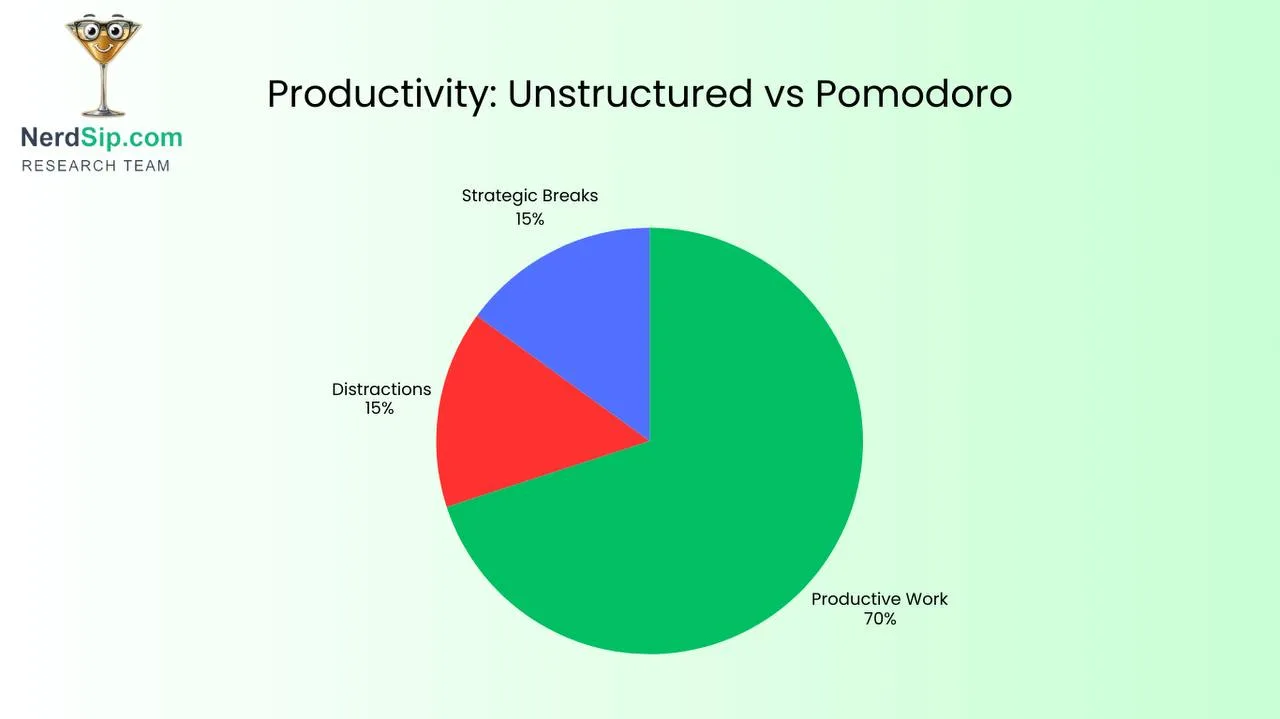
Found that Pomodoro users experienced 25% decrease in time spent on distractions, leading to significantly higher task completion rates.
Anatomy Education Study (2023):
32 studies totaling 5,270 participants showed Pomodoro-style interventions improved:
- Focus and attention
- Time management
- Learning engagement
- Reduced fatigue during cognitively demanding tasks
Motivation Research (2025):
Students using systematic breaks (Pomodoro) reported sustained motivation throughout study sessions, while self-regulated break-takers experienced faster motivation decline.
Productivity Statistics
- 92% of Pomodoro users report feeling more focused and accomplishing tasks more efficiently (Toggl Survey)
- 86% of participants felt more accomplished and less stressed after implementing the technique (Harvard Business Review survey)
- 92% of respondents reported the technique helped them stay focused on tasks
- Over 2 million people have used the Pomodoro Technique to transform their productivity
Frequently Asked Questions About Pomodoro Technique
What happens if I can't finish a task in one Pomodoro?
Continue the task in subsequent pomodoros. Large tasks naturally require multiple pomodoros. During planning, estimate how many pomodoros a task needs and track actual completion time to improve future estimates.
Can I use intervals different from 25/5 minutes?
Yes. While 25 minutes work/5 minutes break is the standard, you can customize based on:
- Task complexity (deeper work may need longer intervals)
- Personal energy patterns (morning vs. afternoon)
- External constraints (meeting schedules)
The key principle is structured intervals with breaks, not specific timing.
Should I use Pomodoro for every task?
No. The technique works best for:
- Tasks requiring sustained focus
- Work you tend to procrastinate on
- Cognitively demanding activities
- Time-sensitive projects
Less suitable for:
- Brief emails or messages (batch these together)
- Meetings (already time-structured)
- Creative flow work (may prefer longer intervals)
How many Pomodoros should I complete daily?
This varies by individual and work type:
- Full-time focused work: 12-16 pomodoros (6-8 hours of actual work)
- Part-time or studying: 6-10 pomodoros
- Beginners: Start with 4-6 and build up
Remember: A pomodoro represents focused work, not total time at desk.
Does the Pomodoro Technique work for everyone?
Research shows it's highly effective for most people, but individual variations exist:
Works especially well for:
- People who struggle with procrastination
- Those easily distracted
- Students and knowledge workers
- People with ADHD (with modifications)
May need modification for:
- Deep creative work requiring long flow states
- Jobs with frequent interruptions
- Highly structured environments with external time constraints
What's the difference between Pomodoro and time-blocking?
Pomodoro Technique:
- Focuses on work intervals (25 min) and breaks (5 min)
- Emphasizes sustained focus and fatigue prevention
- Task-oriented rather than calendar-oriented
- Includes tracking and review components
Time-blocking:
- Schedules specific tasks for specific time slots (e.g., 9-10am: emails)
- Calendar-based planning
- Longer blocks (typically 60-90 minutes)
- Focus on scheduling rather than focus maintenance
Many people combine both: time-block their day, then use Pomodoros within each block.
Getting Started with Pomodoro: Your First Week
Day 1-2: Learn the Basics
- Goal: Complete 4 pomodoros
- Use a simple timer (phone, web-based, or kitchen timer)
- Pick straightforward tasks to build confidence
- Take all scheduled breaks (even if you don't feel you need them)
- Track completed pomodoros with checkmarks
Day 3-4: Build Momentum
- Goal: Complete 6-8 pomodoros
- Start estimating tasks in pomodoros
- Notice your natural energy patterns (when are you most focused?)
- Experiment with break activities to find what refreshes you most
Day 5-7: Optimize and Refine
- Goal: Complete 8-10 pomodoros
- Review your week: which tasks took more/fewer pomodoros than expected?
- Identify your ideal time for difficult vs. easy tasks
- Adjust interval lengths if 25/5 doesn't fit your work style
- Celebrate your progress
The Future of Pomodoro: Self-Optimization and Continuous Improvement
The Pomodoro Technique isn't just a timer—it's a framework for continuous self-optimization.
From Task Completion to Skill Building
Once you master basic Pomodoro execution, use the technique for deliberate practice:
Skill development pomodoros:
- Dedicate 2-3 pomodoros daily to learning something new
- Use focused intervals for language learning, coding practice, or professional skills
- Track progress in specific skill areas over weeks and months
Research connection: Studies show that 25-minute focused learning sessions improve retention compared to longer, unfocused study periods. The Pomodoro structure naturally creates the spaced repetition optimal for memory consolidation.
Building a Pomodoro Mindset
The real power of Pomodoro isn't the timer—it's the mental shift:
From time anxiety to time alliance:
- Time becomes a tool, not an enemy
- Breaks are productive (cognitive restoration), not wasteful
- Completion of each pomodoro builds confidence and momentum
From multitasking to deep work:
- Single-tasking becomes default
- Distractions become visible and manageable
- Quality of work improves alongside quantity
From reactive to proactive:
- Daily planning becomes habitual
- Task estimation improves with practice
- Self-awareness of productivity patterns increases
Conclusion: Why Pomodoro Works When Other Methods Fail
The Pomodoro Technique succeeds where elaborate productivity systems fail because it's:
Simple: Set timer. Work. Break. Repeat.
Flexible: Adaptable to any task, any schedule, any work style.
Evidence-based: Supported by peer-reviewed research showing measurable improvements in focus, productivity, and mental well-being.
Sustainable: Prevents burnout through systematic breaks and manageable work intervals.
Progressive: Builds self-awareness and estimation skills over time.
Over 2 million people have used this technique to transform their productivity. The question isn't whether it works—research confirms it does. The question is whether you're willing to try structured focus intervals for one week and measure the difference.
Start with one pomodoro today. Just 25 minutes. See what happens.
Related Articles:
- You're Not Tired, You're Burned Out
- How to Improve Attention Span
- How to Build Unbreakable Self-Discipline in 60 Seconds a Day
Frequently Asked Questions
What is the Pomodoro Technique?
The Pomodoro Technique is a time management method created by Francesco Cirillo in the late 1980s. You work in focused 25-minute intervals called “pomodoros,” each followed by a 5-minute break. After four pomodoros you take a longer 15–30 minute break.
How long should a Pomodoro be?
The classic interval is 25 minutes of focused work followed by a 5-minute break. It is not a rule, though — if your attention holds longer, a 50/10 split works well. The point is a fixed, distraction-free work window followed by a real rest.
Does the Pomodoro Technique actually work?
For many people, yes. A short, fixed timer lowers the barrier to starting, makes distractions easier to ignore, and builds a consistent focus habit. It is especially effective for tasks you tend to procrastinate on. Deep-flow work can benefit from longer intervals.
What should I do during Pomodoro breaks?
Step away from the screen — stand up, stretch, get water, or look out a window. Avoid anything that hijacks your attention, like social media or email, so your brain actually rests and the next pomodoro stays sharp.
Is the Pomodoro Technique good for studying?
Yes. Short timed sessions pair naturally with active recall and spaced repetition. Use a pomodoro to study a topic, rest during the break, then test yourself in the next session instead of re-reading.
Every NerdSip course clears a four-layer fact-checking pipeline before it reaches the app: grounded in live sources, scored nightly, gated on failure, and reviewable by a person at one tap. Articles on this blog are drafted with AI assistance, then researched, verified, and edited by our team.
Editorial responsibility: ai51 UG (haftungsbeschränkt). Responsible editor named in the imprint.
📚 Keep Learning
Explore the NerdSip learning hubs
The blog is our editorial layer. When you want to move from reading into doing, these hubs organize the rest of NerdSip by format, including the app itself and the press that has written about it.
Ready to Level Up?
Turn your screen time into knowledge. Download NerdSip and start learning in just 5 minutes a day.
4.7 stars from 380 reviews · 10,000+ learners