Self-discipline is not willpower. It is a behavior repeated in the same context until it stops needing a decision. The fastest way to build it is to shrink the behavior until finishing is never in doubt: one action, under 60 seconds, same trigger, every day. The research points the same way from two directions. People who look disciplined are not resisting harder. They are deciding less.
How Do You Build Self-Discipline?
Five steps. The whole thing costs about a minute a day.
- Pick one behavior you can finish in 60 seconds. One push-up. One page. One lesson. Small enough that a bad day cannot stop it.
- Attach it to something you already do daily. After the coffee machine starts. After you close the laptop. The existing habit becomes the alarm clock.
- Write it as an if-then plan. "If it is 8 a.m. and the kettle is on, then I do one push-up." Specific beats motivated.
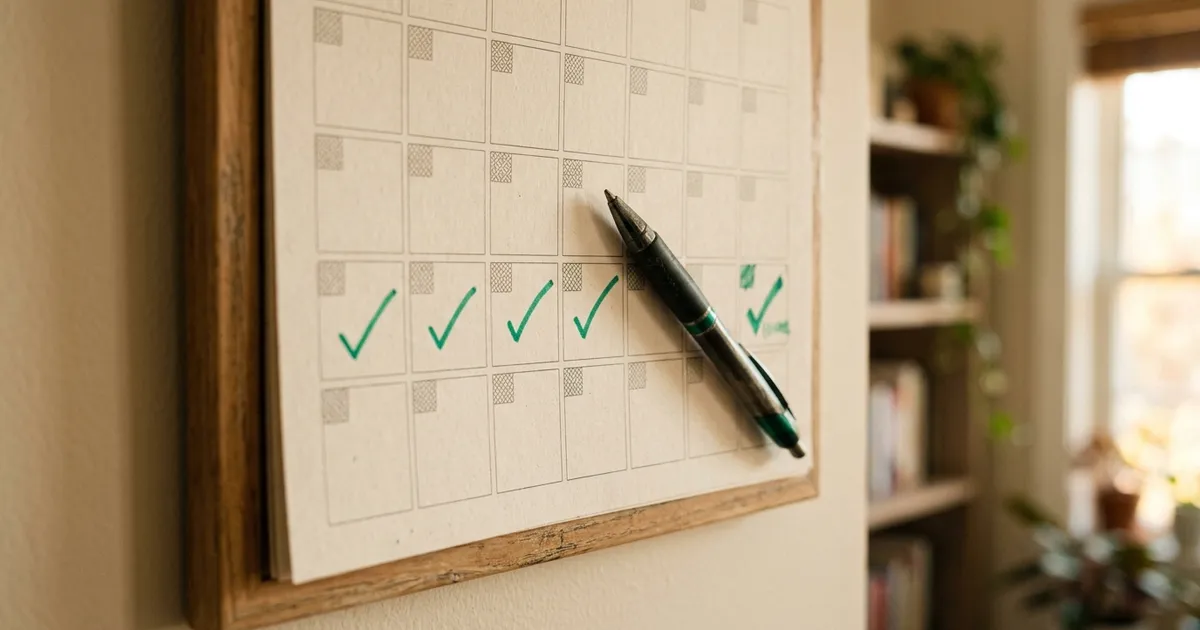
- Never miss twice. One skipped day is noise. Two in a row is how habits die.
- Add the second habit only when the first runs itself. Usually two to three weeks. Sometimes longer. Do not rush this.
That is the method. The rest of this guide explains why willpower is the wrong lever to pull, which 60-second habits are worth starting with, and how long it actually takes before the thing runs without you.
Why Willpower Is the Wrong Lever
For two decades the standard story was ego depletion. Willpower works like a fuel tank, every decision burns a little, and by evening you are running on fumes. It explained why people quit diets at 9 p.m. It felt true.
It did not survive testing.
In 2016, twenty-three laboratories ran the same preregistered ego-depletion experiment across 2,141 participants. The pooled effect was d = 0.04, with a confidence interval that comfortably included zero. In plain terms: nothing happened. The tank does not appear to exist, at least not the way the popular version describes it.
Meanwhile, research on what disciplined people actually do went somewhere more interesting.
Brian Galla and Angela Duckworth ran six studies with 2,274 participants and found that people scoring high on self-control were not better at resisting temptation. They had built stronger automatic habits, so the resisting rarely came up in the first place. The trait everyone calls willpower was mostly a downstream effect of routine.
Marina Milyavskaya and Michael Inzlicht tracked students through a semester and found the same thing from the other side. Effortful self-control was consistently unrelated to whether people reached their goals. What predicted failure was the sheer number of temptations they ran into. The students who succeeded were not winning more fights. They were in fewer.
Discipline is not the strength to resist. It is the absence of a decision.
This is why sixty seconds beats hero mode. A cold plunge you do once takes real willpower and builds nothing. A sixty-second action you do every day stops needing willpower somewhere around week two, and that is exactly when it starts to compound.
Jonathan Bricker, a behavioral scientist at the Fred Hutchinson Cancer Center, makes a related case in his TEDxRainier talk: the useful skill is not fighting the urge but changing your relationship to it.
What Is a Micro-Habit?
A micro-habit is a behavior small enough that doing it costs less effort than deciding whether to do it. In practice: under sixty seconds, one step, no setup, no equipment.
The size is the mechanism, not a beginner's compromise.
Habits automate through repetition in a stable context. Anything that can fail on a bad day will eventually break the chain, and a broken chain is what most people read as proof that they are simply not a disciplined person. Shrinking the behavior deletes the failure mode. You are not trying to get fit with one push-up. You are trying to become someone who does the push-up three hundred times.
The 10 Micro-Habits That Build Self-Discipline
Each of these takes under a minute, except the last one. Pick one. Not three.
| Micro-habit | Time | Best trigger |
|---|---|---|
| 1. The if-then plan | 30 sec | First coffee |
| 2. The first win | 30 sec | Feet hit the floor |
| 3. The physiological sigh | 10 sec | Any spike of tension |
| 4. The put-it-back rule | 40 sec | Finishing anything |
| 5. The phone exile | 10 sec | Before focused work |
| 6. The pause question | 10 sec | Before a tempting choice |
| 7. The ten-minute delay | 10 sec | Any craving |
| 8. The nightly close | 60 sec | Before bed |
| 9. Never miss twice | 0 sec | The morning after a skip |
| 10. The weekly five | 5 min | Sunday evening |
1. The If-Then Plan (30 Seconds)
Not an affirmation. A sentence with a time and a place in it.
"If it is 7 a.m. and I have poured my coffee, then I will read one page."
This is the single best-evidenced trick on the list. A meta-analysis of 94 independent tests covering more than 8,000 people found that forming implementation intentions produced a medium-to-large effect on goal attainment, d = 0.65. Naming the moment in advance means you do not have to decide inside it.
2. The First Win (30 Seconds)
Before the phone, do one small thing. Make the bed. Drink a glass of water. Open the curtains.
You are not doing it for the tidy bed. You are collecting the first piece of evidence of the day that you do what you said you would.
3. The Physiological Sigh (10 Seconds)
Two inhales through the nose, the second one short and stacked on top of the first, then a long slow exhale through the mouth. Repeat twice.
In a randomized controlled trial published in Cell Reports Medicine, five minutes a day of this exhale-weighted breathing improved mood and lowered resting respiratory rate more than an equal dose of mindfulness meditation. Ten seconds will not replicate a month of practice, but it reliably buys you the gap between a trigger and your response. That gap is where discipline actually lives.
4. The Put-It-Back Rule (40 Seconds)
Whatever you just used goes back now. Not later. Now.
Environment is upstream of behavior. A clear desk is not a reward for being disciplined; it is one of the things that makes the next disciplined choice cheaper.
5. The Phone Exile (10 Seconds)
Before focused work, put the phone in another room. Not face down. Another room.
This is the Milyavskaya finding turned into an action. If temptations are what predict failure, then the highest-leverage move is not resisting the phone better. It is not being in the room with it.
6. The Pause Question (10 Seconds)
Before a choice you can feel yourself rationalizing, ask: is this the person I am becoming?
It works because it moves the decision from the immediate reward to the identity, which is the timescale where you actually care.
7. The Ten-Minute Delay (10 Seconds)
When a craving arrives, do not say no. Say "in ten minutes."
Refusal starts a fight. Delay does not, and most cravings do not survive ten minutes of being ignored. If it does survive, have the thing. You are training the delay, not practicing deprivation.
8. The Nightly Close (60 Seconds)
Put three things away. Write tomorrow's if-then plan on one line. Done.
Closing the loop means tomorrow starts without friction, and the plan is already made before you are tired enough to renegotiate it.
9. Never Miss Twice (0 Seconds)
The rule that saves more habits than any other, and the one people skip because it sounds too easy.
Lally's habit-formation data found that missing a single opportunity did not materially affect the automation curve. One skipped day costs you almost nothing. What ends habits is the story people tell themselves after the skipped day, which turns one miss into a week.
10. The Weekly Five (5 Minutes)
Once a week, answer three questions. Which days did I do it? What got in the way? What is the smallest change that would fix that?
This is the one exception to the sixty-second rule, and it is the difference between a habit that adapts and one that quietly dies in week four.
How Long Does It Take to Build Self-Discipline?
Longer than thirty days, and it depends heavily on what you picked.
Phillippa Lally and colleagues at University College London tracked 96 people performing a chosen daily behavior in a fixed context for twelve weeks, measuring automaticity every single day. The median time to reach 95% of full automaticity was 66 days. The range ran from 18 days to 254.
Simple behaviors automated fast. Drinking a glass of water after breakfast landed near the bottom of that range. Harder ones, like fifty sit-ups, took months. The popular 21-day and 30-day numbers are marketing, not findings.
So what does the first month actually get you? Not automation. Evidence.
Week 1. The habit still needs the reminder. You will feel slightly silly doing something this small. That feeling is a good sign; it means the behavior is correctly sized.
Week 2. It starts happening before you remember to plan it. The trigger is doing the work now instead of you.
Week 3. Skipping starts to feel worse than doing. This is the first real shift, and it arrives without any drama.
Week 4. You have roughly thirty data points proving you follow through. That is the part that transfers, because self-trust is not built by intention. It is built by receipts.
What to Do When You Miss a Day
Nothing dramatic. Do it the next day.
This is worth stating plainly because the all-or-nothing reflex destroys more habits than laziness ever has. The Lally data is unambiguous on this point: a single missed opportunity did not meaningfully change the trajectory toward automaticity. The chain metaphor is useful for motivation and a liability for recovery.
If you have missed three or four days, do not restart the streak counter and do not add a punishment. Cut the habit in half and run it again. A behavior you abandoned was almost always too big, never proof of a character defect. Our guide on how to break a bad habit covers the same logic in reverse.
Self-Discipline vs. Willpower vs. Motivation
People use these three words interchangeably, which is most of why the advice around them contradicts itself.
| What it is | How long it lasts | What it depends on | |
|---|---|---|---|
| Motivation | A feeling that makes the action sound appealing | Hours | Mood, novelty, sleep |
| Willpower | Effortful override in the moment | Minutes | Attention and stakes |
| Self-discipline | Behavior that runs without a decision | Years | Repetition in a stable context |
Motivation gets you to start. Willpower covers the gap on bad days. Only the third one scales, and it is the only one you can deliberately build. Most people spend years trying to manufacture more of the first two.
How Micro-Learning Trains the Same Muscle
A sixty-second discipline habit and a five-minute lesson are the same machine wearing different clothes. Both are small, both are daily, both work by removing the decision rather than winning it.
That overlap is useful, because a daily learning habit is unusually easy to keep honest. It has a clear finish line, it takes minutes, and it produces something you can notice. Every completed lesson is another receipt in the pile.
This is the logic behind NerdSip: five-minute lessons with streaks, XP, and progress you can see, so the habit has structure holding it up instead of resolve. Gamification is not decoration here. It is scaffolding for the exact behavior the research says matters, which is showing up again tomorrow.
For more on that side of it, see building a daily learning habit that sticks and the habit-building hub.
The 30-Day Micro-Habit Plan
Week 1: One Habit, Written Down
Choose a single micro-habit and write the if-then plan somewhere you will see it. One habit. Resist the urge to start four, which is the most common way this fails.
Week 2: Protect the Trigger
Do not change the habit. Change what surrounds it. If the trigger keeps getting missed, move it earlier or attach it to something more reliable. The trigger is the part that breaks, not the behavior.
Week 3: Add the Second Only If the First Is Automatic
If you still need a reminder for habit one, stay at one for another week. Nothing is lost by waiting. Plenty is lost by stacking a second habit on an unstable first.
Week 4: Point It at Something That Matters
Now take the same structure and apply it to one area you actually care about: work, fitness, money, or learning. Same shape. Sixty seconds, fixed trigger, never miss twice.
At the end of thirty days you will not have unbreakable discipline. You will have something more useful: proof that the method works on you, and a habit that no longer requires you to be in the mood.
Start With One
Do not try all ten. Pick the one that made you nod.
Do it today, write the if-then plan for tomorrow, and hold at one habit until it stops needing a reminder. Three days for some people. Three weeks for others. Both are normal.
Then add the next one.
Sixty seconds, same trigger, never twice in a row missed. That is the whole thing, and it is boring on purpose. Boring is what survives contact with a bad week.
References
- Hagger, M. S., et al. (2016). A Multilab Preregistered Replication of the Ego-Depletion Effect. Perspectives on Psychological Science, 11(4), 546-573.
- Galla, B. M., & Duckworth, A. L. (2015). More than resisting temptation: Beneficial habits mediate the relationship between self-control and positive life outcomes. Journal of Personality and Social Psychology, 109(3), 508-525.
- Milyavskaya, M., & Inzlicht, M. (2017). What's So Great About Self-Control? Examining the Importance of Effortful Self-Control and Temptation in Predicting Real-Life Depletion and Goal Attainment. Social Psychological and Personality Science, 8(6), 603-611.
- Lally, P., van Jaarsveld, C. H. M., Potts, H. W. W., & Wardle, J. (2010). How are habits formed: Modelling habit formation in the real world. European Journal of Social Psychology, 40(6), 998-1009.
- Gollwitzer, P. M., & Sheeran, P. (2006). Implementation intentions and goal achievement: A meta-analysis of effects and processes. Advances in Experimental Social Psychology, 38, 69-119.
- Balban, M. Y., et al. (2023). Brief structured respiration practices enhance mood and reduce physiological arousal. Cell Reports Medicine, 4(1), 100895.
Boring also describes the apps worth keeping. That is the whole argument in our list of the self-improvement apps that actually work: tools with a mechanism, not platforms with a mood.
Frequently Asked Questions
How do I build self-discipline?
Pick one behavior you can finish in under 60 seconds, attach it to something you already do every day, and write it as an if-then plan that names the time and place. Repeat it daily and never miss two days in a row. Add a second habit only once the first happens without a reminder. Discipline comes from repetition in a stable context, not from trying harder.
Can self-discipline be learned, or are you born with it?
It is learned. Research by Galla and Duckworth across six studies and 2,274 participants found that people who score high on self-control are not better at resisting temptation. They have built stronger automatic habits, so the resisting rarely comes up. What looks like an inborn trait is mostly accumulated routine, which means it can be built deliberately.
How long does it take to build self-discipline?
Longer than the popular 21 or 30 days. Lally and colleagues tracked 96 people performing a daily behavior for twelve weeks and found a median of 66 days to reach 95% automaticity, with a range of 18 to 254 days. Simple behaviors automate in a few weeks; demanding ones can take several months.
Why do I have no self-discipline?
Usually because the behavior is too big and the environment is working against you. Milyavskaya and Inzlicht found that effortful self-control was unrelated to goal attainment, while the number of temptations people encountered predicted failure. If you keep breaking promises to yourself, shrink the behavior until finishing is guaranteed and remove the temptation rather than trying to out-resist it.
What is the 60-second rule for discipline?
Make the habit small enough to complete in under a minute, so doing it costs less effort than deciding whether to do it. The point is not the result of that minute. It is the repetition, because a behavior that cannot fail on a bad day is the only kind that survives long enough to become automatic.
Is self-discipline the same as willpower?
No. Willpower is an effortful override that lasts minutes and depends on attention and stakes. Self-discipline is behavior that runs without a decision and lasts for years. Willpower covers the occasional bad day; only self-discipline scales, and it is built through repetition rather than exertion.
Does missing one day ruin a habit?
No. The Lally habit-formation study found that missing a single opportunity did not materially affect the path toward automaticity. What breaks habits is missing twice in a row and then abandoning the attempt. Treat one skipped day as noise and do it again the next day.
What is the best daily habit for building self-discipline?
An if-then plan tied to an existing routine, because it has the strongest evidence behind it. A meta-analysis of 94 tests and more than 8,000 participants found implementation intentions produced a medium-to-large effect on goal attainment, d = 0.65. Naming the exact moment in advance means you never have to decide in the moment.
Every NerdSip course clears a four-layer fact-checking pipeline before it reaches the app: grounded in live sources, scored nightly, gated on failure, and reviewable by a person at one tap. Articles on this blog are drafted with AI assistance, then researched, verified, and edited by our team.
Editorial responsibility: ai51 UG (haftungsbeschränkt). Responsible editor named in the imprint.
📚 Keep Learning
Explore the NerdSip learning hubs
The blog is our editorial layer. When you want to move from reading into doing, these hubs organize the rest of NerdSip by format, including the app itself and the press that has written about it.
Ready to Level Up?
Turn your screen time into knowledge. Download NerdSip and start learning in just 5 minutes a day.
4.7 stars from 380 reviews · 10,000+ learners