You've tried this before.
Downloaded a learning app. Felt motivated for three days. Then life happened. Work got busy. You got tired. The app sat unopened. Another abandoned attempt at self-improvement.
Here's what nobody tells you: building a learning habit has nothing to do with motivation and everything to do with systems.
Motivation is what gets you started. Systems are what keep you going when motivation dies (which it will, usually around day 4).
This article breaks down exactly how to build a learning habit that becomes automatic—so automatic that NOT learning feels weird.
Sixty-six days tells you when a habit becomes automatic, not when a skill arrives. How many hours it actually takes to learn something new is a different number entirely.
No willpower required. Just the right system.
Why Most Learning Habits Fail (And It's Not Your Fault)
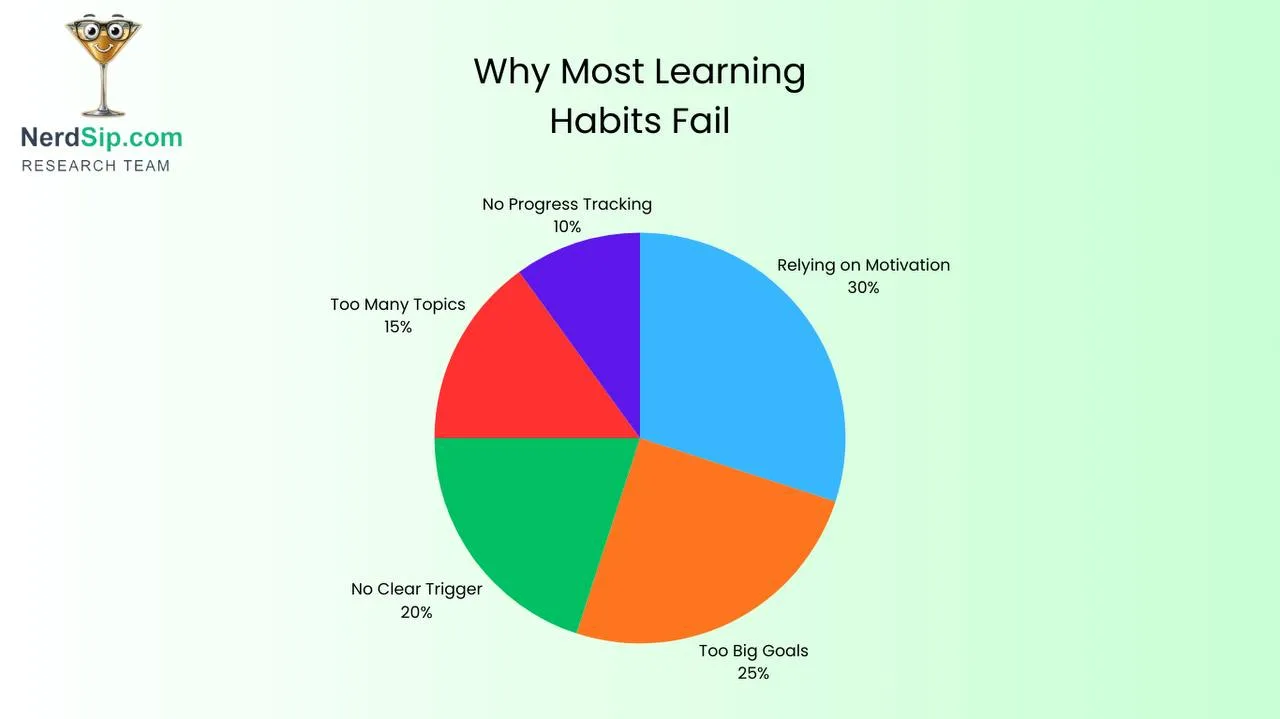
Before we fix the problem, let's understand why it happens.
Reason 1: You're Relying on Motivation
Motivation is a feeling. Feelings are unreliable.
You feel motivated on Monday. By Thursday, you're exhausted and can't muster the energy. The habit dies.
The fix: Build a system that works even when you don't feel like it.
Reason 2: You're Making It Too Big
"I'll study for an hour every day" sounds impressive. It's also unsustainable.
When you inevitably miss a day because you only have 30 minutes, you feel like you failed. You give up entirely.
The fix: Start ridiculously small. Five minutes counts. Two minutes counts. Showing up matters more than duration.
Reason 3: You Have No Trigger
You tell yourself "I'll learn daily" but never specify WHEN or WHERE.
Without a specific trigger, learning becomes something you "should do" but never actually do.
The fix: Attach learning to an existing habit. "After I pour my morning coffee, I open my learning app."
Reason 4: You Pick Too Many Things
Learning Spanish AND coding AND guitar AND marketing simultaneously.
Your brain can't build multiple habits at once. You spread yourself thin and make zero progress on anything.
The fix: One learning habit at a time. Master consistency with one topic before adding another.
Reason 5: You Don't Track Progress
Without visible progress, your brain doesn't register that you're improving. You feel like you're getting nowhere and quit.
The fix: Use apps with streak counters or mark a calendar. Visual progress creates momentum.
The Science of Habit Formation (How Long It Really Takes)
You've probably heard "it takes 21 days to form a habit."
That's wrong. It's a myth based on misinterpreted research from the 1960s.
The actual research: A 2009 study published in the European Journal of Social Psychology found it takes an average of 66 days for a new behavior to become automatic.
The range was 18 to 254 days depending on the complexity of the habit and the person.
What this means for learning habits:
- Expect 2-3 weeks of conscious effort before it starts feeling easier
- By day 30, it should feel somewhat natural
- By day 66, it's automatic—you do it without thinking
The key is surviving those first 21 days when it still requires willpower.
The 66-Day Learning Habit Method (Step-by-Step)
Here's the exact system that works:
Step 1: Pick ONE Learning Topic (Not Three)
Seriously. One.
What do you want to learn most right now? What would genuinely improve your life or career in the next 90 days?
Write it down. That's your focus for the next 66 days minimum.
Examples:
- Spanish for basic conversation
- Python for data analysis
- Public speaking fundamentals
- Excel for financial modeling
- Digital marketing basics
Pick one. Everything else goes on the "later" list.
Step 2: Start Absurdly Small (The 2-Minute Rule)
Your first goal isn't to learn a lot. It's to build consistency.
The 2-minute rule: Make your habit so small you can't fail.
- Don't commit to "30 minutes of Spanish daily"
- Commit to "open Duolingo and complete one lesson (2-5 minutes)"
Why this works: It removes the barrier to starting. Even on your worst days, you can do 2 minutes.
Once you start, you often continue beyond 2 minutes. But even if you don't, you maintained the habit.
Consistency beats intensity every single time.
Step 3: Attach to an Existing Habit (Habit Stacking)
Your brain loves patterns. Use existing habits as triggers for new ones.
The formula: "After [EXISTING HABIT], I will [NEW LEARNING HABIT]"
Examples:
- After I sit down with morning coffee, I open NerdSip for 5 minutes
- After I brush my teeth at night, I do one Duolingo lesson
- After I start my lunch break, I watch one educational video
- After I close my laptop at end of workday, I review my learning app
- After I get on the train for commute, I start today's lesson
The existing habit becomes an automatic trigger. You don't decide IF you'll learn—you just do it because that's what comes after coffee (or whatever your trigger is).
Step 4: Use Tools That Build Streaks
Gamification isn't just fun—it's psychologically effective.
Why streaks work:
- Day 1-6: You're building momentum
- Day 7: You don't want to break a week-long streak
- Day 14: Two weeks feels significant
- Day 30: A month invested—breaking it now feels wasteful
- Day 66: You've won. It's automatic now.
Apps with excellent streak systems:
- NerdSip - Daily streaks, XP systems, leaderboards. The AI generates courses on any topic so you're never limited by what's available.
- Duolingo - The gold standard for streak motivation (language-only though)
- Habitica - Turns habit-building into an RPG game
- Streaks app - Simple habit tracker
Pick one with streak tracking. The visual reminder of your progress is powerful.
Step 5: Make It Stupid-Easy to Start
Remove all friction between you and learning.
Bad setup:
- Phone in another room
- Have to remember password
- Have to decide what to learn today
- Have to find time in your schedule
Good setup:
- App downloaded and logged in
- Notification set for your trigger time
- Learning already decided (following a course path)
- Specific 5-minute window identified
The easier it is to start, the more likely you'll actually do it.
Step 6: Track It Visually
Buy a physical calendar. Hang it somewhere you see daily.
Every day you complete your learning habit, put a big X on that day.
Why this works: After a week, you have a visible chain of X's. Your only job is "don't break the chain."
Jerry Seinfeld used this method to write jokes daily. It works for learning too.
Step 7: Prepare for the Dip (Days 10-20)
Around day 10-20, motivation dies completely.
The novelty is gone. You're bored. It feels hard. You start making excuses.
This is where most people quit.
Expect this phase. When you hit it, remember:
- It's temporary (usually 5-10 days)
- This is where the habit gets forged
- Showing up on bad days matters MORE than showing up on good days
- You don't have to do a perfect session—just maintain the streak
Even if you only do 2 minutes during the dip, do 2 minutes. The consistency is what matters.
The 30-60-90 Day Progression
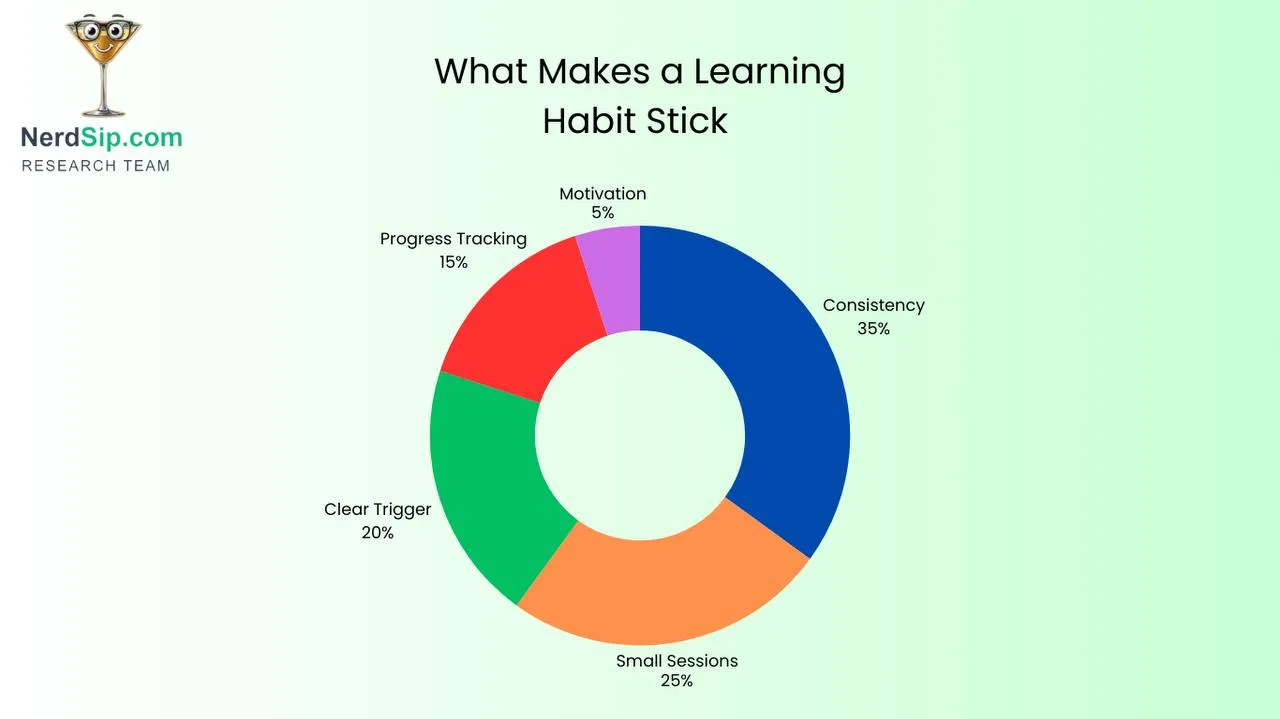
Days 1-30: Building the Foundation
Goal: Show up every single day, even if just for 2 minutes
What to do:
- Keep sessions short (5-10 minutes)
- Focus on consistency over intensity
- Track your streak obsessively
- Don't add more habits yet
- Celebrate small wins
What NOT to do:
- Increase duration before the habit is solid
- Skip days because "I'll do double tomorrow" (you won't)
- Add new learning topics
- Feel bad about short sessions
Expected feeling: Requires conscious effort. You have to remind yourself. Not automatic yet.
Days 31-60: It Starts Feeling Natural
Goal: Maintain consistency, gradually increase duration if desired
What to do:
- Continue daily practice
- Can increase to 10-15 minutes if it feels natural
- Start applying what you're learning
- Join a community (learning groups, subreddits, app social features)
What NOT to do:
- Get overconfident and skip days
- Add too many new topics
- Abandon the system that's working
Expected feeling: Less willpower needed. Starting to feel automatic. Some days are still a grind.
Days 61-90: The Habit Is Automatic
Goal: Maintain and optimize
What to do:
- Keep the daily practice going
- Adjust duration based on your capacity (10-30 minutes)
- Consider adding a second learning topic if first is solid
- Reflect on progress—you've learned more than you realize
Expected feeling: It feels weird NOT to do it. You've become "someone who learns daily."
Advanced Strategies (After You've Built the Baseline Habit)
Once you've mastered daily learning, level up with these:
Strategy 1: Time-Based Progression
Start at 5 minutes daily. Every 2 weeks, add 5 minutes.
- Weeks 1-2: 5 min/day
- Weeks 3-4: 10 min/day
- Weeks 5-6: 15 min/day
- Weeks 7-8: 20 min/day
- Weeks 9+: 20-30 min/day (sustainable long-term)
This gradual increase prevents burnout while building capacity.
Strategy 2: The Two-Topic System
After your first learning habit is solid (66+ days), you can add a second topic.
The schedule:
- Morning: Topic A (5-10 min)
- Evening: Topic B (5-10 min)
Both get daily practice but feel manageable because they're separated.
Example:
- Morning coffee: Spanish on Duolingo
- Evening wind-down: Business skills on NerdSip
Strategy 3: Learning Sprints
Most of the year: Maintain your baseline (10 min/day)
Occasional sprints: Go deeper for 30 days (30-60 min/day)
This creates variety while maintaining the core daily habit.
Strategy 4: Social Accountability
Studies show people with accountability partners have 65% higher success rates. Join subreddits, Discord study servers, or use the social feed in apps like NerdSip to stay on track.
The Best Apps for Building a Learning Habit (2026)
For Any Topic: NerdSip
NerdSip is the ideal choice because it removes the "what to learn" hurdle. AI generates 5-10 minute lessons on literally any topic, keeping you consistent with XP, streaks, and a focused daily feed.
For Languages: Duolingo
The gold standard for language streaks. Lessons are short, notifications are persistent, and progress feels tangible.
The Bottom Line: Systems Beat Motivation
The difference between people who learn new skills and people who stay stagnant isn't intelligence or talent. It's having a system that works even when motivation dies.
Build the system. Survive the first 66 days. Become someone who learns daily.
A daily learning habit is the engine behind becoming a more educated person. If that is the bigger goal, see our guide on how to become more educated.
Your future self will be unrecognizably more capable than you are today.
Start today. Two minutes. One topic. One app. Then tomorrow, do it again.
That's how learning habits get built.
Links you may find useful:
1. What Is Microlearning?
2. Why Can't I Focus When Studying?
3. 10 Study Techniques That Actually Work
Once the habit holds, the next question is which other app deserves a place beside it. We answered that in our list of the self-improvement apps that actually work.
Every NerdSip course clears a four-layer fact-checking pipeline before it reaches the app: grounded in live sources, scored nightly, gated on failure, and reviewable by a person at one tap. Articles on this blog are drafted with AI assistance, then researched, verified, and edited by our team.
Editorial responsibility: ai51 UG (haftungsbeschränkt). Responsible editor named in the imprint.
📚 Keep Learning
Explore the NerdSip learning hubs
The blog is our editorial layer. When you want to move from reading into doing, these hubs organize the rest of NerdSip by format, including the app itself and the press that has written about it.
Keep going: five-minute courses on this
Pick one and finish it before your coffee cools. Every lesson ends with a quick question, so it sticks instead of scrolling past.
Courses on this topic
4.7 stars from 380 reviews · 10,000+ learners