You sit down to study. You open the book. You read one paragraph.
Your phone buzzes. You check it. You put it down. You read the same paragraph again, because nothing from the first pass survived.
Twenty minutes later you look up from a video you never went looking for.
If you keep asking yourself why you can't focus when studying, here is the honest answer: you are not lazy and you are not broken. You are running an ordinary human attention system against software built by thousands of engineers whose entire job is to interrupt it. That is not a fair fight, and willpower does not make it fair.
Below is what the research actually shows, cause by cause, with the fix for each one.
The Short Answer
You can't focus when studying because of nine specific conditions, almost none of which are about character:
- Your phone is in the room, even switched off.
- You are task-switching and paying a cost you cannot feel.
- You are short on sleep and your brain is hiding it from you.
- Your session has no finish line.
- Your session is longer than your attention.
- Your study method is passive, so there is nothing for attention to grip.
- Your environment cues rest, not work.
- You are running on stress instead of fuel.
- The material has no meaning attached to it yet.
Notice what is missing from that list. Willpower. Discipline. Intelligence. None of them are the bottleneck, which is why trying harder has not worked.
Your Brain Is Competing With a Machine Built to Interrupt It
Gloria Mark, an informatics professor at UC Irvine, has been timing how long people stay on a single screen for close to twenty years. In 2004 the average was two and a half minutes. By 2012 it was 75 seconds. Her recent measurements, corroborated by five independent studies between 2014 and 2020, put it at roughly 47 seconds.
Her earlier work put a price tag on each of those switches. When an interruption pulls you off a task, it takes about 23 minutes to get all the way back to it.
If attention resets every 47 seconds and full recovery costs 23 minutes, a two-hour study session can contain almost no studying.
That is arithmetic, not metaphor. And the interruptions are not rare. A 2026 Reviews.org survey found Americans check their phones an average of 186 times a day, with roughly half of those pickups happening within three minutes of the last one. Those are not decisions. That is a reflex.
So the question is not why you can't focus. The question is how anyone does. The answer is that people who focus well have changed the conditions, not their character. Here are the conditions.
The 9 Real Reasons You Can't Focus When Studying
1. Your Phone Is in the Room, Even When You Never Touch It
This one is worse than it sounds. Adrian Ward and colleagues at UT Austin ran 548 undergraduates through working memory and fluid intelligence tests under three conditions: phone face down on the desk, phone in a bag or pocket, phone in another room. Every phone was silenced.
The other-room group performed best. The desk group performed worst. Nobody in the study checked their phone. The mere presence of the device consumed cognitive capacity, and the cost was largest for the people most attached to their phones.
The fix: another room. Not silent. Not face down. Not in a drawer within arm's reach. If moving it to another room feels genuinely uncomfortable, that discomfort is the measurement.
2. You Are Task-Switching and Cannot Feel the Cost
Multitasking is not a thing your brain does. What it does is switch, and every switch leaves a residue of the previous task behind. Organizational psychologist Sophie Leroy named this attention residue: part of your mind is still finishing the last thing while the new thing waits.
In a study by Sana, Weston and Cepeda, students who multitasked on a laptop during a lecture scored about 11 percent lower on a comprehension test. Students who merely sat in view of someone else's multitasking screen scored about 17 percent lower. The bystanders did worse than the multitaskers.
The fix: one document, one tab, one subject per block. Choose your seat so no screen but yours is in your field of view.
3. You Are Short on Sleep and Your Brain Is Hiding It
The nastiest finding in this whole area comes from Van Dongen and colleagues. They restricted participants to six hours of sleep a night for two weeks. Attention lapses climbed steadily the entire time, until the six-hour group matched people who had gone a full night without any sleep at all.
Here is the part that should worry you. Their self-reported sleepiness barely moved. They felt slightly tired and performed like they were impaired. Sleep debt removes your ability to notice sleep debt.
The fix: treat sleep as study time, because it is. If you are choosing between two more hours of reading and two more hours of sleep the night before an exam, sleep wins on the evidence.
4. Your Session Has No Finish Line
"Study biology tonight" is not a task. It has no end state, so your brain has no way to distinguish progress from drift. Anything that vague converts into open tabs and a vibe of productivity.
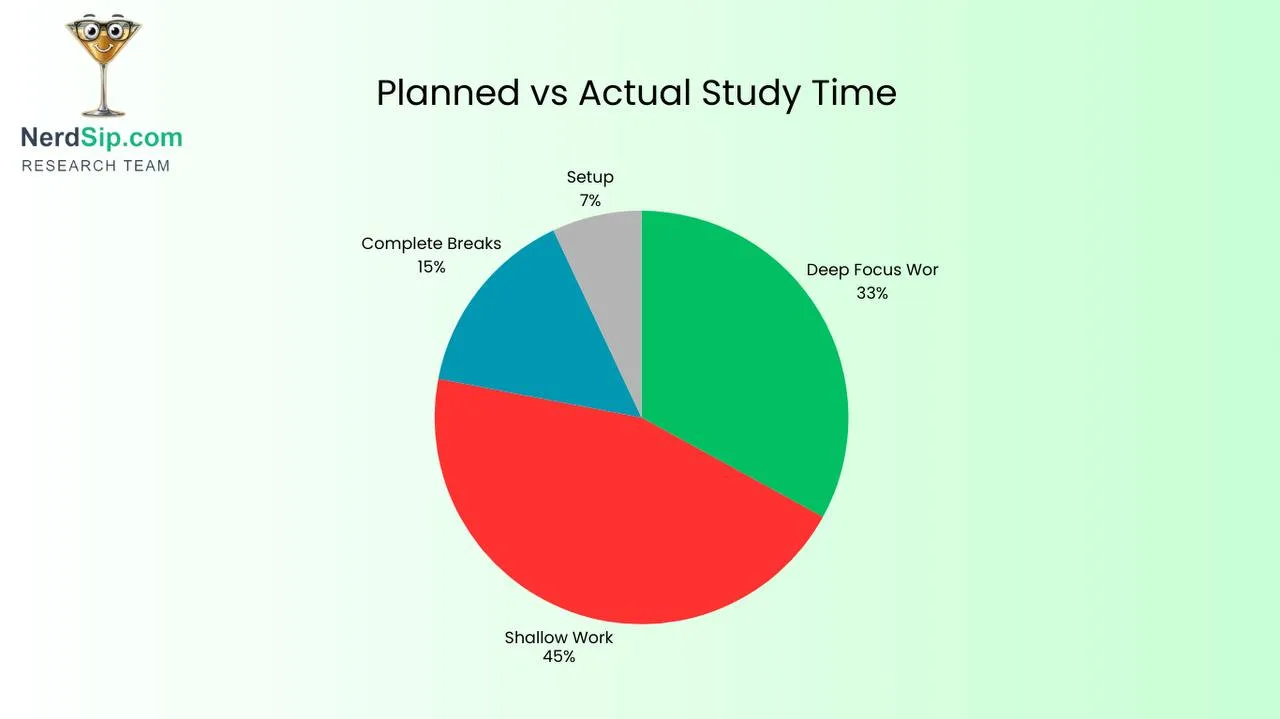
The fix: define the session by a finish condition, not a duration. "Answer the twelve end-of-chapter questions without notes." "Explain the Krebs cycle out loud from a blank page." You should know within a second whether you are done.
5. Your Session Is Longer Than Your Attention
Performance on any sustained task decays over time. Psychologists call it the vigilance decrement, and for decades the assumption was that attention is a fuel tank that empties.
Ariga and Lleras tested that. Eighty-four participants worked a 50-minute task. One group briefly switched to a second, unrelated goal twice during the session. That group held performance flat for the full 50 minutes. Every other group declined. The conclusion was not that attention runs out. It is that a goal held constant fades from awareness, and briefly dropping and resuming it restores the signal.
The fix: plan the break instead of collapsing into one. Work 45 minutes, break 10, and actually leave the chair. The Pomodoro technique is the 25-minute version of the same idea, and it works for the same reason. If you are not sure how long your attention actually holds, a free attention span test will show whether sustained attention or impulse control is the weak link.
6. Your Study Method Is Passive, So Attention Has Nothing to Grip
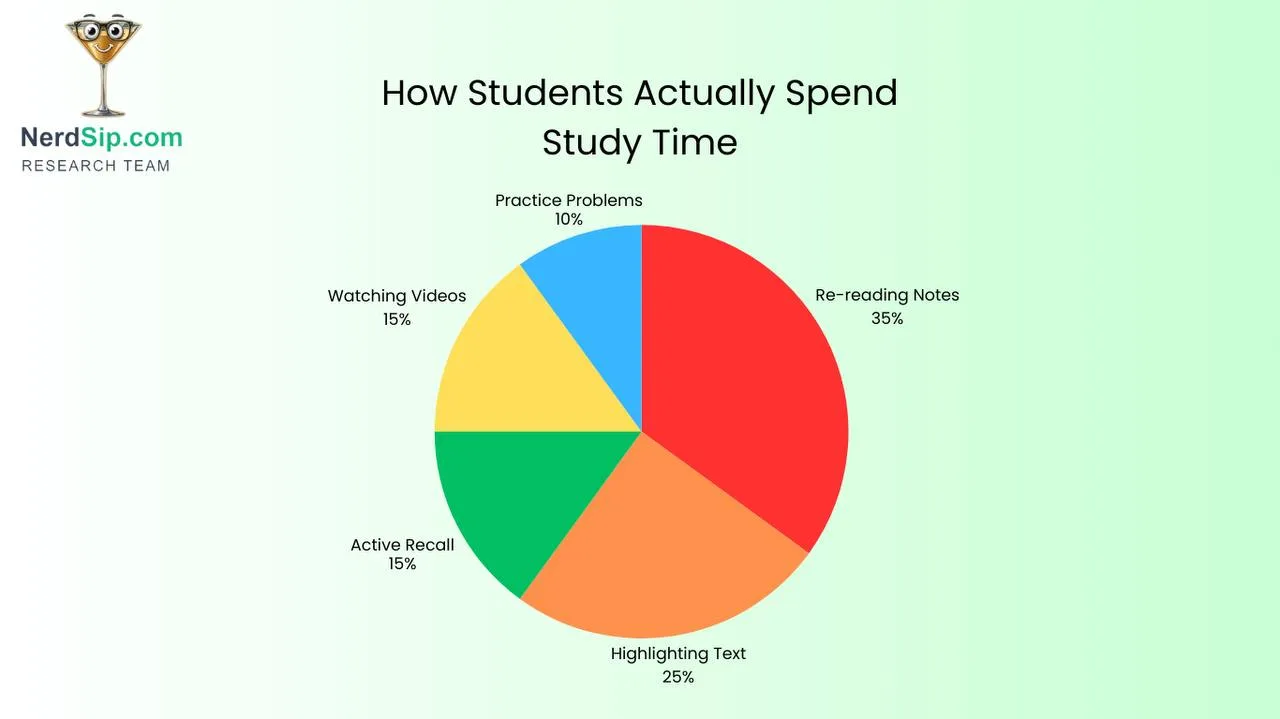
Rereading feels like studying. It is mostly reading.
In the landmark 2013 review by Dunlosky and colleagues, rereading and highlighting were both rated low utility. Only two techniques out of ten earned a high utility rating: practice testing and distributed practice. Passive methods create familiarity, and familiarity feels exactly like knowledge until the exam asks you to produce something.
Attention follows the same logic. Szpunar, Khan and Schacter interrupted a 21-minute online lecture with short memory tests. Students who were tested along the way were half as likely to report mind wandering, took three times as many notes, and remembered more afterward. The testing was not just measuring attention. It was creating it.
The fix: close the source every few minutes and write down what you remember. If you can hold a page open, you are not studying, you are reading. More on this in the study techniques that actually work.
7. Your Environment Cues Rest, Not Work
Your brain runs on context. A bed cues sleep. A kitchen table cues food and interruption. A sofa cues everything except deep work. Studying in those places means fighting the association every single time.
The fix: one place, used only for studying, with nothing on the surface but the current task. After a week or two the location itself starts doing part of the work of starting.
8. You Are Running on Stress Instead of Fuel
Acute stress floods the system with cortisol, which degrades exactly the prefrontal machinery you need for sustained attention. Skipped meals, blood sugar crashes and mild dehydration all pull in the same direction. You cannot force focus out of a nervous system that is bracing for something.
The fix: a ten-minute walk before you sit down, water within reach, and real food rather than a spike and crash from an energy drink. If the stress is about the studying itself, write down what you are actually afraid of before starting. Naming it takes five minutes and returns most of them.
9. The Material Has No Meaning Attached to It Yet
Attention is not neutral. It goes where importance is, and importance is not something you can order yourself to feel. Material that arrives as a disconnected list of facts will be treated as noise, no matter how much you need it.
The fix: before you start, spend sixty seconds answering one question. What does this let me do or explain that I could not before? Once the material has a job, the resistance drops. This is also why learning by curiosity sticks better than learning by obligation.
Why You Can Focus on Games for Six Hours but Not a Textbook
This is the question that makes people conclude something is wrong with them. It is the wrong conclusion, and the comparison is more useful than it looks.
A game gives you feedback in under a second, difficulty tuned to your current skill, an unambiguous goal, and visible progress. A textbook gives you feedback in three weeks, difficulty set by a committee, a goal like "understand chapter 6", and progress you cannot see at all.
Your attention is not defective. It is responding correctly to two very different task designs. Which means focus is partly an engineering problem, and you can engineer it.
- Shrink the goal until finishing is visible from where you are sitting.
- Add feedback by testing yourself every few minutes instead of at the end of the month.
- Make progress countable. Questions answered, cards cleared, pages produced. Not minutes elapsed.
- Match the difficulty. If you are lost, back up a level. Confusion looks identical to boredom from the inside, and both end in your phone.
That is the whole logic behind gamified learning, and it is why a five-minute lesson you finish beats a two-hour session you abandon.
The Fixes That Actually Work
The Phone Protocol
Two minutes of setup buys the whole session. Put the phone in another room. Tell yourself the exact moment you get it back, which is the end of the block, not the moment you feel like it. Set the timer on something that is not the phone. If your study material lives on a laptop, close every tab that is not the material and turn off notifications at the system level, not app by app.
The point is not discipline. The point is to make checking cost more effort than continuing.
The 45/10 Block
Forty-five minutes of one thing, ten minutes away from the desk. Stand up, walk, look at something further than two metres away. Do not spend the break on a screen, because a screen break is not a break from the thing that is fragmenting you.
Two of these blocks a day, done properly, will outperform six hours of the fragmented kind. If you need to stack many of them, structuring a long study day is its own skill.
The Recall Loop
Read for five to ten minutes. Close the source. Write or say everything you remember. Open it and check what you missed, then mark only the gaps. Repeat.
This is uncomfortable in a way rereading never is, and the discomfort is the mechanism. It also solves the attention problem as a side effect, because you cannot drift while retrieving. See how retention actually works for the full method.
The Reset When You Drift
Your attention will wander. Roughly every 47 seconds, if the research holds. The skill is not preventing it, it is shortening the round trip.
Notice it. Do not argue with yourself about it. Say the session goal out loud in one sentence. Put your finger or cursor on the exact spot you left. Continue. The whole thing takes eight seconds, and the eight seconds are what stop a drift from becoming a twenty-minute detour.
Fix the Inputs
Seven to nine hours of sleep, consistently. Protein before a long session rather than sugar. Water on the desk. Movement most days, because exercise improves attention for hours afterward. Caffeine early, not at 4pm, since it will still be measurably in your system at bedtime and cost you the sleep that costs you tomorrow's focus.
None of this is glamorous. All of it outperforms trying harder.
A Study Block That Holds: Six Steps
- Write the finish line. One sentence naming what will exist when the block ends.
- Remove the phone. Another room. Timer on something else.
- Clear the surface and the screen. Only the current task is visible.
- Work 45 minutes on that one thing. When you drift, run the eight-second reset.
- Spend the last five minutes retrieving. Close everything and write what you remember.
- Break for ten minutes, away from screens. Then start the next block or stop for the day.
If you want the underlying attention capacity to grow rather than just be managed, that is a separate project: building a longer attention span takes weeks, and this block is what you do in the meantime.
What Feels Like Studying vs What Holds Attention
| Feels productive | Actually works |
|---|---|
| Rereading the chapter | Closing the book and writing what you remember |
| Highlighting as you go | Turning each heading into a question you answer out loud |
| Phone face down on the desk | Phone in another room |
| A three-hour session | Three 45-minute blocks with real breaks |
| "Study biology tonight" | "Answer the twelve chapter questions without notes" |
| Music with lyrics | Silence, or something wordless |
| Studying in bed | One place used only for studying |
When It Is Not Your Study Habits
For most people, focus problems are conditions. Sometimes they are something else, and the difference matters because the fixes above will not touch the something else.
ADHD
The signal is not that you struggle to focus on studying. Almost everyone does. The signal is a lifelong pattern across unrelated areas: conversations, hobbies, work, admin, things you genuinely want to do. Add chronic disorganisation, impulsivity, time blindness, and a history that goes back to childhood rather than starting last semester.
ADHD is a neurodevelopmental condition with real treatment, not a synonym for distractible. If this describes you, a professional assessment is worth more than another productivity system. Meanwhile, studying with ADHD and the complete ADHD learning guide cover what actually helps.
Anxiety and Depression
Both impair concentration directly, and both are frequently mistaken for laziness by the person experiencing them. Persistent worry that intrudes on ordinary tasks, loss of interest in things you used to enjoy, feeling flattened most of the time, disrupted sleep or appetite. If several of those are present, the concentration problem is downstream and should be treated as such.
Burnout
The tell is a change rather than a baseline. You used to be able to do this, and now you cannot, and effort makes it worse rather than better. Exhaustion, cynicism about the work, a numb detachment, output falling while hours rise. Burnout responds to recovery, not to another optimisation. Adding a stricter study system to a burnt-out brain is the one intervention guaranteed to fail.
The Bottom Line
Your inability to focus is not a character flaw. It is a predictable response to a set of conditions, and every one of those conditions is adjustable.
The phone in another room is the single highest-leverage change, because it removes the source of most interruptions rather than asking you to resist them. After that: a finish line instead of a duration, blocks instead of marathons, retrieval instead of rereading, and enough sleep to make any of it possible.
You do not need more discipline than the people who study well. They are not out-willing you. They have arranged things so that less willpower is required.
Start with one change tonight. Put the phone in another room and set a 45-minute finish line. That single pair of moves will do more than the next five productivity articles you read.
When focus is working again, put it somewhere: the exam prep hub turns it into a plan, the Finding Focus in a Distracted World course rebuilds the habits in five-minute pieces, and studying effectively in a short time shows what to do when the exam is close.
References & Further Reading
- Mark, Gudith & Klocke (2008), The Cost of Interrupted Work: More Speed and Stress, CHI '08
- Mark (2023), Why Our Attention Spans Are Shrinking, American Psychological Association
- Ward, Duke, Gneezy & Bos (2017), Brain Drain: The Mere Presence of One's Own Smartphone Reduces Available Cognitive Capacity, Journal of the Association for Consumer Research
- Sana, Weston & Cepeda (2013), Laptop Multitasking Hinders Classroom Learning for Both Users and Nearby Peers, Computers & Education
- Van Dongen et al. (2003), The Cumulative Cost of Additional Wakefulness, SLEEP
- Ariga & Lleras (2011), Brief and Rare Mental Breaks Keep You Focused, Cognition
- Szpunar, Khan & Schacter (2013), Interpolated Memory Tests Reduce Mind Wandering and Improve Learning of Online Lectures, PNAS
- Dunlosky et al. (2013), Improving Students' Learning With Effective Learning Techniques, Psychological Science in the Public Interest
- Roediger & Karpicke (2006), Test-Enhanced Learning, Psychological Science
- Leroy (2009), Why Is It So Hard to Do My Work? The Challenge of Attention Residue, Organizational Behavior and Human Decision Processes
- Perham & Vizard (2010), Can Preference for Background Music Mediate the Irrelevant Sound Effect?, Applied Cognitive Psychology
Frequently Asked Questions
Why can't I focus when studying?
Almost always because of conditions rather than character. Your phone is in the room, you are task-switching, you are short on sleep, your session has no defined finish line, it runs longer than your attention can hold, and your method is passive. Average attention on a screen is now roughly 47 seconds, while recovering fully from an interruption takes about 23 minutes. Change those conditions and focus returns without any extra willpower.
Why can I focus on video games for hours but not on studying?
Because the two tasks are designed differently, not because your attention is broken. A game gives feedback in under a second, difficulty matched to your skill, an unambiguous goal and visible progress. A textbook gives feedback in three weeks, difficulty set by a committee, a vague goal and invisible progress. Shrink the goal, test yourself every few minutes, and count something concrete, and studying starts behaving more like the thing that holds you.
Does putting my phone in another room actually help?
Yes, and more than silencing it. Ward and colleagues tested 548 undergraduates with their phones face down on the desk, in a bag, or in another room, all silenced. The other-room group scored highest on working memory and fluid intelligence, the desk group lowest. Nobody checked their phone during the tests. Presence alone consumed capacity, so distance is doing the work, not self-control.
How long should a study session be?
Between 25 and 50 minutes of single-task work, then a real break away from screens. Ariga and Lleras found that participants who briefly disengaged and re-engaged with their goal twice during a 50-minute task held performance flat, while every other group declined. The break is not a reward for focusing. It is part of the mechanism that keeps focus available.
Why does my mind wander when I read?
Because reading is passive, and passive input gives attention nothing to hold on to. Szpunar, Khan and Schacter interrupted a 21-minute lecture with brief memory tests and found students were half as likely to mind wander and took three times as many notes. Close the source every few minutes and retrieve what you remember. Mind wandering drops because retrieval is impossible to do absently.
How do I get back on track after losing focus?
Use an eight-second reset instead of a self-criticism spiral. Notice the drift without arguing with yourself, say your session goal out loud in one sentence, put your cursor or finger on the exact place you left, and continue. Drifting is normal and frequent. The skill is shortening the round trip, not preventing the drift.
Is my lack of focus a sign of ADHD?
Not on its own. Struggling to focus on studying is close to universal. The ADHD signal is a lifelong pattern across unrelated areas, including things you genuinely want to do, alongside chronic disorganisation, impulsivity and time blindness, going back to childhood rather than to last semester. If that describes you, a professional assessment is worth more than another study system. Anxiety, depression and burnout also impair concentration and are frequently mistaken for laziness.
Does music help you focus while studying?
Usually not for anything involving words or order. Perham and Vizard found that background music impaired serial recall whether or not participants liked the music, and quiet outperformed both. Lyrics are the worst case because language competes directly with the language processing your reading needs. If silence is unbearable, use something wordless and steady, and treat it as masking noise rather than as a focus aid.
Why do I lose focus after 10 minutes of studying?
Usually a stack of three things: a session with no clear finish line, a passive method like rereading, and a phone within reach. Ten minutes is roughly how long vague work survives before it stops feeling like progress. Give the block a concrete end state, switch to recall instead of rereading, and remove the device. If it still collapses at ten minutes with all three fixed, look at sleep before looking at discipline.
Every NerdSip course clears a four-layer fact-checking pipeline before it reaches the app: grounded in live sources, scored nightly, gated on failure, and reviewable by a person at one tap. Articles on this blog are drafted with AI assistance, then researched, verified, and edited by our team.
Editorial responsibility: ai51 UG (haftungsbeschränkt). Responsible editor named in the imprint.
📚 Keep Learning
- How to Learn with ADHD When You Can't Focus
- Pomodoro Technique Explained: The 25-Minute Method That Boosts Focus by 25% (2026 Guide)
- How to Improve Attention Span: 10 Fixes That Work
- 10 Study Techniques That Actually Work (2026 Guide)
- How to Study Effectively for Exams in a Short Time (2026 Cram Plan)
Explore the NerdSip learning hubs
The blog is our editorial layer. When you want to move from reading into doing, these hubs organize the rest of NerdSip by format, including the app itself and the press that has written about it.
Focus Is Easier When the Session Is Five Minutes
NerdSip turns any topic into short lessons with instant feedback, so finishing is always in sight. Five minutes a day, on the phone that used to be the problem.
Courses on this topic
4.7 stars from 380 reviews · 10,000+ learners