Microlearning is replacing long-form training because long courses are finished by almost nobody. The largest study of the format, covering 12.67 million course registrations, found a 3.13 percent completion rate. Short lessons win on completion, on spacing, and on how fast content can be updated. They do not win on everything, and a large share of the microlearning statistics circulating in 2026 cannot be traced to any study at all.
Is Microlearning Actually Better Than Long-Form Training?
For most workplace and self-directed learning in 2026, yes. Not because short content is inherently better content, but because of three things that are hard to argue with.
- People finish it. The completion problem is the whole ballgame. A brilliant 40 hour course that 96 percent of learners abandon teaches less than a mediocre 5 minute lesson they actually complete.
- It spreads learning across days. Spacing is one of the two most reliable findings in the study of memory, and short daily lessons produce it without anyone planning it.
- It can be changed. When a policy, a tool, or a market shifts, you rewrite one module instead of rebuilding a curriculum.
Where microlearning loses is in depth. Complex reasoning, sustained problem solving, and skills that need supervised practice do not compress into five minute cards, and pretending otherwise is how organizations end up with a library of clips and a workforce that still cannot do the job. The section on where long-form still wins covers that honestly.
Duolingo built one of the largest microlearning systems on earth, and its founder Luis von Ahn is unusually candid about what makes short lessons work, which is less about brevity than about what pulls people back tomorrow:
What Does the Research Actually Show?
Two peer-reviewed syntheses published recently give the clearest picture available, and both are more modest than the marketing around them.
Senandheera and colleagues published a systematic review and meta-analysis in the Journal of Multidisciplinary and Translational Research in 2024. Pooling five controlled studies in higher education, they compared 344 students taught with microlearning against 310 taught with conventional longer formats. The microlearning groups scored 12.6 points higher on post-test theory exams, with a 95 percent confidence interval of 1.2 to 23.9 and a p value of 0.03.
Read that interval carefully, because it is the honest part. The effect is real and statistically significant. It is also imprecisely measured. The true advantage could be a rounding error or it could be enormous, and five studies is a thin base to stand on.
The second synthesis is broader. Monib, Qazi and Apong reviewed 40 studies published between 2020 and 2024 in Heliyon, following PRISMA methodology. Their conclusion was that microlearning produces gains across all three domains of Bloom's taxonomy, cognitive, behavioral and affective, and that the mechanism is not novelty. It is the spacing effect, cognitive load theory and retrieval practice, three principles that were well established long before anyone coined the word microlearning.
That last point matters more than any percentage. Microlearning does not introduce a new way for humans to learn. It packages three old ones into a format people will actually use.
Which Microlearning Statistics Are Real, and Which Are Recycled?
Search for microlearning statistics and you will find the same handful of numbers repeated across hundreds of vendor blogs, each citing the last. Some are solid. Several collapse the moment you look for the paper behind them. Here is where the common ones actually come from.
| Claim | Where it traces to | Verdict |
|---|---|---|
| Only 3 to 15 percent finish online courses | Reich and Ruipérez-Valiente, Science, 2019. 565 MIT and Harvard courses, 12.67 million registrations | Solid. Measured at 3.13 percent in 2017 to 2018 |
| Spaced practice beats cramming | Cepeda et al., Psychological Bulletin, 2006. 254 studies, over 14,000 participants | Solid. One of the best evidenced findings in the field |
| Testing yourself beats rereading | Roediger and Karpicke, Psychological Science, 2006 | Solid. 61 percent recall versus 40 percent after a week |
| You forget half of what you learn within an hour | Ebbinghaus, 1885, replicated by Murre and Dros, PLOS ONE, 2015 | Real, often overstated. Measured on nonsense syllables, not meaningful material |
| Microlearning makes transfer 17 percent more efficient, per the Journal of Applied Psychology | Nowhere we can find. No authors, no volume, no year. Different sources attribute it to different origins | Untraceable. Treat as folklore |
| Human attention span has fallen to 8 seconds, below a goldfish | A defunct statistics aggregator with no underlying study | Debunked. Use Gloria Mark's measured data instead |
| Microlearning courses hit 80 to 90 percent completion | Vendor reports and platform self-reporting, no independent verification | Directionally right, unaudited. Real gains exist, the exact figure does not |
Why we are telling you which of our own supporting stats are weak
Because the alternative is what the rest of the industry does. The 17 percent figure has been cited thousands of times, always to the same journal, never to a paper. If a claim helps our case and we cannot source it, saying so is cheaper than being caught. The case for microlearning survives without the folklore.
Why Do Long Courses Fail?
The failure is not one thing. It is four, and they compound.
Almost nobody finishes
The definitive numbers come from Reich and Ruipérez-Valiente's 2019 analysis in Science, which tracked 565 MIT and Harvard courses on edX across six and a half years and 12.67 million registrations. Completion sat at 3.13 percent in 2017 to 2018, down from roughly 6 percent in 2014 to 2015. It was getting worse, not better, over the period when the platforms were actively trying to fix it.
Two details from that study deserve more attention than they get. First, 52 percent of people who registered never opened a single piece of content. Second, even among learners who paid for a verified certificate, the strongest signal of intent available, completion was 46 percent. Half of the people who put money down still walked away.
The format exceeds working memory
A 90 minute module introduces dozens of new concepts. Nathan Cowan's 2001 review put the capacity of working memory at roughly four chunks of new information at a time, revising George Miller's more famous seven plus or minus two downward. Everything beyond that capacity is not learned slowly. It is discarded.
John Sweller's cognitive load theory names the consequence: when the material exceeds what working memory can hold, the effort goes into managing the overload rather than building understanding. Learners emerge from long sessions feeling exhausted and informed, which is the specific feeling that precedes remembering nothing.
The knowledge arrives at the wrong time
Long courses front-load. You learn the entire body of material now and apply some fraction of it at an unspecified point later. By the time a situation calls for lesson 37, lessons 1 through 36 have decayed and lesson 37 is a vague memory of a slide.
Short lessons invert the order. You learn one thing and use it this week, which is the condition under which memory decides something is worth keeping.
It costs the working day
A two hour session for twenty people costs forty person-hours before anyone measures whether it worked. That cost is visible and painful, which is why training budgets get cut first in a downturn. Five minute lessons delivered inside the workflow do not require anyone to stop working, so they survive the budget conversation.
Why Microlearning Works: Three Mechanisms
Strip away the marketing and short-form learning works for three specific reasons, each with decades of evidence behind it.
1. It respects the capacity limit
One lesson, one concept. Working memory processes it without competing demands, which is the condition for material moving into long-term storage. This is not a claim about attention spans or modern life. It is a structural feature of how memory encodes.
2. It creates spacing by default
A daily five minute lesson produces distributed practice without a study plan. Cepeda and colleagues synthesized 254 studies covering more than 14,000 participants and found spaced practice beat massed practice on final recall, roughly 47 percent against 37 percent, at identical total study time. Same content, same minutes, different arrangement, and the arrangement is worth ten percentage points.
Long courses do the opposite. They compress study into blocks, which is the arrangement the research has consistently rated worst.
3. It forces retrieval
Well-built short lessons end by making you produce the answer rather than recognize it. In Roediger and Karpicke's 2006 experiment, students who tested themselves recalled about 61 percent of a passage a week later, against about 40 percent for students who reread it. Immediately after studying, the rereaders looked better. A week out, they had lost most of it.
Dunlosky's 2013 review for Psychological Science in the Public Interest graded ten common study techniques. Practice testing and distributed practice were the only two rated high utility. Rereading and highlighting, the two things long courses implicitly encourage, landed in the low utility bracket.
Microlearning vs Long-Form Training: Side by Side
Most comparison tables on this topic invent precision. This one marks how much confidence each row deserves.
| Dimension | Long-form training | Microlearning | Evidence |
|---|---|---|---|
| Completion | 3 percent on open platforms, higher when mandated | Substantially higher, exact figures vendor-reported | Strong for the first, weak for the second |
| Retention | Weakened by massed delivery | Strengthened by spacing and retrieval | Strong. Cepeda 2006, Roediger 2006 |
| Exam performance | Baseline | 12.6 points higher, wide interval | Moderate. One 2024 meta-analysis, five studies |
| Time to first use | Weeks, after the course ends | Same day | Structural, not measured |
| Update speed | Full rebuild | One module | Structural |
| Depth of reasoning | Better suited | Weak without a curriculum around it | Consensus, thin direct evidence |
| Supervised practice | Better suited | Not a substitute | Consensus |
| Cost per learner | Higher, mostly delivery time | Lower after build | Vendor-reported, treat with care |
Where Long-Form Training Still Wins
Microlearning has a genuine failure mode, and it is not the one critics usually name. The problem is not that lessons are too short. It is that a pile of short lessons has no structure, and structure is what turns facts into competence.
Long-form still holds four territories.
- Theory that only makes sense whole. Statistical inference, legal reasoning and systems architecture have concepts that depend on each other. Split them into cards and each card is true and useless.
- Sustained problem solving. Some skills require sitting with a hard problem for two hours. The discomfort of not knowing yet is the training. A five minute lesson cannot manufacture it.
- Supervised practice with feedback. Surgery, aviation, therapy, negotiation. An expert watching you fail in real time is not replaceable by content of any length.
- Cohorts and relationships. Leadership programs work partly because of who is in the room. Asynchronous cards do not build a peer network.
The strongest programs in 2026 are not choosing. They use long-form for the load-bearing conceptual work, then run microlearning underneath it for reinforcement, spacing and just-in-time reference. Microlearning is not the replacement for the curriculum. It is the thing that stops the curriculum from evaporating.
How Do You Convert a Long Course Into Microlearning?
Six steps. The first two are where most conversions go wrong.
Step 1: Audit what is actually failing
Pull completion data on your existing courses. Find the ones with high drop-off, content that goes stale fast, or material employees need mid-task rather than in advance. Those convert well. A certification program with a regulatory exam at the end does not.
Step 2: Rebuild around single concepts, do not slice
Cutting a two hour recording into four thirty minute clips produces four bad lessons. Start from the outcome instead: what should someone be able to do after this lesson that they could not do before? If the answer needs the word "and," the lesson is still too broad.
Step 3: Design for a phone and a five minute gap
Assume the learner is standing up, between two other things, on a screen the size of a hand. That constraint kills dense slides and rewards one clear idea with one clear example. If it needs a desk, it is not microlearning.
Step 4: Schedule the reviews before you launch
This is the step almost everyone skips, and it is the one carrying most of the benefit. Plan the return visits: one day, three days, one week, one month. Without them you have short content, not distributed practice, and short content on its own is just a faster way to forget.
Step 5: End every lesson with retrieval
Not a satisfaction survey. A question the learner has to answer from memory, before any answer is shown. Recognition feels like knowledge and is not, which is exactly what a well-placed question exposes.
Step 6: Measure application, not completion
Completion rate tells you the format is tolerable. It says nothing about whether anyone can do the job better. Track how many learners applied the material within a week, how error rates moved, how fast new hires reach proficiency. Those numbers survive a budget review. Attendance does not.
📘 Two short courses that demonstrate the format
Mastering NerdSip: Under the Hood of AI Microlearning walks through how short lessons are structured and sequenced, using the mechanics described above.
Supercharge Your Brain: Learn Faster covers the underlying learning science in three lessons, short enough to finish in one sitting.
What Mistakes Kill Microlearning Programs?
Five failure patterns account for most of the programs that quietly get abandoned.
Chopping instead of rebuilding. Shorter lectures are still lectures. The format change has to come with a design change or nothing improves.
A library with no path. Two hundred unconnected modules is a search problem, not a curriculum. Learners need to know what comes next and why.
No spacing. One-and-done lessons produce one-and-done knowledge. If nothing brings the learner back, the forgetting curve does its usual work.
Passive content. Watching a clip is closer to rereading than to studying, and rereading is the technique the research rates lowest. Every lesson needs a moment where the learner produces something.
Using it for everything. Compressing material that genuinely needs depth into cards produces confident learners who cannot perform. Match the format to the work.
How Does NerdSip Fit In?
NerdSip generates a short course on whatever you want to learn, then handles the spacing so you do not have to.
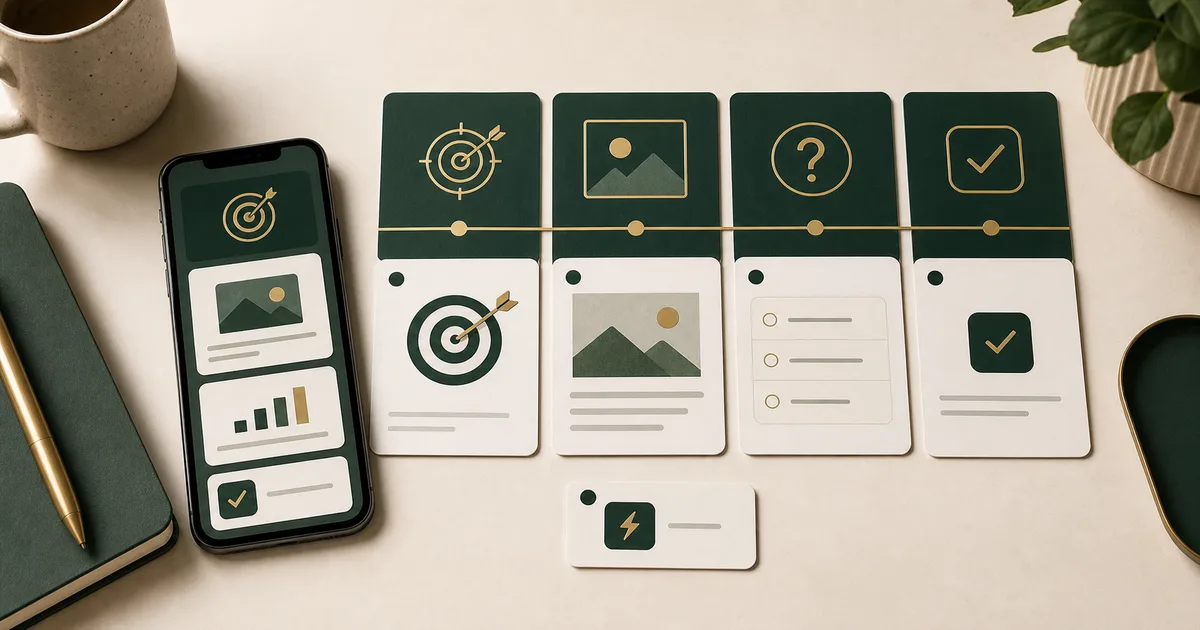
You name a topic and get a structured set of short lessons rather than a search results page. The Repetition tab then looks at everything you finished in the last 30 days and builds a review session out of it, called a Memory Mix. Each mix opens with a recall prompt before showing any answer, because retrieval is the part that builds the memory, then moves through the key idea, a connection to something else you learned, a quick check, and one thing to apply. Material used in a mix is held back for a week, so the gap does its work instead of being closed too early.
The honest version
NerdSip schedules review sessions. It does not grade individual cards the way a dedicated flashcard tool does, and it is not built to replace a compliance curriculum or a certification track. If you want per-card intervals tuned by the day, use a flashcard app and maintain the deck. If you want short lessons on any topic with the spacing handled for you, that is the trade NerdSip makes.
What Happens Next
The interesting shift in 2026 is not that lessons got shorter. It is that generating them stopped being expensive. When a tailored lesson costs almost nothing to produce, the economics that made one-size-fits-all courses rational disappear, and the constraint moves from production to judgment. Someone still has to decide what is worth learning.
Three changes look likely from here. Learning paths assembled per person rather than per role. Delivery triggered by the moment of need, when a tool changes or an error repeats, rather than by a calendar. And a growing gap between organizations measuring application and those still counting completions, because only one of those numbers survives contact with a CFO.
None of that changes the underlying mechanics. Spacing, retrieval and respecting the capacity limit of working memory were true before microlearning had a name, and they will outlast whatever the format is called next.
References & Further Reading
- Reich, J. & Ruipérez-Valiente, J. A. (2019). The MOOC Pivot. Science, 363(6423)
- Senandheera, V. V. et al. (2024). Impact of Microlearning on Academic Performance of Students in Higher Education: A Systematic Review and Meta-Analysis. Journal of Multidisciplinary & Translational Research, 9(1)
- Monib, W. K., Qazi, A. & Apong, R. A. (2024). Microlearning Beyond Boundaries: A Systematic Review and a Novel Framework for Improving Learning Outcomes. Heliyon
- Cepeda, N. J. et al. (2006). Distributed Practice in Verbal Recall Tasks: A Review and Quantitative Synthesis. Psychological Bulletin
- Roediger, H. L. & Karpicke, J. D. (2006). Test-Enhanced Learning. Psychological Science
- Dunlosky, J. et al. (2013). Improving Students' Learning With Effective Learning Techniques. Psychological Science in the Public Interest
- Murre, J. M. J. & Dros, J. (2015). Replication and Analysis of Ebbinghaus' Forgetting Curve. PLOS ONE
- Cowan, N. (2001). The Magical Number 4 in Short-Term Memory. Behavioral and Brain Sciences
- Mark, G. (2023). Attention Span. University of California, Irvine
Frequently Asked Questions
Is microlearning better than traditional training?
For most workplace and self-directed learning, yes, mainly because people finish it. The largest study of open online courses measured 3.13% completion across 12.67 million registrations. A 2024 meta-analysis in the Journal of Multidisciplinary and Translational Research found microlearning groups scored 12.6 points higher on post-test exams than conventional formats, though the confidence interval was wide. Long-form training still wins for deep theory, sustained problem solving, and skills that need supervised practice.
How long should a microlearning lesson be?
Three to seven minutes, covering exactly one concept. The duration matters less than the constraint it enforces: if a lesson needs the word "and" to describe its outcome, it covers two things and should be split. Design for a phone screen and a gap between two other tasks, not for a desk.
What is the completion rate for online courses?
About 3%. Reich and Ruipérez-Valiente analysed 565 MIT and Harvard courses on edX across six and a half years in a 2019 Science paper and found completion fell to 3.13% in 2017 to 2018, down from roughly 6% in 2014 to 2015. Two details are often missed: 52% of registrants never opened any content, and even among learners who paid for a verified certificate, only 46% finished.
Does microlearning actually improve retention?
Yes, but through mechanisms that predate it. Short lessons spread across days produce spaced practice, which Cepeda and colleagues found beat cramming on final recall in a synthesis of 254 studies, roughly 47% against 37% at identical study time. Well-built lessons also end in retrieval, which Roediger and Karpicke showed produced 61% recall after a week against 40% for rereading. Microlearning packages old findings into a format people use.
Is the 17% microlearning statistic from the Journal of Applied Psychology real?
We could not trace it. The claim that microlearning makes knowledge transfer 17% more efficient is cited across hundreds of pages, almost always to the Journal of Applied Psychology, but without authors, volume, year, or title. Some sources attribute the figure to a consultancy instead. Treat it as folklore. The evidenced case for microlearning does not depend on it.
When should you not use microlearning?
Four cases. Theory whose concepts only make sense together, such as statistical inference or legal reasoning. Skills built by sitting with a hard problem for hours. Anything requiring supervised practice with expert feedback, like surgery or negotiation. And cohort programs where the value comes from who is in the room. Strong programs use long-form for the load-bearing work and microlearning underneath it for reinforcement.
How do you convert a long course into microlearning?
Do not slice the recording. Start from outcomes: what should someone be able to do after this lesson that they could not do before. Rebuild each answer as a single-concept lesson designed for a phone, schedule the reviews at one day, three days, one week, and one month before launch, end every lesson with a question answered from memory, and measure application rather than completion.
Is microlearning just short videos?
No, and treating it that way is the most common reason programs fail. Watching a clip is closer to rereading than to studying, and rereading was rated low utility in Dunlosky's 2013 review of study techniques. Microlearning only works when each lesson ends with the learner producing something from memory rather than recognising it on a screen.
Every NerdSip course clears a four-layer fact-checking pipeline before it reaches the app: grounded in live sources, scored nightly, gated on failure, and reviewable by a person at one tap. Articles on this blog are drafted with AI assistance, then researched, verified, and edited by our team.
Editorial responsibility: ai51 UG (haftungsbeschränkt). Responsible editor named in the imprint.
📚 Keep Learning
Explore the NerdSip learning hubs
The blog is our editorial layer. When you want to move from reading into doing, these hubs organize the rest of NerdSip by format, including the app itself and the press that has written about it.
Short Lessons, Spacing Handled
NerdSip turns any topic into short lessons, then builds your review sessions automatically from what you finished in the last 30 days. Five minutes a day, and the forgetting curve works for you instead of against you.
4.7 stars from 380 reviews · 10,000+ learners