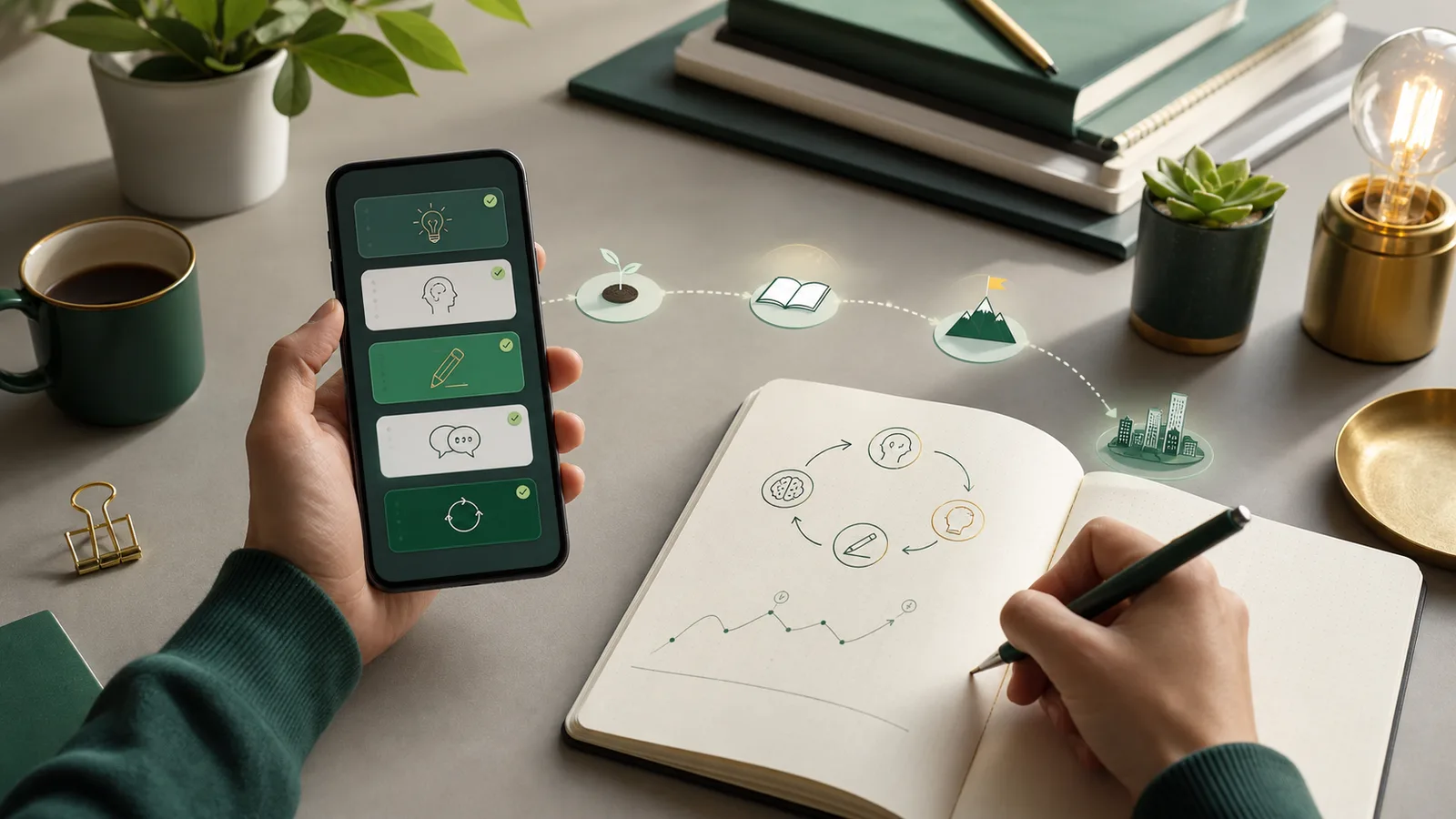
The best method to learn new skills is not a secret technique. It is a loop: learn, recall, practice, get feedback, repeat. The reason most people do not use it is that passive learning feels smoother. Watching a video feels productive. Highlighting feels productive. Saving a course feels productive. But a skill only becomes real when you can use it without the lesson open.
If you want to learn communication, coding, leadership, languages, design, sales, writing, or any other practical skill, the loop matters more than the platform.
Step 1: Learn One Small Piece
Start smaller than feels satisfying. Do not try to learn negotiation. Learn one way to ask for constraints. Do not try to learn Python. Learn one loop pattern. Do not try to become socially confident. Learn one better follow-up question.
Small pieces work because your brain can hold them while you practice. A giant lesson often gives you more information than you can turn into behavior.
Step 2: Recall Before You Rewatch
Active recall means pulling information from memory instead of looking at it again. It feels harder than rereading because it is doing the actual work. After a lesson, close it and ask: what was the idea, why does it matter, and when would I use it?
If you cannot answer, good. You found the weak spot. Look again, then recall again. This is how knowledge becomes retrievable.
Step 3: Practice in the Smallest Real Context
A skill needs a rep. The rep should be real enough to matter and small enough to do today. For communication, rewrite one update. For coding, solve one tiny problem. For language learning, say five sentences out loud. For social skills, ask one follow-up question. For leadership, clarify one next step.
Practice changes the learning from something you recognize into something you can perform.
Step 4: Get Feedback
Feedback does not always require a coach. Sometimes the system gives feedback: the code runs or it does not, the listener understood or they did not, the message got a clear reply or created confusion. Sometimes you can ask a person: was this clear, what would make it stronger, what did I miss?
The point is to compare intention with result. Without feedback, you can practice the wrong thing with great consistency.
Step 5: Repeat After a Delay
Spaced repetition is not only for flashcards. Skills benefit from spacing too. Practice today, then again tomorrow, then later in the week. The delay forces retrieval. It also shows whether the skill survives outside the mood of the lesson.
This is why five minutes a day can beat one long session per month. Daily repetition keeps the skill alive long enough to compound.
The Method in Real Examples
Communication: learn the fact-interpretation-recommendation structure. Recall it without looking. Use it in one work update. See whether your manager responds faster or asks fewer clarifying questions. Repeat next week.
Social confidence: learn one small-story question. Recall it before a coffee chat. Ask it once. Notice whether the answer opens more conversation. Try a variation tomorrow.
Coding: learn one concept. Write it from memory. Break it. Fix it. Build one tiny thing with it. Return to it after a day.
Leadership: learn how to close a meeting with owner, next step, and deadline. Recall the three parts. Use them in one meeting. Watch whether follow-through improves.
Why Apps Help, and Where They Do Not
Good learning apps reduce friction. They put the next lesson in your hand, quiz you, remind you to return, and make progress visible. That is valuable because consistency is the hardest part for most learners.
But no app can do the practice for you. The best apps to learn new skills are the ones that push you toward output: quizzes, projects, speaking, writing, solving, or real-world prompts. If an app only lets you consume, use it carefully.
The One-Week Skill Sprint
Pick one skill and one tiny outcome. For seven days, spend five minutes learning and five minutes practicing. Keep the same skill all week. At the end, write what changed. Did you communicate faster? Remember more? Start conversations more easily? Build a small artifact?
This short sprint teaches the real lesson: progress comes from closing the loop. Learn a little. Recall it. Use it. Check the result. Repeat. Simple, unglamorous, and brutally effective.
Frequently Asked Questions
What is the best method to learn new skills?
Use a loop: learn a small concept, recall it without looking, practice it in a real task, get feedback, and repeat over time. The loop matters more than the length of the lesson.
Why is passive watching bad for skill learning?
Passive watching creates familiarity, which can feel like learning. Skills require retrieval and use. You need to produce, solve, speak, write, build, or decide.
Can microlearning work for real skills?
Yes, when each micro lesson leads to an active rep. Microlearning is best as the trigger for practice, not as a replacement for practice.
Every NerdSip course clears a four-layer fact-checking pipeline before it reaches the app: grounded in live sources, scored nightly, gated on failure, and reviewable by a person at one tap. Articles on this blog are drafted with AI assistance, then researched, verified, and edited by our team.
Editorial responsibility: ai51 UG (haftungsbeschränkt). Responsible editor named in the imprint.
📚 Keep Learning
Explore the NerdSip learning hubs
The blog is our editorial layer. When you want to move from reading into doing, these hubs organize the rest of NerdSip by format, including the app itself and the press that has written about it.
Use the Skill Loop Daily
NerdSip helps you learn in short sessions, test yourself, collect XP, and turn curiosity into a repeatable habit.
4.7 stars from 380 reviews · 10,000+ learners