Quick answer
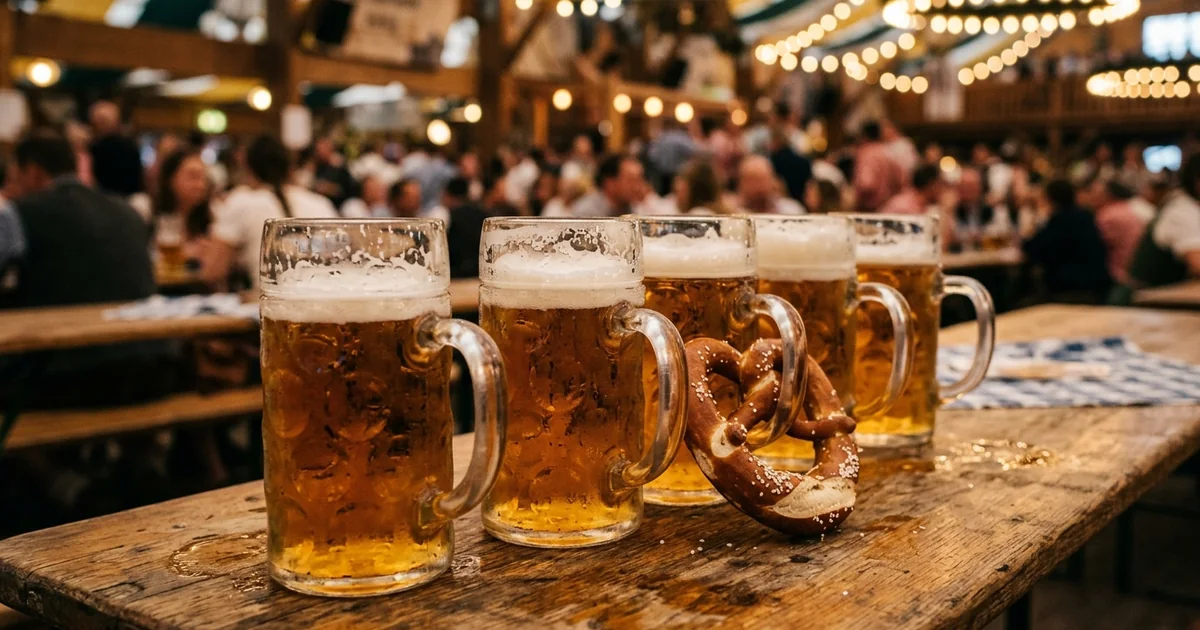
Oktoberfest 2026 is the 191st edition, held from 19 September to 4 October on the Theresienwiese in Munich. It began on 12 October 1810 as the public celebration of Crown Prince Ludwig's wedding to Princess Therese, and the horse race that closed the party was repeated the next year, which turned a wedding into an institution. Only six Munich breweries may pour beer there, a litre costs between €14.80 and €15.90 in 2026, and the festival opens only when the mayor taps the first keg and shouts O'zapft is!
Oktoberfest 2026 dates, times and prices
When is Oktoberfest 2026?
Saturday 19 September to Sunday 4 October 2026, on the Theresienwiese in Munich, Germany. The dates are confirmed by the city.
How long does Oktoberfest last?
Sixteen days in 2026. The length changes from year to year because the festival ends on the first Sunday in October, and is extended to 3 October when that Sunday falls earlier, so some years run 17 or 18 days.
What time does it start?
Noon on the opening Saturday. No beer is poured anywhere on the grounds until the Mayor of Munich taps the first keg in the Schottenhamel tent and says O'zapft is.
How much does a beer cost in 2026?
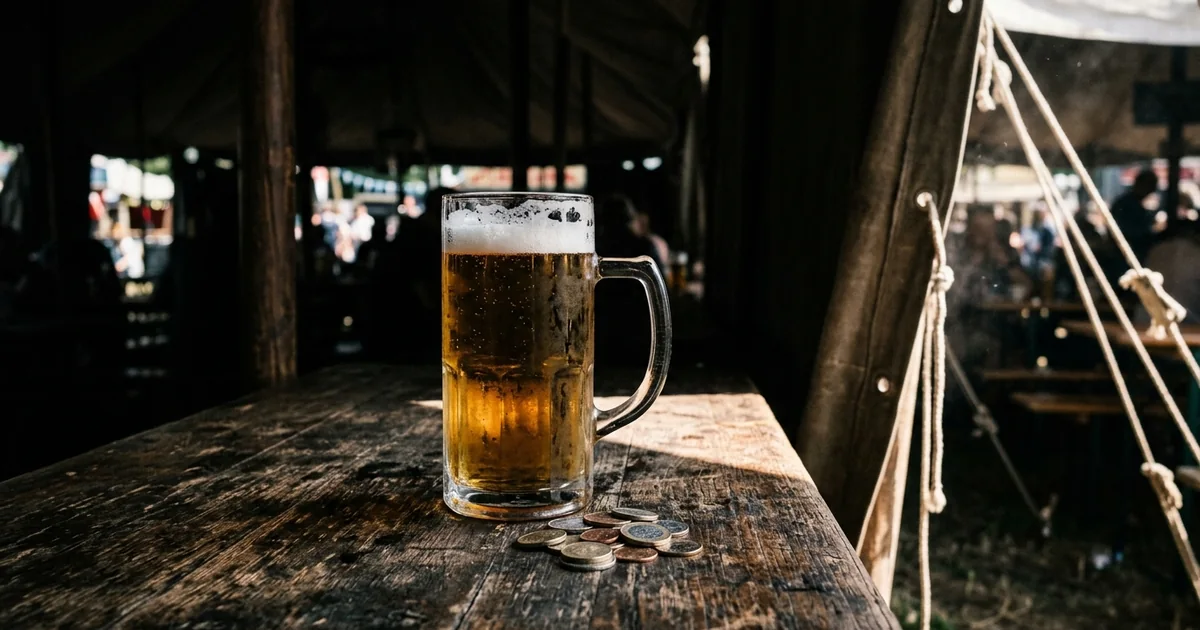
Between €14.80 and €15.90 for a Maß, one full litre, depending on the tent. That is around 2.4 percent up on 2025. Soft drinks are also sold by the litre.
Which Oktoberfest is this?
The 191st. The first was in 1810, but the number is lower than the years elapsed because the festival has been cancelled roughly two dozen times, for cholera, war and hyperinflation.
What is different about 2026?
German Unity Day falls on Saturday 3 October, the second-to-last day. A national holiday landing on the closing weekend makes those final days the busiest of the whole run.
Everything below goes deeper: the walkable gallery of 216 years, why a festival called October happens in September, the six-brewery rule, and the closing numbers.
Walk through 216 years of Oktoberfest
Read the whole gallery as text
1810 · The wedding that never ended
12 October 1810. Crown Prince Ludwig marries Therese of Saxe-Hildburghausen.
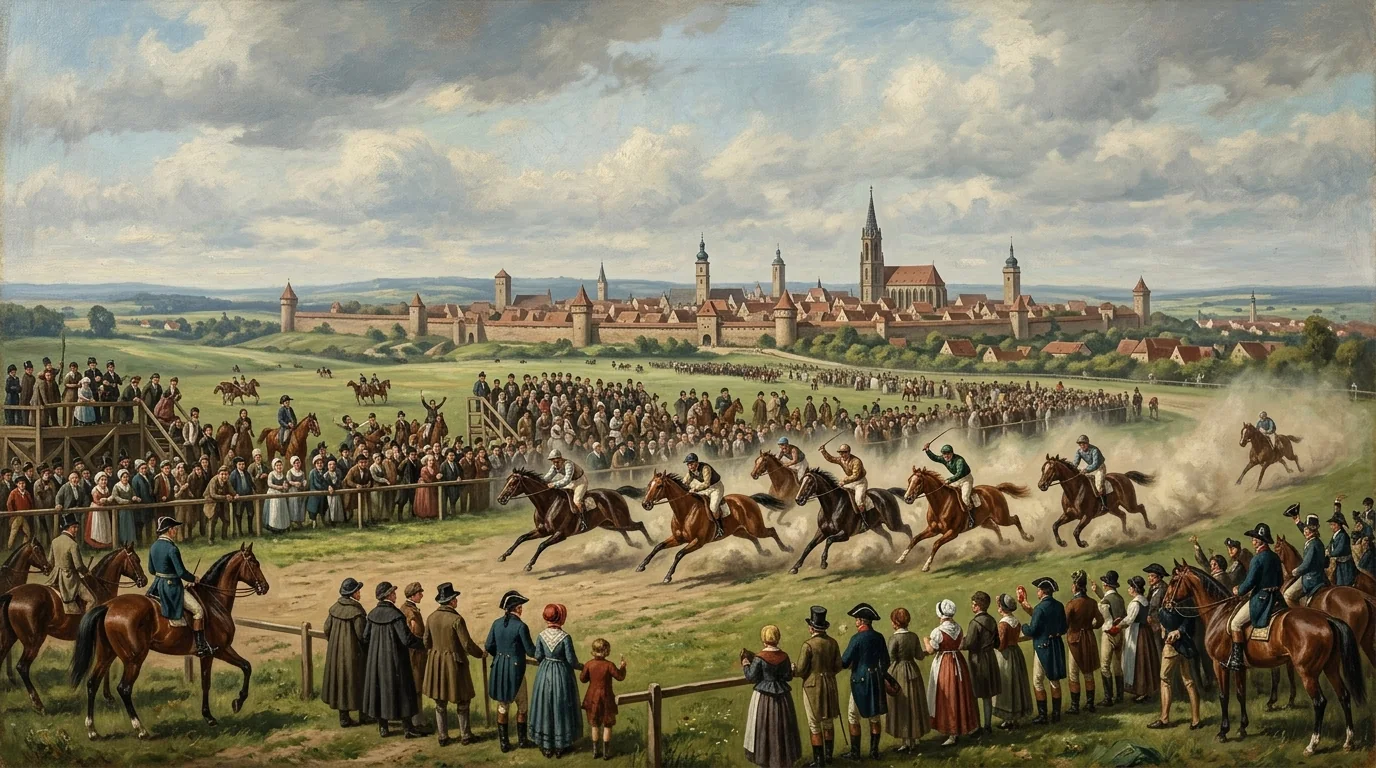
On the twelfth of October 1810, a crown prince married a princess and the whole of Munich was invited. The party finished with a horse race on the meadow outside the city walls. Somebody suggested doing it again the next year. Nobody has stopped since, and the field still carries the bride's name.
1850 · The woman who watches
9 October 1850. The Bavaria statue is unveiled above the Theresienwiese.
Forty years in, a bronze woman eighteen metres tall was raised at the western edge of the meadow. Bavaria stands with her back to the city and her eyes on the festival. There is a staircase inside her. Climb it, and you look out at six million people through slits cut into her hair.
1892 · The day the beer became visible
1892. Stoneware gives way to the glass litre mug.
For eighty years the beer arrived in stoneware. Grey, heavy, opaque, and very easy to under-fill without anyone noticing. In 1892 the glass Maß appeared, and for the first time a drinker could see exactly how much was missing. The complaints started immediately. They have never stopped.
1910 · The hundredth
1910. The centenary. Twelve thousand people under one roof.
The hundredth Oktoberfest put twelve thousand people under a single roof and poured a hundred and twenty thousand litres. This was the year it stopped being a horse race with beer at the side, and became a beer festival with a horse race attached. The horses were quietly dropped later.
1923 · Closed by arithmetic
1923 and 1924. Hyperinflation cancels the festival.
In 1923 the price of a litre was quoted first in millions, then in billions, and it could change between the pouring and the paying. There was no sane way to run a sixteen day festival. It was cancelled, and cancelled again in 1924. Money closed the meadow, not war.
1950 · Two words, nineteen strokes
1950. Thomas Wimmer taps the first keg and invents a ritual.
In 1950 the mayor of Munich picked up a mallet, drove a tap into the first barrel and shouted two words. O'zapft is. It's tapped. It took him nineteen strokes. Every mayor since has been counted in public, and the count is printed in the paper. The record is two.
1980 · The twenty-sixth of September
26 September 1980. A bomb at the main entrance kills thirteen people.
On the twenty-sixth of September 1980 a bomb hidden in a bin at the main entrance killed twelve visitors and the man who planted it, and injured more than two hundred. It is still the deadliest attack in the history of the Federal Republic. A memorial stands at the entrance. The festival reopened the next day, and the argument about whether it should have has never been settled.
2005 · The rule that split the day
2005. The quiet Oktoberfest rule takes effect.
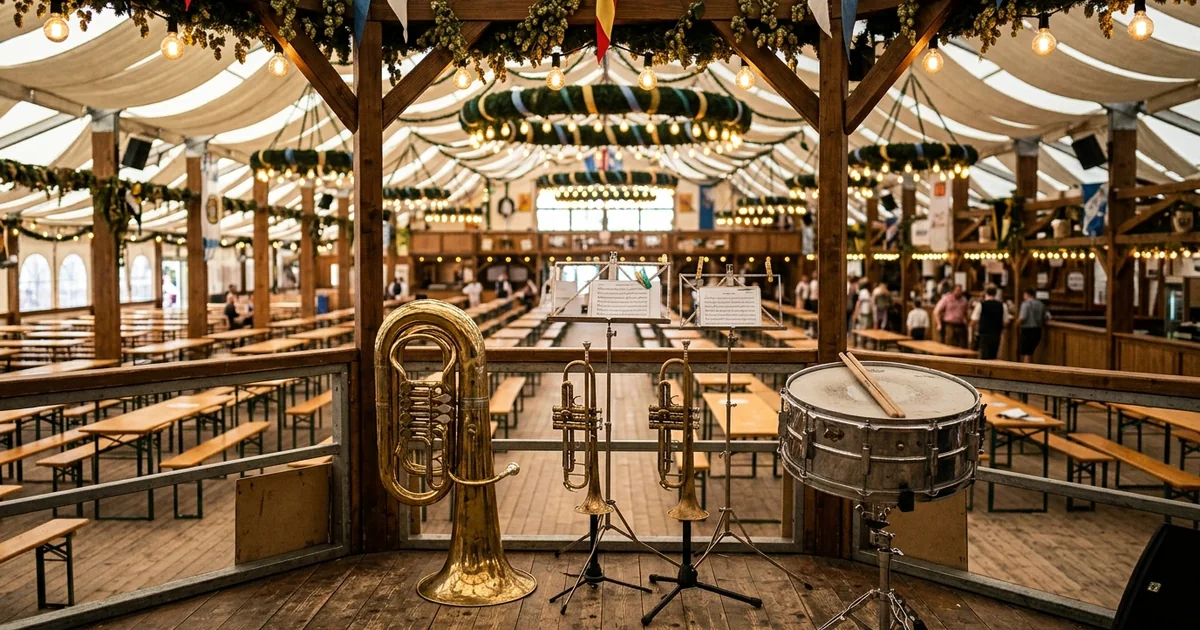
In 2005 the tents agreed on a rule that sounds trivial and changed everything. Before six in the evening, brass only, and never above eighty-five decibels. The point was to give the afternoon back to families. It worked. The Wiesn now has two personalities and it swaps between them at teatime.
2020 · The empty meadow
2020 and 2021. The first cancellations since 1948.
The meadow has gone dark before, for cholera, for war and for inflation. In 2020 a virus closed it, and again in 2021. Those were the first cancellations in seventy-two years. Munich sold the beer anyway, in supermarkets, in bottles, and everyone agreed it was not the same thing at all.
2026 · The hundred and ninety-first
2026. Sixteen days, six breweries, one meadow.
The hundred and ninety-first Oktoberfest runs sixteen days from the nineteenth of September. Only six breweries may pour, all of them inside the old city limits. A litre will cost about fifteen euros eighty. In 1950 the same litre cost eighty-seven cents. Look at the gold line on your right, and watch it climb.
Everything on this page
Free courses on this page
From Royal Wedding to Global Party: Oktoberfest
02 Free courseUntold Mysteries of Oktoberfest
03 Free courseGlobal Oktoberfest: The Most Unexpected Spin-Offs
Go deeper
 History
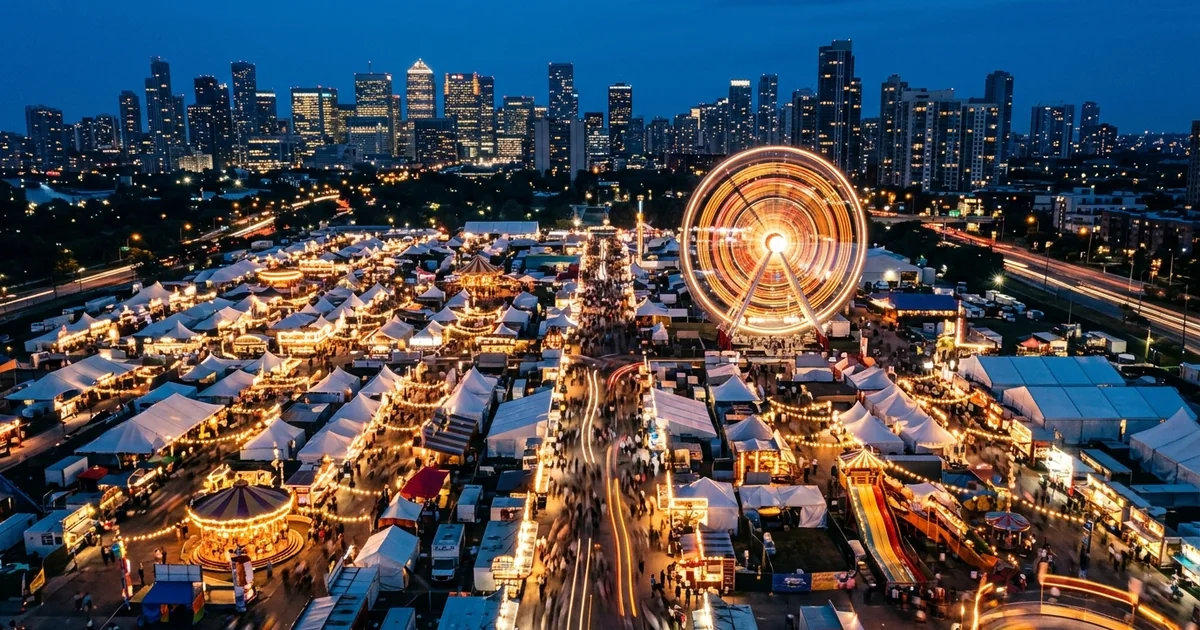
The history of Oktoberfest
 Data
Data
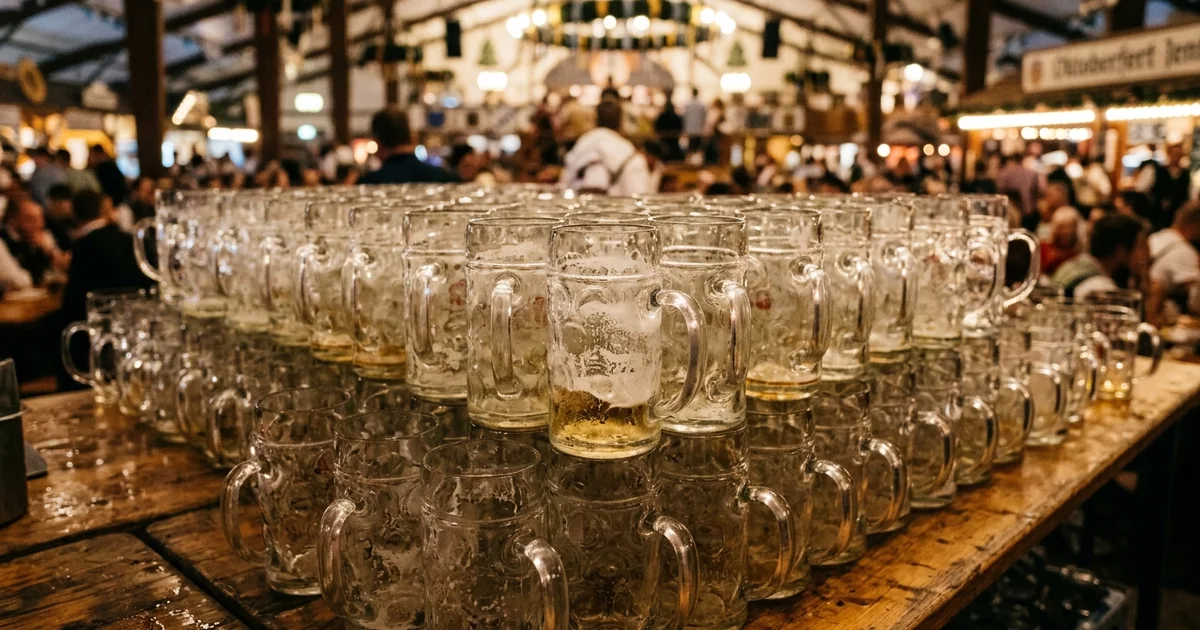
Oktoberfest by the numbers
 Guide
Guide
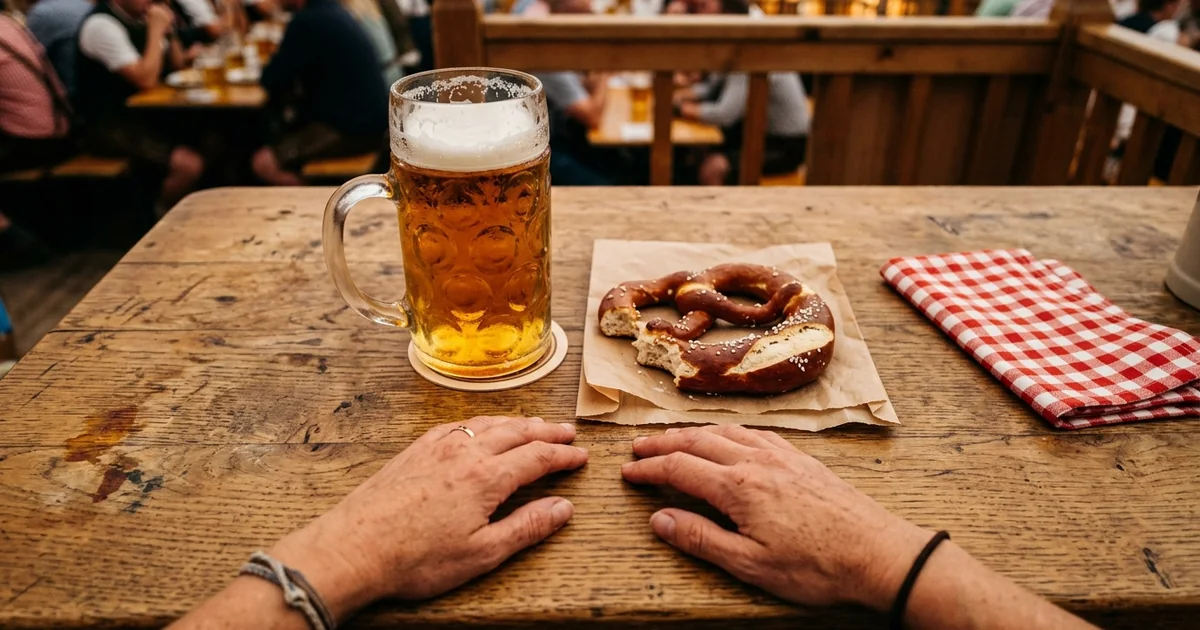
Oktoberfest traditions explained
 Quiz
Quiz
40 Oktoberfest trivia questions
 Daten
Daten
Every Maß price since 1950
Related courses in the app
When
Saturday 19 September to Sunday 4 October 2026. Sixteen days, always ending on the first Sunday in October or later.
Where
The Theresienwiese in Munich, a 42-hectare meadow named after the bride whose wedding started the whole thing.
What it costs
A Maß, one full litre of Wiesn beer, runs €14.80 to €15.90 in 2026. Entry to the grounds and the tents is free.
Oktoberfest 2026 dates and how the calendar works
Oktoberfest 2026 opens on Saturday 19 September and closes on Sunday 4 October. Nothing pours before the mayor taps the first keg in the Schottenhamel tent at noon on the opening Saturday. Until that moment, the largest beer festival on Earth serves no beer at all.
The end date is set by a rule rather than a calendar square. Oktoberfest always finishes on the first Sunday in October, and if that Sunday falls on 1 or 2 October, the festival is extended to 3 October so it covers German Unity Day. That is why the festival runs 16 days in some years and 17 or 18 in others.
Daily rhythm matters more than most first-timers expect. Tents open in the morning, the first Sunday brings the traditional costume and riflemen's parade through central Munich, and weekday afternoons are the only realistic chance of walking into a big tent without a reservation.
Why a festival called Oktoberfest happens in September
The name is a leftover. The original celebration took place in October 1810, tied to a wedding on 12 October. As the festival was repeated year after year, organisers kept nudging it earlier for a simple reason: September nights in Munich are warmer and the evenings are longer, which is worth a lot when your venue is an open meadow and your product is served outdoors.
By the late nineteenth century the bulk of the festival had shifted into September while the finish stayed anchored in early October. The name never changed. So the correct answer to "why is Oktoberfest in September" is weather, daylight and inertia, in that order.
Take the free Oktoberfest courses
Three short courses from the NerdSip app. The first traces the festival from the 1810 wedding to the modern Wiesn, the second collects the details that even regulars get wrong, and the third follows Oktoberfest around the world. Read the lesson, then tap an answer. All three came out of the same engine as the rest of the library and went through the same checks, which the features page explains in full.
13 lessons, 3 courses, no signup needed. Tap an answer to check yourself as you read.
From Royal Wedding to Global Party: Oktoberfest
From a royal wedding and a horse race in 1810 to the modern festival: the calendar shift, the brewery rule, the tapping ritual, and the cancellations it survived.
Lesson 1A Royal Wedding to Remember
In October 1810, Crown Prince Ludwig of Bavaria married Princess Therese of Saxe-Hildburghausen. To celebrate the royal union, the citizens of Munich were invited to festive fields located outside the city gates. The main highlight was a grand public horse race that drew tens of thousands of excited spectators from across the region.
To honor the new bride, locals named the festival grounds Theresienwiese, which translates to "Therese's Meadow." Today, locals still affectionately refer to Oktoberfest simply as die Wiesn. The inaugural celebration proved so wildly popular that the royal house decided to repeat the festivities the following year, giving birth to a lasting tradition.
In those early days, the event was primarily a sporting and cultural gathering rather than a beer festival. Small food booths and beer stands appeared gradually over time, but the primary focus remained on community spirit and horse racing. That royal wedding reception established the foundation for what would eventually become the world's largest festival.
Key takeaway
Oktoberfest began in 1810 as a royal wedding celebration featuring a public horse race.
Test yourself
What was the central feature of the very first Oktoberfest in 1810?
Lesson 2Moving the Calendar
As Oktoberfest grew in popularity during the 19th century, organizers encountered an ongoing challenge: Munich's unpredictable autumn weather. October evenings often brought chilly winds and heavy rain, dampening outdoor celebrations. To provide guests with warmer weather and longer daylight hours, city organizers made the strategic decision to shift the start date forward into September.
Today, the festival typically launches on the third Saturday of September and concludes on the first Sunday of October. This timing allows visitors to enjoy outdoor beer gardens and carnival attractions under milder weather conditions. While the name Oktoberfest remains unchanged, most of the actual drinking and celebrating now occurs during the pleasant final weeks of September.
Along with the schedule change, the festival site evolved significantly. Simple wooden beer stands were gradually replaced by massive, sturdy beer halls built by local breweries. Agricultural shows, carnival rides, and traditional food stalls transformed the former sports grounds into a thriving fairground, setting the stage for the modern spectacle enjoyed today by millions.
Key takeaway
Oktoberfest was shifted to September to give visitors warmer weather and longer daylight hours.
Test yourself
Why was Oktoberfest officially moved earlier into mid-September?
Lesson 3Munich's Golden Rules
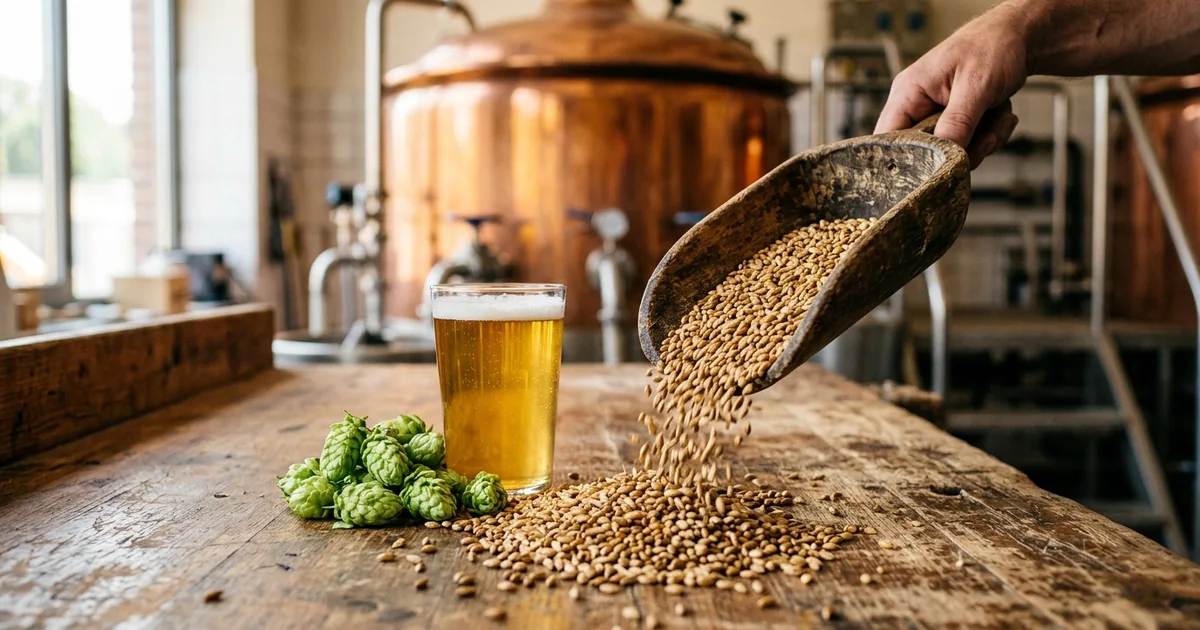
Not just any beverage can be served at Munich's iconic festival. According to strict festival regulations, only beer brewed within the official Munich city limits is permitted. Furthermore, every drop must comply with the historic Reinheitsgebot, the famous Bavarian beer purity law of 1516, which restricts ingredients strictly to water, barley, hops, and yeast.
Only six historic establishments, known locally as the Big Six, hold the exclusive privilege to serve beer at Oktoberfest. These celebrated breweries include Paulaner, Spaten, Hofbräu, Hacker-Pschorr, Augustiner, and Löwenbräu. Each brewery erects massive temporary beer tents on the grounds, serving millions of visitors their unique, custom-brewed festival beverages throughout the event.
The beer served is a specific style called Oktoberfestbier, a rich lager that is slightly stronger than standard beers, averaging about 6% alcohol content. It is traditionally served in heavy one-liter glass mugs known as a Maß. This combination of strict tradition, high quality, and distinct presentation makes the festival's beer world-famous.
Key takeaway
Only six historic Munich breweries obeying strict purity laws are allowed to serve beer at Oktoberfest.
Test yourself
Which breweries are permitted to serve beer at Oktoberfest?
Lesson 4"O'zapft is!"
Despite Oktoberfest's centuries-old origin, one of its most famous traditions is surprisingly modern. In 1950, Munich Mayor Thomas Wimmer inaugurated a new opening ceremony by tapping the first beer barrel inside the Schottenhamel tent. After hammering the tap into the wooden keg, he loudly proclaimed "O'zapft is!", which translates from Bavarian dialect to "It is tapped!"
That dramatic moment established an official rule that continues today: no beer hall on the grounds may serve alcohol until the mayor taps the inaugural keg. Following the mayor's call, twelve traditional cannon shots echo from the nearby hillside, signaling to all other tent commanders that they may finally begin serving beer to expectant crowds.
Over the decades, how many mallet strikes the mayor requires to tap the barrel has become a source of friendly public scrutiny. Mayor Wimmer needed 17 hits during his nervous first attempt in 1950. Modern mayors spend time practicing before the festival, with the record standing at just two swift, confident strikes.
Key takeaway
Oktoberfest officially begins when Munich's mayor taps the first keg and shouts "O'zapft is!"
Test yourself
What does the mayor's exclamation "O'zapft is!" signal?
Lesson 5Resilience and Global Fame
Although Oktoberfest is celebrated as an uninterrupted annual tradition, the festival has faced serious historical disruptions. Over its two-century history, the event has been canceled roughly two dozen times. War, severe hyperinflation, and deadly disease outbreaks, including 19th-century cholera epidemics and the recent COVID-19 pandemic, have forced organizers to temporarily halt festivities.
Despite these recurring setbacks, Oktoberfest has consistently bounced back stronger, demonstrating the deep resilience of Bavarian culture. Modern organizers welcome around 6,000,000 visitors to Munich each year. Guests from all over the globe gather in giant halls to enjoy traditional folk music, Bavarian cuisine, and millions of liters of specially brewed beer.
What began as an exclusive 1810 royal wedding reception has evolved into the world's largest public folk festival. Oktoberfest's remarkable transformation reflects over two centuries of heritage, adapting to modern times while preserving its authentic Bavarian soul. Today, it remains an enduring symbol of community, celebration, and international friendship.
Key takeaway
Overcoming many historical cancellations, Oktoberfest expanded into a world-famous celebration attracting millions of visitors.
Test yourself
How did Oktoberfest evolve despite facing over twenty historical cancellations?
Want the XP, streaks, and progress tracking? Take this course in the NerdSip app.
Open in the appUntold Mysteries of Oktoberfest
Five things most visitors never learn: the electrification of the tents, the beer pipelines under the floor, and what turns up in the lost and found.
Lesson 1The Royal Wedding That Started It All
Most people assume Oktoberfest was created to celebrate Bavarian beer. In reality, the very first event in October 1810 was a lavish royal wedding celebration. Crown Prince Ludwig of Bavaria married Princess Therese of Saxe-Hildburghausen, and they invited the entire city of Munich to celebrate on a field outside the city gates.
The grand highlight of this five-day festival was not beer drinking, but a dramatic horse race. The event was so wildly popular that townspeople decided to repeat the festivities the following autumn. That single decision birthed an annual tradition that eventually evolved into the massive cultural phenomenon we recognize today.
Interestingly, beer stalls were not even allowed on the main festival grounds during those early years. Drinks had to be purchased outside the meadow. As decades passed, horse racing faded away while giant beer tents gradually took center stage, completely changing the festival's identity forever.
Key takeaway
Oktoberfest originated as a public celebration for a royal wedding, complete with horse races instead of beer halls.
Test yourself
What was the main event at the very first Oktoberfest in 1810?
Lesson 2The Genius Electrician in the Tents
Long before he revolutionized theoretical physics, a seventeen-year-old named Albert Einstein worked at Oktoberfest. In 1896, young Einstein was employed by his family's electrical engineering company in Munich. His primary job was helping install the very first electric lights inside one of the festival's largest beer tents.
Before electricity arrived, festival tents relied on dim oil lamps and dangerous open candles. Einstein helped electrify the famous Schottenhamel tent, screwing in light bulbs so visitors could safely celebrate into the night. This technical leap laid the foundation for the glowing, high-energy nighttime spectacle modern visitors enjoy today.
While Einstein soon moved on to reshape physics, his brief summer job highlights how rapidly Oktoberfest adopted modern technology. The transition from candlelight to electric power allowed tents to grow much larger, accommodating thousands of enthusiastic guests under one brightly lit roof.
Key takeaway
A teenage Albert Einstein helped install Oktoberfest's first electric lights in 1896.
Test yourself
What job did young Albert Einstein do at Oktoberfest in 1896?
Lesson 3The Secret Rule of Six Breweries
Not just any brewery can sell beer at Oktoberfest. Under strict local tradition and legal regulations, only 6 specific historic Munich breweries are permitted to serve their brew at the festival. Every drop must adhere strictly to the Bavarian Reinheitsgebot, or Beer Purity Law, established back in 1516.
To qualify, the beer must be brewed strictly within Munich's official city limits. The six elite breweries craft a specially designed Oktoberfestbier. This unique amber lager is slightly stronger than standard beer, averaging around 6% alcohol content to match the festival's high-energy atmosphere.
To keep up with massive demand, festival tents rely on modern engineering marvels. One major beer tent even constructed a secret underground beer pipeline. Running beneath the festival grounds, this chilled network pumps thousands of liters directly from central tanks to the taps, keeping beer fresh and flowing endlessly.
Key takeaway
Only six historic Munich breweries meeting strict purity laws can serve beer at Oktoberfest, often using hidden underground pipelines.
Test yourself
Which rule dictates which beer can be served at Oktoberfest?
Lesson 4Bizarre Discoveries at Lost and Found
With millions of visitors celebrating every year, the official Oktoberfest Lost and Found bureau becomes a repository of strange stories. Every season, staff collect thousands of misplaced items left behind in beer tents. Alongside predictable items like lost smartphones, jackets, and wallets, workers routinely discover truly shocking possessions.
Unbelievably, lost property routinely includes items like false teeth, wheelchairs, crutches, hearing aids, and even actual wedding rings. How someone manages to leave the festival grounds without their own dentures or mobility aids remains one of Oktoberfest's most humorous and puzzling mysteries.
Unclaimed items are held by the city of Munich for six months to give owners time to recover them. If no one steps forward, the city host an official public auction. Buyers bid on mysterious lost boxes, turning forgotten festival items into unexpected local treasures.
Key takeaway
The festival's lost and found collects thousands of items annually, including weird findings like dentures, wheelchairs, and wedding rings.
Test yourself
What happens to lost property that stays unclaimed for six months?
Lesson 5Banishments and Tapping Rituals
No visitor is allowed to take a single sip of beer until the official opening ceremony takes place. On the festival's first day at noon, the Mayor of Munich must tap the first wooden beer keg in the Schottenhamel tent, shouting O'zapft is!, which translates to "It is tapped!"
This ritual is serious business, and locals closely track how many hammer blows the mayor needs to pierce the keg. Former Mayor Christian Ude holds the record for efficiency with just two strikes, while an earlier mayor required nineteen blows in 1950 before beer finally flowed.
Oktoberfest also enforces strict security and cultural etiquette. In 2006, celebrity Paris Hilton earned a permanent ban from the festival. She showed up in a non-traditional dirndl to promote a canned wine brand without permission. Offended organizers promptly banned her for disrespecting Bavarian traditions and commercializing the event.
Key takeaway
Oktoberfest strictly begins only when the mayor taps the first keg, and organizers enforce strict cultural rules.
Test yourself
Why was Paris Hilton banned from Oktoberfest in 2006?
Want the XP, streaks, and progress tracking? Take this course in the NerdSip app.
Open in the appGlobal Oktoberfest: The Most Unexpected Spin-Offs
The spin-offs that outgrew novelty: Blumenau in Brazil, Qingdao in China, and an Alpine village in Argentina that tap kegs their own way.
Lesson 1Blumenau, Brazil: Samba Meets Lederhosen
In 1850, German pharmacist Hermann Blumenau founded the city of Blumenau in southern Brazil [1.1.4]. More than a century later, in 1984, catastrophic floods severely devastated the city's local economy and infrastructure. In response, resilient residents created a Bavarian-style Oktoberfest to lift community spirits, generate disaster relief funds, and successfully jumpstart local tourism.
That emergency fundraiser quickly blossomed into the largest Oktoberfest in the Americas. Every October, more than half a million enthusiastic visitors pack the Vila Germânica, a sprawling festival park filled with traditional half-timbered Alpine architecture. Guests don classic dirndls and lederhosen, filling the town streets with vibrant German-Brazilian energy and celebration.
The celebration seamlessly blends authentic Bavarian heritage with distinct South American flair. High-energy brass bands play traditional German folk songs right alongside upbeat Brazilian hits, while bustling food stalls serve classic sausages alongside ice-cold local craft beers. It vividly demonstrates how a beloved European tradition can flourish under tropical South American skies.
Key takeaway
Blumenau transformed a natural disaster recovery effort into the largest Oktoberfest celebration in the Americas.
Test yourself
What led to the creation of Brazil's massive Oktoberfest in 1984?
Lesson 2Qingdao, China: Beachside Beers & Plastic Bags
In 1903, German settlers established the Tsingtao Brewery in the coastal Chinese city of Qingdao. Decades after foreign colonial rule ended, the city's passion for brewing remained exceptionally strong. In 1991, municipal leaders launched the Qingdao International Beer Festival, transforming this coastal resort into Asia’s ultimate beer destination every summer.
Often dubbed the Asian Oktoberfest, this month-long extravaganza takes place along the picturesque Golden Sands Beach. Sprawling Bavarian-style beer tents host millions of attendees from around the world, featuring thousands of different beers. Revelers enthusiastically toast with shouts of 'Ganbei!' while enjoying live concerts, drone shows, and spirited drinking contests.
What makes Qingdao truly distinct is its quirky street drinking culture. Local vendors pour fresh draft beer straight from stainless steel kegs into plastic bags, tied with a straw for easy portable drinking. Pairing a cold bag of beer with grilled seafood skewers offers China's unique, beachside take on classic Bavarian festivities.
Key takeaway
Qingdao combines its 1903 German brewing legacy with coastal nightlife to host Asia's largest beer festival.
Test yourself
How do many local festival-goers in Qingdao enjoy fresh draft beer on the go?
Lesson 3Villa General Belgrano: Argentina's Alpine Oasis
Nestled in the picturesque hills of Argentina's Córdoba province, Villa General Belgrano feels like a mountain village plucked directly from the Swiss Alps. Settled by German, Austrian, and Swiss immigrants during the 1930s, the town preserves Central European timber architecture, artisanal crafts, and rich culinary traditions deep inside South America.
Since 1964, the town has proudly hosted the Fiesta Nacional de la Cerveza, Argentina's official Oktoberfest. Held in the wooded Bosque de los Pioneros, the festival showcases Central European folk dance troupes, colorful costume parades, and locally crafted beers. It offers an authentic taste of European alpine culture with Argentine warmth.
The festival's signature highlight is the espiche, the traditional ceremonial tapping of a fresh wooden beer barrel. When the wooden mallet strikes the faucet, draft beer sprays dramatically high into the air over the crowd. Catching the foam in your stein is believed to bring good luck for the year.
Key takeaway
Villa General Belgrano brings Bavarian mountain traditions to South America with its famous barrel-tapping ritual.
Test yourself
What happens during the 'espiche' ritual at Argentina's Oktoberfest?
Want the XP, streaks, and progress tracking? Take this course in the NerdSip app.
Open in the appInteresting facts about Oktoberfest
Past the dates and the beer price, these are the Oktoberfest facts that actually surprise people.
Wiesnbier is brewed stronger
Munich's own rules demand at least 13.5 percent original wort, which puts the beer near six percent alcohol. A Mass is a full litre of it.
You cannot order a half
The large tents sell beer in one-litre Mass only. There is no small size.
It has been called off about two dozen times
For cholera in 1854 and 1873, for three wars, for hyperinflation in 1923 and 1924, and for a virus in 2020 and 2021.
The first tap is scored in public
Since 1950 the mayor drives the tap into the first barrel and the strokes are counted. Nineteen the first time. The record is two.
The bow on a dirndl is information
Tied on the left it traditionally means single, on the right taken, and at the back it is worn by widows and by waitresses.
The tents are temporary
Around seventeen large tents are built from bare meadow every summer and gone again within weeks of the last day.
Lost property fills a warehouse
Thousands of items each year: phones, keys, wallets, spectacles, and reliably a few sets of dentures.
The oxen are counted and named
The Ochsenbraterei roasts roughly a hundred oxen over the sixteen days and puts the running total on a board.
It ends with gunfire
On the final Sunday a gun salute is fired at the foot of the Bavaria statue above the meadow.
The festival travelled further than the beer
Blumenau in Brazil, Qingdao in China and Villa General Belgrano in Argentina all run their own versions.
The three free courses above are the quickest interesting things to learn about Oktoberfest, from the 1810 wedding to the spin-offs on four continents.
The rules that keep the Wiesn from becoming a generic beer festival
Oktoberfest looks chaotic and is in fact one of the most tightly regulated events in Europe. Four rules do most of the work.
Six breweries only
Augustiner, Hacker-Pschorr, Hofbräu, Löwenbräu, Paulaner and Spaten. The beer must be brewed inside Munich city limits and meet the Wiesn standard, which is stronger than everyday lager.
O'zapft is
The mayor taps the first keg at noon on opening day. The number of strokes it takes is counted, reported, and quietly held against them.
Quiet before six
Until 18:00 the tents play brass band music at limited volume, which is what makes the afternoon the family window. The party music starts later.
The brewery rule is the one that shapes the taste. Wiesn beer is brewed specifically for the festival at a higher original gravity than standard Helles, which is why a litre of it lands differently than a litre of supermarket lager.
Oktoberfest by the numbers
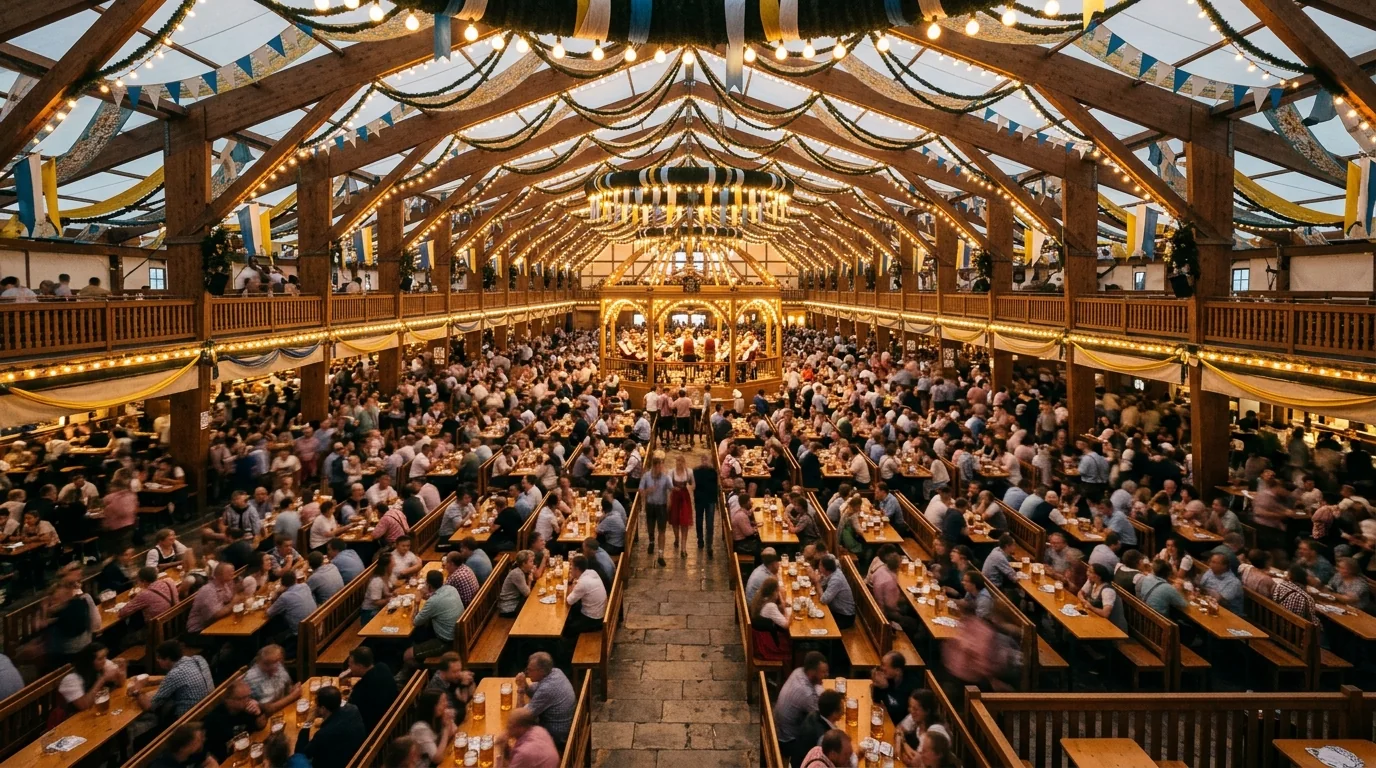
Munich publishes a closing report every year, and the figures are the fastest way to understand the scale of the thing.
| Measure | 2025 festival |
|---|---|
| Visitors | About 6.5 million over 16 days |
| Beer served | About 6.5 million litres |
| Beer mugs intercepted from would-be souvenir takers | 116,000 |
| Items handed to lost and found | 4,500 |
| Waste | 764 tonnes |
| Electricity | 2.8 million kWh |
Two numbers are worth sitting with. Roughly one litre of beer per visitor, which is far less than the reputation suggests, and 116,000 attempted mug thefts, which is exactly as much as the reputation suggests. Demand for alcohol-free beer rose again in 2025, by 6 to 10 percent depending on the tent.
Figures from the City of Munich's closing report for the 2025 festival. Prices for 2026 come from the official Munich price list published in July. · Press contact and previous coverage: media page.
Frequently asked questions
What are some interesting facts about Oktoberfest?
Oktoberfest beer must be brewed inside Munich's old city limits at a minimum of 13.5 percent original wort, and the large tents sell it only by the litre. The festival has been cancelled around two dozen times, for cholera, war, hyperinflation and a virus. Since 1950 the mayor's first keg tap is counted in public, with a record of two strokes against nineteen for the first one. Around seventeen large tents are built from scratch each summer and removed again within weeks.
When is Oktoberfest in Germany in 2026, and what time does it open?
Oktoberfest 2026 runs from Saturday 19 September to Sunday 4 October on the Theresienwiese in Munich, Germany. The first day starts at noon, when the Mayor of Munich taps the first keg in the Schottenhamel tent. No beer is served anywhere on the grounds before that moment.
How long does Oktoberfest last?
Sixteen days in 2026, from Saturday 19 September to Sunday 4 October. The length varies year to year because the festival ends on the first Sunday in October, and runs on to 3 October when that Sunday falls on the 1st or 2nd, so that German Unity Day is covered. That produces runs of 16, 17 or 18 days.
When is Oktoberfest 2026?
Oktoberfest 2026 runs from Saturday 19 September to Sunday 4 October 2026 on the Theresienwiese in Munich. It is the 191st edition.
Why is Oktoberfest in September and not October?
The first celebration was held in October 1810 for a royal wedding. Organisers gradually moved the festival earlier because September nights in Munich are warmer and the evenings longer. The end date stayed in early October, and the name stuck.
How much does a beer cost at Oktoberfest 2026?
A Maß, one litre of Wiesn beer, costs between €14.80 and €15.90 in 2026, depending on the tent. That is an average increase of about 2.4 percent over 2025. Non-alcoholic drinks are also priced by the litre, with table water around €11.
Which breweries are allowed to serve at Oktoberfest?
Only six: Augustiner, Hacker-Pschorr, Hofbräu, Löwenbräu, Paulaner and Spaten. Each must brew its Oktoberfest beer within Munich city limits and to the festival's stricter specification.
Do you need a ticket for Oktoberfest?
No. Entry to the Theresienwiese and to the tents is free. What sells out is table reservations, which large groups typically arrange months ahead. Individuals can still get seats on weekday afternoons if they arrive early.
How did Oktoberfest start?
It began as the public celebration of the marriage of Crown Prince Ludwig of Bavaria and Princess Therese of Saxe-Hildburghausen on 12 October 1810. The party ended with a horse race on the meadow outside the city gates. The race was repeated the following year, and the meadow was named Theresienwiese after the bride.
What does O'zapft is mean?
It is Bavarian for "It's tapped." The Mayor of Munich taps the first keg in the Schottenhamel tent at noon on the opening Saturday and shouts the phrase. Only then may beer be served anywhere on the grounds.
How much beer is drunk at Oktoberfest?
About 6.5 million litres in 2025, down from 7 million in 2024 and 7.4 million in 2023. That works out at roughly one litre per visitor.
Has Oktoberfest ever been cancelled?
Yes, more than two dozen times. Cholera outbreaks in the nineteenth century, both world wars, hyperinflation in the 1920s and the COVID-19 pandemic in 2020 and 2021 all stopped it.
What should you wear to Oktoberfest?
Ordinary clothes are fine and plenty of visitors wear them. Most Germans wear Tracht: a dirndl for women, lederhosen with a checked shirt for men. If you buy an outfit, buy it from a Bavarian shop rather than a costume site. The difference between real Tracht and a fancy dress version is obvious to everyone around you.
Can you go to Oktoberfest without a table reservation?
Yes, and most people do. Reservations cover only part of each tent and the rest is first come, first served. Arrive before about 11am on a weekday and you will find a bench without trouble. Friday and Saturday evenings are close to hopeless without one.
What food is served at Oktoberfest?
Roast chicken is the classic order, followed by pork knuckle, grilled fish on a stick, giant pretzels, Obatzda cheese spread, and Weisswurst, which by tradition is only eaten before noon. Kaiserschmarrn, a shredded pancake with plum compote, is the standard finish.
Is Oktoberfest suitable for children?
Yes, before the evening. Since 2005 the tents play only quiet brass music below 85 decibels until six o'clock, which keeps the afternoons manageable. Tuesdays are family days with reduced prices on the rides, and the Oide Wiesn section stays calmer throughout.
Read next
The history of Oktoberfest
From a wedding horse race in 1810 to six million visitors, and every cancellation in between.
DataOktoberfest by the numbers
Beer, chickens, lost property and the price of a Maß across two decades.
GuideOktoberfest traditions explained
Tapping, Tracht, the parade, table etiquette, and how to say prost without embarrassing yourself.
Quiz40 Oktoberfest trivia questions
Test yourself on the Wiesn, from the 1810 wedding to the beer pipelines.
DatenEvery Maß price since 1950
The full Oktoberfest beer price series, converted and sourced.
CourseBrewing basics: grain to glass
What actually happens between barley and a full stein.
CourseThe 1873 Frankfurt beer riots
When the price of beer put a German city on the barricades.
EventTotal solar eclipse, 12 August 2026
Europe's first totality since 1999, with path maps and safe viewing.
EventNobel Prize week 2026
Announcements run 5 to 12 October. The rules, the money, the snubs.
Learn something new in 5 minutes a day
NerdSip turns any topic into a short course with quizzes, XP, and streaks. Free to start, no doomscrolling required.
4.7 stars from 380 reviews · 10,000+ learners