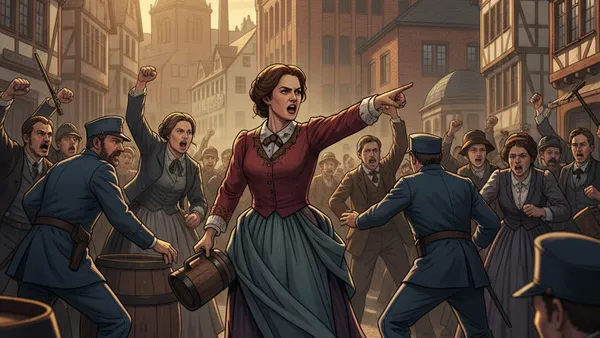
Would you start a violent city-wide revolution over a 12.5% beer price hike?
Prompted by A NerdSip Learner
Understand the deadly 1873 Frankfurt Beer Riots.
In 1873, beer wasn't just a fun weekend drink in Frankfurt—it was a crucial daily staple for the working class. Because urban water quality was often unreliable and unsafe, beer served as a sanitized, calorie-dense alternative that fueled laborers through long shifts.
At the time, a glass of beer cost 4 *Kreuzer*, a coin affectionately known as a "Batzen." But on April 1, 1873, local breweries colluded to raise the price to 4.5 Kreuzer. This steep 12.5% hike was devastating to the poorly paid workers.
To make matters worse, there was a major logistical flaw: half-Kreuzer coins didn't actually exist! Thirsty patrons had to pay 5 Kreuzer and receive a paper voucher for their change. Infuriatingly, this voucher was only valid at that specific pub, effectively forcing workers into a trap of brand loyalty just to get their hard-earned money's worth.
Key Takeaway
A steep price hike on beer, combined with a frustrating voucher system, deeply squeezed Frankfurt's working class.
Test Your Knowledge
Why did the lack of half-Kreuzer coins worsen the anger over the beer price hike?
The brewing anger finally boiled over on April 21, 1873. It was the final day of Frankfurt's traditional spring fair, a rare and much-anticipated day off for the city's laborers.
As the workers drank and celebrated, the resentment over the new beer prices and the restrictive voucher system grew. Fueled by alcohol and deep economic frustration, a crowd of about 100 people gathered and began to march. They tore down a red curtain, fashioned it into a makeshift protest flag, and took to the streets.
Their rallying cry echoed through the city: "Mir wolle Batzebier!" (We want Batzen beer!). The demonstration rapidly swelled into a violent, unstoppable mob. Over the next few hours, the rioters systematically targeted the city's breweries and pubs. They smashed windows, destroyed furniture, and dumped hundreds of liters of the newly expensive beer straight into the cobblestone streets.
Key Takeaway
A working-class holiday turned into a massive, violent riot against local breweries over the price of beer.
Test Your Knowledge
What was the main rallying cry of the rioters during the Frankfurt Beer Riot?
The local Frankfurt police were completely overwhelmed by the sheer size and fury of the beer rioters. Unable to restore order as pubs were being dismantled, the city authorities made a fateful decision: they called in the heavily armed Prussian military.
Six companies of infantry marched into the city to quell the unrest. The crackdown was brutal and swift. Soldiers fired directly into the crowds in the old city and the cathedral square. Tragically, historians estimate around 20 people were killed in the chaos, including individuals who weren't even participating, such as an elderly woman and a young boy.
In the aftermath, the city was placed under martial law, and nearly 50 rioters were sentenced to hard labor or prison. Ironically, the violent uprising actually worked. Horrified by the bloodshed and destruction of property, the Frankfurt breweries quickly announced they would reverse the price hikes. The beloved "Batzenbier" returned, though at a terrible human cost.
Key Takeaway
The Prussian military brutally crushed the riot, but the terrified breweries ultimately reversed the price hike.
Test Your Knowledge
How did the 1873 Frankfurt Beer Riot ultimately resolve?
Track your progress, earn XP, and compete on leaderboards. Download NerdSip to start learning.