Discover the extinct birds and trapped lizards of Bermuda!
Prompted by NerdSip Explorer #4704
Explore the wonders of Bermuda's unique wildlife.
Bermuda is a tiny dot in the middle of the massive Atlantic Ocean. Because it is completely surrounded by deep water and far from any continent, getting there without a boat or a plane is incredibly hard!
Before humans arrived, the only animals that lived on the island were ones that could fly, swim, or float on driftwood. This means that for millions of years, Bermuda had zero native land mammals. No bears, no deer, no mice!
Instead, the island became a paradise for seabirds, a single type of lizard, and insects. It was a unique, peaceful kingdom ruled by creatures of the sky and the sea. Without large predators, the island's wildlife evolved in very special ways.
Key Takeaway
Bermuda's extreme isolation meant only flying, swimming, or floating animals could naturally reach it.
Test Your Knowledge
Why were there no native land mammals in Bermuda before humans arrived?
Imagine a bird coming back from the dead! The Bermuda Petrel, also known as the Cahow, is Bermuda's national bird. It is a seabird that nests in underground burrows and makes a spooky, calling sound at night.
When early explorers arrived with pigs, rats, and dogs, the Cahow nests were easily destroyed. By the 1620s, people believed the Cahow was completely extinct. For over 300 years, not a single one was seen.
But in 1951, scientists searching a rocky cliff made a shocking discovery: 18 nesting pairs were still alive! Today, thanks to strict protection, the Cahow population is slowly growing again. It is famous worldwide as a "Lazarus species"—a creature that miraculously returned after being declared extinct!
Key Takeaway
The Cahow was thought to be extinct for over 300 years until it was miraculously rediscovered in 1951.
Test Your Knowledge
What is a "Lazarus species"?
Remember how Bermuda has no native land mammals? Well, it only has one native land-dwelling vertebrate (an animal with a backbone). Meet the Bermuda Skink, also called the rock lizard.
These small, shiny lizards with pinkish bellies love to hang out on the island's rocky coasts. They are the "original Bermudians," having lived there for maybe up to two million years! But today, they are critically endangered.
One of their biggest enemies is surprisingly simple: glass bottles. Unlike geckos, the Bermuda Skink doesn't have sticky pads on its feet. If it crawls into an empty soda bottle tossed on the ground, it slides down the slippery glass and can't climb back out.
Key Takeaway
The Bermuda Skink is the island's only native land vertebrate, but it gets easily trapped in discarded glass bottles.
Test Your Knowledge
Why do Bermuda Skinks get trapped in glass bottles?
Imagine a place where you could step back in time to see exactly what Bermuda looked like 400 years ago. That place is Nonsuch Island!
In the 1960s, a brilliant scientist named Dr. David Wingate decided to turn this small island into a "Living Museum." He and his team worked tirelessly to remove all the invasive plants and animals that humans had brought over the centuries.
Then, they replanted native forests and brought back the original animals, like the Cahow bird and the Bermuda Skink. Today, Nonsuch Island is so highly protected that you can't just visit it for a beach day. It is an amazing, real-life time machine dedicated to saving nature.
Key Takeaway
Nonsuch Island is a protected nature reserve designed to show what Bermuda looked like before humans arrived.
Test Your Knowledge
What is the main goal of the Nonsuch Island project?
If you ask anyone in Bermuda how they know summer is coming, they will point to the sky and say, "The Longtails are back!"
The White-tailed Tropicbird, affectionately called the Longtail, is a stunning white seabird with a long, elegant tail feather that trails behind it like a kite string. They spend their cold winter months far out in the open ocean.
Every spring, they migrate back to Bermuda to breed. They build their nests in the small holes and crevices of the island's jagged limestone cliffs. Their arrival is celebrated across the island as the unofficial start of warm, sunny weather and beach season!
Key Takeaway
The White-tailed Tropicbird, or Longtail, is a beautiful seabird whose arrival in Bermuda signals the start of summer.
Test Your Knowledge
Where do Longtails build their nests when they arrive in Bermuda?
When humans finally settled in Bermuda, they brought along some uninvited guests. These are called invasive species—animals from other parts of the world that cause trouble in their new home.
Early sailors left behind pigs, hoping to eat them on future return trips. But the feral pigs trampled the ground and destroyed the burrows of the native Cahow birds. Later, ships accidentally brought rats and mice, which caused even more damage.
Even today, the ocean faces a huge invader: the Lionfish. Originally from the Pacific Ocean, this beautiful but venomous fish has no natural predators in Bermuda. It eats up all the small, helpful reef fish, throwing the underwater world out of balance.
Key Takeaway
Invasive species like rats, pigs, and lionfish harm Bermuda's native wildlife because they don't naturally belong there.
Test Your Knowledge
Why is the Lionfish considered a problem in Bermuda?
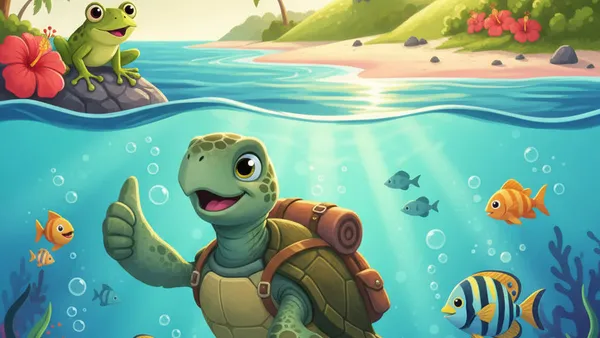
If you go snorkeling in the crystal-clear waters of Bermuda, you have a very good chance of spotting a sea turtle gliding gracefully by!
Bermuda is mostly surrounded by beautiful coral reefs and underwater meadows of sea grass. This makes it the perfect "nursery" for young Green Sea Turtles.
Interestingly, these sea turtles rarely lay their eggs on Bermuda's beaches. Instead, they hatch far away in places like the Caribbean or Florida. They swim all the way to Bermuda to eat, grow, and stay safe in the calm waters until they are adults. Once they are fully grown, they swim thousands of miles back to where they were born!
Key Takeaway
Bermuda acts as a safe, food-rich nursery for young sea turtles to grow before they return to their birthplaces.
Test Your Knowledge
Why do young sea turtles come to Bermuda?
Sometimes, it takes a massive team effort to save a tiny creature. The Greater Bermuda Snail is a unique land snail found nowhere else on the planet.
For a long time, scientists thought this little snail had gone completely extinct due to invasive predators eating them. But remarkably, a small surviving group was eventually found hiding in a damp alleyway in Bermuda's capital city!
To save them, scientists carefully sent a few of these snails on a 3,000-mile flight to a special zoo in England. The zoo experts helped the snails breed safely until there were thousands of them. Finally, the babies were flown back home and released into the wild on Nonsuch Island!
Key Takeaway
The Greater Bermuda Snail was saved from extinction by a captive breeding program in an English zoo.
Test Your Knowledge
Where were the last surviving Greater Bermuda Snails found before being rescued?
Bermuda isn't just home to tiny snails and birds; it also gets visited by some of the largest creatures on Earth!
Every spring, massive Humpback Whales use the deep waters around Bermuda as a giant underwater highway. These gentle giants are migrating from their warm winter breeding grounds in the Caribbean up to their cold, food-rich summer homes near Canada and Iceland.
As they pass by Bermuda, you can often see them jumping completely out of the water—a move called breaching! If you put a microphone underwater, you might even hear the male whales singing long, complex songs that echo for miles through the deep ocean.
Key Takeaway
Humpback whales pass by Bermuda every spring while migrating from the Caribbean to the cold northern oceans.
Test Your Knowledge
What is it called when a whale jumps completely out of the water?
Before human settlers arrived, Bermuda was covered in lush, thick forests of Bermuda Cedar trees. These trees were so important that early explorers used them to build ships, houses, and even furniture.
Because the cedar trees were cut down so quickly over the centuries, many animals that relied on them lost their homes. One beautiful survivor of this changing landscape is the Bermuda Buckeye Butterfly.
This special butterfly is endemic to Bermuda, meaning it is found nowhere else on Earth. It has light brown wings with bright orange markings and large "eyespots" that look like giant eyes to scare away hungry birds. Today, people are planting new cedar trees to help protect the home of the Buckeye and other native creatures.
Key Takeaway
Replanting native Bermuda Cedar trees helps protect the habitats of unique local insects like the Bermuda Buckeye butterfly.
Test Your Knowledge
What do the "eyespots" on the wings of the Bermuda Buckeye butterfly do?
Track your progress, earn XP, and compete on leaderboards. Download NerdSip to start learning.