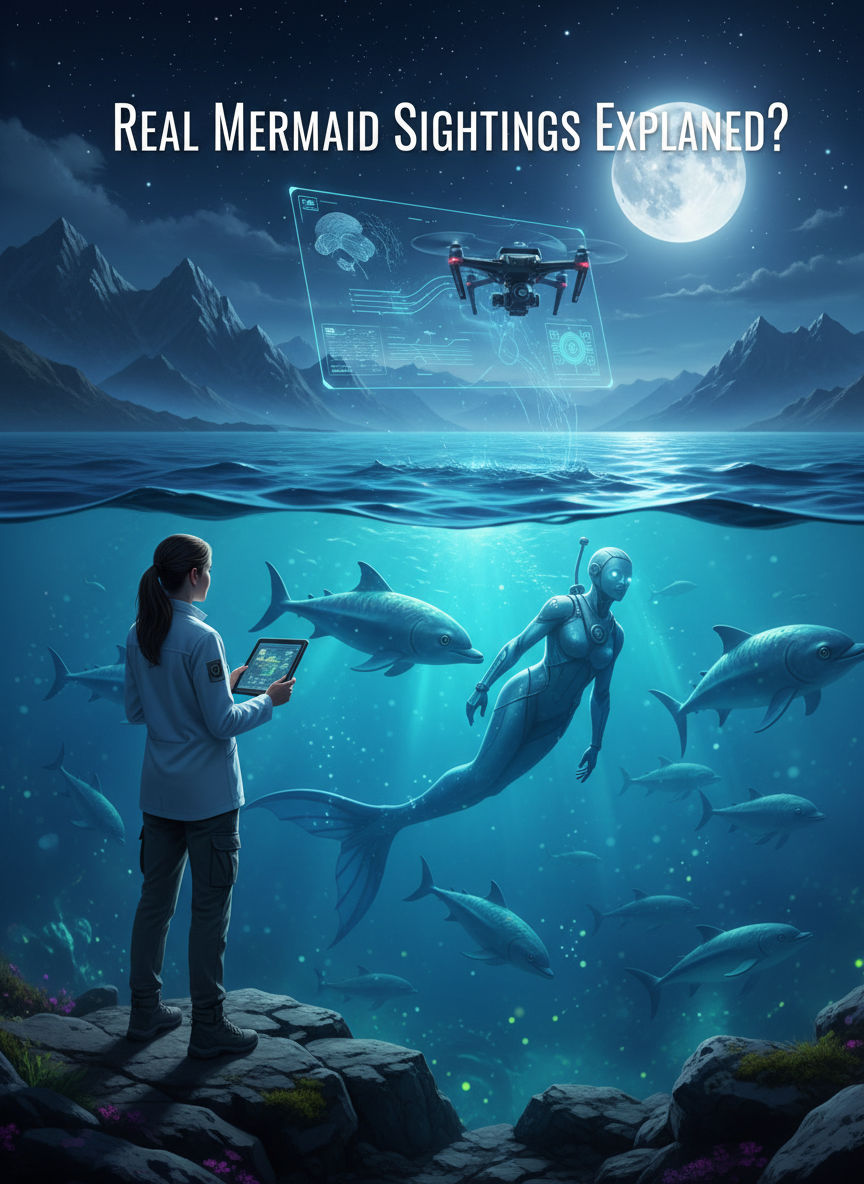
Are mermaids real? The truth behind the ocean's greatest myth.
Prompted by A NerdSip Learner
Discover the real animals behind mermaid sightings.
In January 1493, while sailing near the Dominican Republic, Christopher Columbus made a fascinating entry in his ship's log. He claimed to have spotted three mermaids rising high out of the sea.
However, the famous explorer was incredibly disappointed. He famously noted that these legendary creatures were 'not half as beautiful as they are painted,' and complained that they had distinctly masculine facial features.
What Columbus actually saw were manatees. These gentle, slow-moving aquatic mammals often bob at the surface of the water to breathe. In a brilliant nod to this historical mix-up, scientists eventually classified manatees and their close relatives, the dugongs, under the biological order *Sirenia*.
The name *Sirenia* is a direct reference to the sirens, the alluring and dangerous mythical women of the sea from ancient Greek folklore. So, while mermaids might be mythical, their legacy lives on in official marine biology!
Key Takeaway
Early explorers mistook manatees for mermaids, leading to the biological classification 'Sirenia.'
Test Your Knowledge
What animal did Christopher Columbus most likely mistake for a mermaid?
How could experienced sailors possibly mistake a 1,000-pound, bulbous sea cow for a beautiful half-human maiden? The answer lies in the harsh realities of historical sea travel.
Sailors spent months or even years on open water, surviving on poor diets that often led to nutritional deficiencies like scurvy. Combine extreme physical exhaustion with severe homesickness, and the human brain becomes highly susceptible to suggestion.
This brings us to a psychological phenomenon called pareidolia. Pareidolia is the brain's natural tendency to impose familiar patterns—like human faces or bodies—onto ambiguous shapes. When peering through the fog, a manatee performing a 'tail-stand' in shallow water suddenly looked like a person.
Furthermore, unlike most marine animals, manatees have flexible neck vertebrae that allow them to turn their heads from side to side, much like a human. To a lonely, exhausted sailor, this simple biological quirk was all the proof they needed.
Key Takeaway
Exhaustion and pareidolia tricked sailors' brains into seeing human forms in marine wildlife.
Test Your Knowledge
What is 'pareidolia'?
You might assume that mermaid sightings ended in the modern era of HD cameras and advanced marine biology. However, the myth experienced a massive, controversial resurgence as recently as 2012.
That year, the television network Animal Planet aired a wildly popular special called *Mermaids: The Body Found*. The program featured compelling underwater footage, dramatic interviews with researchers, and a government cover-up narrative regarding a mysterious aquatic ape.
Millions of viewers were stunned, believing they were watching a factual documentary. In reality, it was a docufiction—a mockumentary designed purely for entertainment. The footage was entirely CGI, and the passionate 'scientists' on screen were actually paid actors reading a script.
The public reaction was so overwhelming that the US National Oceanic and Atmospheric Administration (NOAA) was flooded with inquiries. The government agency was ultimately forced to release an official, public statement confirming that 'no evidence of aquatic humanoids has ever been found.'
Key Takeaway
A highly convincing 2012 mockumentary tricked millions into believing mermaids were real, prompting a government denial.
Test Your Knowledge
Why did the US government (NOAA) issue a statement about mermaids in 2012?
Track your progress, earn XP, and compete on leaderboards. Download NerdSip to start learning.