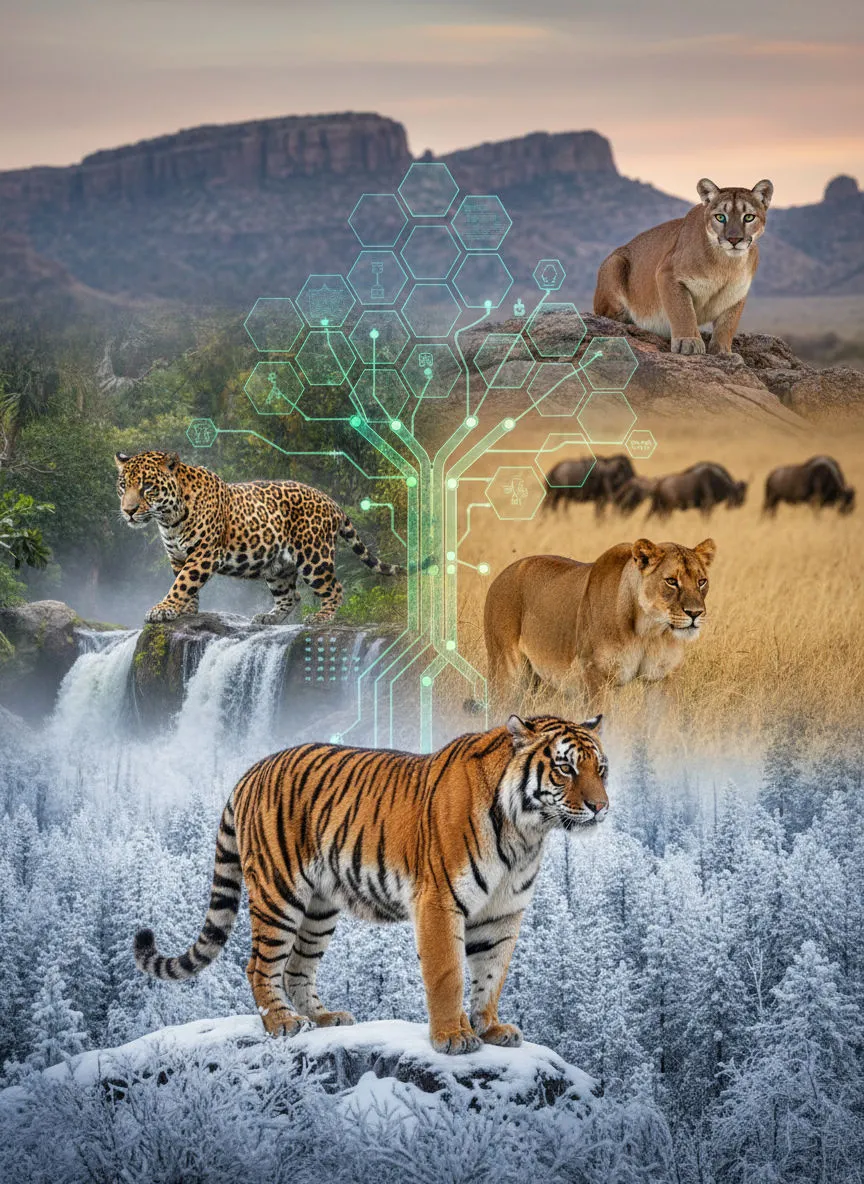
Which massive cat truly rules the wild, and how do they hunt?
Prompted by A NerdSip Learner
Master the traits of the top 3 big cats.
Meet the tiger, the true heavyweight champion of the feline world. Stretching up to 10 feet long and sometimes weighing well over 600 pounds, these solitary giants are the largest wild cats on Earth.
Unlike pack hunters, tigers rely completely on the element of surprise. Their iconic striped coats act as perfect camouflage in tall grass and dense forests. They are ambush predators, stalking their prey silently before launching a devastatingly fast and powerful attack.
Tigers possess incredible muscle density and a bite force that can easily snap the spine of massive prey. Because they hunt alone, every strike must be meticulously calculated; a missed meal or an injury can be life-threatening for a solo hunter.
From the freezing forests of Russia to the sweltering jungles of India, the tiger's adaptability makes it one of nature's most formidable apex predators. Despite their immense power, they are highly endangered, making every surviving individual a vital piece of the global ecosystem.
Key Takeaway
Tigers are the largest and heaviest wild cats in the world, relying on solitary stealth and immense explosive power to ambush prey.
Test Your Knowledge
Why must tigers be highly calculated and careful when hunting?
Taking the silver medal in size is the majestic lion. Weighing up to roughly 500 pounds, the lion is the second-largest big cat, but it holds a truly unique distinction in the feline world: it is the only highly social cat.
Lions live in family groups called prides, which fundamentally changes how they operate as hunters. Instead of relying purely on solitary stealth, lions use the power of teamwork. The females, or lionesses, are the primary hunters of the pride.
Working together, these females use complex, coordinated flanking maneuvers to trap fast-moving prey on the open savanna. While the females do most of the hunting, the larger, mane-draped males serve as the pride's heavy enforcers.
Males protect the territory from rivals and step in to help muscle down exceptionally large prey, like buffalo. This cooperative lifestyle allows lions to secure food more consistently than solitary cats, proving that teamwork is a brilliant survival tool.
Key Takeaway
Lions rank second in size but stand out as the only truly social big cats, utilizing coordinated teamwork to take down prey.
Test Your Knowledge
What is the primary hunting role of the male lion in a pride?
Rounding out the top three is the jaguar, the undisputed heavyweight of the Americas. While smaller than tigers and lions—weighing up to around 210 pounds—the jaguar is famously robust, sporting a broad head, short legs, and incredibly powerful jaws.
What truly sets the jaguar apart is its highly unique hunting technique. Most big cats kill by biting the throat to suffocate their prey. The jaguar, however, delivers a fatal, bone-crushing bite directly to the skull or neck of its target. Their bite is so uniquely powerful it can easily pierce the shells of turtles and the tough hides of armored reptiles.
Furthermore, jaguars are the water-lovers of the big cat family. They are exceptional swimmers and regularly hunt in the rivers of the Amazon rainforest.
Unlike most domestic cats that despise getting wet, the jaguar embraces the water to dominate a completely different ecosystem, making it a perfectly adapted amphibious hunter.
Key Takeaway
Jaguars are the third-largest felines, famous for their aquatic agility and a unique, skull-crushing hunting technique.
Test Your Knowledge
How does the jaguar's killing bite differ from most other big cats?
Track your progress, earn XP, and compete on leaderboards. Download NerdSip to start learning.