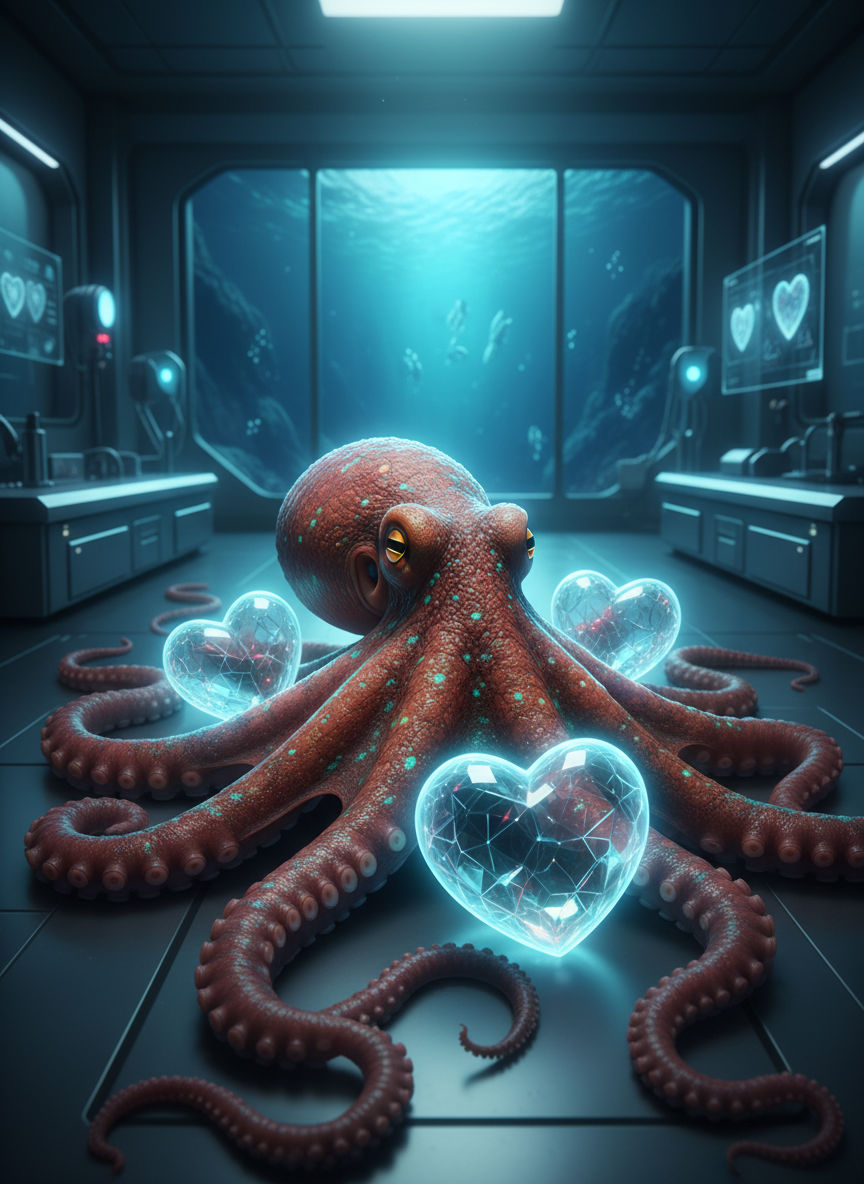
Why do octopuses have blue blood and three hearts?
Prompted by A NerdSip Learner
Master the bizarre anatomy of the ocean's smartest invertebrate.
Have you ever wondered why an octopus needs more than one heart? It comes down to their incredibly unique anatomy. Octopuses are equipped with three separate hearts, acting together like a highly specialized pumping station.
Two of these are called branchial hearts. Think of them as the intake pumps. Their sole job is to pump blood directly through the octopus's two gills to soak up as much oxygen as possible from the ocean water.
Once the blood is fully loaded with oxygen, it travels to the third heart, known as the systemic heart. This is the main engine. It takes that oxygen-rich blood and forcefully pumps it throughout the octopus's entire body, reaching all eight of its flexible arms and its massive brain.
Without this tag-team approach, the octopus wouldn't be able to survive. The three-heart system ensures that oxygen is efficiently distributed, keeping these brilliant creatures moving, thinking, and hunting in the deep sea.
Key Takeaway
Octopuses use two hearts to pump blood to their gills and a third heart to pump oxygenated blood to the rest of their body.
Test Your Knowledge
What is the specific job of the two branchial hearts?
If you were to scrape your knee, you'd see red blood. That’s because human blood contains iron, which binds to oxygen. But if an octopus gets a paper cut, its blood is literally blue.
Instead of iron, octopuses use a copper-rich protein called hemocyanin to transport oxygen. When this copper-based protein binds with oxygen, it turns a striking shade of blue.
Why use copper? In the freezing, low-oxygen depths of the ocean where octopuses evolved, hemocyanin is actually much more efficient at carrying oxygen than our iron-based blood. It’s a perfect evolutionary lifehack for surviving in extreme marine environments.
However, there is a catch. This copper-rich blood is much thicker and more viscous than human blood. It’s so incredibly thick that a single heart simply isn't strong enough to circulate it. That is exactly why the octopus relies on its three-heart system to generate enough pressure to keep that thick blue blood moving!
Key Takeaway
Octopus blood is blue because it uses a copper-rich protein called hemocyanin, which is highly efficient in cold, low-oxygen water.
Test Your Knowledge
Why is an octopus's blood blue instead of red?
When you picture an octopus, you probably imagine it gliding gracefully through the open ocean. Surprisingly, octopuses actually hate swimming! They much prefer to "walk" or crawl along the seafloor using their suction-cupped arms.
The reason for this comes down to a bizarre biological design flaw. Whenever an octopus swims forward using fast jet propulsion, its main systemic heart completely stops beating.
Imagine if your heart stopped every time you went for a jog! Because the blood flow to their organs and brain is temporarily cut off, swimming is incredibly exhausting for them. They quickly run out of oxygen and energy.
Therefore, swimming is strictly reserved for emergencies, like escaping a hungry predator. For everyday hunting and exploring, crawling is the most energy-efficient choice. It allows their three-heart system to keep pumping normally, ensuring they stay alert and ready for action.
Key Takeaway
An octopus's main heart stops beating when it swims, making the activity so exhausting that they prefer to crawl.
Test Your Knowledge
Why do octopuses prefer crawling on the seafloor instead of swimming?
Track your progress, earn XP, and compete on leaderboards. Download NerdSip to start learning.