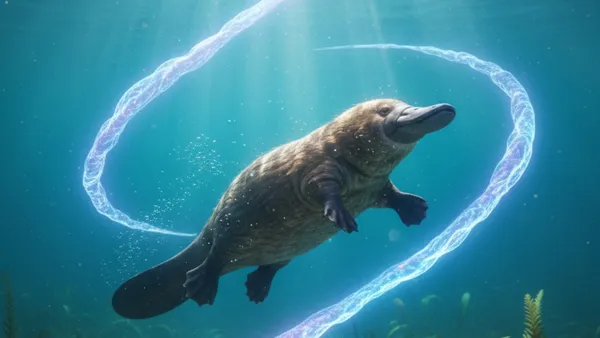
Did you know that the platypus is one of the only mammals that lays eggs and is venomous?
Prompted by A NerdSip Learner
Explore the bizarre genetics of nature’s most confused-looking mammal.
When European scientists first examined a platypus specimen, they famously thought it was a prank—a duck’s bill sewn onto a beaver’s body. Today, we know the truth is even stranger. The platypus is a monotreme, a rare type of mammal that lays eggs instead of giving birth to live young.
Recent sequencing of the platypus genome has revealed exactly why this creature is so wonderfully weird. Their DNA is an evolutionary time capsule, featuring a bizarre mashup of genetic traits belonging to mammals, birds, and reptiles. It is believed that monotremes branched off from our shared ancestors roughly 160 to 170 million years ago.
By retaining ancient reptilian traits—like egg-laying—while simultaneously developing mammalian features like fur and milk production, the platypus serves as a living bridge to our distant evolutionary past. It is nature’s ultimate remix!
Key Takeaway
The platypus genome is a genetic time capsule, containing a mix of mammalian, reptilian, and avian features.
Test Your Knowledge
What does the platypus genome reveal about its evolutionary history?
In humans and most other mammals, biological sex is determined by just two sex chromosomes: XX for females and XY for males. The platypus, however, plays by its own genetic rules.
A male platypus has a staggering 10 sex chromosomes: five X and five Y. During the production of sperm, these 10 chromosomes link up in an intricate, alternating chain to ensure they divide correctly.
Even more surprising is the origin of these chromosomes. When scientists compared platypus sex chromosomes to those of other animals, they discovered they share more in common with the Z chromosomes of birds than with the X and Y chromosomes of humans. It’s yet another example of how this creature blurs the lines between different animal classes.
Key Takeaway
Platypuses have an incredibly complex system of 10 sex chromosomes that bear striking similarities to those of birds.
Test Your Knowledge
How many sex chromosomes does a male platypus have?
While venom is usually associated with snakes and spiders, the platypus is one of the few venomous mammals on Earth. Male platypuses possess sharp, hollow spurs on their hind legs that can deliver a highly painful venom. This defensive weapon is primarily used when competing with other males during the breeding season.
The genetics behind this venom are fascinating. The platypus produces venom by repurposing defensins—genes originally designed for the immune system.
Interestingly, some reptiles also use modified defensin genes to produce their venom. However, the platypus didn't inherit its venomous abilities directly from reptiles. Instead, this is a prime example of convergent evolution: two completely different animal lineages independently evolving the exact same biological trick!
Key Takeaway
Male platypuses deliver venom through hind leg spurs, an ability that evolved independently from reptiles through duplicated immune genes.
Test Your Knowledge
Where does the male platypus deliver its venom from?
A platypus hunting underwater is a masterclass in sensory adaptation. The moment a platypus dives, it seals its eyes, ears, and nostrils completely shut. So, how does it find its food in the murky depths without seeing, hearing, or smelling?
The secret lies in its iconic, duck-like bill. The bill is packed with thousands of highly specialized receptors that can detect faint electrical fields.
Every time a tiny shrimp or worm flexes a muscle, it generates a microscopic electrical signal. The platypus sweeps its bill from side to side to pick up on these signals, effectively hunting using electroreception. It’s a literal "sixth sense" that allows this remarkable mammal to catch its prey entirely in the dark.
Key Takeaway
The platypus hunts blind and deaf underwater, relying entirely on the electrosensory capabilities of its bill.
Test Your Knowledge
How does a platypus locate prey underwater?
Like all mammals, the platypus feeds its young with milk. But because its evolutionary lineage branched off so early, it never evolved nipples or teats.
Instead, a mother platypus secretes milk directly from modified mammary glands in her skin. The milk oozes out much like sweat and pools in special grooves on her abdomen, allowing her babies (called puggles) to simply lap it up from her fur.
Since this feeding method exposes the milk to the bacteria-rich environment of a dirt burrow, the platypus has evolved a brilliant genetic workaround. Platypus milk is heavily fortified with unique, highly potent antibacterial proteins. These proteins protect the vulnerable puggles from infections and are currently being studied by scientists as a potential weapon against antibiotic-resistant superbugs!
Key Takeaway
Platypuses secrete milk through their skin rather than nipples, and their milk contains powerful antibacterial proteins to protect their young.
Test Your Knowledge
How do baby platypuses (puggles) drink milk from their mother?
If you were to look inside a platypus, you would notice a major organ is completely missing: the stomach. In a platypus, the throat connects directly to the intestines.
Millions of years ago, the ancestors of the platypus actually had a stomach. However, over time, the genes responsible for producing stomach acid and digestive enzymes like pepsin were deactivated and eventually lost entirely from their genome.
In evolutionary biology, complex traits that are lost at the genetic level are rarely, if ever, regained. Because the platypus has permanently discarded the genetic instructions for a stomach, it digests its diet of soft-bodied aquatic invertebrates entirely in its intestines. It’s a remarkable example of an evolutionary "use it or lose it" scenario.
Key Takeaway
Platypuses lack a stomach and the genes required for gastric digestion, meaning their food goes straight from the throat to the intestines.
Test Your Knowledge
Why doesn't the platypus have a stomach?
Just when you thought the platypus couldn't possibly pack any more strange traits into one body, scientists recently discovered that it glows in the dark!
When exposed to ultraviolet (UV) light, the normally dull brown fur of a platypus absorbs the UV rays and re-emits them as visible light, giving the animal an eerie blue-green glow. This phenomenon, known as biofluorescence, is found in some amphibians and fish, but it is incredibly rare in mammals.
Scientists aren't entirely sure why the platypus glows. It might serve as a form of camouflage to hide from UV-sensitive nocturnal predators, or it could simply be a harmless chemical byproduct of the structure of their fur. Regardless of the reason, it adds one final, glowing mystery to nature’s most wonderfully confused mammal.
Key Takeaway
Under UV light, a platypus's fur glows blue-green, a rare trait among mammals known as biofluorescence.
Test Your Knowledge
What happens to a platypus when it is exposed to ultraviolet (UV) light?
Track your progress, earn XP, and compete on leaderboards. Download NerdSip to start learning.