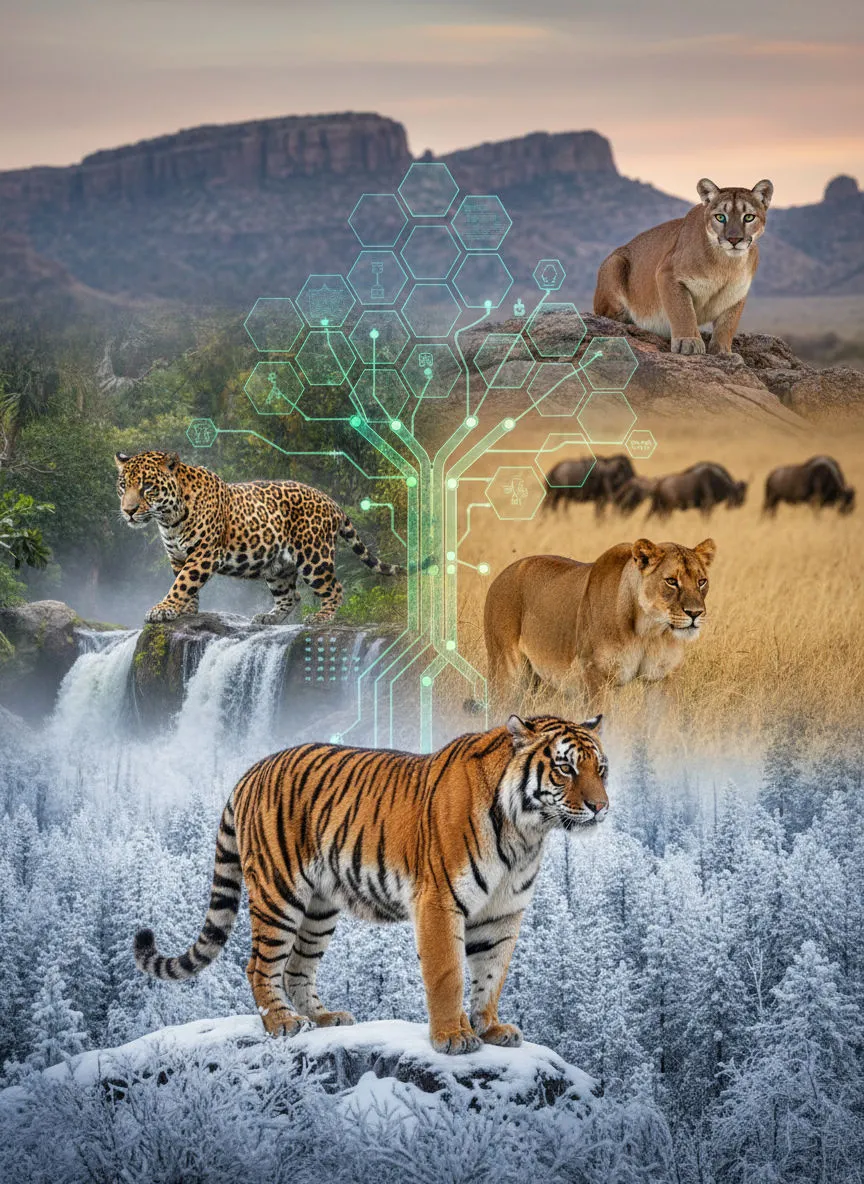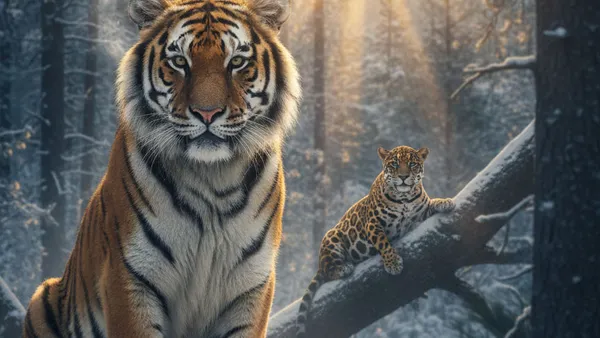
What happens when you scale a housecat to 1,000 pounds?
Prompted by A NerdSip Learner
Uncover the biomechanics of apex feline predators.
While modern Siberian tigers peak around 300 kg (660 lbs), the extinct giants of the Pleistocene shattered these biological limits. Smilodon populator, a massive machairodont (saber-toothed predator) from South America, reached estimated weights exceeding 400 kg (880 lbs). It possessed heavily reinforced, muscular forelimbs designed to wrestle multi-ton Ice Age megafauna to the ground before delivering a fatal, surgical neck bite.
Meanwhile, Panthera atrox, the American Lion, was arguably the largest "true cat" to ever exist. Averaging roughly 25% larger than modern African lions, the biggest males were historically estimated to weigh well over 300 kg, possessing longer and more robust limbs than any living lion today.
These ancient apex predators dominated North and South American ecosystems. However, their extreme specializations ultimately became their downfall. When the climate shifted at the end of the Pleistocene epoch, the giant megafauna they relied upon vanished, taking the titans of the feline world with them.
Key Takeaway
The largest feline hunters in history were heavily specialized Pleistocene giants that evolved to tackle Ice Age megafauna.
Test Your Knowledge
What evolutionary advantage did Smilodon populator's exceptionally robust forelimbs provide?
Why can a tiger roar with enough low-frequency acoustic power to shake the jungle, while a housecat can only purr? The secret lies in a tiny, U-shaped structure in the throat called the hyoid bone.
In the true "roaring cats" (the Pantherinae subfamily, which includes lions, tigers, and jaguars), the hyoid bone is incompletely ossified. Instead of solid bone, it contains flexible cartilage and a highly elastic ligament. This unique elasticity allows the larynx to drop and expand, creating a deep, resonating roar that can travel for miles across open terrain.
However, this incredible acoustic flexibility comes with a strict evolutionary trade-off: roaring cats cannot continuously purr. By contrast, "purring cats" (the Felinae subfamily) have a completely hardened, rigid hyoid bone. This solid structure allows the larynx to vibrate rapidly and continuously during both inhalation and exhalation, producing a rhythmic purr, but physically preventing them from ever producing a roar. Nature demands a choice: vibrate or amplify.
Key Takeaway
A feline can either roar or purr, determined entirely by the rigidity or flexibility of its hyoid bone.
Test Your Knowledge
What anatomical feature is responsible for a big cat's ability to roar rather than purr?
The fourth-largest extant wild cat on Earth isn't technically a "big cat" at all. The Puma (*Puma concolor*), frequently known as the mountain lion or cougar, actually belongs to the Felinae subfamily. This evolutionary placement makes it the undisputed largest purring cat in the world.
Because it shares its direct lineage with smaller felines like domestic housecats, the puma possesses an entirely rigid hyoid bone and cannot roar. Instead, these massive predators communicate with high-pitched chirps, hisses, and terrifying, human-like screams that echo through the mountains.
What the puma lacks in roaring acoustic dominance, it more than makes up for in astonishing explosive biomechanics. Its extraordinarily powerful hind legs are proportionally the longest and largest of any feline. From a complete standstill, an adult puma can leap over 15 feet vertically into a tree, or bound up to 40 feet horizontally, making it an elite, hyper-agile ambush predator.
Key Takeaway
The puma is the world's fourth-largest wild feline, classifying it as the largest cat capable of purring.
Test Your Knowledge
Why is the puma officially classified as the largest "purring cat" rather than a "true big cat"?
Track your progress, earn XP, and compete on leaderboards. Download NerdSip to start learning.