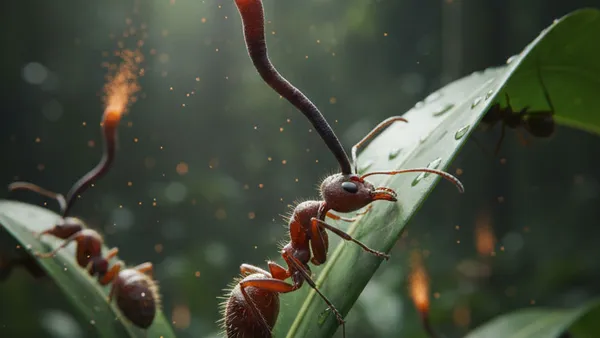
How does a microscopic fungus turn a living ant into a mindless zombie?
Prompted by NerdSip Explorer #6146
Discover the real-world science of zombie mind control.
Imagine walking through a lush, vibrant tropical rainforest. High up in the dense canopy, a worker carpenter ant is busy going about its daily business, foraging for food to bring back to its colony. Suddenly, a microscopic, seemingly harmless spore drifts through the air and lands on the ant’s body. This isn't just any ordinary spore—it belongs to Ophiocordyceps unilateralis, famously known to scientists and nature lovers as the "zombie-ant fungus."
The invasion begins immediately, though the ant doesn't feel a thing. The spore uses specialized, highly targeted enzymes to literally drill a hole through the ant's hard outer shell, known as the exoskeleton. Once inside the body cavity, the fungus begins to grow and thrive.
It secretly multiplies, spreading through the ant's internal systems like a hidden, microscopic network of creeping roots. For the first few days of this infection, the ant acts completely normal. It continues to work and socialize with its sisters. It has absolutely no idea that its body is slowly being compromised by an alien invader, quietly waiting for the perfect moment to take complete control.
Key Takeaway
The zombie-ant fungus begins its takeover by secretly drilling through the ant's exoskeleton and multiplying inside its body.
Test Your Knowledge
How does the fungus first enter the ant's body?
You might naturally assume that to achieve "mind control," the fungus must invade and destroy the ant's brain. But the biological truth is actually much creepier and far more sophisticated! Researchers have discovered that the fungus intentionally leaves the ant's brain completely intact.
Instead of consuming the brain tissue, the invading fungal cells multiply and build an intricate, 3D network around the brain and weave themselves deeply into the ant's muscle fibers. Once in position, the fungus begins to secrete a powerful, custom-made cocktail of chemical compounds and neuromodulators.
These bioactive chemicals act exactly like a biological remote control. They hijack the ant's central nervous system from the outside, drastically altering how the insect responds to environmental stimuli. The ant essentially becomes a trapped prisoner inside its own body. It is fully alive, and its brain is still functioning, but it is no longer the author of its own movements or decisions. The fungus is now the ultimate puppet master pulling the strings.
Key Takeaway
The fungus controls the ant by surrounding its intact brain and muscles with chemicals, acting like a biological remote control.
Test Your Knowledge
Why is the infected ant considered a "prisoner" in its own body?
Once the fungus is firmly in the driver's seat, it forces the worker ant to do something entirely against its natural instincts. First, the fungus induces violent, whole-body convulsions. These spasms cause the infected ant to clumsily fall out of its safe, highly organized home in the tree canopy and plummet down to the dark, leafy forest floor.
But the journey is far from over. The fungal puppet master now commands the ant to start climbing again. It makes the helpless insect crawl up the stem of a small plant or sapling. The fungus guides the ant to a very specific, carefully calculated height—usually about 25 centimeters (or 10 inches) above the soil.
Why choose this exact height? Scientific studies show that this specific micro-environment possesses the absolute perfect balance of temperature and humidity for the fungus to thrive. The ant isn't just a host; it is being driven like a stolen delivery vehicle to secure the ultimate piece of fungal real estate!
Key Takeaway
The fungus forces the ant to climb to a specific height where the temperature and humidity are perfect for fungal growth.
Test Your Knowledge
Why does the fungus make the ant climb to about 25 cm above the ground?
When the heavily infected ant finally reaches that perfect 25-centimeter mark on the plant, the fungus initiates its final, fatal command. It forces the ant to open its jaws and bite down onto the main vein on the underside of a leaf with all the strength it can muster.
This terrifying behavior is known in the scientific community as the "death grip." To ensure the ant doesn't let go, the fungus goes to extreme measures. It actually grows directly into the ant's jaw muscles, separating the muscle fibers and physically locking them into place. Simultaneously, it destroys the motor neurons, meaning the muscles atrophy and freeze permanently.
Even after the ant slowly dies of starvation and fungal consumption, its jaws remain tightly clamped shut. The insect's lifeless body is permanently anchored to the leaf, providing a stable, weather-resistant platform for the victorious fungus to safely complete its gruesome, incredible lifecycle.
Key Takeaway
The "death grip" permanently anchors the ant to a leaf because the fungus physically locks the jaw muscles in place.
Test Your Knowledge
What physically causes the ant's "death grip" to be permanent?
With the ant dead and securely fastened to the underside of the leaf, the fungus moves into its final, most visible phase. Over the next few weeks, a long, dramatic stalk-like structure—called a fruiting body—begins to erupt directly out of the back of the dead ant's head. It looks like something straight out of a science fiction movie!
This stalk slowly matures, absorbing the last remaining nutrients from the ant's hollowed-out shell. Once it is fully grown and ready, the tip of the fruiting body acts like a microscopic, biological cannon. It forcefully ejects thousands of fresh, infectious fungal spores, sending them raining down onto the forest floor below.
This location is no accident. Because the ant was forced to die directly above the established foraging trails of its former colony, the invisible spores shower down exactly where other unsuspecting worker ants are walking. The trap is set, and the incredible cycle of the zombie-ant fungus begins all over again!
Key Takeaway
A fungal stalk grows out of the dead ant's head to drop new spores onto unsuspecting ants walking below.
Test Your Knowledge
What is the primary purpose of the stalk that grows out of the ant's head?
Track your progress, earn XP, and compete on leaderboards. Download NerdSip to start learning.