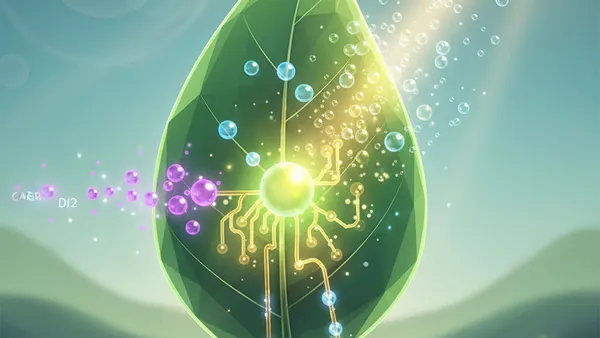
How do plants turn thin air and sunshine into food?
Prompted by A NerdSip Learner
Understand how plants create food and oxygen.
Imagine you are hungry but you cannot walk to the fridge or drive to a restaurant. You are completely rooted to the ground! What do you do? If you are a plant, you just stand in the sun and make your own food out of thin air. This amazing superpower is called photosynthesis.
To cook up a delicious meal, a plant needs just three basic ingredients from its environment. First, it needs sunlight, which provides the essential energy to get things cooking. You can think of the sun as the oven that bakes the food.
Second, the plant needs water, which it drinks up from the deep soil using its vast network of roots. Finally, it takes in carbon dioxide, an invisible gas floating in the air that humans and animals breathe out.
When a plant successfully gathers these three ingredients—sunlight, water, and carbon dioxide—it has absolutely everything it needs to fire up its internal food factory and survive!
Key Takeaway
Plants act like tiny chefs, combining sunlight, water, and carbon dioxide to start making their own food.
Test Your Knowledge
Which three ingredients does a plant need for photosynthesis?
So, how exactly does a plant catch the sunlight it needs to cook its food? The secret lies in a special green pigment called chlorophyll.
Chlorophyll is what gives leaves their beautiful, vibrant green color. But it does so much more than just make the plant look pretty! You can think of chlorophyll as thousands of microscopic solar panels built directly into the plant's leaves.
When sunlight beams down and hits the leaves, these biological solar panels spring into action to trap the light energy. This trapped energy acts just like electricity in a machine, powering the plant's inner factory to actively mix the water and carbon dioxide together.
Without chlorophyll, plants simply would not be able to grab the sun's powerful energy, and the entire food-making process would immediately shut down. It is the absolute key to plant survival on Earth!
Key Takeaway
Chlorophyll is a green pigment in leaves that acts like a microscopic solar panel to trap the sun's energy.
Test Your Knowledge
What is the main job of chlorophyll in a plant?
Now that the plant has perfectly mixed its ingredients using the power of the sun, what exactly comes out of its biological oven? The plant creates two incredibly important things: sugar and oxygen.
The sugar is the plant's actual food. It uses this sweet energy to grow taller, sprout new leaves, and eventually produce beautiful flowers or tasty fruits. It is just like the plant making its very own energy drink from scratch!
But here is the absolute best part for us: as a natural byproduct of making that sugar, the plant releases oxygen back into the air. This is the exact same fresh oxygen that humans and animals need to breathe every single second.
So, every time you take a deep, refreshing breath, you can thank a plant! Through the magic of photosynthesis, plants successfully feed themselves and provide the vital oxygen that keeps the entire planet alive.
Key Takeaway
Photosynthesis produces sugar to feed the growing plant and releases oxygen for us to breathe.
Test Your Knowledge
What two important things do plants create during photosynthesis?
Track your progress, earn XP, and compete on leaderboards. Download NerdSip to start learning.