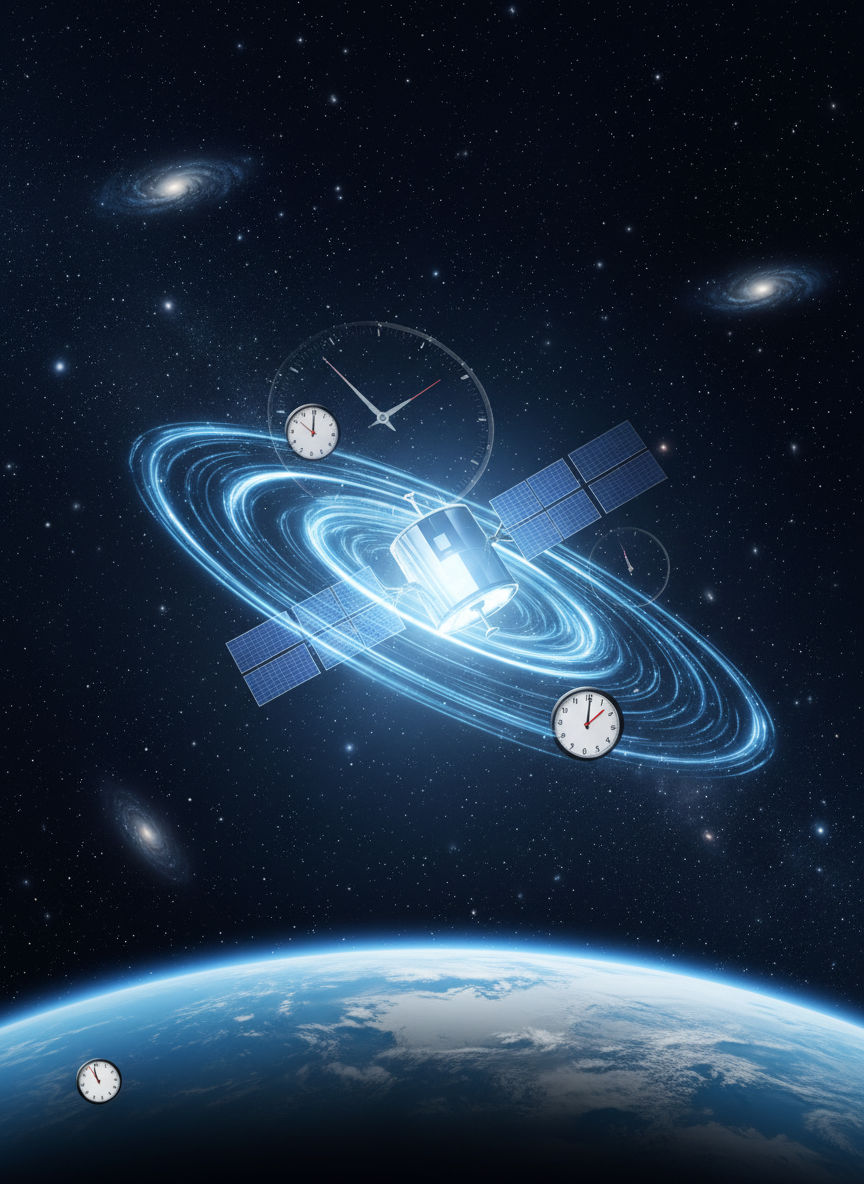
Why does time tick differently in space? Einstein has the answer.
Prompted by A NerdSip Learner
Master the physics of time dilation.
Have you ever wished you could slow down time? According to Albert Einstein, you actually can—you just need to move incredibly fast!
In his theory of Special Relativity, Einstein revealed that time is not a fixed, universal ticking clock. Instead, it is flexible. The faster you move through space, the slower you move through time relative to people standing still. This is known as velocity time dilation.
Think of it like sharing a fixed budget between moving through space and moving through time. If you spend more energy zooming through space, you have less left over for aging!
Satellites orbit the Earth at blistering speeds. The International Space Station (ISS), for example, tears through the sky at roughly 17,500 miles per hour (28,000 km/h). Because it is moving so fast, a clock on the ISS naturally ticks slower than a clock sitting on your nightstand.
Key Takeaway
The faster an object moves through space, the slower it moves through time.
Test Your Knowledge
What happens to a clock's ticking rate as it travels at extremely high speeds?
Speed isn't the only thing that messes with our clocks. Gravity has its own mind-bending tricks, thanks to Einstein's revolutionary General Relativity.
Einstein discovered that massive objects like planets and stars literally bend the fabric of the universe, creating what we feel as gravity. This invisible bending also warps time. The rule of thumb is surprisingly simple: the stronger the gravity, the slower time passes.
Down here on Earth's surface, we are sitting deep inside our planet's gravitational well. Time is constantly being dragged down and slowed. But as you travel upward—into the sky and out into the vastness of space—Earth's gravitational grip steadily gets weaker.
Because satellites are orbiting hundreds or thousands of miles above the surface, they experience far less gravity than we do on the ground. Escaping that heavy gravitational pull means that, from their perspective, time is unleashed. Therefore, just based on gravity alone, a satellite's clock will tick faster than ours!
Key Takeaway
Weaker gravity at higher altitudes causes time to speed up compared to the surface.
Test Your Knowledge
Why does weaker gravity cause a satellite's clock to tick differently than a clock on Earth?
So, we have a fascinating cosmic paradox! Two of Einstein's mind-blowing theories are actively fighting against each other inside every single satellite.
On one side of the battle, we have Special Relativity. The satellite is flying around the Earth at thousands of miles per hour. This extreme, blistering speed pulls time backward, making the onboard clocks naturally run slower.
On the exact opposite side, we have General Relativity. The satellite is floating high above the Earth, far away from our planet's heavy, dragging gravitational pull. This weaker gravity pushes time forward, making the onboard clocks naturally run faster.
Every single object in orbit is permanently caught in this invisible tug-of-war. Speed constantly hits the brakes on time, while high altitude constantly hits the gas pedal. Which force actually wins? It entirely depends on exactly how high up the satellite is, and how fast it has to move to stay in that specific orbit.
Key Takeaway
Satellites experience a tug-of-war where speed slows time down, but high altitude speeds time up.
Test Your Knowledge
Which two forces are competing to alter the flow of time on a satellite?
Let's look at the scoreboard of this cosmic tug-of-war by comparing two famous examples: the ISS and our GPS satellites.
The International Space Station (ISS) sits in Low Earth Orbit, about 250 miles (400 km) up. Because it is so close to Earth, it has to move incredibly fast to avoid falling back down. Here, the sheer speed dominates the equation. Speed wins the tug-of-war, meaning time actually moves slower for astronauts. After six months in space, they return a tiny fraction of a second younger!
But GPS satellites live much further out—roughly 12,500 miles (20,000 km) high. Up there, they don't need to orbit as fast, and Earth's gravity is drastically weaker. For GPS satellites, the lack of gravity is the dominating force. Gravity wins the tug-of-war, meaning time actually moves faster for a GPS satellite by roughly 38 microseconds every single day!
Key Takeaway
Time moves slower on the ISS due to extreme speed, but faster on GPS satellites due to weaker gravity.
Test Your Knowledge
Why does time move faster on a GPS satellite compared to the ISS?
You might be thinking, "Who cares about a few microseconds?" Well, your smartphone does! It relies entirely on this cosmic math.
GPS works by measuring the exact time it takes for radio signals to travel from multiple satellites down to your phone. Because light travels so unbelievably fast, even a microscopic error in timekeeping will completely ruin the calculation of physical distance.
Remember that a GPS satellite's clock runs about 38 microseconds faster per day than a clock on Earth. If software engineers didn't program the satellites to artificially "slow down" and correct for Einstein's theories, the global network would fail almost instantly.
Within a single day, your navigation app would be off by about 7 miles (11 kilometers). By the end of the week, Google Maps would place your local coffee shop in the middle of the ocean! The fact that you can find your way to a new restaurant is daily proof that Einstein was right.
Key Takeaway
GPS systems must mathematically correct for time dilation, or global navigation would fail within hours.
Test Your Knowledge
What would happen if GPS satellites didn't mathematically correct for time dilation?
Track your progress, earn XP, and compete on leaderboards. Download NerdSip to start learning.