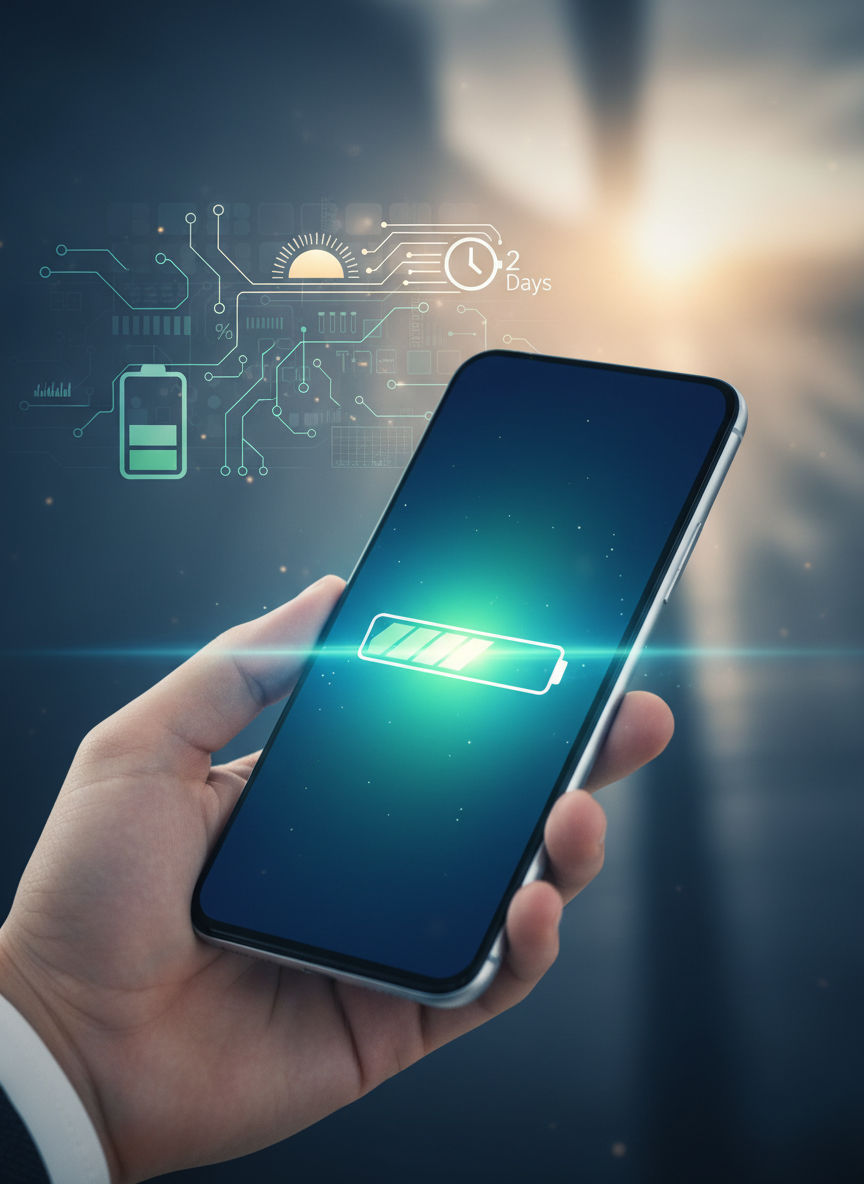
How do modern phones actually survive 48 hours without a charger?
Prompted by A NerdSip Learner
Discover the 3 tech breakthroughs killing daily charging.
Have you noticed phones aren't getting thicker, but their batteries last remarkably longer? The secret is a massive chemistry upgrade hidden inside your device.
For years, smartphone batteries relied on a standard graphite anode to store lithium ions. It worked reliably well, but graphite has a strict chemical limit on how much energy it can hold. Think of it like a rigid, hard-shell suitcase—once it's perfectly packed full, you simply cannot force more clothes inside.
Enter the era of Silicon-Carbon batteries. Silicon acts like a magical sponge for energy, capable of chemically bonding with significantly more lithium ions than graphite. By carefully blending silicon with carbon to prevent the battery from swelling too much during charging, engineers created a flexible new 'suitcase' that expands to hold roughly 40% more power in the exact same physical space!
This incredible breakthrough allows modern smartphones to pack massive 6,000mAh to 7,000mAh batteries into ultra-slim glass designs. It essentially gives you a full second day of charge without adding heavy, awkward bulk to your pocket.
Key Takeaway
Silicon-carbon batteries store vastly more energy in the same physical space compared to older graphite technology.
Test Your Knowledge
Why did smartphone makers switch from pure graphite to silicon-carbon blends for batteries?
Your phone's processor is the tiny engine driving everything from sending a quick text to rendering a massive 3D game. But running a powerful sports car engine all the time would drain your gas tank in a few hours.
To fix this massive power drain, modern phone chips use an ingenious architecture often called 'big.LITTLE.' Instead of relying on one single, massive brain to do all the work, your phone has a diverse team of different-sized processing cores.
The 'Performance Cores' are the heavy lifters of the group. They eagerly wake up when you are editing high-resolution video or playing intense games. They consume a lot of battery power, but they get the job done instantly.
The real heroes of a two-day battery life, however, are the 'Efficiency Cores.' These tiny, low-power processing units handle background tasks like syncing your emails, playing Spotify, or receiving text messages. They sip battery power like a hybrid car in eco-mode, allowing the heavy-lifting performance cores to stay completely asleep for most of the day!
Key Takeaway
Your phone saves power by using tiny 'efficiency cores' for basic tasks and only waking up 'performance cores' when you need heavy lifting.
Test Your Knowledge
What is the main job of the 'Efficiency Cores' in your smartphone?
Historically, the glowing display has been the absolute biggest battery drain on any smartphone. Every single time your screen flashes to show a new frame, it costs precious electrical energy.
Older phones refreshed their screens 60 times a second (60Hz), no matter what you were actually doing. Whether you were playing a frantic, fast-paced racing game or just staring at a totally static photograph, the screen was chugging battery power at the exact same relentless rate.
Today's secret weapon for battery longevity is the LTPO display. This brilliant piece of technology allows your screen's refresh rate to dynamically shift on the fly based on your visual needs.
If you are scrolling quickly, the screen boosts up to 120Hz for buttery smoothness. But the moment you stop to read a static text message, the screen instantly drops its refresh rate to just 1 time per second (1Hz). By not redrawing a static image unnecessarily, your phone saves a staggering amount of battery life over a 48-hour period!
Key Takeaway
Modern LTPO screens dynamically slow down their refresh rate when you look at static images, saving massive amounts of power.
Test Your Knowledge
How does an LTPO display save battery when you are reading a static block of text?
Track your progress, earn XP, and compete on leaderboards. Download NerdSip to start learning.