Could the genetic recipe for life have actually come from deep space?
Prompted by A NerdSip Learner
Discover how an asteroid carries DNA's building blocks.
Imagine trying to grab a handful of dirt from a speeding bullet in the pitch black of night. In 2014, Japan's space agency (JAXA) launched the Hayabusa2 spacecraft to do something almost as difficult: intercept a near-Earth asteroid named Ryugu.
Ryugu is a diamond-shaped, carbon-rich space rock orbiting the Sun. Scientists view it as a perfectly preserved time capsule from roughly 4.6 billion years ago, dating back to the chaotic era when our solar system's planets were just beginning to form.
In 2018, Hayabusa2 didn't just passively orbit Ryugu. It boldly swooped down, fired a tiny projectile to stir up the ancient surface, and carefully collected about 5.4 grams of pristine rock and dust.
In 2020, those precious samples were safely dropped back to Earth in a securely sealed capsule. This detail is absolutely crucial! Because the capsule was perfectly airtight, scientists knew any complex chemicals found inside were genuinely forged in deep space, entirely ruling out any chance of accidental contamination from Earth's environment.
Key Takeaway
Hayabusa2 brought back pristine, uncontaminated rock from a 4.6-billion-year-old asteroid named Ryugu.
Test Your Knowledge
Why was it absolutely crucial that the Ryugu samples were kept in a perfectly sealed capsule?
Before we dive into exactly what scientists discovered inside the Ryugu samples, let's take a quick look at the biological alphabet that makes life possible.
You have likely heard of DNA, the famous double-helix molecule that acts as the ultimate genetic instruction manual for all living things. DNA is held together by structural "rungs" known as nucleobases.
You can think of nucleobases as molecular Lego bricks. In DNA, there are four main types: Adenine (A), Thymine (T), Cytosine (C), and Guanine (G). There is also a hard-working cousin molecule called RNA, which is responsible for translating those DNA instructions. RNA swaps out Thymine for a slightly different nucleobase called Uracil (U).
Every plant, animal, and human on Earth relies entirely on these exact same five chemical letters to grow, heal, and function. For decades, researchers have pondered a massive question: did Earth cook up these complex biological letters completely on its own, or did it receive a cosmic delivery from space?
Key Takeaway
Nucleobases are the fundamental chemical "letters" (A, C, G, T, and U) that make up the genetic code in DNA and RNA.
Test Your Knowledge
Which of these nucleobases is typically found in RNA instead of DNA?
When astrobiologists finally cracked open the Ryugu samples and gently soaked the asteroid dust in hot water to extract its secrets, they were absolutely stunned by the results.
In 2023, researchers proudly announced they had discovered Uracil—one of the key RNA letters we just learned about—hidden right there in the ancient asteroid rock. Finding this essential building block of genetic information on a lifeless space rock was considered a massive breakthrough for science.
But the surprises didn’t stop at Uracil! The team also found Nicotinic acid, a chemical compound you might know better as Vitamin B3 or niacin. This familiar vitamin is incredibly important for maintaining healthy cellular metabolism in living organisms.
This remarkable discovery proved that the complex organic chemistry needed for life doesn't require a warm, cozy planet with oceans to form. Instead, these vital, life-supporting molecules were actively being forged out in the freezing, highly irradiated vacuum of deep space!
Key Takeaway
Initial tests on the uncontaminated Ryugu samples revealed the surprising presence of Uracil and Vitamin B3.
Test Your Knowledge
What common nutritional supplement was discovered alongside Uracil in the asteroid samples?
The astonishing story of asteroid Ryugu didn't end with the discovery of Uracil. In March 2026, an incredible new study published in the journal *Nature Astronomy* dropped a total scientific bombshell.
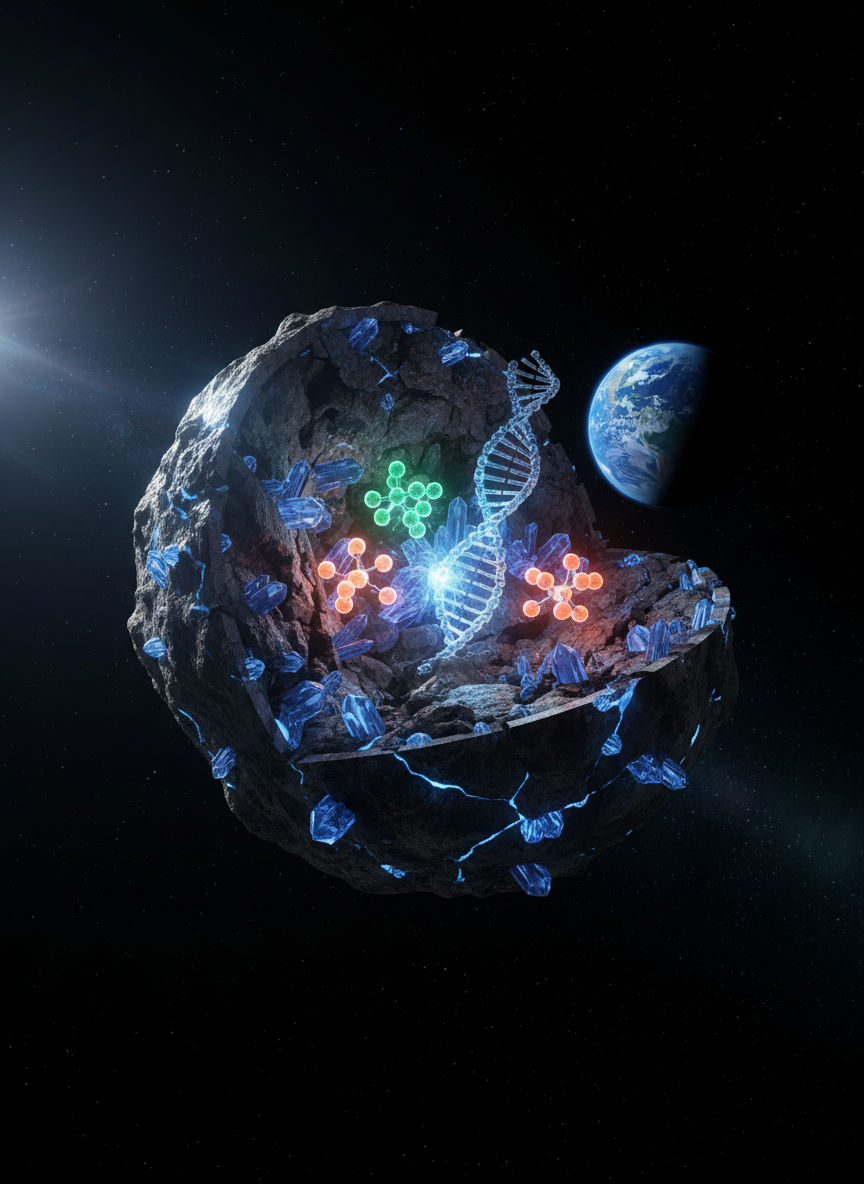
Using highly advanced, incredibly sensitive mass spectrometry technology, scientists analyzed the Ryugu samples again. This time, they successfully detected the rest of the missing puzzle pieces: Adenine, Guanine, Cytosine, and Thymine!
That means all five canonical nucleobases—the complete set of chemical letters required for both DNA and RNA—were officially found buried in the pristine asteroid dirt.
This was a truly unprecedented milestone. While a few of these bases had been spotted in fallen meteorites before, there was always a lingering fear that those rocks had just been contaminated by Earth's soil after they crashed. Finding the entire, complete set on a surgically sealed sample retrieved directly from Ryugu confirms beyond a shadow of a doubt that the full "starter kit" for genetic material naturally exists in outer space.
Key Takeaway
In 2026, scientists confirmed that all five major nucleobases for DNA and RNA are present on asteroid Ryugu.
Test Your Knowledge
Why was the 2026 discovery on Ryugu considered such an unprecedented scientific milestone?
So, what does this actually mean? Does finding DNA bases on asteroid Ryugu imply that there are space aliens or tiny microbes living on asteroids? Not quite!
Scientists are very careful to point out that these nucleobases are just the raw *ingredients* of life, not life itself. You can think of it like finding a bag of flour, some sugar, and eggs sitting on a kitchen counter—it definitely doesn’t mean you have a fully baked cake yet!
However, this mind-blowing discovery provides a massive boost to the theory of cosmic delivery. It suggests that the early Earth didn't have to invent the chemistry of life from scratch. Billions of years ago, carbon-rich asteroids just like Ryugu likely crashed into our young, barren planet, delivering a massive payload of these complex chemical building blocks.
These space-born molecules may have splashed into Earth's primordial soup, providing the exact chemical inventory needed to eventually kickstart the very first living biological cells.
Key Takeaway
Asteroids like Ryugu likely crashed into early Earth, delivering the essential chemical ingredients needed to kickstart life.
Test Your Knowledge
What does the presence of DNA bases on Ryugu actually suggest about life on Earth?
Track your progress, earn XP, and compete on leaderboards. Download NerdSip to start learning.