What if you woke up to a gas giant dominating the sky?
Prompted by A NerdSip Learner
Understand the physics of swapping the Moon for Saturn.
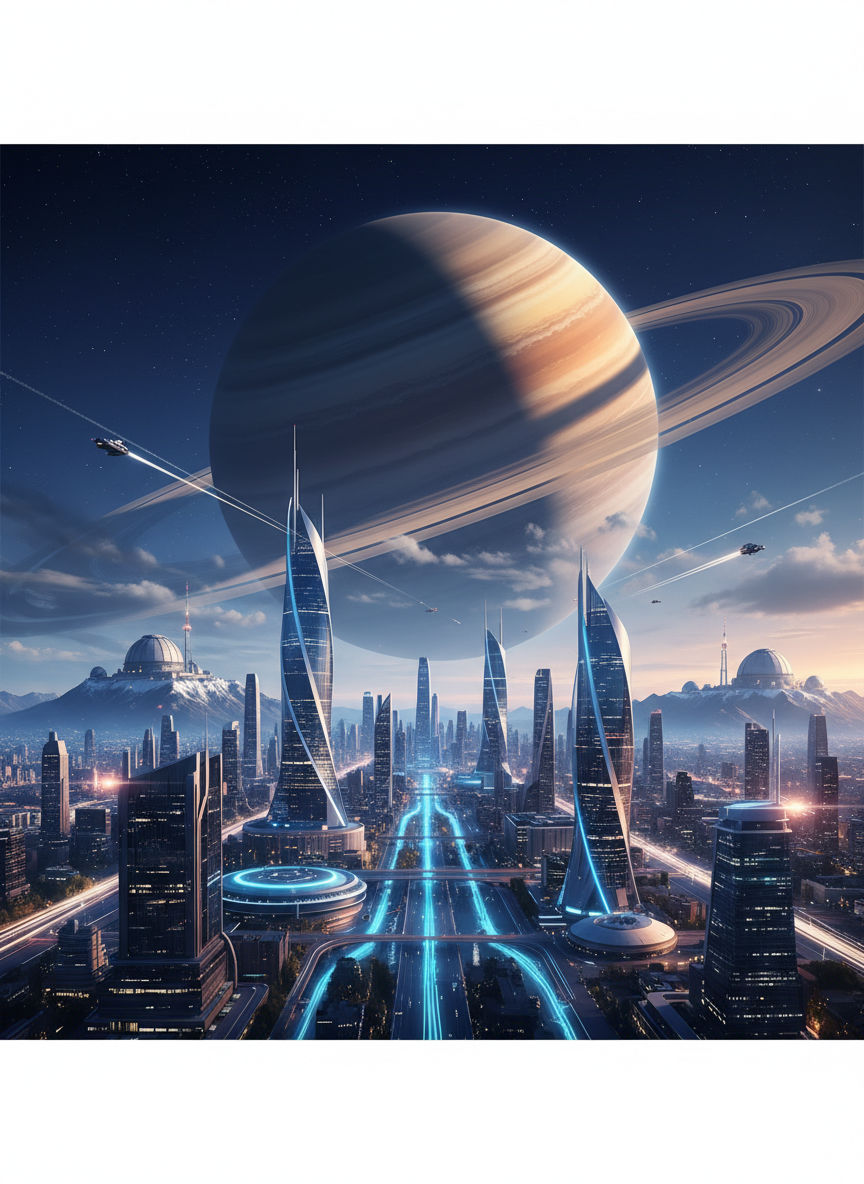
Imagine stepping outside, looking up at the night sky, and preparing yourself for the ultimate cosmic view. Instead of a small, glowing white orb, your entire field of view is dominated by a majestic, ringed gas giant. It would feel like living inside a science fiction movie!
Saturn is nearly 100 times wider than our Moon. If it sat at the exact same distance from us—around 384,400 kilometers away—it would take up almost 20 degrees of the sky. To put that into perspective, that is roughly 40 times larger to our naked eyes than the Moon!
Its iconic rings would stretch across the horizon, glowing brilliantly as they reflect the sun. But this beauty comes with a catch. Because Saturn is so enormous, it would frequently block out the sun entirely. Daily solar eclipses would become the new normal, plunging Earth into hours of darkness.
Key Takeaway
Saturn would dominate our sky, appearing 40 times larger than the Moon and causing daily solar eclipses.
Test Your Knowledge
How much wider is Saturn compared to our current Moon?
Here is the biggest, most mind-bending twist: if Saturn suddenly replaced the Moon in our sky, Earth would no longer be the boss of the relationship.
Gravity is ultimately a game of mass, and Saturn is an absolute heavyweight. It is about 95 times more massive than Earth. In the strict laws of orbital mechanics, the smaller object always orbits the larger one.
Instantly, Earth would be demoted from a proud, independent planet orbiting the Sun to a mere satellite (or moon) of Saturn. The gravitational center of our system would drastically shift.
We would immediately begin orbiting the gas giant, becoming part of its complex, crowded system of pre-existing moons. While Saturn continues its long journey around the Sun, we would just be along for the ride as a rocky sidekick.
Key Takeaway
Because of its immense mass, Saturn would capture Earth, instantly turning our planet into one of its moons.
Test Your Knowledge
Why would Earth become a moon to Saturn?
Our current Moon’s gravity gently pulls on our oceans, creating the rhythmic, daily tides that we know and love. But if Saturn took its place, it wouldn’t be nearly so gentle.
Saturn’s gravitational pull on Earth would be roughly 7,900 times stronger than the Moon’s. This immense, crushing force would create a tidal bulge of truly apocalyptic proportions. The water would have nowhere to hide from that intense gravity.
Within mere hours, massive walls of water—tsunamis hundreds of meters high—would surge across the globe. These extreme tides would completely wipe the coasts clean, flattening cities and flooding hundreds of miles inland. The oceans wouldn't just rise gently; they would be violently dragged back and forth across the planet's surface every single day, reshaping our continents forever.
Key Takeaway
Saturn's immense gravity would create catastrophic, world-destroying tidal waves that would scrub the continents.
Test Your Knowledge
How much stronger would Saturn's tidal force be compared to the Moon?
Water isn't the only thing Saturn's massive gravity would violently pull on. Its overwhelming gravitational force would literally stretch and squeeze the solid rock of our planet.
This intense geological process is known as tidal heating. As Earth orbits Saturn, the massive gravitational friction would cause our planet’s crust to flex, bulge, and bend like a piece of plastic being repeatedly bent back and forth.
This internal friction would generate unbelievable amounts of heat deep within the Earth. Every dormant volcano would likely erupt simultaneously. The Earth's crust would tear apart, triggering continuous, immense earthquakes globally. Earth would rapidly transform into a molten, volcanic hellscape. In fact, we would look very similar to Jupiter's intensely active, pizza-colored moon, Io.
Key Takeaway
Gravitational friction would violently flex Earth's crust, causing global earthquakes and relentless volcanic eruptions.
Test Your Knowledge
What is the process that causes a planet's crust to heat up from gravitational flexing?
There is one last magnificent but deadly cosmic hazard to consider: Saturn’s famous rings. These rings are essentially made of billions of pieces of frozen ice, rock, and dust, ranging in size from tiny grains of sand to massive, mountain-sized boulders.
Depending on our exact orbital alignment around the gas giant, Earth might find itself plowing straight through the outer edges of Saturn's ring system.
This would result in a relentless, global meteor shower. Huge chunks of ice and rock would continuously bombard our atmosphere, creating massive fireballs in the sky. Even if we somehow managed to survive the crushing tides and global volcanoes, this constant barrage from the sky would make the surface of Earth completely uninhabitable. It would be a beautifully destructive end!
Key Takeaway
Earth's new orbit might drag it through Saturn's massive rings, causing a devastating, endless meteor shower.
Test Your Knowledge
What are Saturn's rings primarily made of?
Track your progress, earn XP, and compete on leaderboards. Download NerdSip to start learning.