Why does your signal vanish when surrounded by people?
Prompted by A NerdSip Learner
Understand the hidden physics of crowded networks.
Imagine a WiFi router as a single bartender at a popular club. When there are only a few people, everyone gets their drinks instantly. But when 500 people rush the bar at once, service slows to an absolute crawl!
This is exactly what happens with your WiFi connection. Routers have a hard physical limit on how much data (bandwidth) they can process and how many individual devices they can talk to simultaneously.
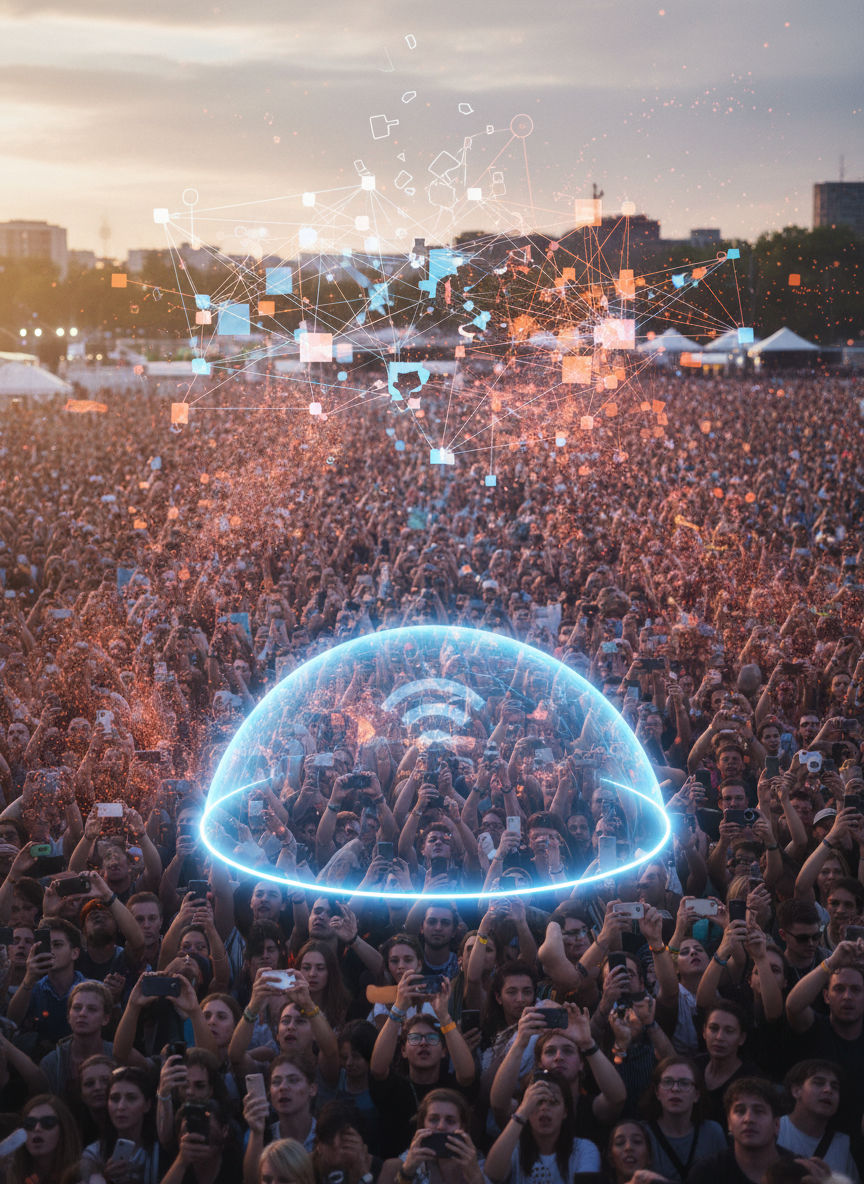
When thousands of smartphones in a stadium or concert try to connect, they are all shouting at the router at the exact same time. The router quickly becomes overwhelmed, forcing it to drop connections just to keep up with the sheer volume of requests.
To make matters worse, many devices constantly search for connections in the background. Even if someone isn't actively scrolling, their phone is quietly pinging the network for updates, adding to the invisible congestion.
Key Takeaway
WiFi routers have a limited capacity for handling data and simultaneous connections, leading to digital traffic jams in crowds.
Test Your Knowledge
What happens when thousands of devices try to connect to a router at once?
WiFi doesn't just work by magic; it relies on invisible radio waves to send data back and forth. Think of these radio frequencies as specific lanes on a digital highway.
Most public WiFi networks operate on just two main frequency bands: 2.4 GHz and 5 GHz. Within these bands, there are only a few non-overlapping 'lanes' available for data to travel cleanly.
In a crowded space, thousands of phones aren't just trying to connect to the venue's WiFi—they are also broadcasting their own Bluetooth signals, personal hotspots, and cellular data. This creates massive signal interference.
It's like being in a room where thousands of people are trying to have separate conversations using walkie-talkies on the exact same channel. Data packets collide in the air, forcing the router to constantly resend information, which slows everything to a crawl.
Key Takeaway
Signal interference from thousands of overlapping devices creates digital static that ruins your connection.
Test Your Knowledge
Why do personal hotspots and Bluetooth devices make public WiFi worse?
Did you know that your own body is a natural WiFi blocker? It sounds like something out of a sci-fi movie, but the physics behind it are completely real.
Radio waves travel best through empty space. Unfortunately for your smartphone connection, the human body is made up of roughly 60% water. Water is incredibly dense and is highly effective at absorbing radio frequency energy.
In fact, the 2.4 GHz frequency used by standard WiFi is the exact same frequency your microwave uses to heat up the water molecules in your leftovers!
When you are packed into a dense crowd, you are surrounded by thousands of human 'water shields.' These bodies physically absorb and weaken the WiFi signals before they can even reach your phone's tiny internal antenna. The crowd is literally soaking up the WiFi!
Key Takeaway
The human body is mostly water, which naturally absorbs and physically blocks WiFi radio waves.
Test Your Knowledge
Why does a dense crowd physically block WiFi signals?
Track your progress, earn XP, and compete on leaderboards. Download NerdSip to start learning.