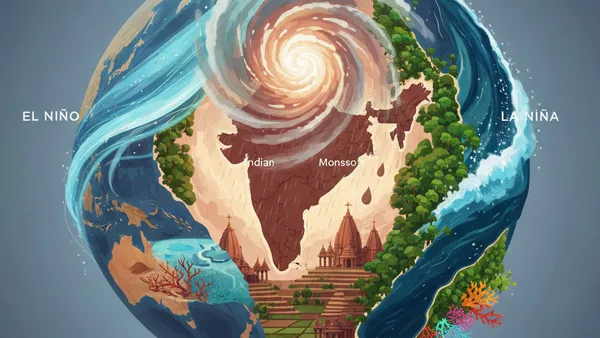
How can ocean water thousands of miles away steal India's rain?
Prompted by A NerdSip Learner
Understand how ocean temperatures control India's weather.
Have you ever noticed how a hot, paved road shimmers in the summer sun, radiating intense heat? Land heats up much faster than water. This simple scientific fact is the powerful engine behind one of Earth's most spectacular and vital weather events: the Indian Monsoon.
During the peak of summer, the vast landmass of the Indian subcontinent gets baking hot. As this hot air rapidly rises into the atmosphere, it creates a giant area of low pressure—essentially a massive vacuum. To fill this empty space, cool, moisture-packed winds eagerly rush in from the Indian Ocean.
When these heavy, wet winds hit the land and are forced upward by mountains, they cool down and unleash massive downpours. This seasonal rainy period usually lasts from June to September and is incredibly important. It provides roughly 70% of India's annual water supply!
The monsoon is truly the lifeblood of the country. It waters the crops, fills the rivers, and cools down the scorching summer heat. But this massive weather engine doesn't operate in isolation—it is deeply connected to ocean temperatures thousands of miles away.
Key Takeaway
The Indian Monsoon is driven by hot land acting like a vacuum, pulling in moist ocean winds.
Test Your Knowledge
What primarily causes the moist ocean winds to rush toward India during the monsoon?
To understand how India's precious rain can sometimes be stolen, we have to travel halfway across the globe to the Pacific Ocean. Every few years, a mysterious and powerful climate pattern awakens, known as El Niño (which is Spanish for "The Little Boy").
Normally, strong and steady trade winds push warm surface water toward Asia, keeping the eastern Pacific Ocean relatively cool. But during an El Niño event, these dependable winds suddenly weaken, or sometimes even reverse their direction entirely.
Without the wind continuously pushing it away, a massive pool of warm water begins to build up in the central and eastern Pacific Ocean. It is essentially like throwing a giant, warm blanket over a huge chunk of the globe!
This abnormal ocean warming might seem incredibly far away from India, but it drastically rewires the entire global atmosphere. It alters where massive rain clouds form and shifts the jet streams that guide storms, setting off a chaotic domino effect of extreme weather all over the planet.
Key Takeaway
El Niño is a climate pattern caused by an abnormal build-up of warm water in the Pacific Ocean.
Test Your Knowledge
What happens to the Pacific Ocean during an El Niño event?
So, how does a pool of warm water in the distant Pacific Ocean affect the summer rain in India? It all comes down to a massive, global tug-of-war over atmospheric wind and moisture.
During an El Niño event, the huge area of warm water in the Pacific creates intense heat and rising air over the ocean. This rapidly rising air acts like a giant atmospheric vacuum of its own, eagerly pulling moisture and rain clouds toward the center of the Pacific.
Because the Pacific is aggressively hogging all the available moisture, the winds that usually rush toward India become extremely weak and lazy. The low-pressure "vacuum" over the Indian subcontinent simply cannot compete with the massive heat engine of El Niño.
As a direct result, the Indian Monsoon gets heavily disrupted. Instead of lush, heavy rains, the subcontinent often experiences prolonged dry spells, delayed rainfall, and sometimes devastating droughts. Millions of farmers who completely rely on this seasonal rain are left anxiously waiting for a shower that barely arrives.
Key Takeaway
El Niño creates a powerful vacuum over the Pacific that pulls moisture away from India, often causing droughts.
Test Your Knowledge
How does El Niño typically affect the Indian Monsoon?
If El Niño is the warm, rain-stealing phase of the Pacific Ocean, it is time to meet its equally powerful sister: the cold phase. Enter La Niña (which translates from Spanish to "The Little Girl").
La Niña acts as the exact opposite of El Niño. During this climatic phase, the normal trade winds that blow across the Pacific Ocean go into absolute overdrive. They blow exceptionally hard, forcefully pushing all the warm surface water far to the western side of the ocean.
Because the warm water is pushed away so effectively, deep, ice-cold water from the very bottom of the ocean is forced to rise to the surface. This process leaves the central and eastern Pacific Ocean feeling unusually chilly.
Just like her warm brother, La Niña creates a massive ripple effect throughout the Earth's atmosphere. But instead of throwing a warm blanket over the ocean, she essentially turns on a global atmospheric air conditioner, completely flipping global weather patterns and trade winds once again!
Key Takeaway
La Niña is the opposite of El Niño, characterized by unusually cold water in the central and eastern Pacific.
Test Your Knowledge
Which of the following best describes La Niña?
We already know that El Niño acts as a global rain thief, but what exactly happens to India when La Niña takes the stage? In short, she acts like a massive monsoon supercharger!
Because La Niña significantly cools down the eastern Pacific Ocean, it completely stops pulling moisture away from the rest of the world. Instead, the powerful winds associated with La Niña help push enormous amounts of warm water and intense storm clouds right toward Asia and the Indian Ocean.
With all this extra moisture piled up near India, the summer monsoon engine kicks into extremely high gear. The natural vacuum over the hot Indian landmass easily pulls in these dense, water-logged clouds from the nearby ocean.
The final result is often a historically strong and active Indian Monsoon. While this is certainly great news for refilling dried-up reservoirs and watering vast agricultural fields, it can also be too much of a good thing. La Niña years frequently bring heavier-than-normal rains, often leading to severe and widespread flooding across the subcontinent.
Key Takeaway
La Niña pushes extra moisture toward Asia, frequently resulting in heavier, stronger monsoon rains in India.
Test Your Knowledge
What is a common consequence of La Niña on the Indian subcontinent?
Track your progress, earn XP, and compete on leaderboards. Download NerdSip to start learning.