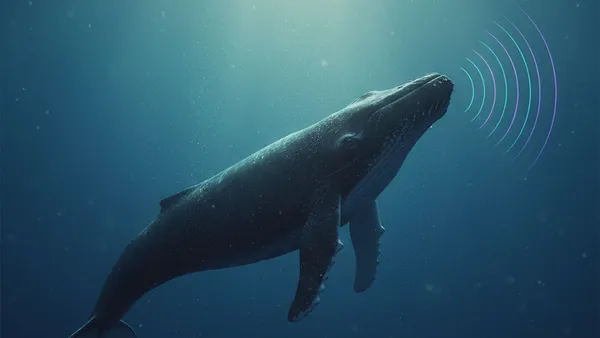
Is the world's loneliest whale actually all alone?
Prompted by A NerdSip Learner
Uncover the science behind the 52Hz whale.
In 1989, researchers at the Woods Hole Oceanographic Institution were listening to underwater recordings when they heard something startling. A mysterious creature was singing in the deep, but its voice was completely unique.
To understand why this was so strange, you have to know how whales usually communicate. Most blue whales rumble at a deep, bass-heavy frequency of 10 to 39 hertz, while fin whales sing at a steady 20 hertz. But this mystery whale was broadcasting at exactly 52 hertz—roughly the same pitch as the lowest note on a tuba, or a G# on a piano!
The research team tracked the whale using SOSUS, a classified network of underwater microphones originally built by the U.S. Navy to track enemy submarines during the Cold War. Year after year, as the whale migrated from Alaska to California, its steady 52-hertz song echoed through the Pacific. Yet, despite decades of tracking its distinct acoustic signature, no human has ever actually *seen* this elusive giant.
Key Takeaway
The 52-hertz whale was discovered in 1989 through its unique, high-pitched song that doesn't match any known whale species.
Test Your Knowledge
How did scientists first track the 52-hertz whale?
Because the 52-hertz whale sings at a noticeably higher pitch than other baleen whales, the media quickly gave it a heartbreaking nickname: the "World's Loneliest Whale."
The romantic, somewhat tragic idea was that this whale was swimming across the massive Pacific Ocean, desperately calling out for a mate or a friend, but speaking a language no one else could comprehend. If a blue whale is instinctively listening for a 20-hertz rumble, a 52-hertz call might not even register as another whale. It would be like trying to tune into an FM radio station using an AM radio.
But why does the whale known as "52 Blue" sound so radically different? Scientists have debated a few fascinating theories. The most popular scientific hypothesis is that the whale is a hybrid—the rare offspring of a blue whale and a fin whale, mixing their vocal traits. Other marine biologists suggest it might have a physical deformity in its vocal cords, or that the whale might simply be deaf and unable to hear its own strange voice.
Key Takeaway
Nicknamed the "Loneliest Whale," its unique frequency might be the result of being a rare blue-fin whale hybrid.
Test Your Knowledge
Why was the 52-hertz whale nicknamed the "world's loneliest"?
The emotional story of the lonely whale has inspired musicians, filmmakers, and even a hit song by the pop group BTS. But is "52 Blue" truly destined to wander the freezing ocean in total isolation?
Marine biologists urge us not to project human feelings of loneliness onto a wild animal. First of all, its acoustic track record proves it is a resilient survivor. The fact that it has been singing and migrating for over thirty years means it is successfully finding tons of food and navigating the vast ocean without a pod's help. Over time, its voice has actually deepened slightly, which is a normal sign that the whale has grown into a healthy, mature adult.
Furthermore, baleen whales have incredibly sensitive hearing. Other whales can almost certainly *hear* the 52-hertz song, even if it just sounds like a strange accent to them. Finally, in 2010, sensors off the coast of California picked up *two* 52-hertz signals at the exact same time. While unconfirmed, it hints at a deeply comforting possibility: the world's loneliest whale might not be so lonely after all.
Key Takeaway
Despite its nickname, the 52-hertz whale is a healthy survivor, and other whales can likely hear its unique song.
Test Your Knowledge
What evidence suggests the 52-hertz whale is actually doing physically well?
Track your progress, earn XP, and compete on leaderboards. Download NerdSip to start learning.