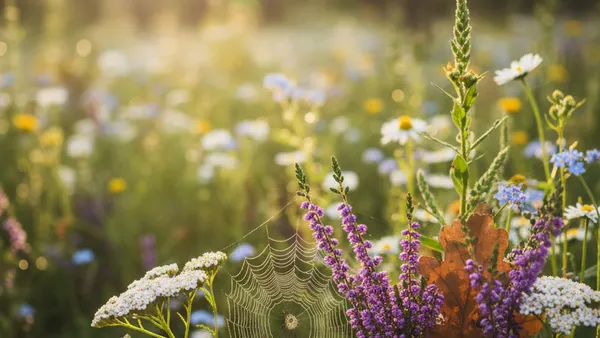
Why one oak supports hundreds of species while garden hedges are 'green deserts.'
Prompted by A NerdSip Learner
Identify key native plants and master their role in a thriving ecosystem.
When we speak of native plants, we usually refer to species that settled in a region after the last Ice Age without human help. Scientists call them *indigenous*. These plants are perfectly adapted to our local climate, rainfall, and soil conditions.
In botany, there is a fascinating historical boundary: the year 1492. With the discovery of the Americas, global trade ignited, changing the plant world forever. Seeds began traveling across oceans, mixing ecosystems that had been separate for eons.
Plants that arrived *before* 1492 via human travel are called archaeophytes (ancient immigrants, like the cornflower). Those that arrived *after* 1492 are known as neophytes (newcomers, like the potato). While science often favors the 'originals,' many older immigrants are now vital parts of our nature.
Key Takeaway
True native plants evolved naturally; 1492 marks the split between ancient and modern arrivals.
Test Your Knowledge
Which historical event is used in botany to define 'new' plants (neophytes)?
Why are native plants so indispensable? The answer lies in co-evolution. Over thousands of years, local plants and insects have grown up together, fine-tuning their relationship into a perfect biological dance.
Think of it as a specialized lock-and-key principle. Many local caterpillars or wild bees simply cannot digest exotic plants or reach their nectar. To our insects, manicured gardens filled with foreign shrubs are often nothing more than 'green deserts.'
A single mature native oak can support up to 500 different insect species! By choosing to grow native plants, we aren't just gardening; we are providing a lifeline for insects, and by extension, the birds that rely on them for food.
Key Takeaway
Native plants and insects are perfectly synced partners that rely on each other to survive.
Test Your Knowledge
Why are exotic ornamental plants often 'useless' for local insects?
If humans hadn't settled so densely across the continent, much of it would naturally be covered by vast European Beech forests. The beech (*Fagus sylvatica*) is the quintessential tree of the temperate landscape.
Its name in many languages (like the German 'Rotbuche') refers to the slightly reddish tint of its wood, rather than its leaves. In spring, beeches sprout in a vibrant, almost neon green that makes entire forests feel like they are glowing from within.
The secret to the beech's dominance is its extreme shade tolerance as a sapling. Seedlings can wait for decades in the deep shadows of giants. The moment an old tree falls and light breaks through, they shoot upward to claim the canopy.
Key Takeaway
The European beech dominates the forest by patiently waiting for light in the deep shade.
Test Your Knowledge
Where does the 'red' in the beech's traditional name come from?
The stinging nettle is often dismissed as a pesky weed, but it is actually one of our most versatile and vital native plants. It is a powerhouse of nutrition and a cornerstone of the ecosystem.
Its infamous stinging hairs act like tiny glass hypodermic needles. Upon contact, they break and inject a cocktail of histamine and formic acid into the skin. This clever defense keeps large grazers away—but it doesn't stop the insects!
For the caterpillars of roughly 50 butterfly species, the nettle is a mandatory nursery. For humans, it is a 'superfood' that grows for free: it contains more Vitamin C than citrus fruits and is incredibly rich in iron and minerals.
Key Takeaway
The nettle uses chemical warfare for defense but remains a vital life source for butterflies.
Test Your Knowledge
What substances in the nettle's hairs cause the skin to burn?
As soon as the snow melts, an intense garlic aroma begins to drift through damp woodlands. Wild garlic (also known as ramsons) is a beloved spring messenger and a star of the wild-foraged kitchen.
But be careful when foraging! Harvesting comes with a serious risk. Its leaves look strikingly similar to highly toxic plants—specifically the Lily of the Valley and the Autumn Crocus. A simple mistake can be life-threatening.
A reliable identifying feature is the stem: each wild garlic leaf has its own distinct, individual stem, and the underside of the leaf is matte. Lily of the Valley leaves usually grow in pairs on a single stalk, and Autumn Crocus leaves sprout directly from the soil.
Key Takeaway
Always check for matte leaf undersides and individual stems to avoid toxic wild garlic lookalikes.
Test Your Knowledge
Which poisonous plant is most commonly confused with wild garlic?
When midsummer grain fields are speckled with blue and red, you are seeing the beautiful cornflower. However, strictly speaking, these iconic flowers aren't 'original' prehistoric locals.
They belong to the archaeophytes—plants that arrived in ancient times through human migration. When our ancestors began farming, the seeds of these flowers traveled unintentionally with grain from the Middle East and Mediterranean.
Today, they are a cherished part of our cultural landscape. Unfortunately, modern industrial farming and herbicides have made them increasingly rare. Conservationists now work hard to resow them to ensure our fields don't lose their vibrant diversity.
Key Takeaway
Ancient immigrants like the cornflower arrived with early farming and have enriched our fields for millennia.
Test Your Knowledge
How did cornflowers and poppies originally arrive in our region?
Common Yarrow (*Achillea millefolium*) is one of our most resilient wild plants. You can find it almost anywhere: along dusty roadsides, in dry meadows, and even sprouting through gravel.
Its botanical name, *Achillea*, tells a story. Legend has it that the Greek hero Achilles used the plant to treat the bleeding wounds of his soldiers during the Trojan War. This gives it the nickname 'soldier’s woundwort.'
Yarrow contains essential oils and flavonoids still valued today in herbal tea to aid digestion and reduce inflammation. Its fine, feathery leaves are a masterpiece of nature, allowing it to survive extreme drought with grace.
Key Takeaway
Yarrow is a tough, drought-resistant plant with a legendary history in ancient and modern healing.
Test Your Knowledge
Which mythical hero gave his name to the botanical genus of yarrow?
The Black Elderberry often grows unnoticed in hedges, but ecologically, it is a grand banquet. In early summer, its fragrant white blossoms attract a cloud of hoverflies and beetles.
By late summer, these turn into dark, juicy berries. Experts estimate that over 60 bird species feed on them. As birds eat the fruit, they drop the seeds elsewhere, helping the elderberry spread naturally through the landscape.
For humans, the elder is a treasure too—but with a warning. Raw berries are mildly toxic and cause stomach upset. Only heating them neutralizes the toxin *sambunigrin*, turning the berries into a safe, vitamin-rich juice or syrup.
Key Takeaway
Elderberries are a vital food source for birds, but humans must cook them to make them safe to eat.
Test Your Knowledge
Why should you never eat elderberries straight from the bush?
Not every new plant arrival is a friend. Some newcomers—known as invasive neophytes—threaten to overwhelm our native flora and disrupt the ecological balance.
Two famous examples are Himalayan Balsam and Giant Hogweed. Balsam grows at lightning speed, crowding out smaller native plants near streams by 'shooting' its seeds meters away. It is pretty, but aggressive.
Giant Hogweed is actually dangerous to touch. Its sap is phototoxic; if it gets on your skin and is exposed to sunlight, it causes severe chemical burns and blisters. This is why authorities spend significant resources trying to control its spread.
Key Takeaway
Invasive species displace local plants and can even pose a serious risk to human health.
Test Your Knowledge
Which invasive plant causes skin burns when touched in combination with sunlight?
Now that you’ve met the secret stars of our landscape, you might wonder: how can I help? The most effective step is surprisingly simple: embrace the mess!
A perfectly manicured lawn offers little to wildlife. Even a single balcony box or a 'wild corner' in your garden where the grass grows tall makes a massive difference for local biodiversity.
Plant native herbs, leave dried stalks standing through winter for insects to hide in, or sow a mini wildflower meadow. Every square inch of wilderness counts. Native nature doesn't happen far away—it starts right at your doorstep.
Key Takeaway
Small, 'untidy' patches of native wildflowers are the best way to support local biodiversity at home.
Test Your Knowledge
What is an easy and effective way to help native insects in your own space?
Track your progress, earn XP, and compete on leaderboards. Download NerdSip to start learning.