Did you know there is a tiny animal that can stay dehydrated for 30 years and wake up like nothing happened?
Prompted by NerdSip Explorer #2352
Meet the 'water bear,' the only creature on Earth that can survive the radiation and vacuum of space.
Have you ever wondered what the toughest animal on Earth looks like? You might picture a rhinoceros or a great white shark, but the true champion is practically invisible. Meet the tardigrade, a microscopic animal that rarely grows larger than a millimeter.
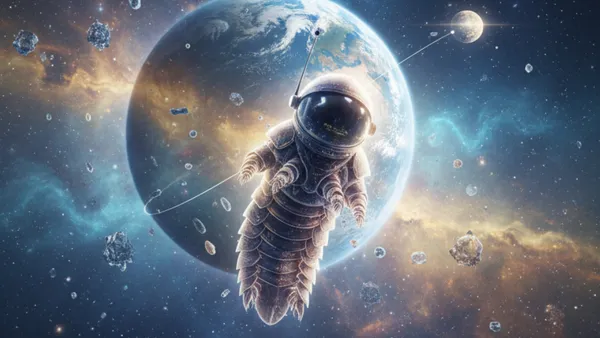
Often called "water bears" or "moss piglets," these creatures have chubby bodies, eight tiny legs tipped with claws, and a slow, lumbering walk. When viewed under a microscope, they look surprisingly like microscopic gummy bears in space suits.
Tardigrades are aquatic, meaning they need a thin layer of water to live and move. Because of this, they are found almost everywhere on Earth where there is moisture. From the damp moss in your backyard to the depths of the ocean and the peaks of the Himalayas, water bears are quietly thriving.
Despite their delicate, squishy appearance, scientists have discovered that these tiny creatures possess an incredible secret weapon. When their watery homes dry up, they don't die—they simply prepare for the worst.
Key Takeaway
Tardigrades, also known as water bears, are microscopic, eight-legged animals found in moist environments all over the Earth.
Test Your Knowledge
What is a common nickname for the tardigrade?
Most animals need a constant supply of water, food, and oxygen to stay alive. If you remove any of these, survival becomes impossible. But tardigrades play by a different set of rules entirely. When their environment becomes hostile, they enter a state of suspended animation called "cryptobiosis."
When a tardigrade's home dries out, it triggers an astonishing transformation. The creature retracts its head and eight legs, rolling into a tiny, dehydrated ball known as a "tun." During this process, it expels almost all the water from its body.
Inside the tun, the tardigrade's metabolism drops to less than 0.01% of its normal rate. For all practical purposes, biological time stops. It neither eats, nor drinks, nor moves. It essentially pauses its life until conditions improve.
This deep sleep is the key to their legendary resilience. As long as they remain in the tun state, they stop interacting with the dangerous environment around them, turning into an almost indestructible biological vault.
Key Takeaway
Tardigrades survive deadly environments by curling into a dehydrated ball called a "tun" and pausing their metabolism, a state known as cryptobiosis.
Test Your Knowledge
What happens to a tardigrade's metabolism when it enters the "tun" state?
Earth has some extreme environments, from freezing polar ice caps to bubbling hot springs. For a tardigrade in its protective tun state, these extremes are just a minor inconvenience. They are incredibly resistant to temperature shocks that would instantly destroy other organic life.
In scientific tests, tardigrades have been exposed to temperatures as low as roughly -272°C (almost absolute zero). At this temperature, the atoms themselves barely move. Yet, when returned to a comfortable temperature and given water, the tardigrades simply uncurled and walked away.
They are equally resilient against extreme heat. Researchers have found that some species can survive being heated to roughly 150°C for short periods. This is well past the boiling point of water, a temperature that cooks most proteins and destroys cell membranes.
How do they do it? When they form a tun, they replace the water in their cells with special protective molecules. Without liquid water inside them, freezing cannot create sharp ice crystals that would normally rupture their cells, and extreme heat cannot cause their internal fluids to boil.
Key Takeaway
In their dormant state, tardigrades can withstand temperature extremes ranging from nearly absolute zero to well above the boiling point of water.
Test Your Knowledge
Why does freezing not destroy the cells of a dehydrated tardigrade?
Imagine going to sleep and waking up three decades later, completely unharmed and ready for breakfast. For a tardigrade, this sounds like a normal Tuesday. Their ability to survive without water for extraordinary lengths of time is a specific type of cryptobiosis called "anhydrobiosis."
When water disappears, tardigrades don't just dry out like raisins; they actively protect their cellular structure. It is believed that they produce special sugars, such as trehalose, and unique proteins. These substances coat their internal machinery, holding everything exactly in place.
Because their cellular structure is frozen in this glassy state, they don't age. Some tardigrades have been revived after spending over 30 years completely dried out in a museum moss sample. Once a drop of water was added, they rehydrated and returned to active life.
This effectively makes them biological time travelers. A tardigrade can wait out a decades-long drought, only resuming its life when a rainstorm finally arrives.
Key Takeaway
By using special proteins and sugars to protect their cells, tardigrades can remain dormant and completely dehydrated for over 30 years.
Test Your Knowledge
What is the primary function of the special sugars produced by tardigrades during dehydration?
Radiation is a massive threat to living things because it acts like microscopic scissors, slicing through DNA and destroying the instructions cells need to survive. A dose of just a few hundred Grays of radiation is lethal to most animals. However, tardigrades can survive doses thousands of times higher.
Scientists were baffled by this resilience until they looked closely at the water bear's genetics. They discovered a unique protein specific to tardigrades, aptly named "Dsup," which stands for Damage Suppressor.
The Dsup protein works like a physical shield. It wraps itself tightly around the tardigrade's DNA. When intense radiation hits, this protein barrier absorbs the damage, preventing the delicate DNA strands from being sliced apart.
Even if some DNA does get broken, tardigrades are remarkably efficient at repairing it once they wake up. This combination of an impenetrable shield and an elite repair crew allows them to shrug off radiation levels that are instantly fatal to humans.
Key Takeaway
Tardigrades use a unique protein called Dsup to shield their DNA, allowing them to survive massive doses of deadly radiation.
Test Your Knowledge
What does the abbreviation "Dsup" stand for in tardigrade biology?
Space is the ultimate hostile environment. It is a harsh vacuum devoid of oxygen, utterly freezing, and bombarded by intense solar radiation. Unprotected life as we know it cannot exist there. But in 2007, scientists decided to test the limits of the water bear.
During a mission cleverly named TARDIS (Tardigrades in Space), researchers sent thousands of dehydrated tardigrades into Earth's orbit. They were attached to the outside of a satellite and exposed directly to the vacuum of space and raw cosmic radiation for ten days.
When the satellite returned to Earth, the scientists rehydrated the tardigrades. Astonishingly, many of them woke up, wriggled around, and even went on to lay healthy eggs. They had officially become the first animals to survive the vacuum of space.
This incredible feat proved that tardigrade survival mechanisms are so robust that they can withstand environments that don't even exist naturally on Earth. It is as if nature over-engineered them for catastrophes they will hopefully never face.
Key Takeaway
In a 2007 experiment, tardigrades became the first known animals to survive direct exposure to the extreme vacuum and radiation of outer space.
Test Your Knowledge
What happened to the tardigrades that were exposed to the vacuum of space in 2007?
Tardigrades are more than just a biological curiosity; they might hold the keys to revolutionary scientific breakthroughs. By studying how these microscopic creatures cheat death, scientists hope to solve major challenges in medicine and space exploration.
One exciting possibility involves vaccines. Many life-saving vaccines must be kept constantly refrigerated, making them difficult to transport to remote areas. If we can adapt the tardigrade's trick of using protective sugars to stabilize proteins, we might create vaccines that can be safely stored at room temperature for years.
Furthermore, studying the Dsup protein could help us understand how to better protect human cells from radiation. This research could eventually lead to improved treatments for cancer patients or new ways to shield astronauts from cosmic rays during long journeys to Mars.
We might never possess the sheer invincibility of the water bear, but unlocking the secrets of their biology could help humanity thrive in the future. The toughest animal on Earth is quietly teaching us how to be stronger.
Key Takeaway
Unlocking the biological secrets of tardigrades could lead to innovations like room-temperature vaccines and better radiation protection for astronauts.
Test Your Knowledge
How might tardigrade biology help improve the distribution of life-saving medicines?
Track your progress, earn XP, and compete on leaderboards. Download NerdSip to start learning.