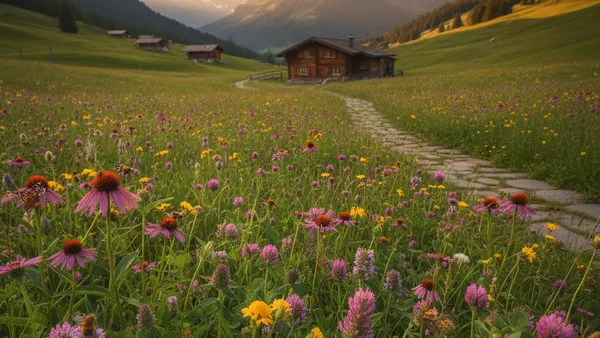
Why are native perennials the secret to wild bee survival?
Prompted by A NerdSip Learner
Master the ecology of essential Swiss perennials for insects.
Why are native perennials irreplaceable for Swiss insects? The answer lies in thousands of years of shared, slow evolution.
While honeybees are generalists that visit almost any flower, roughly 30% of Switzerland's 600 wild bee species are highly specialized (oligolectic). They have adapted their flight times, behaviors, and even tongue shapes to specific native plant families.
If the host plant is missing, the insect species locally disappears. Exotic garden plants often lack usable pollen or have "double" flowers that hide nectar, making them useless for these specialists.
By choosing native plants, you aren't just gardening; you are practicing genetic conservation. These perennials act as life-saving islands in a fragmented landscape.
Key Takeaway
About one-third of Swiss wild bees rely on specific native perennials for survival.
Test Your Knowledge
What does it mean if a wild bee species is described as "oligolectic"?
Greater Knapweed (*Centaurea scabiosa*) is a crown jewel of Swiss flora. From June to September, its purple-violet heads attract butterflies and specialized wild bees like magic.
A botanical secret lies in its structure: the large, showy outer florets are sterile, acting as a "billboard" for pollinators. The smaller, inner tubular florets hold the actual nectar and pollen for the visitors.
This perennial excels in the face of climate change. Thanks to a deep taproot, it survives weeks of drought in dry, permeable soils effortlessly.
It is a dominant representative of Swiss dry meadows. By planting it, you bring essential resilience and high-quality food into our modern landscapes.
Key Takeaway
Greater Knapweed uses sterile outer flowers as decoys and survives drought with its deep taproot.
Test Your Knowledge
What is the function of the outer florets on Greater Knapweed?
Viper’s Bugloss (*Echium vulgare*) is a striking presence on sunny Swiss slopes. Its flowers start pink and shift to deep blue after pollination—a visual signal telling insects where the fresh nectar is.
Ecologically, this plant is a heavyweight. Over 40 butterfly species and countless wild bees visit it regularly to refuel.
For the Viper’s Bugloss Mason Bee (*Osmia adunca*), it is a life-or-death necessity. This bee collects pollen exclusively from the Boraginaceae family, with *Echium* as its favorite.
Without this specific plant, this specialist cannot sustain its offspring. By preserving it, you safeguard an entire evolutionary lineage.
Key Takeaway
Viper's Bugloss signals nectar status via color and is vital for specialized mason bees.
Test Your Knowledge
Why do the flowers of Viper's Bugloss change from pink to deep blue?
Meadow Clary (*Salvia pratensis*), with its deep blue spikes, is a staple of Swiss meadows. It often blooms twice—once in early summer and again in late summer if cut back properly.
Its fame comes from a complex lever mechanism. The flower is built so that it doesn't give away its pollen to just any random visitor.
When a heavy insect, like a bumblebee, lands on the lower lip to find nectar, it triggers a lever. The stamens swing down, "stamping" pollen onto the insect's back.
As the bee moves to the next flower, the pollen is perfectly placed to reach the stigma. Smaller insects are often too light to trigger this sophisticated system.
Key Takeaway
Meadow Clary uses a mechanical lever to selectively place pollen on heavy insects like bumblebees.
Test Your Knowledge
How does pollination work in Meadow Clary?
Not all native stars love the heat. Purple Loosestrife (*Lythrum salicaria*) towers up to 120 cm along Swiss lake shores and streams. Its purple spires bloom from June through September.
It features tristyly: three distinct flower types with different stamen and style lengths. This genetic strategy prevents self-pollination and ensures robust genetic diversity.
It serves as a crucial late-summer food source. The endangered Loosestrife Oil-bee (*Melitta nigricans*) depends almost entirely on it for survival.
Hoverflies and moths also flock to its nectar during the lean late season. It is a vital pillar of Swiss wetland ecosystems.
Key Takeaway
Purple Loosestrife uses tristyly to ensure cross-pollination and supports specialized oil-bees.
Test Your Knowledge
What is "tristyly" in the context of Purple Loosestrife?
At first glance, Field Eryngo (*Eryngium campestre*) looks like a desert exotic. Yet, this metallic blue-green, prickly perennial is a true native of dry, limestone-rich Swiss meadows.
Its roots reach meters deep, making it a survivalist during hot summers. Its waxy, thorny leaves minimize evaporation even on the hottest days.
During its peak bloom, this "hostile" plant becomes a biodiversity hub. Its flat flower heads provide easy nectar access.
This attracts not just bees, but specialized digger, ruby, and ichneumon wasps. These insects rely on this easy energy source to power their hunting and nesting activities.
Key Takeaway
The drought-resistant Field Eryngo provides easy-access nectar for a variety of wasps and bees.
Test Your Knowledge
Why does Field Eryngo attract so many wasps in addition to bees?
Field Scabious (*Knautia arvensis*) is a delicate lilac-blue perennial found in nutrient-poor Swiss meadows. While it looks like a knapweed, it belongs to the teasel family.
It blooms tirelessly from May through late summer, providing a reliable food source during a long, critical window for wildlife.
Its importance is best seen in its bond with the Large Scabious Mining Bee (*Andrena hattorfiana*). This bee is strictly specialized on its pollen.
When the bee collects it, it forms distinct, bright pink "pollen pants" on its legs. This is a beautiful, visible sign of a healthy ecological niche in our landscape.
Key Takeaway
Field Scabious is the essential long-blooming host for the specialized Large Scabious Mining Bee.
Test Your Knowledge
What visual sign indicates a Large Scabious Mining Bee has visited this flower?
Wild Teasel (*Dipsacus fullonum*) is a majestic biennial that reaches two meters. In its second year, it shoots up a massive, thorny stem topped with prickly flower heads.
The flowers bloom in rings, moving from the middle outward, providing food for butterflies and bumblebees for weeks.
A genius feature is its leaf pairs, which fuse at the stem to form small basins. These "Venus basins" collect rainwater.
Researchers believe they deter climbing pests while serving as vital drinking stations for beneficial insects and songbirds during scorching summer days.
Key Takeaway
Wild Teasel is a structural marvel whose leaf basins provide essential water for insects.
Test Your Knowledge
What is the ecological function of the leaf basins on Wild Teasel?
Most insect magnets love the sun, but Switzerland has masters of the shade too. Dusky Crane’s-bill (*Geranium phaeum*) thrives on forest edges and in cool garden corners.
Its dark, reflexed petals earned it the name "Mourning Widow." It blooms early, usually from May to late June.
This early blooming makes it ecologically vital. While sun-loving plants are still growing, this geranium provides critical pollen for early-flying insects.
Mason bees and early mining bees use it as a life-saving fuel station during the often unpredictable chill of the Swiss spring.
Key Takeaway
Dusky Crane’s-bill fills a vital food gap for early-flying wild bees in the spring shade.
Test Your Knowledge
Why is the Dusky Crane’s-bill so valuable for insects?
To maximize the potential of native Swiss perennials, you need a plan. A random mix is less effective than a design that mimics wild communities.
Pros use the 10-40-50 principle. A stable bed consists of 10% structural plants (tall species like Teasel), 40% companion plants (mid-height like Meadow Clary), and 50% groundcover.
The groundcover protects the soil from drying out. The most vital tip: leave the stalks for winter!
Never cut back in autumn. Countless wild bee larvae overwinter inside hollow stems. Only cut back in late spring once the next generation has safely emerged.
Key Takeaway
A nature-friendly bed follows a height hierarchy and is strictly cut back only in the spring.
Test Your Knowledge
Why should perennials be cut back in late spring rather than autumn?
Track your progress, earn XP, and compete on leaderboards. Download NerdSip to start learning.