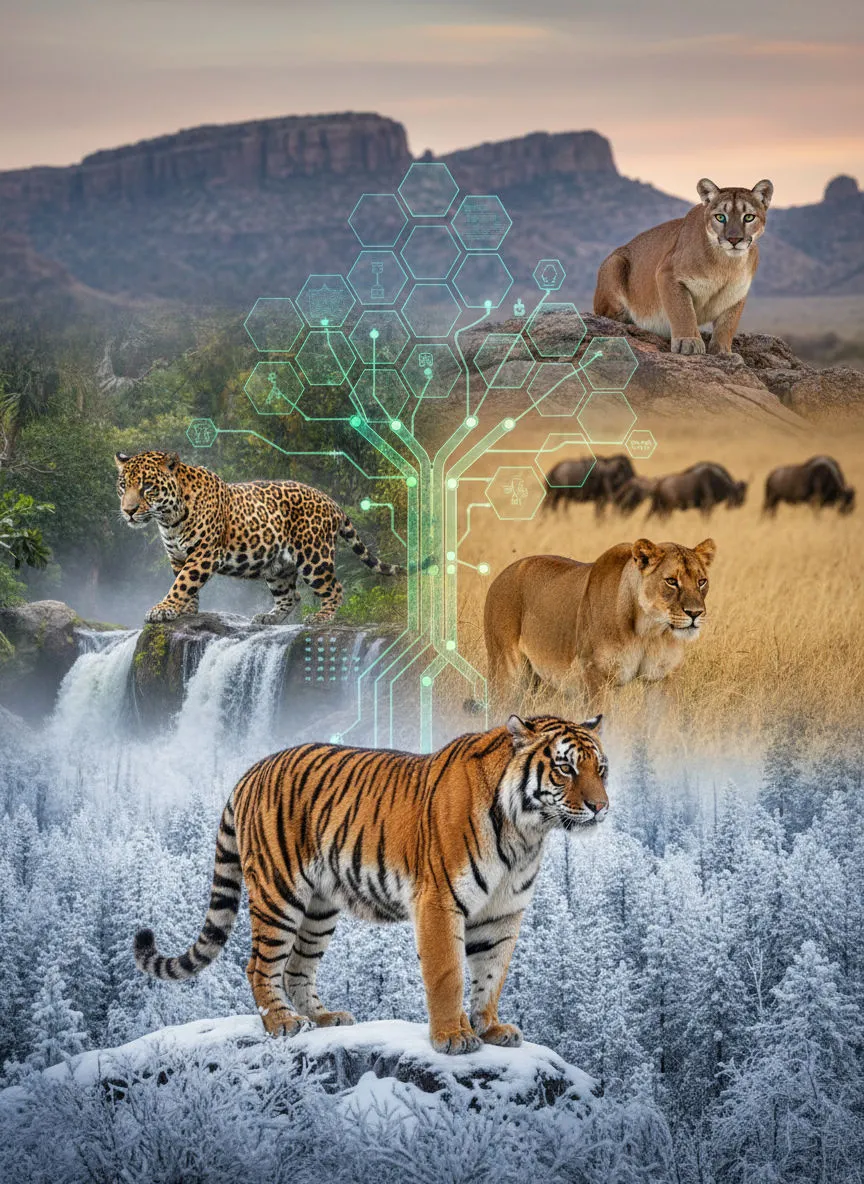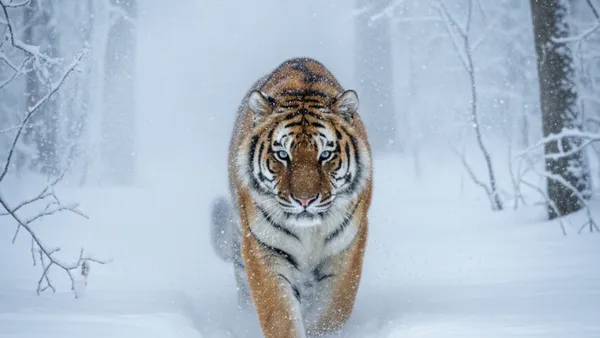
Did you know that a Siberian tiger's roar can paralyze its prey in fear?
Prompted by A NerdSip Learner
Explore the survival tactics and massive power of the world's largest feline.
Siberian tigers, also known as Amur tigers, are the undisputed heavyweights of the feline world. Native to the snowy coniferous forests of the Russian Far East and parts of China, these apex predators command absolute respect. They can reach lengths of over 10 feet from nose to tail and weigh roughly 600 pounds, dwarfing almost every other big cat.
Despite their massive, bulky frames, they are remarkably agile. They possess an incredibly muscular build designed for explosive power rather than sustained speed. Their robust hind legs allow them to leap distances of over 20 feet in a single bound.
Being the largest feline on the planet requires an immense amount of energy. A hungry Siberian tiger can consume up to 60 pounds of meat in a single night! This staggering size and strength make them the true masters of their frozen ecosystem.
Key Takeaway
The Siberian tiger is the largest cat species on Earth, possessing immense power and agility.
Test Your Knowledge
What is another common name for the Siberian tiger?
A tiger's roar is objectively terrifying, but it literally possesses the power to paralyze. Tigers produce incredibly deep, rumbling vocalizations known as infrasound. These sound waves vibrate at frequencies of 18 hertz or lower, dropping completely below the threshold of human hearing.
When a Siberian tiger unleashes a full-throated roar, the accompanying blast of infrasound can temporarily rattle and stun its prey. The intense, low-frequency vibrations physically affect the body, causing a split-second of muscle paralysis. This acoustic weapon gives the massive cat a crucial advantage, allowing it to close the final distance before its victim can react.
Even experienced animal handlers report feeling a profound physical jolt from a tiger's low-frequency growl. The sensation is often described as feeling the roar deep within one's bones. By the time a deer or wild boar registers the sound, the 'ghost of the snow' is already upon them.
Key Takeaway
Siberian tigers use low-frequency infrasound in their roars to temporarily stun and paralyze their prey.
Test Your Knowledge
How does a tiger's roar physically affect its prey?
Unlike their tropical cousins in India or Southeast Asia, Siberian tigers thrive in sub-zero temperatures. Their bodies are specifically built for the harsh, prolonged winters of the taiga. They possess a thick, double-layered coat of fur that grows noticeably shaggier and lighter in color during the winter, alongside a thick mane that shields their neck from freezing winds.
They also carry an extra layer of fat—particularly along their flanks and belly—acting as vital insulation against the biting cold. When temperatures plummet, this bodily furnace is essential for their survival.
Perhaps their most impressive cold-weather adaptation is their massive paws. Measuring up to the size of dinner plates, these extra-wide, heavily furred paws act like natural snowshoes. They distribute the tiger's heavy weight evenly, allowing them to silently glide over deep snowdrifts without sinking, making them the ultimate winter predators.
Key Takeaway
Thick fur, insulating fat, and snowshoe-like paws allow the Siberian tiger to survive extreme winter conditions.
Test Your Knowledge
How do a Siberian tiger's massive paws help it survive in the winter?
Despite their colossal size, Siberian tigers are incredibly elusive, earning them the nickname 'ghosts of the snow.' They are solitary and primarily nocturnal hunters, using the cover of darkness and the thick forest underbrush to secretly ambush their prey. Their primary diet consists of large ungulates, such as wild boar, elk, and sika deer.
Because prey is sparsely distributed in the frozen wilderness, Siberian tigers rely heavily on their camouflaging stripes. In the winter forest, their pale orange fur and dark stripes beautifully disrupt their outline against the vertical shadows of bare trees, branches, and snow.
A successful hunt requires immense patience. The tiger will creep silently, often placing its back paws precisely in the footprints of its front paws to avoid snapping twigs. It gets within 30 to 50 feet of its target before launching a powerful, explosive sprint to secure its meal.
Key Takeaway
Siberian tigers are solitary, nocturnal ambush predators that rely on striped camouflage and stealthy movements to hunt.
Test Your Knowledge
Why do Siberian tigers place their back paws in the footprints of their front paws while hunting?
Food scarcity in the harsh Russian taiga means that Siberian tigers require massive home ranges to survive. While a tropical tiger might be content with a territory of just a few dozen square miles, a male Siberian tiger's domain can easily span 400 to 500 square miles. To put that into perspective, that is roughly the size of Los Angeles!
These majestic cats continuously patrol their vast domains. They communicate their ownership by scent-marking trees with urine and aggressively scratching bark to warn other males to stay out. These visual and chemical markers act as clear boundary lines in the deep forest.
A dominant male will typically allow the territories of a few females to overlap with his own, but he will fiercely defend his borders against any rival males. The immense size of these territories is a major reason why the population density of Siberian tigers naturally remains quite low.
Key Takeaway
Because prey is scarce, Siberian tigers maintain incredibly massive territories to ensure they have enough food to survive.
Test Your Knowledge
Why do Siberian tigers need significantly larger territories than tropical tigers?
A Siberian tigress typically gives birth to a litter of two to four cubs in a deeply secluded den, often tucked away in rocky crevices or thick brush. For the first few months, the cubs are blind, helpless, and completely dependent on their mother's warmth and rich milk.
This early stage of life is precarious. The mother must periodically leave her cubs alone to hunt in the freezing cold, exposing them to potential dangers from the weather and other predators. As the cubs grow stronger, she slowly introduces meat into their diet and begins the long process of teaching them how to hunt.
Siberian tiger cubs stay with their mother for up to two years. During this crucial apprenticeship, they learn the intricate arts of stalking, pouncing, and surviving the punishing winters. Once fully trained, they venture out to claim their own solitary territories.
Key Takeaway
Siberian tiger cubs are highly vulnerable and depend entirely on their mother for up to two years to learn survival skills.
Test Your Knowledge
How long do Siberian tiger cubs typically stay with their mother before claiming their own territory?
The Siberian tiger is a true survivor, but human activity nearly drove it to extinction in the 20th century. By the 1940s, relentless hunting and extensive habitat loss had reduced the wild population to an incredibly fragile bottleneck estimated at just 40 individuals.
Thanks to rigorous international conservation efforts, stringent anti-poaching laws, and dedicated forest rangers, these resilient cats have made a remarkable comeback. Today, researchers estimate there are roughly 500 to 600 Siberian tigers roaming the wild forests of Russia and China.
While this recovery is a massive success story, the species remains classified as endangered. Continued threats include illegal logging, which destroys their native pine forest habitats, and poaching driven by the illegal black market demand for tiger parts. Safeguarding these magnificent 'ghosts of the snow' requires constant global vigilance and continued protection.
Key Takeaway
Though conservation efforts saved Siberian tigers from the brink of extinction, they remain endangered and require ongoing protection.
Test Your Knowledge
What was the estimated wild population of Siberian tigers at their lowest point in the 1940s?
Track your progress, earn XP, and compete on leaderboards. Download NerdSip to start learning.