What really hides in the pitch-black alien world beneath our oceans?
Prompted by NerdSip Explorer #1070
Discover how life survives extreme ocean depths.
Have you ever wondered what happens as you travel straight down into the ocean? For the first 200 meters, sunlight easily pierces the water, supporting the bustling marine life we usually see on nature documentaries.
But as you keep sinking, the world quickly fades into a gloomy twilight. By the time you reach 1,000 meters deep, you have entered the Midnight Zone. Here, the sun's rays can no longer reach you. It is entirely pitch black, freezing cold, and astonishingly vast.
The lack of light isn't the only challenge—the water above you is incredibly heavy. Down in the deepest trenches, the water pressure is immense. Imagine the weight of a full-grown elephant balancing entirely on your big toe!
Despite this crushing, freezing darkness, the deep sea is far from empty. It is home to bizarre, alien-like creatures that have uniquely adapted to survive in one of the harshest environments on our planet.
Key Takeaway
The deep sea is completely dark, freezing, and has crushing water pressure, yet life still finds a way to survive.
Test Your Knowledge
What is a major environmental challenge for animals living in the deepest parts of the ocean?
If the deep ocean is completely pitch black, how do animals see each other? The answer is a spectacular natural magic trick called bioluminescence.
Since there is no sunlight, many deep-sea creatures create their own! They have special chemicals in their bodies that react to produce stunning glowing light, much like a firefly in your backyard. In fact, current understanding suggests that most animals in the deep ocean use this built-in glow in some way.
This glowing ability is an essential survival tool. Some animals use a sudden flash of bright blue light to startle predators and make a quick escape. Others use their lights to find a mate in the vast, dark emptiness.
The most famous example is the anglerfish. It dangles a glowing, fleshy lure right in front of its mouth. In the dark, hungry fish swim toward this mysterious floating light, only to become a quick snack!
Key Takeaway
Many deep-sea animals create their own chemical light, called bioluminescence, to hunt, hide, and communicate in the dark.
Test Your Knowledge
What is bioluminescence?
For a long time, scientists believed that all life on Earth depended on the sun. Plants use sunlight to grow, and animals eat those plants. But the deepest parts of the ocean hide a shocking exception.
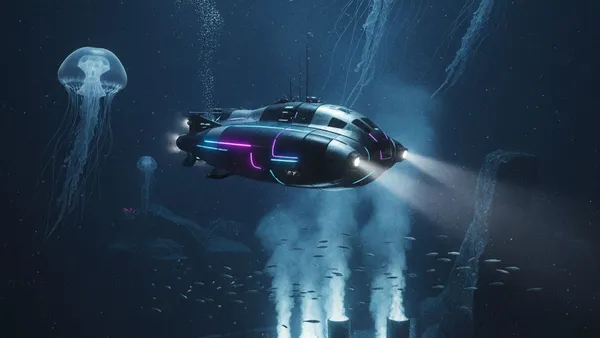
Scattered across the ocean floor are hydrothermal vents. These are essentially underwater hot springs or volcanoes. They spew out scorching, mineral-rich water from deep within the Earth's crust into the freezing ocean.
Instead of sunlight, special bacteria use the toxic chemicals rushing out of these vents to create energy. This completely unique process is called chemosynthesis.
These bacteria form the base of an entirely alien food web. Clustered around these scorching vents, you will find massive tube worms, ghostly white crabs, and strange shrimp. They have built a thriving, bustling metropolis in the darkest, most unexpected corner of our planet!
Key Takeaway
Deep-sea hydrothermal vents support thriving ecosystems that rely on chemicals from the Earth, rather than sunlight, to survive.
Test Your Knowledge
How do creatures survive around deep-sea hydrothermal vents?
Track your progress, earn XP, and compete on leaderboards. Download NerdSip to start learning.