How do tiny prairie rodents survive deep freezes and reshape entire landscapes?
Prompted by A NerdSip Learner
Master the physiological secrets of Alberta's rodents.
Beavers are the ultimate ecosystem engineers of Alberta's waterways, but their most impressive tool isn't their flat tail—it's their heavily fortified teeth. To fell massive trembling aspens, beavers rely on incisors that never stop growing and possess a highly specialized chemical composition.
Unlike human enamel, beaver enamel is heavily infused with iron. This iron replaces calcium in the enamel matrix, rendering the front of their teeth a distinct rust-orange color and drastically increasing their resistance to mechanical stress and cracking.
But a dull axe is useless. Beavers maintain razor-sharp edges through a brilliant structural adaptation. The front of the tooth is armored with this hard, iron-rich enamel, while the back consists of much softer dentin. As the beaver chews on wood, the softer dentin wears away far more rapidly than the iron-clad front.
This differential wear creates a permanent, self-sharpening chisel edge. By combining materials engineering and ecosystem manipulation, beavers fundamentally alter riparian zones, creating wetlands that support countless other species.
Key Takeaway
Beavers maintain permanently sharp teeth through differential wear between iron-infused enamel and softer dentin.
Test Your Knowledge
What structural adaptation allows beaver teeth to be self-sharpening?
When temperatures plummet, the Richardson’s ground squirrel doesn't just sleep; it enters a state of profound metabolic suspension known as torpor. This physiological marvel allows them to survive underground for up to nine months of the year without food or water.
During deep hibernation, their core body temperature drops to near ambient soil levels—sometimes hovering just above freezing. To survive this chill, their cardiovascular system slows to a crawl, and they undergo a massive shift in cellular metabolism.
Instead of burning carbohydrates, their bodies actively suppress the Pyruvate Dehydrogenase Complex (PDC). By inhibiting this crucial enzyme in the liver, the squirrel effectively halts carbohydrate oxidation. This forces the body to rely almost entirely on stored lipids (fats) for survival.
Interestingly, hibernation is not continuous. It is punctuated by periodic, energy-expensive euthermic arousals where their temperature returns to normal for a brief window. The exact biological necessity of these highly demanding warm-up periods remains one of the greatest mysteries in mammalian physiology.
Key Takeaway
Richardson's ground squirrels survive hibernation by repressing key enzymes, switching their metabolism from carbohydrates to stored fats.
Test Your Knowledge
Which metabolic shift occurs during deep torpor in Richardson's ground squirrels?
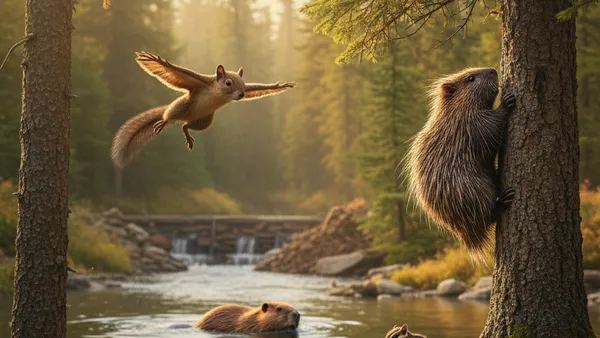
Soaring through the canopy of Alberta's old-growth coniferous forests, the Northern flying squirrel is a nocturnal acrobat. They don't achieve powered flight; instead, they stretch a specialized furry membrane called a patagium from their wrists to their ankles, allowing them to glide up to 150 feet between trees.
While their aerial maneuvers are stunning, their true ecological value lies on the forest floor. These rodents are heavily mycophagous, meaning a significant portion of their diet consists of fungi. Specifically, they forage for hypogeous fungi—truffles that fruit beneath the soil surface.
This dietary preference makes them a critical keystone species. The fungi they consume form mycorrhizal networks, symbiotic relationships with tree roots that allow conifers to absorb essential water and nutrients.
Because truffles grow underground, they cannot disperse their spores via wind. Instead, they rely on the flying squirrel. After digesting the fungi, the squirrel glides across the forest, dispersing the viable fungal spores through its feces, quite literally seeding the forest's future health.
Key Takeaway
Northern flying squirrels are vital for forest health because they consume truffles and disperse mycorrhizal fungal spores across the canopy.
Test Your Knowledge
What critical ecological service do Northern flying squirrels provide to coniferous forests?
The North American porcupine is a slow-moving herbivore that survives Alberta’s fierce predator landscape using an elite biomechanical defense system. Their armor consists of roughly 30,000 modified hairs called quills, which possess a deceptively sophisticated architecture.
Under a microscope, the tip of a porcupine quill is covered in hundreds of microscopic, backward-facing barbs. Research has shown that these barbs serve a dual biomechanical purpose. First, they act like a serrated knife, significantly reducing the force required to penetrate tissue. It takes far less energy to push a barbed quill into skin compared to a smooth one.
Second, once embedded, the barbs flare outward, maximizing the extraction force required to pull them out. A predator attempting to remove the quill often drives it deeper into the muscle.
Fascinatingly, because porcupines frequently fall out of trees and impale themselves, their quills are coated in a greasy matrix of free fatty acids. This coating has potent antibiotic properties, ensuring that an accidental self-inflicted stab doesn't result in a lethal infection.
Key Takeaway
Porcupine quills utilize microscopic barbs to penetrate tissue easily while making extraction highly difficult, and feature an antibiotic coating.
Test Your Knowledge
What dual biomechanical purpose do the microscopic barbs on a porcupine's quill serve?
Surviving as a semi-aquatic rodent in Alberta means braving freezing wetland temperatures. For the muskrat, the biggest threat to its survival isn't predators—it's hypothermia. With a dense, waterproof coat, its core remains insulated, but its hairless tail and feet are highly vulnerable to heat loss.
To prevent freezing from the outside in, muskrats employ a brilliant vascular adaptation known as regional heterothermy, driven by a counter-current heat exchange system.
In the muskrat’s extremities, the arteries carrying warm, oxygenated blood from the heart are intertwined with the veins returning cold blood from the feet and tail. As the warm arterial blood travels outward, it transfers its thermal energy directly to the adjacent venous blood flowing back inward.
This thermal short-circuit means that the blood reaching the tail is already cooled, minimizing heat lost to the icy water. Meanwhile, the returning blood is pre-warmed before it hits the animal's core. This allows the muskrat's tail to hover near freezing while its core safely remains at 37°C.
Key Takeaway
Muskrats utilize a counter-current heat exchange system to keep their vital core warm while their extremities remain near freezing.
Test Your Knowledge
How do muskrats prevent severe core heat loss through their hairless tails?
Deep in the rocky crevices of Alberta's foothills, the bushy-tailed woodrat acts as nature’s archivist. Colloquially known as packrats, these rodents have a compulsive habit of gathering vegetation, bones, and oddities to build massive nests, or middens.
While a pile of debris might seem unremarkable, it becomes an invaluable scientific treasure due to the woodrat’s bathroom habits. Packrats urinate directly on their middens. In arid and semi-arid environments, this viscous urine dries and crystallizes into a dark, rock-hard cement called amberat.
Amberat is an incredible preservative. It completely seals the gathered organic material from moisture and decay. Some of these crystallized middens have survived intact for tens of thousands of years.
Paleoclimatologists slice open these ancient amberat deposits to extract perfectly preserved pollen, plant macrofossils, and even environmental DNA. By analyzing the botanical contents of different geological layers, scientists can accurately reconstruct how the regional climate and flora have drastically shifted since the last Ice Age.
Key Takeaway
Bushy-tailed woodrats create invaluable paleoclimate archives by preserving vegetation in crystallized urine known as amberat.
Test Your Knowledge
What substance allows bushy-tailed woodrat middens to serve as ancient climate archives?
Beneath the prairie grasslands, the Northern pocket gopher operates as a relentless subterranean bulldozer. These solitary rodents spend nearly their entire lives underground, constructing elaborate tunnel systems that aerate the soil and promote deep root growth for native grasses.
Because digging with claws in compacted soil requires immense energy, pocket gophers frequently use their front teeth as excavation tools. However, chewing through dirt presents a massive risk of ingesting soil and choking.
To solve this, they evolved extracutaneous incisors. Their furry lips are uniquely designed to close firmly *behind* their massive front teeth. This biological seal allows the gopher to gnaw through roots and compacted clay without a single particle of dirt entering its oral cavity.
Through this relentless digging, they drive large-scale bioturbation—the vertical mixing of soil horizons. While often viewed as agricultural pests, they are crucial ecosystem engineers, moving tons of earth per acre and cycling vital nutrients back to the surface.
Key Takeaway
Pocket gophers dig with extracutaneous incisors, allowing them to excavate soil without getting dirt in their mouths.
Test Your Knowledge
How do pocket gophers manage to dig through dense soil with their teeth without swallowing dirt?
High in the alpine zones of the Canadian Rockies, the Hoary marmot faces some of the most unforgiving winters on Earth. To survive the brutal cold and profound lack of resources, these hefty rodents have mastered the art of social thermoregulation.
Unlike their solitary lowland cousins, Hoary marmots hibernate in dense familial groups. They retreat into deep burrows and huddle closely together, forming a shared thermal mass. But merely touching isn't enough; they must perfectly synchronize their physiological rhythms.
Hibernation involves long periods of deep torpor interrupted by brief, energy-intensive arousals where their body temperature spikes. If one marmot woke up while the others were cold, it would rapidly lose its costly body heat to its freezing family members.
To prevent this thermal drain, the entire colony synchronizes their arousal periods. They warm up together and cool down together. This synchronized social hibernation drastically minimizes individual energy expenditure, allowing the family unit to stretch their limited fat reserves until the alpine spring finally arrives.
Key Takeaway
Hoary marmots survive harsh alpine winters by huddling in groups and synchronizing their hibernation cycles to prevent rapid heat loss.
Test Your Knowledge
What behavioral strategy do hoary marmots use to minimize energy expenditure during alpine winters?
While many rodents escape Alberta’s bitter winters by hibernating, the Meadow vole takes a completely different approach: it stays fully active, hiding in plain sight. Its secret weapon is the subnivean zone, a fragile, hidden microhabitat that forms directly beneath the winter snowpack.
As snow accumulates over the prairie, the latent heat rising from the earth begins to melt the bottommost layer of snow, creating a shallow, crystalized gap between the ground and the snowpack.
Snow is a phenomenal insulator. No matter how violently the surface air temperature fluctuates—even dropping to -30°C—the subnivean zone maintains a remarkably stable temperature hovering just around 0°C.
In this thermal refuge, voles construct complex highway systems of grass tunnels. They forage, breed, and socialize entirely out of sight from avian predators and extreme weather. However, their survival is precarious; unseasonal mid-winter thaws or a lack of insulating snow can cause this vital zone to collapse, exposing them to lethal freezing.
Key Takeaway
Meadow voles survive severe winters without hibernating by living in the insulated subnivean zone beneath the snowpack.
Test Your Knowledge
What physical phenomenon keeps the subnivean zone survivable for voles during brutal winters?
The Deer mouse is one of the most widespread and highly adaptable rodents in North America, thriving everywhere from boreal forests to prairie barns. Ecologically, they are a classic r-selected species, meaning their evolutionary strategy relies on rapid maturation and incredibly high reproductive rates to offset heavy predation.
However, this explosive population dynamic has serious epidemiological consequences. The Deer mouse is the primary reservoir host for the Sin Nombre orthohantavirus, a pathogen that causes severe respiratory illness in humans.
The virus doesn't sicken the mice. Instead, it is continuously shed in their urine, saliva, and feces. The danger arises during 'mast years'—seasons of unusually high seed and food production. These resources trigger a massive population boom in the deer mouse population.
As mouse densities skyrocket, they increasingly infiltrate human structures to nest. When humans sweep or clean these infested areas, the viral particles in the dried excreta become aerosolized. Inhaling this contaminated dust allows the virus to spill over into human hosts.
Key Takeaway
Deer mice are a highly fecund species that can spread the Sin Nombre hantavirus to humans, especially following rapid population booms.
Test Your Knowledge
What ecological event often precedes an increased risk of Sin Nombre hantavirus spillover into human populations?
Track your progress, earn XP, and compete on leaderboards. Download NerdSip to start learning.