How did a drifting piece of the Pacific create a tropical paradise?
Prompted by NerdSip Explorer #5918
Understand the fiery tectonic origins of the Caribbean.
Imagine the Earth hundreds of millions of years ago. It didn't look anything like the map we know today. All the major landmasses were squished together into one giant, continuous supercontinent known as Pangea. At this point in history, the beautiful, tropical Caribbean Sea simply did not exist!
Around 200 million years ago, intense heat from deep inside the Earth caused this massive supercontinent to slowly fracture and rip apart. North America and South America began steadily drifting away from each other. Think of it like two gigantic sliding doors slowly opening up over millions of years.
As these colossal continents separated, ocean water rushed in to fill the void, leaving behind a massive, watery gap. However, this new ocean space wouldn't remain empty forever. The widening gap between the two Americas became the perfect parking spot for a wandering piece of the Earth's crust. This spectacular continental breakup set the stage for the creation of the Caribbean region we know and love today!
Key Takeaway
The Caribbean Sea began as a giant gap created when North and South America drifted apart.
Test Your Knowledge
What created the initial space for the Caribbean Sea?
You might naturally assume that the Caribbean islands were born exactly where they sit on the map today. However, most geologists agree on a fascinating twist: the foundation of the Caribbean actually came from the Pacific Ocean!
The Earth's outer crust isn't one solid shell; it is broken into massive, interlocking puzzle pieces called tectonic plates. Tens of millions of years ago, a thick, fiery piece of oceanic crust formed far away in the Pacific. As the gap between North and South America widened, this wandering "Caribbean Plate" began to slowly slide eastward into the open space.
Think of it like a giant geological raft floating into a newly opened parking spot. It squeezed itself right between the two giant American continents. This massive, migrating tectonic plate eventually became the deep ocean floor that now holds up the crystal-clear waters and vibrant islands of the modern Caribbean Sea.
Key Takeaway
The tectonic plate beneath the Caribbean actually formed in the Pacific Ocean and drifted eastward.
Test Your Knowledge
Where do geologists believe the Caribbean Plate originally formed?
So, if the ocean floor slid in from the Pacific, how did the actual tropical islands form? The answer lies in an epic, slow-motion geological collision. As the Caribbean Plate squeezed between the Americas, its edges crashed into other surrounding oceanic plates.
When tectonic plates collide head-on, one usually gets shoved deep underneath the other—a violent geological process called subduction. Imagine pushing two heavy rugs together on the floor until one is forced to slide under the other. The plate getting pushed down into the Earth gets incredibly hot and begins to melt.
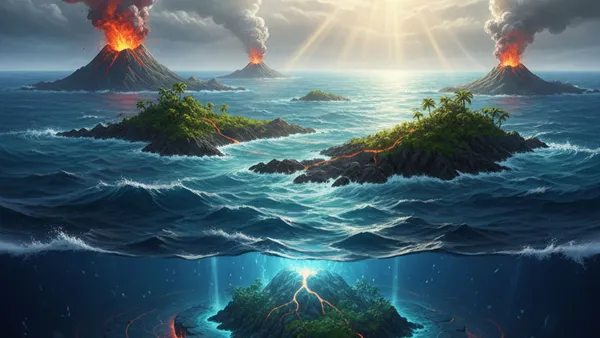
This newly melted rock, known as magma, behaves like boiling soup. It bubbles upward toward the surface. Over millions of years, these underwater volcanoes erupted over and over, steadily stacking layers of cooled lava. Eventually, the peaks of these volcanoes broke through the ocean's surface, creating the mountainous, curved chain of islands we call the Antilles, which includes lush islands like St. Lucia and Grenada!
Key Takeaway
Many Caribbean islands are the peaks of underwater volcanoes formed by colliding tectonic plates.
Test Your Knowledge
What is the geological process called when one tectonic plate is shoved underneath another?
Not all Caribbean islands were born from fiery, dramatic volcanoes. In fact, some of the flatter, famous white-sand destinations—like the Bahamas and Barbados—were actually built by billions of tiny, living creatures!
When underwater volcanoes or shifting crusts don't quite reach the ocean's surface, they create shallow, sunlit underwater platforms. These warm, elevated platforms are the absolute perfect real estate for tiny marine animals called coral polyps. These remarkable creatures extract calcium from the seawater to build hard, protective limestone shells around themselves.
When these corals die, their hard shells remain behind. Over millions of years, layer upon layer of coral skeletons, crushed seashells, and marine debris piled up, slowly compressing into solid limestone rock. It is essentially nature’s way of 3D-printing an island from the seafloor up! When sea levels eventually dropped, or tectonic forces gently pushed these platforms upward, they emerged as the stunning, flat tropical islands we see today.
Key Takeaway
Flat Caribbean islands were largely built over millions of years by the accumulated shells of coral and marine life.
Test Your Knowledge
What material makes up the foundation of the flatter, non-volcanic Caribbean islands?
The Caribbean might look like a peaceful, relaxing paradise in vacation brochures today, but beneath the surface, the Earth is still incredibly hard at work. The entire region remains a highly active geological construction zone!
The Caribbean Plate hasn't stopped its long journey. It is currently shifting eastward at a rate of roughly one inch (about 20 millimeters) per year. To put that into perspective, that is approximately the exact same speed at which your fingernails grow!
Because this giant tectonic puzzle piece is constantly moving, it grinds against the massive North and South American plates along its edges. This immense friction creates built-up stress that occasionally releases, causing the region to regularly experience earthquakes. Furthermore, the magma from the subduction zones we learned about continues to fuel modern volcanic activity. It is a powerful, awe-inspiring reminder that our planet is alive and constantly reshaping itself.
Key Takeaway
The Caribbean Plate is still moving eastward, causing modern-day earthquakes and volcanic activity.
Test Your Knowledge
About how fast is the Caribbean Plate currently moving?
Track your progress, earn XP, and compete on leaderboards. Download NerdSip to start learning.