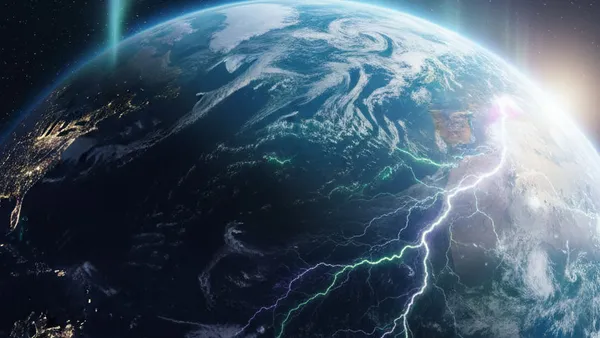
What happens when the solid earth and upper atmosphere brew their own secret storms?
Prompted by NerdSip Explorer #9622
Master the physics of Earth's most bizarre invisible storm systems.
While we normally think of storms in the sky, the solid crust of the Earth can experience intense "storms" of its own. Unlike atmospheric weather, a seismic storm (or earthquake storm) takes place over decades along major tectonic fault lines.
When a fault ruptures during an earthquake, we naturally assume the local tectonic pressure is released. However, through a geophysical mechanism known as Coulomb stress transfer, the relief of stress in one specific zone mathematically redistributes intense strain to adjacent fault segments.
Instead of a single, isolated tectonic event, this transferred stress triggers a cascading chain reaction of catastrophic ruptures. The most documented example is the North Anatolian Fault, which progressively unzipped in a sequential "storm" of massive, devastating quakes migrating steadily westward throughout the 20th century.
Because these storms unfold in geological time, a single sequence can take fifty years to finish its destructive path. Mapping this stress transfer is currently one of geophysics' best tools for forecasting where the next major rupture will strike.
Key Takeaway
Earthquakes can cluster in long-term "storms" where one rupture mathematically transfers stress to the next via Coulomb stress transfer.
Test Your Knowledge
What mechanism causes a seismic storm to propagate along a fault line?
Tsunamis are famously triggered by underwater earthquakes or massive landslides. But the atmosphere can independently spawn nearly identical, highly destructive walls of water known as meteotsunamis.
The catalyst isn't tectonic; it's a fast-moving atmospheric pressure disturbance, such as a severe squall line or an atmospheric gravity wave. When this sudden change in air pressure speeds across the open ocean, it pushes a tiny, almost unnoticeable displacement of water ahead of it.
The real danger kicks in when this atmospheric wave travels at the exact same velocity as the ocean’s underlying shallow-water waves. This perfect synchronization triggers a phenomenon called Proudman resonance. Because the atmospheric push and the water wave are locked in step, energy continuously transfers from the sky into the sea.
This resonance dramatically amplifies a tiny centimeter-level ripple into a massive, surging tsunami that can suddenly inundate coastlines—entirely without a single seismic tremor. Scientists are now deploying high-frequency micro-barometers to detect these invisible triggers before the wave strikes.
Key Takeaway
Meteotsunamis are generated by atmospheric pressure waves that perfectly synchronize with ocean waves through a process called Proudman resonance.
Test Your Knowledge
What synchronization phenomenon is responsible for amplifying a meteotsunami?
Way above the troposphere where our normal weather occurs, the stratosphere harbors a massive, rotating pool of frigid winter air known as the polar vortex. But occasionally, this vortex experiences a violent, invisible disruption.
Giant atmospheric ripples called planetary waves (or Rossby waves) can propagate upward from the lower atmosphere. When these massive, global-scale waves crash and "break" in the upper stratosphere—much like ocean waves breaking on a beach—they dump immense amounts of kinetic energy and heat into the surrounding thin air.
This wave-breaking aggressively decelerates the vortex's jet stream, causing localized temperatures to spike by up to 50°C in just a few days. This event, known as a Sudden Stratospheric Warming (SSW), can completely split or shatter the polar vortex.
While the violent warming happens 30 kilometers above us, the shattered vortex eventually bleeds downward, often sending extreme, prolonged blasts of freezing Arctic weather crashing onto continents weeks later.
Key Takeaway
Sudden Stratospheric Warmings occur when planetary waves break in the upper atmosphere, destroying the polar vortex and eventually triggering extreme winter weather on the surface.
Test Your Knowledge
What causes the extreme localized temperature spike during a Sudden Stratospheric Warming?
Track your progress, earn XP, and compete on leaderboards. Download NerdSip to start learning.