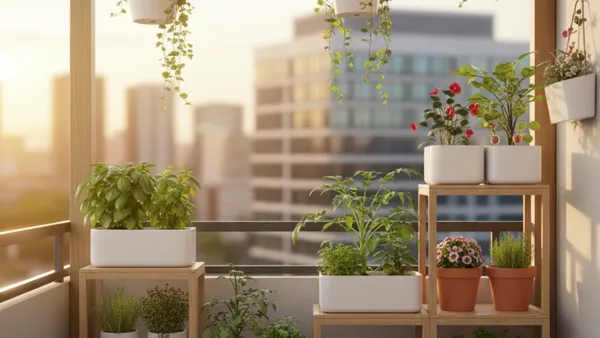
Did you know you can grow up to 20kg of tomatoes on a tiny balcony?
Prompted by A NerdSip Learner
Grow your own organic vegetables in less than ten square feet.
Welcome to your new urban oasis! Before you buy a single seed, you need to understand your balcony's unique microclimate. The most critical factor is sunlight. Track how many hours of direct sun your space gets. Most fruiting veggies (like tomatoes and peppers) need at least 6 to 8 hours, while leafy greens can thrive on just 4 hours.
Next, consider the wind. Balconies, especially on higher floors, can be incredibly windy. Wind dries out plants quickly and can snap delicate stems. You might need a windbreak or heavier pots to keep things stable.
Finally, think about weight capacity. Wet soil is surprisingly heavy! Check with your building manager if you plan to use massive planters. For most standard setups, lightweight resin or fabric pots are safe and practical choices.
Key Takeaway
Understanding your balcony's sunlight, wind exposure, and weight limits is the first crucial step to a successful garden.
Test Your Knowledge
What is the most critical environmental factor to assess on your balcony before planting?
Now that you know your space, let's talk pots! The golden rule of container gardening is simple: drainage. If your pot doesn't have holes at the bottom, water will pool, and your plants will drown from root rot. Always choose containers with excellent drainage.
Size matters, too. A tiny pot dries out incredibly fast and restricts root growth. For vegetables like tomatoes or peppers, you want a container that holds at least 5 to 10 gallons of soil. Shallower pots are perfectly fine for lettuce and herbs.
Material affects how you garden. Terracotta breathes well but dries out quickly, requiring more frequent watering. Plastic and glazed ceramic retain moisture better. Fabric grow bags are a fantastic, lightweight option for balconies because they prevent roots from circling and are easy to store in winter.
Key Takeaway
Choose containers with drainage holes and ensure the pot size is large enough to support the plant's root system.
Test Your Knowledge
What is the golden rule of container gardening?
Here is a secret every beginner must know: never use dirt from the ground in your balcony pots! Garden soil is far too dense, lacks proper aeration, and can harbor unwanted pests or diseases.
Instead, you need a high-quality "potting mix." These mixes are specially formulated to be light and fluffy, ensuring water drains well while retaining enough moisture for the roots. They usually contain ingredients like peat moss or coco coir, perlite (those little white rocks that help with drainage), and compost.
Because container plants are completely trapped in their pots, they rely entirely on you for nutrients and a healthy environment. A good organic potting mix will give your vegetables a strong start, providing the foundation they need to yield that massive harvest you are aiming for!
Key Takeaway
Always use a light, fluffy potting mix instead of dense garden soil to ensure proper drainage and root aeration.
Test Your Knowledge
Why should you avoid using regular garden soil in your balcony containers?
It is time for the fun part: choosing what to grow! Since you are working with less than ten square feet, you want to focus on high-yield, container-friendly varieties.
For absolute beginners, herbs like basil, mint, and chives are incredibly forgiving and take up minimal space. Leafy greens like spinach, arugula, and Swiss chard grow quickly and can be harvested multiple times throughout the season.
If you want to hit that goal of growing kilos of produce, look for "determinate" or "bush" varieties of tomatoes and cucumbers. These are bred to stay compact while producing a heavy yield all at once. Cherry tomatoes are especially great for small spaces and are less prone to issues than large beefsteak varieties. Radishes and bush beans are also fast-growing favorites!
Key Takeaway
Select compact, high-yielding plant varieties like herbs, leafy greens, and bush tomatoes to maximize a small balcony space.
Test Your Knowledge
Which type of tomato is best suited for a small balcony space?
Watering container plants is a delicate balancing act. On a sunny, breezy balcony, pots can dry out in a single afternoon. Conversely, overwatering is the number one killer of beginner plants!
The best way to know if your plant needs water is the "finger test." Stick your index finger into the soil up to your second knuckle. If it feels dry, it is time to water. If it feels moist, wait another day.
When you do water, water deeply. Pour water evenly over the soil surface until it starts running out of the drainage holes at the bottom. This ensures the entire root zone is hydrated, encouraging deep, healthy roots rather than shallow, weak ones. Try to water in the early morning so plants have moisture to face the hot afternoon sun.
Key Takeaway
Use the finger test to check soil moisture and always water deeply until excess water runs out the drainage holes.
Test Your Knowledge
How do you know when it is time to water your container plants?
Every time you water your container garden, a little bit of nutrient goodness washes out the bottom. Because your plants are confined to pots, they quickly deplete the nutrients in their soil. To get big, juicy tomatoes and vibrant greens, you need to feed them.
Start with a balanced, organic liquid fertilizer or a slow-release granular fertilizer. Liquid fertilizers act like a quick vitamin shot and are usually mixed with water every one to two weeks. Granular fertilizers are mixed into the soil and break down slowly over a few months.
When plants are just growing leaves, they love nitrogen. But once they start producing flowers and fruit (like peppers and tomatoes), switch to a fertilizer higher in phosphorus and potassium to encourage blooming. Always follow the package instructions to avoid "burning" your plants with too much food!
Key Takeaway
Container plants need regular feeding with fertilizers because frequent watering washes natural nutrients out of the soil.
Test Your Knowledge
Why do container plants need to be fertilized regularly?
You only have ten square feet of floor space, but how much vertical space do you have? The absolute secret to growing massive yields on a tiny balcony is to go up!
Using trellises, stakes, and netting allows you to grow vining plants like peas, beans, and certain cucumbers up your walls or railings. This keeps the fruit off the soil (preventing rot) and frees up precious floor space for other pots.
Don't forget the ceiling or overhead structures. Hanging baskets are perfect for trailing plants like strawberries or cascading cherry tomatoes. You can also buy tiered plant stands or vertical wall planters to stack your herbs and leafy greens. By layering your plants vertically, you transform a flat balcony floor into a lush, three-dimensional jungle.
Key Takeaway
Maximize your crop yield by using trellises, hanging baskets, and tiered stands to grow plants vertically rather than horizontally.
Test Your Knowledge
What is a major benefit of using vertical space for vining plants?
Track your progress, earn XP, and compete on leaderboards. Download NerdSip to start learning.