Did you know some squids have eyes the size of basketballs to see in total darkness?
Prompted by NerdSip Explorer #1450
Explore the biological reality of gargantuan sea creatures lurking in the midnight zone.
Welcome to the abyss! If you dive down between 1,000 and 4,000 meters (about 3,300 to 13,000 feet) below the ocean's surface, you enter the bathypelagic or "midnight" zone. At this extreme depth, sunlight is completely extinguished. The water is perpetually near freezing, and hydrostatic pressure can easily crush a standard submarine.
Yet, despite these hostile conditions, this realm is home to some of the largest creatures on Earth. But why do animals get so big down here?
Scientists point to a phenomenon known as "deep-sea gigantism." In the freezing, food-scarce environment of the deep ocean, growing massive offers several distinct survival advantages. Larger bodies are more efficient at conserving heat, and a bigger mass allows creatures to store more energy. When meals are few and far between, the ability to slowly patrol massive stretches of the ocean without starving is an evolutionary superpower!
Key Takeaway
The midnight zone is a freezing, pitch-black environment between 1,000 and 4,000 meters deep, where "deep-sea gigantism" helps creatures conserve energy and survive.
Test Your Knowledge
Why is deep-sea gigantism considered an evolutionary advantage in the midnight zone?
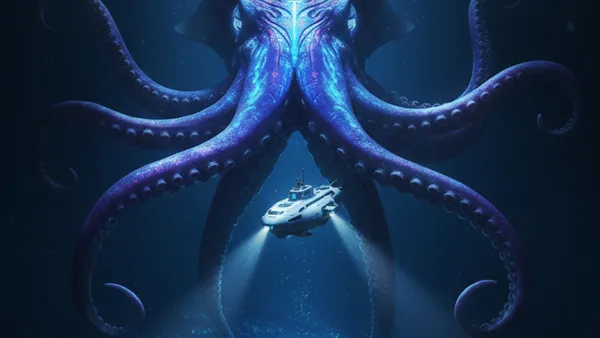
For centuries, sailors whispered tales of the "Kraken," a monstrous cephalopod that dragged ships to the depths. While the myth is exaggerated, the biological reality is just as fascinating. Meet the Giant Squid, a creature that can grow up to roughly 12 meters (39 feet) long!
The most astonishing feature of the Giant Squid isn't its tentacles, but its eyes. Measuring up to 27 centimeters (nearly 11 inches) across, they are roughly the size of basketballs. These are some of the largest eyes in the animal kingdom. But why would an animal need such massive eyes in a world with zero sunlight?
Mathematical models show that eyes this large aren't meant for crisp, close-up vision. Instead, they are highly sensitive light-gatherers. The Giant Squid's enormous pupils are perfectly adapted to detect the faint bioluminescent glow of plankton being disturbed. When a massive predator like a sperm whale swims through the dark, it triggers a glowing wake. The squid's basketball-sized eyes serve as a long-range early warning system to help it dodge its greatest foe!
Key Takeaway
The Giant Squid possesses basketball-sized eyes specifically adapted to detect the glowing bioluminescent wake of approaching predators.
Test Your Knowledge
What is the primary function of the Giant Squid's enormous eyes?
If the Giant Squid is a lightweight boxer, the Colossal Squid is the undisputed heavyweight champion of the abyss. Living in the freezing waters around Antarctica, the Colossal Squid is slightly shorter in total length than its giant cousin, but it is substantially heavier and more robust.
While the Giant Squid relies on suckers lined with small chitinous teeth to grip its prey, the Colossal Squid wields a far more terrifying weapon. Its tentacles are armed with swiveling, three-pointed hooks! These massive, sharp hooks allow it to latch onto struggling prey—like large Patagonian toothfish—and ensure they cannot escape into the dark.
Because it lives in such a frigid, low-energy environment, the Colossal Squid is believed to be an ambush predator. Instead of aggressively chasing down fast prey, it likely hangs suspended in the dark water column, expending very little energy, and waits for a meal to swim just a little too close.
Key Takeaway
The Colossal Squid is heavier than the Giant Squid and uses unique swiveling hooks on its tentacles to ambush and secure prey.
Test Your Knowledge
How does the Colossal Squid differ from the Giant Squid in how it secures its prey?
Imagine a fish that looks like a shimmering ribbon of silver, adorned with a bright red, crown-like crest on its head. Now imagine that ribbon stretching up to roughly 8 meters (26 feet) long! This is the Giant Oarfish, officially recognized as the longest bony fish alive today.
Because they usually live in the deep pelagic zones, Oarfish are rarely seen by humans unless they are sick or dying, which causes them to float to the surface. It is highly probable that historical sightings of these massive, undulating creatures washing ashore or lingering near the surface inspired ancient mariners' tales of sea serpents.
Unlike typical fish that swim horizontally, the Oarfish has a rather bizarre method of moving through the water column. Observations from deep-sea submersibles reveal that they often hover completely vertically in the water. By undulating their long dorsal fin, they can remain perfectly suspended in place, likely keeping a low profile to avoid predators and quietly filter-feed on tiny crustaceans.
Key Takeaway
The Giant Oarfish is the longest bony fish on Earth and likely inspired sea serpent myths, known for its unique habit of hovering vertically.
Test Your Knowledge
Why are Giant Oarfish believed to be the origin of sea serpent myths?
When we think of giant sea creatures, we usually imagine a single, massive animal like a whale or a shark. But in the deep ocean, some giants are actually highly organized colonies. Enter the Siphonophore.
At first glance, a deep-sea siphonophore looks like a single, incredibly long piece of string drifting through the water. In 2020, scientists exploring underwater canyons off Western Australia discovered a spiraled siphonophore estimated to be roughly 45 meters (150 feet) long, making it a strong candidate for the longest animal ever measured!
The secret to its size is that it isn't one single body. A siphonophore is made up of thousands of tiny, genetically identical individuals called "zooids." These zooids reproduce asexually to build the colony, but they are highly specialized. Some zooids act entirely as swimming bells to move the colony, some exist only to digest food, and others act as stinging tentacles to capture prey. They cannot survive alone, but together, they form a colossal, floating net.
Key Takeaway
Siphonophores are massive deep-sea creatures composed of thousands of specialized, cloned zooids working together as a single functional colony.
Test Your Knowledge
What makes a siphonophore fundamentally different from a whale or a squid?
Not all abyssal giants are invertebrates or floating colonies. The Greenland Shark is a massive apex predator of the deep, cold waters of the North Atlantic and Arctic oceans. Growing up to 5 to 7 meters (16 to 23 feet) long, they rival Great White Sharks in size, but they operate at a completely different pace.
Everything about the Greenland Shark is astonishingly slow. They swim at a sluggish cruising speed of barely 1 mile per hour, earning them a place in the "sleeper shark" family. This extreme slowness is a direct adaptation to their freezing, deep-water habitat, allowing them to conserve precious energy.
But the most mind-blowing fact about these sharks is their lifespan. Because their metabolism is so incredibly slow, scientists have discovered that Greenland Sharks can live for hundreds of years. Using radiocarbon dating on the lenses of their eyes, researchers estimate that some individuals swimming today are over 400 years old, making them the longest-living vertebrates on Earth!
Key Takeaway
The Greenland Shark is a massive, slow-moving deep-sea predator that holds the record for the longest-living vertebrate, potentially reaching over 400 years of age.
Test Your Knowledge
What is the main reason for the Greenland Shark's incredibly long lifespan?
What happens when the largest creatures on Earth—whales—die and sink into the midnight zone? They create one of the most remarkable phenomena in the deep sea: a "whale fall."
In a realm where meals are typically scarce, a 40-ton whale carcass dropping to the abyssal plain is like an all-you-can-eat buffet suddenly appearing in a desert. This massive influx of food instantly becomes the anchor for a brand-new, localized ecosystem.
A whale fall goes through distinct stages. First, mobile scavengers like sleeper sharks and massive swarms of hagfish strip the flesh. Next, small crustaceans and worms arrive to consume the remaining soft tissues. Finally, in a stage that can last for decades, specialized bacteria break down the lipids inside the whale's massive bones. These bacteria produce sulfides, which in turn support extraordinary creatures like deep-sea mussels and tube worms. Even in death, ocean giants sustain the abyss!
Key Takeaway
A "whale fall" occurs when a massive carcass sinks to the deep ocean floor, creating a thriving, localized ecosystem that can last for decades.
Test Your Knowledge
What characterizes the final, longest-lasting stage of a whale fall ecosystem?
Track your progress, earn XP, and compete on leaderboards. Download NerdSip to start learning.