Boredom is not always a lack of things to do. Sometimes it is a lack of the right kind of mental food.
That is why most lists of things to learn when you're bored do not quite work. They hand you a flat pile of suggestions: learn coding, learn guitar, learn a language, learn history. Fine ideas, but not very helpful when your actual feeling is more specific.
Maybe you want to understand people better. Maybe you want to sound more interesting at dinner. Maybe the world feels confusing and you want a clearer map. Maybe you only have five minutes and the emotional budget of a tired phone battery.
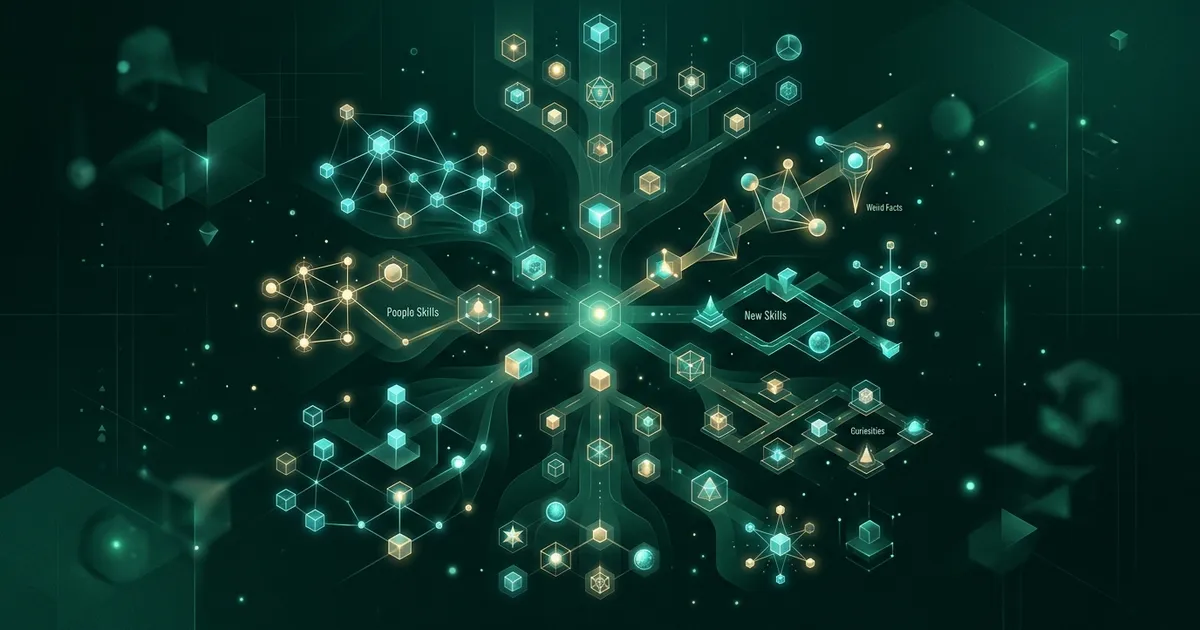
So use this as a curiosity menu. Do not read it like homework. Skim the mood headings, stop where your brain perks up, then choose one idea and give it a short first session. The goal is not to become an expert tonight. The goal is to turn boredom into a clean little spark.
How to Use This Curiosity Menu
Pick by mood first:
- I want to understand people: choose psychology, body language, or social dynamics.
- I want to sound more interesting: choose conversation fuel with a story baked in.
- I want to understand the world: choose systems, history, media, money, or geopolitics.
- I want something useful for work: choose a skill that makes tomorrow easier.
- I want a science rabbit hole: choose something that bends your intuition.
- I want practical confidence: choose a life skill that lowers future stress.
- I want something weird and memorable: choose a topic with a built-in wait-what moment.
- I feel stuck: choose a topic that changes your state, not your resume.
- I only have five minutes: choose one tiny concept and stop while it still feels fun.
One rule: pick the smallest interesting version. "Learn economics" is too big. "Learn why prices rise when everyone expects them to rise" is a doorway. Bored learning works when the doorway is visible.
If You Want to Understand People
Choose this mood when the most interesting thing in the room is not your phone, it is why humans keep doing human things.
1. Attachment styles. Learn why some people chase closeness, some avoid it, and some do both in the same week. The hook: old patterns often show up disguised as adult preferences.
2. The spotlight effect. People notice your awkward moments far less than you think. The hook: this one can make you instantly braver in public.
3. Active listening. Learn how reflections, labels, and follow-up questions make people feel understood. The hook: good conversation is often less about saying better things and more about proving you heard the last thing.
4. Status games. Learn the subtle ways people signal importance, safety, belonging, and competence. The hook: once you see status moves, meetings and group chats become easier to read.
5. Conflict styles. Avoiding, competing, accommodating, compromising, collaborating: most people have a default. The hook: arguments get less personal when you can see the pattern underneath.
6. Cognitive empathy. Learn to model what someone else might believe without agreeing with it. The hook: this is the skill behind negotiation, better friendships, and not losing your mind online.
7. Nonverbal leakage. Learn why stress often appears in feet, hands, posture, and timing before it appears in words. The hook: body language is not mind-reading, but it is useful weather.
8. The psychology of apologies. Learn the difference between explaining impact and defending intent. The hook: a good apology is a repair attempt, not a courtroom statement.
9. Group conformity. Learn why people privately disagree but publicly go along. The hook: courage often starts with one person calmly naming what everyone already noticed.
If You Want to Sound More Interesting
Choose this mood when you want better conversation fuel: not trivia for showing off, but ideas that naturally invite another question.
10. The history of coffeehouses. Learn how coffeehouses became hubs for writers, traders, scientists, and revolutionaries. The hook: caffeine helped build modern public life.
11. Why accents change. Learn how geography, class, migration, and identity reshape speech. The hook: accents are living fossils of movement and belonging.
12. The origin of everyday gestures. Handshakes, thumbs-up, crossed fingers, salutes: each has a strange little history. The hook: your body is carrying cultural leftovers.
13. Lost city myths. Learn why humans keep imagining hidden civilizations, from El Dorado to Atlantis. The hook: lost cities reveal more about desire than geography.
14. The psychology of jokes. Learn why surprise, status, tension, and harmless violation make things funny. The hook: humor is a tiny machine for breaking expectations safely.
15. Why maps lie. Every map distorts something: size, distance, politics, importance. The hook: a map is an argument pretending to be a picture.
16. Food taboos. Learn why some cultures reject foods others prize. The hook: disgust is partly biology, partly identity, and partly history with a fork in it.
17. The history of passwords. From military watchwords to digital authentication, secrets have always needed rituals. The hook: online security has ancient social roots.
18. Why fashion cycles repeat. Learn how nostalgia, scarcity, rebellion, and algorithms revive old styles. The hook: clothes are one of the fastest ways culture argues with itself.
If You Want to Understand the World
Choose this mood when the news feels noisy and you want mental models instead of another headline.
19. Supply chains. Learn how raw materials become products across factories, ships, ports, warehouses, and stores. The hook: one delayed part can ripple across the planet.
20. Inflation expectations. Learn why prices can rise partly because people expect prices to rise. The hook: economics is full of feedback loops that sound like mind games.
21. How borders form. Rivers, wars, treaties, mountains, colonial maps, and accidents all leave lines behind. The hook: many borders are old decisions still making new problems.
22. Media framing. Learn how word choice changes what a story seems to be about. The hook: "protest," "riot," "uprising," and "unrest" can describe overlapping events while steering your emotions differently.
23. Energy grids. Learn why electricity must be balanced constantly between supply and demand. The hook: modern life depends on one of the biggest coordination systems humans have ever built.
24. Demographics. Learn why birth rates, aging populations, and migration shape schools, housing, taxes, and politics. The hook: slow population changes explain fast political arguments.
25. Incentives. Learn to ask, "What does this system reward?" before judging behavior. The hook: people often behave strangely because the scoreboard is strange.
26. Public goods. Learn why clean air, roads, scientific research, and herd immunity create coordination problems. The hook: some good things are hard to fund precisely because everyone benefits.
27. The attention economy. Learn how platforms compete for time, emotion, and repeat behavior. The hook: your feed is less a window and more a marketplace for your next minute.
If You Want Useful Work Skills
Choose this mood when boredom has a slightly restless edge: you want future-you to have an easier Tuesday.
28. Writing sharper emails. Learn to put the ask, context, deadline, and next step where a busy person can see them. The hook: clear writing is a workplace superpower wearing boring shoes.
29. Basic spreadsheet logic. Learn formulas, filters, lookups, and simple charts. The hook: spreadsheets are small machines for thinking with numbers.
30. Meeting notes that create action. Learn the difference between minutes, decisions, owners, and deadlines. The hook: a good note can save a whole team from re-discussing the same fog.
31. Prioritization frameworks. Learn impact versus effort, ICE scoring, or the Eisenhower matrix. The hook: prioritization is not doing more, it is making trade-offs visible.
32. Negotiation basics. Learn BATNA, anchors, concessions, and what to do before numbers appear. The hook: negotiation is mostly preparation with a short live performance at the end.
33. AI literacy. Learn what language models are good at, where they fail, and how to verify outputs. The hook: the useful skill is not magic prompting; it is judgment plus iteration.
34. Data storytelling. Learn how to turn a chart into a point someone can act on. The hook: numbers do not speak for themselves; they mumble until you give them context.
35. Decision logs. Learn to record the options, assumptions, and reason behind a decision before memory rewrites the story. The hook: your future hindsight gets much less smug.
If You Want a Science Rabbit Hole
Choose this mood when you want the good kind of brain stretch: a concept that makes reality feel larger.
36. Emergence. Learn how simple rules create complex behavior, from ant colonies to markets. The hook: intelligence can appear without a single boss in charge.
37. The microbiome. Learn how bacteria in and on your body influence digestion, immunity, and maybe mood. The hook: you are less an individual than an ecosystem with opinions.
38. Time dilation. Learn why clocks tick differently depending on speed and gravity. The hook: time is not one universal river; it is local.
39. Evolutionary trade-offs. Learn why bodies are full of compromises instead of perfect designs. The hook: biology is not an engineer; it is a tinkerer with deadlines.
40. Sleep architecture. Learn the difference between light sleep, deep sleep, and REM. The hook: sleep is not shutdown mode; it is scheduled maintenance with dreams.
41. Phase transitions. Learn why water boiling, magnets flipping, and crowds panicking can share similar math. The hook: small changes can suddenly become a new state.
42. The immune system. Learn how your body identifies self, threat, and false alarms. The hook: immunity is a security system that must be aggressive without becoming paranoid.
43. The science of taste. Learn how smell, texture, temperature, and expectation shape flavor. The hook: your tongue is only one member of the committee.
If You Want Practical Life Skills
Choose this mood when you want the satisfying calm of becoming slightly harder to inconvenience.
44. Reading a lease. Learn deposits, notice periods, renewal clauses, fees, and maintenance responsibilities. The hook: the boring paragraphs are where the expensive surprises live.
45. Building a simple budget. Learn fixed costs, variable costs, sinking funds, and one honest weekly check-in. The hook: a budget is not a punishment; it is a dashboard.
46. Basic food safety. Learn temperature danger zones, cross-contamination, leftovers, and when smell is not enough. The hook: confidence in the kitchen starts before the recipe.
47. Reading a medicine label. Learn dosage timing, active ingredients, interactions, and duplicate ingredients across products. The hook: two different boxes can secretly contain the same drug.
48. Emergency documents. Learn what to keep in one folder: IDs, insurance, medical info, contacts, account basics. The hook: future stress hates organized folders.
49. Basic repair diagnosis. Learn how to describe a problem clearly: what changed, when, what you tried, what the error says. The hook: half of fixing things is asking a better first question.
50. Reading contracts. Learn parties, obligations, payment terms, cancellation, liability, and renewal language. The hook: contracts are not meant to be admired; they are meant to be understood before you need them.
51. Personal safety planning. Learn exits, check-in habits, location sharing, and the difference between discomfort and danger. The hook: good safety habits are quiet and boring until they matter.
If You Want Something Weird and Memorable
Choose this mood when you want the kind of knowledge that sticks because it has edges.
52. Number stations. Learn about mysterious shortwave broadcasts of voices reading numbers. The hook: some Cold War communication methods never fully left the air.
53. Phantom islands. Learn about islands that appeared on maps for centuries but never existed. The hook: old errors can become geography if enough people copy them.
54. The history of time zones. Learn how railroads, commerce, and politics standardized local time. The hook: noon used to be a local opinion.
55. Forensic linguistics. Learn how word choice, punctuation, and phrasing can identify anonymous writers. The hook: your writing has fingerprints.
56. Cargo cults. Learn how communities interpreted military supply drops through local belief systems. The hook: technology without context looks like ritual.
57. Bog bodies. Learn how peat preserves ancient human remains with eerie detail. The hook: chemistry can turn a marsh into a time capsule.
58. The history of lotteries. Learn how governments used chance to fund public projects and sell hope. The hook: lotteries are math, psychology, and public finance wearing confetti.
59. Failed utopias. Learn why ideal communities often collapse over governance, money, labor, or human nature. The hook: every perfect society eventually has to decide who washes the dishes.
If You Feel Unstuck Would Be Nice
Choose this mood when you do not need more information as much as a shift in motion.
60. Behavioral activation. Learn why doing a small useful thing can improve mood before motivation arrives. The hook: action often creates the feeling you were waiting for.
61. The two-minute version. Learn to shrink any task until starting feels almost silly. The hook: "open the document" beats "fix my life" every time.
62. Mental contrasting. Learn to pair a goal with the obstacle most likely to block it. The hook: optimism works better when it brings a map of the potholes.
63. Attention resets. Learn how a short walk, a timer, or changing rooms can break a loop. The hook: sometimes your brain does not need discipline; it needs a new context.
64. Values sorting. Learn the difference between what sounds impressive and what actually matters to you. The hook: stuckness often comes from optimizing for someone else's scoreboard.
65. Self-compassion. Learn why speaking to yourself like a decent coach improves persistence more than harshness. The hook: being mean to yourself is not the same as having standards.
66. The fresh start effect. Learn why Mondays, birthdays, seasons, and clean pages can make change feel more possible. The hook: your brain loves symbolic reset buttons.
67. Environment design. Learn how to make the wanted behavior easier and the unwanted behavior slightly annoying. The hook: willpower is expensive; friction is cheap.
If You Only Have Five Minutes
Choose this mood when your attention span is tiny but not gone. These are not big projects. They are small sparks.
68. Learn one logical fallacy. Start with false dilemma, straw man, or survivorship bias. The hook: you will spot it in the wild within a day.
69. Learn one root word. Try bene (good), chron (time), or phil (love). The hook: vocabulary becomes easier when words have visible parts.
70. Learn one keyboard shortcut. Pick the shortcut you would use ten times this week. The hook: tiny digital skills compound because you repeat them constantly.
71. Learn one map fact. Look up the capital, neighbor countries, or major river of a place in the news. The hook: geography makes headlines less abstract.
72. Learn one bias. Try availability bias, anchoring, or loss aversion. The hook: biases are little labels for mistakes you already make.
73. Learn one finance term. Try liquidity, diversification, amortization, or opportunity cost. The hook: money gets less intimidating when the vocabulary stops being fog.
74. Learn one body signal. Learn what heart rate, sleep debt, hunger, or caffeine timing does to your mood. The hook: sometimes your personality is just your physiology asking for maintenance.
75. Learn one story behind an object near you. Your zipper, glass, battery, pencil, sneaker, or microwave all have invention histories. The hook: ordinary objects become less ordinary when you learn who had to solve the first version.
How to Choose One Tonight
If you are still undecided, use this quick picker:
- Low energy: choose a five-minute idea.
- Lonely or socially curious: choose understanding people.
- Restless: choose practical life skills.
- Ambitious: choose useful work skills.
- Overwhelmed by the news: choose understanding the world.
- Hungry for wonder: choose science rabbit holes.
- In need of a story: choose weird and memorable topics.
Then give yourself one tiny finish line. Watch one short explanation. Read one article. Take one NerdSip lesson. Write a three-sentence summary in your own words. Stop before the spark turns into obligation.
The best learning habit is not built from heroic motivation. It is built from making curiosity easy to follow when boredom appears.
The Bottom Line
When you are bored, the question is not "What is the most productive thing I could possibly learn?" That question is too heavy. Ask something lighter and more accurate: "What kind of curiosity do I have right now?"
If you want people to make more sense, learn psychology. If you want the world to feel less chaotic, learn systems. If you want a quick win, learn one tiny concept. If you want to be memorable, follow the weird topic with a great hook.
Boredom is just an empty tab in your mind. Fill it with something that gives you a little more language for reality.
Pick one idea. Learn for five minutes. Let that be enough for today.
Still scanning for the right spark? Our list of 50 random interesting topics anyone can learn is the next menu to raid.
Frequently Asked Questions
What should I learn when I'm bored but have no idea where to start?
Start with your mood, not the topic. If you feel social, learn something about people. If you feel restless, learn a practical life skill. If you feel foggy, choose a five-minute concept. Matching the topic to your current energy makes learning feel easier.
Is it better to learn useful skills or random interesting topics when bored?
Both are good, but they serve different moods. Useful skills are best when you want confidence or momentum. Random topics are best when you want novelty, conversation fuel, or a quick curiosity hit. The best habit is mixing both.
How do I make bored learning actually stick?
Keep the first session tiny, then repeat it. Pick one idea, spend 5 to 15 minutes on it, explain it back in your own words, and revisit it tomorrow. Spaced repetition and small quizzes make casual curiosity turn into memory.
Every NerdSip course clears a four-layer fact-checking pipeline before it reaches the app: grounded in live sources, scored nightly, gated on failure, and reviewable by a person at one tap. Articles on this blog are drafted with AI assistance, then researched, verified, and edited by our team.
Editorial responsibility: ai51 UG (haftungsbeschränkt). Responsible editor named in the imprint.
📚 Keep Learning
Explore the NerdSip learning hubs
The blog is our editorial layer. When you want to move from reading into doing, these hubs organize the rest of NerdSip by format, including the app itself and the press that has written about it.
Turn Boredom Into a Learning Streak
NerdSip turns any curiosity into bite-sized lessons, quizzes, and daily progress. Pick a topic, learn for five minutes, and come back smarter.
Courses on this topic
4.7 stars from 380 reviews · 10,000+ learners