General knowledge used to sound like trivia. Nice to have, maybe useful at a pub quiz, but not exactly life-changing.
That view is outdated.
In 2026, broad knowledge is a real advantage. It makes you faster at understanding new topics, better in conversations, sharper at work, and harder to manipulate by whatever the algorithm is serving this week. The person who knows a little about psychology, history, science, economics, health, art, and technology has more mental hooks than the person who only knows their job and the last ten videos in their feed.
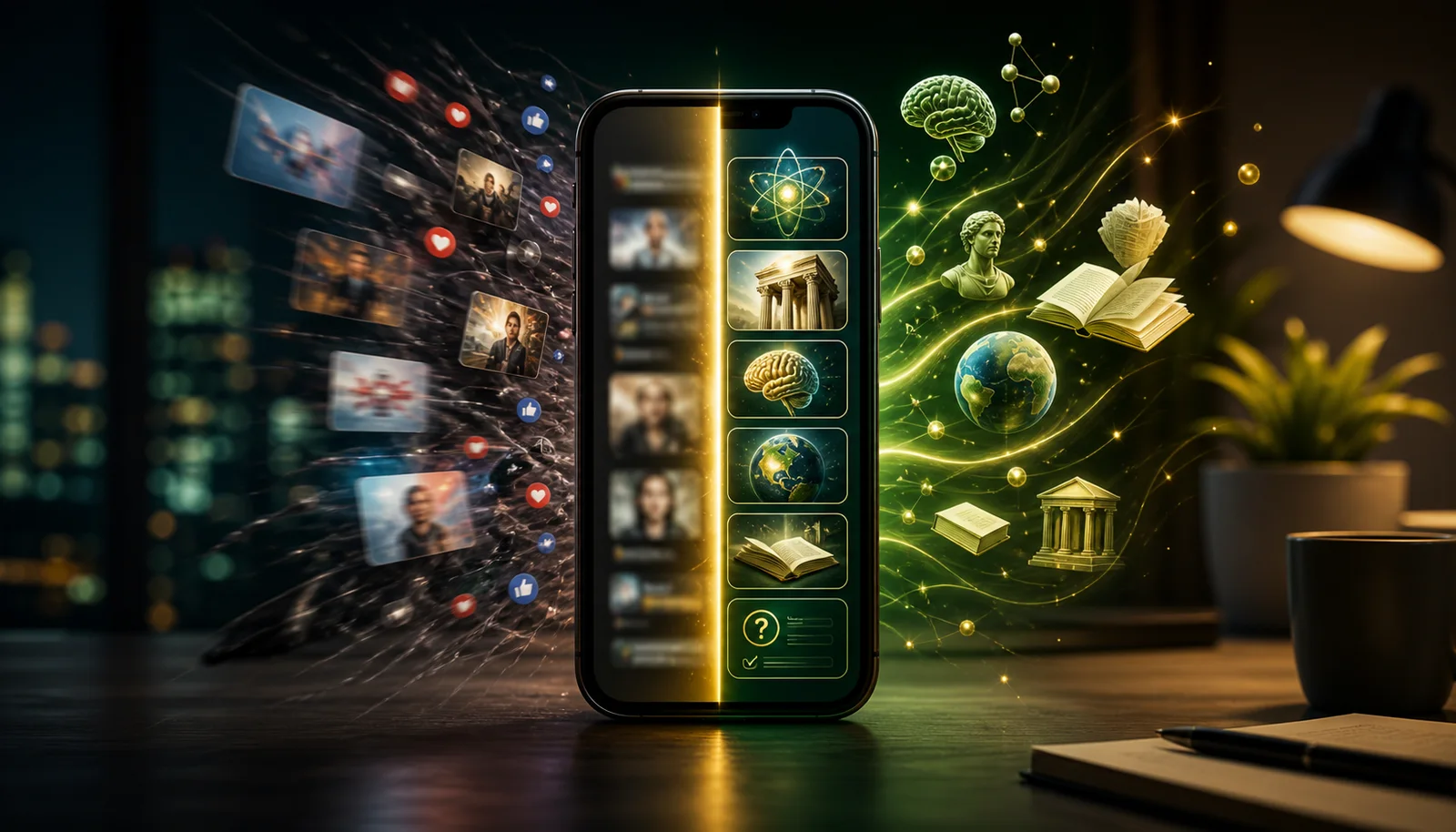
The problem is not access to information. Your phone already has infinite information. The problem is turning dead screen time into knowledge you actually remember.
That is where general knowledge apps help. The best ones are not just content libraries. They give you a repeatable way to learn one useful thing every day, whether you have five minutes in line, twenty minutes on a train, or an hour on the couch where TikTok would normally win.
Before the list, here is the method the best of these apps are really delivering, in six and a half minutes:
What Makes a Great General Knowledge App?
A good general knowledge app does three things well.
First, it covers more than one lane. A language app is useful, but it is not really a general knowledge app. Same with a coding app or a meditation app. General knowledge means breadth: science, history, psychology, society, philosophy, money, health, culture, technology, and the weird connective tissue between them.
Second, it fits into real life. Nobody needs another massive course they will abandon after lesson two. The best apps teach in short, satisfying sessions that work during the little gaps where social media usually slips in.
Third, it helps knowledge stick. Passive content can be entertaining, but it disappears fast. Quizzes, repetition, summaries, stories, visuals, audio, and progress systems all help turn information into memory.
With that standard, these are the seven best general knowledge apps in 2026. If you specifically want to be quizzed rather than taught, we compared the best quiz apps separately, including QuizDuel, LearnClash and Yuno.
1. NerdSip: Best Overall General Knowledge App
Best for: Replacing empty scrolling with short, gamified learning.
NerdSip is built around a simple idea: your phone should make you smarter, not emptier. Instead of opening a feed and hoping the algorithm accidentally teaches you something, you open NerdSip and take a five-minute course on something useful, weird, practical, or fascinating. It is built in Northern Germany, and we call it the German Knowledge Machine for good reasons.
PC Tech Magazine published a full NerdSip review in 2026, walking through how the AI course generation holds up in daily use and where the free plan runs out.
The app covers broad knowledge across science, psychology, history, social skills, health, business, technology, philosophy, and everyday life. Lessons are short enough to finish in the gaps where you would normally scroll. Each course uses quizzes and summaries so you are not just looking at information, you are doing something with it.
The reason NerdSip belongs at number one is the habit loop. It does not feel like school. You earn XP, keep streaks, unlock rewards, climb leaderboards, collect items, and build visible progress. The same mechanics that make social apps hard to quit are pointed toward learning instead.
That matters because general knowledge compounds. One lesson on cognitive biases makes a future lesson on advertising easier. A course on sleep science changes how you understand productivity. A short dive into Roman politics makes a later article about modern institutions more interesting. The more hooks you build, the faster new knowledge sticks.
Why it stands out: NerdSip combines breadth, speed, AI-generated topic flexibility, quizzes, social features, and game mechanics in one app. It is the strongest choice if your real goal is to replace mindless phone time with a daily learning habit.
Price: Free tier available. Paid tiers unlock heavier use and more AI generation.
Fact-checking: Every course is generated against live search results, scored nightly for content integrity, kept out of the swipe deck if it fails the bar, and reportable in one tap to a queue that real people work through.
2. Brilliant: Best for Understanding How Things Work
Best for: Math, science, computer science, logic, and interactive problem-solving.
Brilliant is not a broad culture app, but it absolutely belongs on a general knowledge list because it teaches the kind of knowledge most people avoid: probability, logic, scientific thinking, algorithms, physics, data, and math.
The format is the opposite of passive video. Brilliant makes you solve problems. You tap, drag, test, guess, fail, correct yourself, and slowly build understanding. That effort is the point. When you solve your way through a concept, you remember it better than if someone simply explained it to you.
Brilliant is especially useful for adults who feel they missed the STEM train in school. It rebuilds technical intuition without making you sit through a lecture hall. You can learn how neural networks work, why probability is unintuitive, or what calculus is actually for in a way that feels active rather than punishing.
Why it stands out: It is the strongest app here for rigorous thinking. If NerdSip and Chunks make you broader, Brilliant makes you sharper in formal reasoning.
Price: Limited free content. Premium subscription for full access.
3. CuriosityStream: Best Passive General Knowledge App
Best for: Documentary lovers who want smarter TV time.
CuriosityStream is the app for evenings when you want to watch something but do not want your brain to melt into another algorithmic entertainment loop. It is a documentary streaming service focused on science, history, nature, technology, and society.
It is not the best app for retention because watching documentaries is still passive. But passive does not mean useless. A good documentary can give you context, images, stories, and emotional hooks that make a subject come alive. Sometimes that is exactly what you need before you go deeper.
CuriosityStream works best as a replacement for low-value video time. If you already watch shows at night, swapping one session a week for a documentary is a low-friction upgrade. You do not have to become a productivity machine. You just have to make the default slightly smarter.
Why it stands out: It is the easiest lean-back option for general knowledge. Open it when you want to watch, not study.
Price: Paid subscription, typically cheaper than mainstream streaming services.
4. Chunks: Best Curated Story App for General Knowledge
Best for: People who want bite-sized stories across humanities, science, and culture.
Chunks is one of the most interesting microlearning apps in the general knowledge space. It breaks complex topics into narrated stories that usually take four to eight minutes, with content across history, philosophy, literature, science, art, music, nature, and health.
The main difference between Chunks and many learning apps is tone. Chunks is narrative-driven. Instead of feeling like a stack of flashcards, it feels like someone telling you a well-edited story about a topic worth knowing. That makes it especially good for people who like history, culture, biographies, ideas, and the kind of knowledge that makes conversations richer.
Chunks also has a useful read-or-listen format. If you want to read, you can. If you are walking, commuting, or cooking, you can listen. That flexibility matters because the best learning app is usually the one that fits the moment you actually have.
Why it stands out: Chunks is curated rather than open-ended. Premium members can now request a story on their own topic, but the main library is hand-picked, and that gives the app a strong editorial feel. It is a good companion to NerdSip: use NerdSip when you want any-topic learning and gamified retention, and use Chunks when you want a polished story from a curated library.
Price: Free to download with paid options for the full library.
5. Blinkist: Best for Nonfiction Breadth
Best for: Getting the core ideas from popular nonfiction books quickly.
Blinkist compresses nonfiction books into short text and audio summaries. It covers business, psychology, productivity, science, health, culture, money, and self-improvement. If your reading list is full of books you keep meaning to start, Blinkist gives you the main argument before you commit to the full thing.
The strength is breadth. In a single week, you can sample ideas from behavioral economics, negotiation, memory, leadership, nutrition, and creativity. That is valuable for general knowledge because you start recognizing patterns across fields.
The weakness is depth. A book summary is not the same as a book. You lose examples, nuance, and the slow build of an argument. Blinkist is best used as a filter: learn the core idea, then decide which books deserve real time.
Why it stands out: It is one of the fastest ways to survey modern nonfiction and build a mental map of important ideas.
Price: Limited free access, paid subscription for the full library.
6. Wikipedia: Best Free Rabbit Hole
Best for: Open-ended exploration when a question grabs you.
Wikipedia is still one of the most powerful general knowledge tools ever built. The app is fast, free, and perfect for following curiosity wherever it goes. Start with the history of coffee and you might end up reading about trade routes, plant biology, Ottoman culture, colonial economics, and caffeine chemistry.
That is the magic of Wikipedia: it shows you that knowledge is connected. Every blue link is a door. For curious people, that is almost dangerous in the best way.
The limitation is structure. Wikipedia will not decide what you should learn next. It will not quiz you. It will not build a habit for you. It will not separate what is essential from what is merely interesting. You have to bring your own direction.
Why it stands out: It is free, enormous, and unbeatable for fast context. Use it as your rabbit-hole engine, not your only learning system.
Price: Free.
7. TED: Best for Fast Exposure to Big Ideas
Best for: Discovering new topics through short expert talks.
TED is uneven, but its best talks are still excellent introductions to ideas you would not have found on your own. The app gives you short talks from researchers, writers, artists, entrepreneurs, scientists, and thinkers across almost every subject.
TED is good for intellectual sampling. You might not become an expert in urban design, regret, body language, creativity, or astronomy from one talk. But you can discover that you care about those topics. That matters because curiosity often needs a spark before it becomes a habit.
Use TED when you want to be exposed to something outside your normal lane. Then, if the topic sticks, go deeper with NerdSip, Chunks, Brilliant, Wikipedia, books, or podcasts.
Why it stands out: It is one of the easiest ways to meet new ideas in under twenty minutes.
Price: Free.
The Best General Knowledge Stack
You do not need all seven apps. In fact, downloading everything is usually how people change nothing. Pick a stack that matches your real behavior.
If you want to replace social media: Start with NerdSip. It is short, rewarding, and built for the exact moments where scrolling usually wins. Add Chunks if you like story-driven learning.
If you want smarter entertainment: Use CuriosityStream instead of another streaming show, and TED when you want a quick idea instead of a full documentary.
If you want sharper thinking: Combine Brilliant for formal reasoning with NerdSip for broader knowledge.
If you want free exploration: Use Wikipedia, but pair it with something structured. Rabbit holes are fun, but habits need rails.
How to Actually Learn Something Useful Every Day
The app matters less than the replacement habit.
Do not tell yourself you will study for an hour every night. You probably will not. Instead, attach learning to a moment that already exists.
- When you reach for TikTok, open NerdSip first.
- When you wait for coffee, read one Chunks chapter.
- When you eat lunch alone, watch one TED talk.
- When you want TV but not junk TV, open CuriosityStream.
- When a question pops into your head, search Wikipedia instead of ignoring it.
Five minutes a day sounds small because it is small. That is why it works. One useful idea per day becomes thirty ideas a month. Thirty ideas a month becomes a mental library. A mental library changes how you think, speak, decide, and notice the world.
That is the real value of general knowledge apps. Not trivia. Not pretending to be smart. A wider mind.
If your goal is to make your phone less empty, start with our guide to the best apps to replace social media. If your goal is broader learning, compare this list with our roundups of apps that make you smarter, apps for curious adults, and microlearning apps.
Want to know whether any of these apps is actually working? Test yourself once a week. Our general knowledge questions with answers take ten minutes and need no app.
Frequently Asked Questions
What is the best general knowledge app in 2026?
NerdSip is the best general knowledge app for people who want a daily habit because it combines short lessons, quizzes, XP, streaks, and broad topic coverage. Chunks is excellent if you prefer curated, story-driven learning. Wikipedia is best for free exploration, while Brilliant is best for STEM.
Which apps help you learn something useful every day?
NerdSip, Chunks, Brilliant, CuriosityStream, Blinkist, Wikipedia, and TED all help you learn something useful every day. The key difference is format: NerdSip is gamified microlearning, Chunks is curated stories, Brilliant is interactive problem-solving, and CuriosityStream is documentary video.
Can general knowledge apps replace social media?
They can replace the bored-on-your-phone habit if they are just as easy to open. NerdSip and Chunks work especially well because they fit into short breaks and give your brain a quick reward without sending you into an endless feed.
Are general knowledge apps worth paying for?
They are worth paying for if they become part of your routine. A paid app you use daily is more valuable than a free app you ignore. Start with free tiers, then pay only for the format you actually keep using.
Every NerdSip course clears a four-layer fact-checking pipeline before it reaches the app: grounded in live sources, scored nightly, gated on failure, and reviewable by a person at one tap. Articles on this blog are drafted with AI assistance, then researched, verified, and edited by our team.
Editorial responsibility: ai51 UG (haftungsbeschränkt). Responsible editor named in the imprint.
📚 Keep Learning
- Best Quiz App in 2026: 4 Tested (And What Happens When You Get One Wrong)
- How to Improve Your General Knowledge: A Daily System That Works
- How to Get Better at Pub Quizzes (Without Reading More Trivia)
- 8 Best Apps That Make You Smarter in 2026 (Tested for 30 Days)
- 9 Best Apps for Curious Adults Who Just Like Knowing Things (2026)
- TikTok for Smart People: 7 Knowledge Apps to Replace TikTok (2026)
- 12 Best Apps to Replace Social Media in 2026 (What to Use Instead)
Explore the NerdSip learning hubs
The blog is our editorial layer. When you want to move from reading into doing, these hubs organize the rest of NerdSip by format, including the app itself and the press that has written about it.
Replace the Scroll With Knowledge
Open NerdSip when you would normally scroll. Learn one useful thing in five minutes, earn XP, and build a brain-feeding habit that actually sticks.
Courses on this topic
4.7 stars from 380 reviews · 10,000+ learners