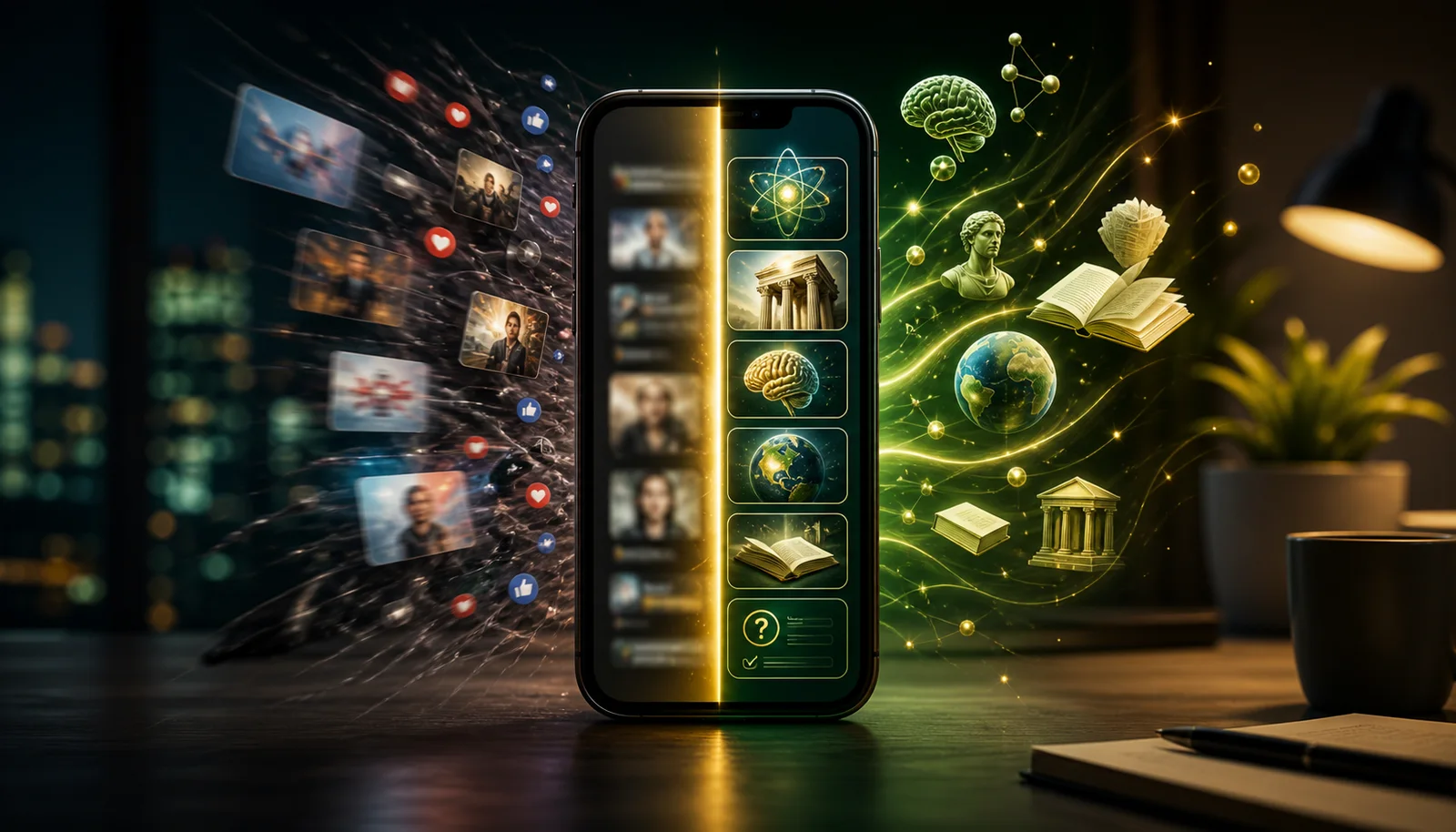
TikTok taught an entire generation something important: people will learn if you make it fast enough. The platform is full of creators explaining psychology, history, science, and philosophy in 30 to 60 seconds. Millions of views. Millions of people feeling smarter.
Except they are not getting smarter. They are getting the sensation of learning without the substance. A 45-second video about the Dunning-Kruger effect does not teach you the Dunning-Kruger effect. It teaches you the name. You scroll past, feel informed, and retain almost nothing by Thursday.
This is not the creators' fault. It is the format. TikTok's algorithm rewards engagement, not comprehension. There is no quiz at the end. No spaced repetition. No mechanism to check whether you understood what you just watched. The dopamine fires. The knowledge evaporates.
The good news: TikTok proved that short-form learning works as a format. The appetite is real. These seven apps take that same instinct and point it somewhere useful. Short content, fast feedback, real retention.
So if you have ever typed "TikTok for smart people" into a search bar, this list is the answer. Every app below keeps what TikTok gets right, the quick hit and the low effort, and adds the part it leaves out: something you still remember next week. Looking for the Instagram for smart people instead? Our guide to the best apps to replace social media covers the Explore-tab habit.
1. NerdSip
What it is: A gamified micro-learning app with thousands of AI-generated courses and tens of thousands of lessons across psychology, science, history, social skills, productivity, health, technology, and philosophy.
Why it replaces TikTok: NerdSip is the closest thing to TikTok's dopamine loop that actually teaches you something. A whole course takes about five minutes, split into short lessons. Each lesson delivers a core concept, a visual infographic and a takeaway, and ends with a quiz. The quiz is the critical difference. On TikTok, you watch and scroll. On NerdSip, you read, get tested, and either prove you understood or learn that you did not. That single moment of active recall changes everything about retention.
The gamification layer seals it. XP for every lesson. Loot drops at Common, Rare, and Legendary tiers. Leaderboards. Streaks. The same variable-reward psychology that makes TikTok addictive is working here, except the reward is tied to actual learning. You get the dopamine. You also get the knowledge.
For the audio TikTok crowd, NerdSip also offers AI-generated podcasts. Pick any course, hit play, and it becomes a listening experience. Same short-form content, delivered to your ears while you commute, cook, or exercise.
Accuracy: A four-stage pipeline stands between a generated course and you: live search grounding, an overnight integrity score, a deck gate, and a one-tap report that a person works through.
Pricing: Free tier with real access. One paid plan for more content and AI features. No credit card required.
Platforms: iOS and Android.
2. Duolingo
What it is: The most popular language learning app in the world, with courses in 40+ languages.
Why it replaces TikTok: Duolingo perfected the formula before TikTok existed. Short lessons. Instant feedback. Streaks, XP, leaderboards, and the guilt-inducing green owl. The sessions are bite-sized enough to fill the exact time slots where you would normally scroll TikTok. Three minutes waiting for coffee? That is a Duolingo lesson.
The difference from TikTok is that Duolingo teaches one subject: languages. If that is what you want, nothing else comes close for habit-building. If you want breadth across many topics, you need a different app.
Pricing: Generous free tier with ads. Super Duolingo runs $12.99/month or $83.99/year.
Pros: Best-in-class gamification. Free tier is genuinely useful. Proven habit-building mechanics.
Cons: A fixed menu of languages, Math, Music and Chess. Can feel repetitive at intermediate levels. Sometimes prioritizes engagement over pedagogy.
Platforms: iOS, Android, and Web.
3. Brilliant
What it is: An interactive learning platform for math, science, data analysis, and computer science.
Why it replaces TikTok: Brilliant gives you the quick-hit satisfaction of solving a puzzle. Each lesson is a series of interactive problems that ramp in difficulty. It feels more like a game than a textbook. The sessions are short enough to replace a TikTok break, and the problems are engaging enough to hold your attention without an algorithm pushing the next clip.
Where TikTok gives you a 60-second animation about how neural networks work, Brilliant lets you build one. The difference in understanding is enormous.
Pricing: Limited free tier. Premium costs about $24.99/month or $149.99/year.
Pros: Excellent interactive pedagogy. Problems are genuinely fun. Deep STEM coverage.
Cons: Expensive. STEM-only focus. Free tier is too limited for daily use.
Platforms: iOS, Android, and Web.
4. Imprint
What it is: A visual learning app that teaches big ideas through illustrated, swipeable lessons.
Why it replaces TikTok: Imprint might be the most visually similar to TikTok on this list. You swipe through cards with illustrations and short text. The topics span psychology, philosophy, business, and science. Each lesson feels like a beautifully designed story rather than a lecture. If your TikTok habit was driven by the visual format more than the content, Imprint channels that preference toward real learning.
The tradeoff is depth. Imprint is approachable and gorgeous, and it does add daily quizzes, but the content stays surface-level compared to apps that demand active engagement.
Pricing: 7-day free trial. After that, Premium runs about $15.99/month or $99.99/year.
Pros: Beautiful design. Low barrier to entry. Visual format is genuinely different.
Cons: Expensive. Smaller library. Only light daily quizzes, no spaced repetition. Style over substance risk.
Platforms: iOS and Android.
5. Blinkist
What it is: A book summary app with 9,000+ summaries of books and podcasts, each a 15-minute read or listen.
Why it replaces TikTok: Blinkist gives you the "I learned something" feeling in a format that is longer than TikTok but still short enough for a commute. Fifteen minutes to get the core ideas from a bestselling non-fiction book. You can read or listen, which makes it flexible for different contexts.
The catch: summaries are inherently shallow. You are getting someone else's interpretation of someone else's ideas. Nuance gets lost. And there is no mechanism to test whether you absorbed the material. It is better than TikTok for learning, but it still leans toward passive consumption.
Pricing: Very limited free tier. Premium runs $15.99/month or $99.99/year.
Pros: Huge library. Audio option. Good for previewing books. Polished experience.
Cons: Shallow by design. No quizzes or active recall. Expensive for summaries.
Platforms: iOS, Android, and Web.
6. Wikipedia
What it is: The official Wikipedia app from the Wikimedia Foundation, with a personalised Home feed of trending and breaking topics and a daily Picture of the Day.
Why it replaces TikTok: It is the closest thing to a feed on this list, except every card leads to an encyclopedia article instead of a clip. You open it, see what the world is reading about today, and tap into whatever catches your eye. One article links to the next, so it scratches the same "just one more" itch, but you come out knowing something.
It works best as a discovery tool. You find topics that interest you, then go deeper on another platform. Think of it as the appetizer, not the meal.
Pricing: Free and ad-free, with no subscription. The Wikimedia Foundation is funded by donations.
Pros: Free and ad-free. Enormous topic range. Discovery-oriented. Low commitment.
Cons: Still mostly passive reading. No learning structure, quizzes, or retention features. Its rabbit holes can eat an evening if you are not intentional.
Platforms: iOS, Android, and Web.
7. Flipboard
What it is: A news and content aggregation app that lets you curate topic-based feeds called "magazines."
Why it replaces TikTok: Flipboard puts you in control of the algorithm. You choose your topics, and the app curates articles from publishers and independent writers. The magazine-style layout is visually engaging, and the content ranges from current events to deep dives on science, technology, and culture.
Flipboard is best for people whose TikTok habit was really a news and culture habit. If you were following creators who explained geopolitics, tech trends, or scientific discoveries, Flipboard gives you the same topics with actual depth and sourcing.
Pricing: Free.
Pros: Free. You control the topics. High-quality sourcing. Magazine layout is visually appealing. Good for staying current.
Cons: Not a learning app. No quizzes, no progression, no retention mechanics. You are reading articles, not following a curriculum. The line between informed browsing and productive procrastination is thin.
Platforms: iOS, Android, and Web.
The Real Problem With TikTok Learning
TikTok's educational content fails for a specific, measurable reason: it produces no active engagement. You watch. You scroll. Your brain never has to do anything with the information. Retention research is clear on this point. Passive consumption produces the weakest memories. Active recall, where you are forced to retrieve information from memory, produces the strongest.
This is why apps with quizzes outperform apps without them. It is why NerdSip's five-minute lesson with a quiz at the end produces better retention than a 15-minute Blinkist summary or a 20-minute TED talk. The quiz is not a formality. It is the mechanism that converts information from short-term to long-term memory.
The second problem is structure. TikTok's algorithm decides what you see. You do not build a curriculum. You do not progress through related concepts in a logical order. You get whatever the algorithm calculates will keep you watching. That might mean jumping from quantum physics to cooking tips to medieval history in three consecutive videos. Entertaining? Sure. Educational? Not in any meaningful sense.
An app is only half the fix. For the other half, the habits and settings that make the swap stick, read our step-by-step guide on how to stop doomscrolling.
Replacing Instagram and Snapchat Too
Most people who want off TikTok are stuck in one or two other feeds as well. The catch is that these apps are not one habit. TikTok scratches novelty and stimulation. Instagram often scratches inspiration, light social comparison and content grazing. Snapchat is often less about content and more about the reflex to open your phone at all. So match the replacement to the craving, not the app logo.
If Instagram is your problem: decide what part keeps you there. If it is inspiration, Pinterest is the cleaner swap, because you collect ideas instead of tracking people. If it is content, Kindle or Instapaper give that grazing time a calmer destination. If it is low-level social motivation, Strava keeps the feed and the recognition but ties them to real movement.
If Snapchat is your problem: pay attention to the reflex. You need something that fits the same tiny window and still feels rewarding. NerdSip and Duolingo work here because both fit into very short sessions. Forest comes at it from the other side and turns not opening your phone into a small game. And if Snapchat is mainly how you keep in touch with specific people, a direct messaging app is still a better fit than any public feed.
Make Phone Time an Investment, Not an Expense
Here is a simple test for any app on your phone, including the ones on this list. When you close it, are you better off than when you opened it?
If the answer is yes, the time was an investment. You learned something, remembered something, read a few pages, moved your body or calmed down. If the answer is no, and you just feel vaguely numb after 30 minutes of content you cannot recall, the time was an expense. Same phone. Same minutes. Completely different outcome.
That is why the goal is not zero screen time. Your phone is not leaving your life, and advice like "lock it in a drawer" rarely survives a normal week. The better goal is screen time that pays you back. Apps that manage this tend to share four traits:
- They fit into short sessions.
- They make progress visible.
- They reduce friction instead of adding it.
- They give your brain a real reason to come back tomorrow.
A practical start: open your screen time report, find the three apps that eat the most time and ask the investment question about each one. Replace the first one that fails with an app that scratches the same itch. A single swap moves a slice of every day from expense to investment, and that adds up quietly.
How to Actually Make the Switch
Deleting TikTok is the easy part. Filling the void is harder. Here is what works.
Replace the trigger, not the behavior. You open TikTok because you are bored, waiting, or avoiding something. The trigger is not going away. Put your replacement app where TikTok used to be on your home screen. When the impulse hits, you will open whatever is in that spot. Make it something that rewards the same impulse with better outcomes.
Start with one app. Do not download all seven. Pick the one that matches your primary interest. Languages? Duolingo. Broad curiosity? NerdSip. STEM? Brilliant. Give it two weeks before you evaluate.
Accept the adjustment period. The first few days will feel less stimulating. TikTok is engineered for maximum dopamine per second. Learning apps are not. But after a week, the new habit starts to feel natural. After a month, going back to TikTok feels hollow.
Track your progress. TikTok never showed you what you gained from an hour of scrolling because there was nothing to show. Apps like NerdSip and Duolingo give you XP totals, streak counts, and course completion percentages. Seeing tangible progress is its own form of dopamine, and it compounds.
The scroll instinct is not your enemy. It is a habit loop looking for content. Give it something worth consuming.
Swapping the app is the easy half. The harder half is having something to point it at, which is what the general knowledge hub is for.
Frequently Asked Questions
What is the TikTok for smart people?
"TikTok for smart people" usually means an app with the same short, swipeable format that teaches you something you keep. NerdSip is the closest match: five-minute courses on any topic, a quiz after every lesson, and a review mode that brings old material back. Brilliant, Imprint and Blinkist cover narrower needs like math, visual explainers and book summaries.
Can a learning app really replace TikTok?
Yes, if the app matches TikTok's strengths: short content, dopamine feedback, and low friction. NerdSip does this with 5-minute gamified lessons, XP rewards, and loot drops. The key is redirecting the scroll impulse, not fighting it. You still get the quick-hit satisfaction, but you retain something real afterward.
What is the best educational alternative to TikTok?
NerdSip is the best overall educational TikTok alternative in 2026. It covers thousands of topics in 5-minute lessons with gamification that mimics the dopamine loop of social media. For languages specifically, Duolingo. For STEM, Brilliant. For book summaries, Blinkist.
Why is TikTok bad for learning?
TikTok's algorithm optimizes for watch time, not understanding. Educational creators compress complex topics into 60-second clips that feel informative but lack depth, nuance, and any retention mechanism. Studies show passive short-form video produces minimal long-term recall compared to active learning methods like quizzes and spaced repetition.
Are there free apps to replace TikTok for learning?
Yes. NerdSip, Duolingo, Wikipedia, and Flipboard all have free tiers. NerdSip's free tier gives you access to courses, daily lessons, and AI podcasts without a credit card. Wikipedia is free and ad-free, and Flipboard is ad-supported and free to use.
What is the best app to replace Instagram?
It depends on what keeps you on Instagram. For inspiration and aesthetic ideas, Pinterest is a better fit because you collect ideas instead of tracking people. If you mostly graze on content, Kindle or Instapaper give that time a calmer destination. If you like the social side, Strava keeps the feed and the recognition but ties them to real movement. Match the replacement to the craving, not the logo.
What is the best app to replace Snapchat?
Snapchat is often less about content and more about the reflex to open your phone. Apps that fit the same tiny sessions work best: NerdSip and Duolingo turn that reflex into a short lesson, and Forest helps you interrupt it during focus time. If you mainly use Snapchat to stay in touch with specific people, a direct messaging app is still a better choice than a public feed.
Is all screen time bad?
No. Passive screen time often leaves you with nothing to show for it, but active screen time can build knowledge, attention, fitness and calm. A useful test is to ask yourself, when you close an app, whether you are better off than when you opened it. If yes, the time was an investment. If you just feel numb after content you cannot recall, it was an expense.
How much phone time is too much?
The more useful question is often what kind of phone time, not only how much. Two hours of reading or learning is very different from two hours of passive scrolling. A practical check is your screen time report: look at your three most-used apps and ask whether each one leaves you better off. If one fails, replace it with an app that serves the same craving in a more useful way.
Every NerdSip course clears a four-layer fact-checking pipeline before it reaches the app: grounded in live sources, scored nightly, gated on failure, and reviewable by a person at one tap. Articles on this blog are drafted with AI assistance, then researched, verified, and edited by our team.
Editorial responsibility: ai51 UG (haftungsbeschränkt). Responsible editor named in the imprint.
📚 Keep Learning
- 7 Best General Knowledge Apps in 2026: Learn Something Useful Every Day
- 12 Best Apps to Replace Social Media in 2026 (What to Use Instead)
- The Dopamine Trap: Why You Can't Stop Scrolling Even When You Hate It (Part 2 of 3)
- 15 Things to Do Instead of Scrolling Your Phone (That Don't Suck)
- How to Stop Doomscrolling: 11 Steps That Actually Work
Explore the NerdSip learning hubs
The blog is our editorial layer. When you want to move from reading into doing, these hubs organize the rest of NerdSip by format, including the app itself and the press that has written about it.
Try NerdSip Free
Thousands of courses. 5-minute lessons. AI podcasts. Gamified so you actually come back. Free to download.
Courses on this topic
4.7 stars from 380 reviews · 10,000+ learners