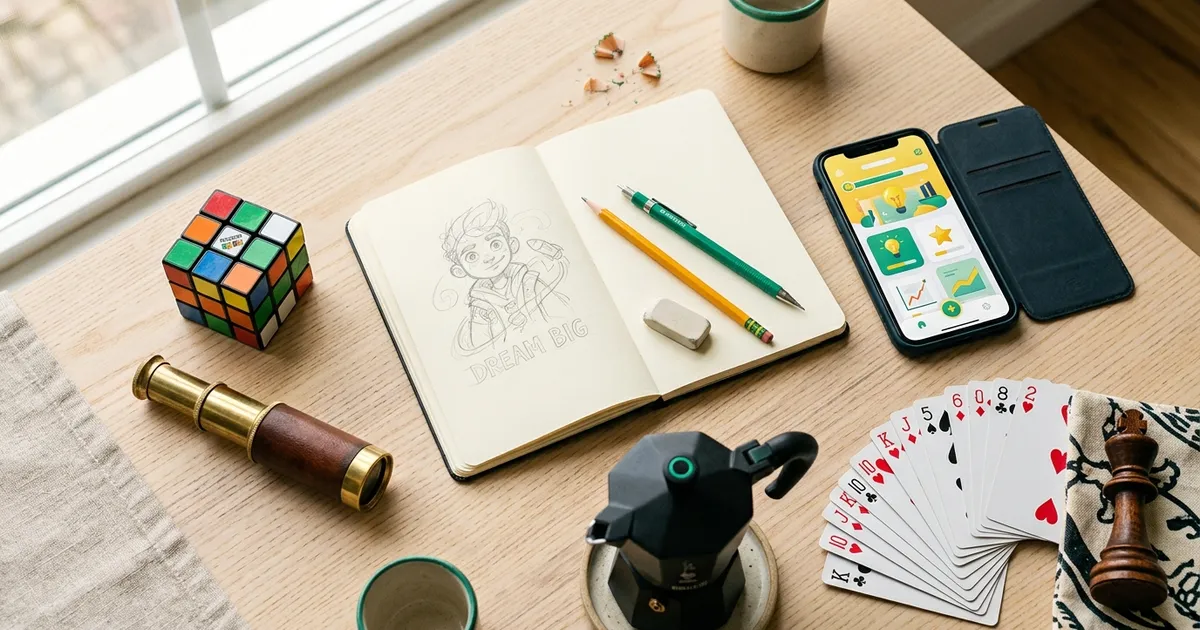
You pick up your phone to check the time. Forty minutes later you're watching a video of someone reorganizing their pantry in Austria and you can't explain why.
Nobody chooses this. You didn't sit down thinking, "I'd love to spend the next half hour consuming content I won't remember tomorrow." It just happened. Again. Because your phone is specifically engineered to make it happen, and you are a human with a dopamine system, not a robot.
Here's the thing nobody mentions in those "just put your phone down!" hot takes: the problem isn't the phone. It's the void. Boredom, a 30-second wait, a commercial break, your brain hates empty space and your thumb fills it automatically. Delete TikTok, and you'll be on Reddit within a week. Delete Reddit, and you'll be checking email for the ninth time.
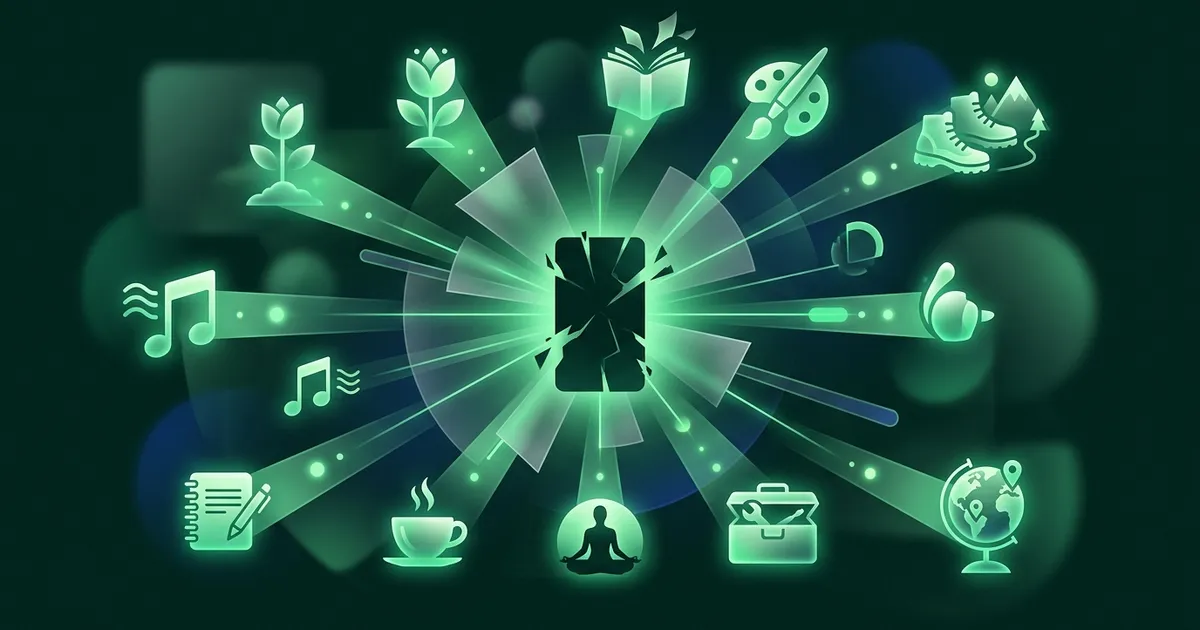
The only thing that actually works is replacement. Specifically: replacements that are just as easy to start, just as stimulating, and don't leave you with that vaguely hollow feeling you get after 40 minutes of scroll.
These 15 aren't "read a book" or "go for a walk", the suggestions you've heard a hundred times and ignored because they feel like homework. These are specific, actually appealing, and most of them fit into the same 5-to-15 minute windows where doomscrolling currently lives.
First: Why You Actually Can't Stop Scrolling
Before the list, a quick two-minute neuroscience detour, because understanding the trap helps you escape it.
Social media feeds run on a variable reward schedule. You scroll, and sometimes you find something hilarious or fascinating, but most of it is nothing. That unpredictability is the entire trick. Your brain's dopamine system responds more strongly to uncertain rewards than guaranteed ones; it's the same mechanism that makes slot machines irresistible. You keep scrolling not because the content is good, but because the next thing might be.
On top of that, every like, notification, and comment is a small dopamine hit. Stack enough of those and your brain recalibrates its baseline. Regular activities feel boring by comparison. Sitting still starts to feel physically uncomfortable. You reach for the phone before you're even conscious of doing it.
This is not a willpower problem. It's a neurology problem. And the solution isn't discipline; it's giving your brain a different source of stimulation that's just as immediate but doesn't leave you feeling worse.
With that out of the way, here are 15 things that actually do that.
Things to Do That Stimulate Your Brain (Without the Rot)
1. Learn why octopuses have three hearts in 90 seconds
Not "go read a 400-page book about marine biology." Genuinely: spend 90 seconds finding out one bizarre, specific fact about something you've never thought about. Octopuses have three hearts (two pump blood to their gills, one to the rest of the body), and when they swim, the main heart stops beating, which is apparently why they prefer crawling. That took less time to read than one TikTok.
This scratches exactly the same itch as scrolling: novelty, a little dopamine hit, and that satisfying "huh, that's wild" feeling. The difference is you'll actually remember it tomorrow. Apps like NerdSip are built for exactly this: bite-sized lessons on topics that are actually interesting (why do we dream? how did the Roman Empire actually fall? what's happening inside a black hole?) delivered in 5-minute chunks with quizzes so the knowledge sticks. It's the scrolling experience, redesigned to make you smarter instead of dumber.
Starting move: Download NerdSip, pick any course that sounds vaguely interesting, and do one lesson. Just one. If it doesn't hook you in five minutes, nothing will.
2. Text someone a compliment they'd never expect
Pick someone from your contacts, not a close friend, someone you haven't talked to in months, and send them a genuine, specific compliment. Not "hey how are you" small talk. Something like: "I've been thinking about that thing you said about your job last year and I think you were completely right." Or: "I don't think I ever told you this but that trip you organized three years ago was genuinely one of my favourite memories."
This sounds small. It isn't. The research on social connection and mood is overwhelming: meaningful interaction (even a brief one) triggers a stronger, longer-lasting dopamine response than passive consumption. You'll feel good. They'll feel good. And you'll have done something that actually matters instead of watching a stranger's vacation highlights.
Starting move: Open your contacts. Scroll to someone you haven't talked to in a while. Type one sentence. Send it before your brain talks you out of it.
3. Solve a logic puzzle or riddle
Your brain craves challenge as much as it craves novelty. When you scroll, you're passively receiving stimulation. Your brain is a tourist. When you solve a puzzle, your brain has to actually do something. That active engagement creates a different kind of dopamine hit: the satisfaction of figuring something out.
You don't need a chess set. There are entire apps built around this: Wordle (still excellent), NYT Mini Crossword (takes 90 seconds on a good day), or just Googling "lateral thinking puzzle" and reading the first result. The key is that you're creating instead of consuming. Your brain is working, not just being worked on.
Starting move: Open your phone's browser and search "hard riddle with answer." Try to solve it before scrolling to the answer. You won't be able to. You'll try it anyway. That's the hook.
4. Write three sentences about what's actually on your mind
Not a journal. Not a diary. Not a 20-minute reflection exercise. Three sentences. That's it. What's actually bothering you right now? What are you looking forward to? What did you notice today that you didn't expect?
The reason people scroll when they're anxious is that scrolling silences the internal noise by replacing it with external noise. Writing does the opposite: it forces you to look at the noise directly, which paradoxically quiets it faster. Psychologists call it "expressive writing" and the evidence behind its effect on stress and mood is remarkably strong for how stupid-simple it is.
Starting move: Open the notes app on your phone (it's already there). Write three sentences. Don't read them back. Just close it and see how you feel.
5. Look up the backstory of something you walk past every day
That building on your corner, when was it built, and what was there before it? The street name, where did it come from? The company logo on that truck you see every morning, what does it actually mean? The world is full of stories and most of us are walking past them on autopilot while we stare at our phones.
This turns idle moments into micro-adventures. You become a person who knows things, not because you studied but because you paid attention. And unlike scrolling, each rabbit hole you go down adds to an actual mental map of the world instead of disappearing into the void the moment you look away.
Starting move: Pick one thing you see regularly and have never thought about. Search it right now. Read for two minutes. That's a complete interaction.
6. Do the 5-4-3-2-1 grounding technique
This sounds like the kind of thing a wellness influencer would say in front of a sunset, but hear it out. The 5-4-3-2-1 technique is a clinical anxiety tool: name 5 things you can see, 4 you can hear, 3 you can touch, 2 you can smell, 1 you can taste. It takes about 90 seconds and it's specifically designed to interrupt rumination loops by anchoring you to the present moment.
A lot of doomscrolling is actually avoidance: your brain is anxious about something and scrolling is a way to not deal with it. The grounding technique addresses the root cause directly, which makes the urge to scroll noticeably weaker afterward. It's not magic, but it's faster than therapy and requires zero equipment.
Starting move: Try it right now. Seriously. Put this down for 90 seconds and name five things you can see. Come back when you're done.
Things to Do That Are Actually Fun
7. Watch one stand-up comedy clip you've never seen before
This might sound like swapping one screen for another, but there's a meaningful difference between intentional consumption and passive scrolling. Choosing to watch a specific 7-minute stand-up set is a decision. Scrolling is an absence of decisions. Your brain processes them differently: intentional viewing leaves you feeling entertained, passive scrolling leaves you feeling vaguely worse even when the content was fine.
YouTube is full of underrated sets from comedians you've never heard of. Search "best stand-up 2024" or "underrated comedy specials" and pick one thing. Watch it to the end. Then put your phone down. One complete experience beats forty interrupted ones.
Starting move: Search "underrated stand-up clips" on YouTube. Pick something with a thumbnail that makes you curious. Commit to watching the whole thing.
8. Plan something you're actually excited about
Not a vague "I should take a trip someday" fantasy. A specific thing. A dinner with a specific friend at a specific restaurant. A weekend hike to a specific trail. A day trip to a place you've been meaning to visit for three years. Open Google Maps, look up the logistics, check the hours, figure out when you're free.
Anticipation is one of the strongest mood boosters that exists, and most people have almost none of it because nothing is ever planned enough to look forward to. Five minutes of actual planning creates weeks of low-grade excitement. That's a better return on your attention than anything your feed will serve you today.
Starting move: Think of one thing you'd actually enjoy doing in the next 30 days. Open your calendar. Block the time. Text whoever needs to be invited.
9. Doodle or draw something badly on purpose
Not art. Not something shareable. Not something you'll show anyone. Just open the notes app or grab a scrap of paper and draw something: a face, a building, your hand, the view from your window, without caring how it looks.
The act of drawing activates a completely different cognitive mode than scrolling. You're creating, not consuming. Your hands are involved. Your visual-spatial processing kicks in. Studies on "visual note-taking" and doodling consistently find that it improves recall and reduces mind-wandering, which is the exact thing you're trying to fix. It also happens to be weirdly meditative once you give yourself permission to be bad at it.
Starting move: Draw a self-portrait right now using only straight lines. No looking in the mirror. See what happens. You cannot do it wrong.
10. Listen to one song with your full attention
Not as background music. Not while doing something else. Lie down, close your eyes, put headphones on, and actually listen to one song from start to finish. Notice the bass line. Notice when the lyrics rhyme in unexpected ways. Notice the moment the song shifts emotionally.
Most people haven't truly listened to music in years. It's become wallpaper. Giving a song your full attention is a genuinely restorative experience, close to meditation in terms of how it affects your nervous system, and three minutes of it beats fifteen minutes of half-attentive scrolling in every meaningful way.
Starting move: Open Spotify or Apple Music. Pick a song you used to love. Put headphones in. Lie down. Press play. Don't touch your phone until it ends.
11. Do 10 minutes of something physical, right where you are
Not "go to the gym." Not "start a workout routine." Ten minutes, wherever you currently are. Twenty push-ups, then rest, then twenty more. A set of squats during the ad break. A ten-minute walk around the block. Stretch your hip flexors because you've been sitting for three hours and they're screaming at you.
Movement breaks work for a reason beyond the obvious physical benefits: physical activity releases BDNF (brain-derived neurotrophic factor), which is essentially fertilizer for your neurons. Your focus improves, your mood lifts, and the urge to numb out with your phone drops significantly. It takes roughly seven minutes of movement to get that effect. You've spent longer in queue at Starbucks.
Starting move: Stand up. Do ten jumping jacks. Sit back down. Notice that you feel different. That's the floor. Build from there.
12. Have a real conversation, with no purpose
Not a catch-up where you both update each other on logistics. Not a work call. Not a "we should hang out" exchange that leads nowhere. Call someone, or talk to whoever is physically near you, with absolutely zero agenda. Ask them something you're genuinely curious about. What are they excited about right now? What's something they think about that they've never told anyone?
Human beings are the most interesting thing on the planet and most of us are neglecting the ones in arm's reach while we watch content from people we'll never meet. The conversations you remember at the end of your life won't be the ones where you exchanged information efficiently. They'll be the strange, wandering ones that went nowhere and everywhere at once.
Starting move: Next time someone is in the same room as you, put your phone in your pocket. Ask them a question you've never asked before. See where it goes.
Things to Do That Are Actually Productive Without Feeling Like Work
13. Declutter one small thing
Not your whole closet. One drawer. One shelf. One section of your phone's camera roll. The back of your fridge. Something with a clear start, a clear end, and a visible result. The "done" feeling from a small, bounded task is surprisingly powerful: your brain registers completion as a reward, which is why crossing things off lists feels satisfying even when the tasks were tiny.
Doomscrolling is partly about avoidance: there are things you should be doing and the scroll is a way to not think about them. Doing one small thing, even something unrelated to the Thing You're Avoiding, breaks the avoidance loop and makes the rest of the day feel more manageable. It's a weird trick. It works.
Starting move: Open your camera roll. Delete ten blurry photos right now. Just ten. That's the whole task.
14. Learn one skill that takes less than an hour to get started
Not a skill you'll spend months mastering. A skill with an immediate, visible result. How to tie five useful knots. How to shuffle a deck of cards properly. How to throw a card like a professional magician. How to fold a fitted sheet without it turning into a fabric snowball. How to pick a lock (for legitimate reasons obviously).
YouTube has tutorials for all of these that are under five minutes. The satisfaction of going from zero to "I can now do a thing I couldn't do an hour ago" is disproportionately large for how much time it takes. And unlike scrolling, the skill is still there tomorrow. And the day after. And when you're at a dinner party and someone asks if anyone knows how to do a card flourish, you are suddenly the most interesting person in the room.
Starting move: Search "useful skill under 5 minutes to learn" on YouTube. Pick the first result that looks fun. Learn it. Actually try to do the thing, not just watch someone do it.
15. Map out one part of your life that's been vague
Most people have areas of their life where they know something is off but it's never concrete enough to act on. Money ("I should probably sort out my finances"). Career ("I don't really know where I want to be in two years"). Health ("I should eat better and I know it and I'm not doing anything about it"). Relationships ("there are people I've been meaning to reach out to for months").
Pick one. Spend ten minutes getting specific. Not fixing it, just getting it out of the vague murk and into a format where you can look at it. Write down what's actually going on. What would "better" concretely look like? What's one thing you could do this week that would move the needle? The goal isn't to solve the problem. It's to shrink it from "looming existential dread" to "specific actionable list," which is about eighty percent of the work.
Starting move: Open your notes app. Write the name of the one area of your life that's been noisiest in your head. Write three bullet points about what you actually want there. Close the app and go about your day.
Replacing the scroll works better when the replacement is already installed. Our roundup of the self-improvement apps we rate for 2026 covers what to reach for instead, from five-minute lessons to friction apps with published trial data.
Replacing the scroll works best alongside a few structural changes. Our step-by-step guide on how to stop doomscrolling covers them, and the free phone addiction test gives you a baseline to measure against.
The Setup That Makes This Actually Work
Reading this list won't change anything. You need one more thing: friction management.
Your phone defaults to scrolling because scrolling is frictionless. The apps are on your home screen. They open instantly. Your thumb knows the way. To replace the habit, you need to make the alternatives equally frictionless and make scrolling slightly harder.
Move your social media apps off your home screen. Put them in a folder, on the last page, buried. You can still use them when you decide to, but you won't be opening them on autopilot anymore, because autopilot needs a clear path.
Put your alternatives front and center. NerdSip, your notes app, a puzzle app, Spotify: whatever you picked from this list goes on your home screen exactly where Instagram used to be. Muscle memory is a real thing. Use it.
Commit to one alternative, not all fifteen. Pick the one that genuinely appeals to you most. Start with that for two weeks before adding anything else. The goal is a new default, not a new to-do list.
The first few days will feel weird. You'll reach for your feed and find something else. You'll open it anyway sometimes and that's fine: the goal isn't perfection, it's shifting the ratio. Less automatic scrolling, more deliberate choices. After about two weeks, the new habit starts to feel natural. After a month, you'll find yourself genuinely less interested in your feed. Not because you developed iron discipline. Because you found better things to do.
Knowing what to do instead is one half of it. The other is interrupting the reach in the first place, which we cover in how to stop doomscrolling.
Every NerdSip course clears a four-layer fact-checking pipeline before it reaches the app: grounded in live sources, scored nightly, gated on failure, and reviewable by a person at one tap. Articles on this blog are drafted with AI assistance, then researched, verified, and edited by our team.
Editorial responsibility: ai51 UG (haftungsbeschränkt). Responsible editor named in the imprint.
📚 Keep Learning
- What to Do When Bored: 100 Ideas That Aren't Scrolling
- 9 Best Productive Apps Instead of Social Media in 2026
- 7 Best Apps to Stop Doomscrolling in 2026 (Why Blockers Alone Fail)
- Reddit Proved People Love Learning. Schools Just Made It Feel Boring.
- How to Stop Doomscrolling: 11 Steps That Actually Work
Explore the NerdSip learning hubs
The blog is our editorial layer. When you want to move from reading into doing, these hubs organize the rest of NerdSip by format, including the app itself and the press that has written about it.
Turn Your Phone Time Into Superpower Time
NerdSip gives you 5-minute lessons on literally anything, history, psychology, science, strategy. Gamified so you actually come back. Free to download.
4.7 stars from 380 reviews · 10,000+ learners