There is a popular story that people do not want to learn anymore. They want entertainment, distraction, dopamine, and easy noise. Their attention spans are broken. Their curiosity is gone.
That story falls apart the moment you look at Reddit.
Communities like r/todayilearned, r/Damnthatsinteresting, r/AskHistorians, r/dataisbeautiful, and r/MapPorn are not built around celebrities dancing or people yelling into microphones. They are built around facts, explanations, maps, history, data, science, and odd little windows into reality.
And people show up. Not because a teacher assigned it. Not because an exam is coming. Not because a manager added it to a training portal. They show up because they want the feeling of understanding something they did not understand a minute ago.
That should change how we talk about learning.
The Problem Was Never Curiosity
Most people are more curious than they get credit for. They wonder why cities are shaped the way they are. They want to know how memory works, why animals behave strangely, how a historical event really happened, what a chart reveals, what a machine does, or why a tiny decision changed the future.
The problem is that formal learning often makes curiosity arrive too late. First comes the syllabus. Then the terminology. Then the abstract explanation. Then maybe, if you survive long enough, the interesting part appears.
Reddit reverses the order. It starts with the interesting part.
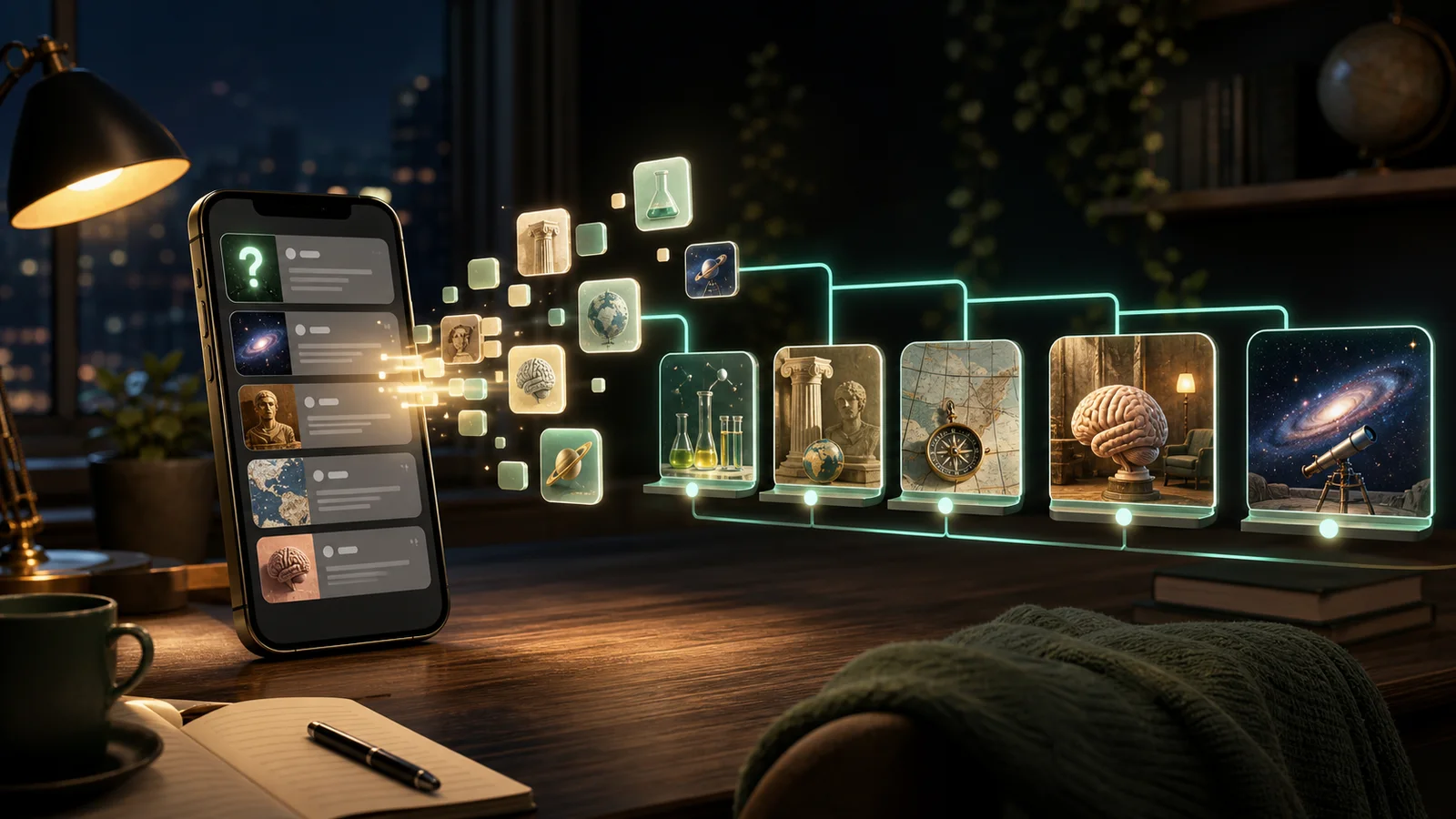
Here is a strange image. Here is a fact you did not expect. Here is a map that makes history visible. Here is a question with an answer that turns out to be deeper than it looks. The hook comes first, and that hook gives the brain a reason to care.
This is not shallow. It is good learning design. Humans learn better when new information arrives with surprise, relevance, or emotion attached to it. A dry paragraph about atmospheric optics may be ignored. A post showing a rare light pillar in the sky makes you ask what caused it. Same topic, different doorway.
What Reddit Gets Right
Reddit gets several things right about curiosity.
It makes learning low-friction. You do not have to enroll, register, plan, or commit. You can learn one thing while waiting for coffee. That matters because most daily learning opportunities are small.
It makes learning social. A fact feels more alive when people argue about it, add context, correct it, joke about it, or share their own experience. Knowledge becomes less like a lecture and more like a conversation.
It makes learning specific. Good Reddit posts are rarely titled "an introduction to biological adaptation." They are more likely to show one animal doing one astonishing thing. Specificity is a better entry point than abstraction.
It rewards rabbit holes. A comment leads to a link, the link leads to another question, and suddenly you are reading about medieval trade routes at 1:12am. That is not always healthy, but it proves a point: curiosity has momentum when the path stays interesting.
These are lessons educators, creators, and learning apps should take seriously. People do not need every learning experience to feel like school. In many cases, school is exactly the association we need to escape.
What Reddit Gets Wrong
Reddit is great at discovery. It is weaker at learning.
The feed has no obligation to build on what you saw yesterday. A fascinating science post may be followed by a joke, then a political argument, then a celebrity clip, then a photo of someone doing something reckless. There is no sequence. No memory support. No progression. No guarantee that the next thing will deepen the previous thing.
That is fine if your goal is entertainment. It is not enough if your goal is knowledge.
There is also the problem of retention. The internet can make you feel smart for a few seconds. You read an explanation, nod along, and feel the satisfying glow of understanding. But familiarity is not mastery. If you cannot explain the idea later, apply it, or recognize it in a new context, it probably did not stick.
That is where microlearning has an opening. It can borrow the spark from Reddit but add the missing pieces: structure, recall, progression, and repetition.
The Missing Middle Between School and Scrolling
Most people treat learning as if there are only two modes.
Mode one is serious learning: books, courses, lectures, notes, exams, effort. Valuable, but often heavy. Mode two is casual learning: feeds, facts, videos, posts, links, podcasts. Fun, but often leaky.
The missing middle is microlearning.
Microlearning says: make the lesson short enough to start casually, but structured enough to matter. Keep the spark. Add the takeaway. Add a small question. Add a reason to come back tomorrow.
This is where NerdSip fits. It is built for people who already like the feeling of discovering something cool, but want that feeling to compound. You open it because the topic sounds interesting. You stay because the lesson is short. You remember more because the app asks you to retrieve the idea instead of merely recognizing it.
That is the important shift. Curiosity becomes less random. It becomes repeatable.
Attention Span Is the Wrong Diagnosis
When someone says attention spans are dead, ask what they mean. People binge three-hour podcasts. They spend an hour reading comment threads. They watch 40-minute explainers about ancient battles, stock market crashes, or aircraft accidents. They read entire Reddit debates about whether a map projection is misleading.
The attention is there. It is just selective.
People give attention to things that feel rewarding, concrete, and alive. They withhold it from things that feel padded, vague, or compulsory. That is not a crisis. That is feedback.
For creators, the lesson is uncomfortable but useful: you do not earn attention by declaring your topic important. You earn it by making the first step obvious, interesting, and worth taking.
For learners, the lesson is even better: you do not need to wait until you become disciplined enough to study for an hour a day. You can start with the curiosity you already have. Then you can shape it.
How to Build a Curiosity System
If you love Reddit-style learning, do not try to eliminate it. Upgrade it.
Keep one discovery feed. Let yourself browse interesting communities, channels, newsletters, or podcasts. Serendipity is valuable. You want exposure to ideas you would never search for directly.
Capture the best sparks. When something genuinely grabs you, do not just upvote and move on. Save the question. Write the topic down. Search for a short explainer. The goal is to notice which ideas keep tugging at you.
Convert one spark per day into a lesson. This is the NerdSip move. Take one interesting thing and give it five focused minutes. Learn the core explanation. Answer a question about it. Connect it to something else.
Review what matters. Not everything needs to be remembered. But the ideas that change how you see the world deserve another pass. A tiny review later is what turns novelty into knowledge.
This system does not fight your curiosity. It respects it. It treats interest as the ignition, not as a distraction.
What a Better Learning Feed Would Look Like
Imagine a feed that respected the part of Reddit people actually love: surprise, range, and the feeling that the world is stranger than you thought. Now imagine that feed also cared whether you remembered anything tomorrow.
It would still start with curiosity. A lesson might begin with a weird question, a sharp image, a chart, a historical twist, or a practical social situation. The first job would be to make you care.
Then it would slow down just enough to explain. Not a lecture. Not a wall of academic language. A clean explanation that tells you what is happening and why it matters. The learner should never have to guess the point.
Then it would ask you to do something small. Pick the right cause. Explain the idea in one sentence. Choose the better example. Connect the idea to a previous topic. This is the moment where passive interest becomes active learning.
Finally, it would bring important ideas back later. Not forever, not annoyingly, but at the moment where memory is starting to fade. That is how knowledge compounds. The first exposure creates interest. The second and third exposures create ownership.
This is the product challenge NerdSip is trying to solve. Not how to make learning look serious, but how to make useful knowledge feel as easy to begin as a good post and much easier to remember than a feed.
What This Means for NerdSip Content
The blog should not talk about curiosity from a distance. It should behave like a curiosity engine. That means direct answers, strong hooks, clean examples, and paths into related articles.
A reader who lands here because they like TIL-style facts should naturally find the best way to learn cool stuff. A reader who wants better phone habits should find things to do instead of scrolling. A reader looking for tools should find apps for curious adults.
That is good for readers and good for search. It tells Google, AI assistants, and human visitors the same thing: NerdSip owns this cluster. It is not only another app page. It is a growing library around curiosity, microlearning, and better screen time.
The Future of Learning Looks More Like Curiosity
The best learning experiences of the next decade will not feel like miniature textbooks squeezed onto phones. They will feel closer to guided rabbit holes: surprising entry points, short explanations, strong visuals, active recall, and optional depth.
They will understand that people want both fun and substance. They will not make learners choose between being entertained and becoming smarter. They will use the mechanics of feeds and games, but point them toward better outcomes.
That is the opportunity. Reddit already proved that people want to learn cool things. The question is what happens after the first click.
If the answer is just another scroll, the curiosity leaks away. If the answer is a small learning loop, it compounds.
People love learning. They always have. The trick is to stop packaging it like punishment.
Start with wonder. Keep it short. Make it memorable. Then do it again tomorrow.
Frequently Asked Questions
Why do people like TIL-style facts so much?
TIL-style facts work because they are surprising, low-friction, and easy to share. They give the brain a quick reward while opening a door to a bigger topic.
Does Reddit prove people have good attention spans?
It proves people will give attention when the format earns it. The issue is less about short attention spans and more about whether learning feels relevant, concrete, and rewarding.
What can learning apps learn from Reddit?
Learning apps can borrow Reddit's sense of novelty, social proof, and rabbit holes, but they need to add structure, recall, progression, and repetition.
Every NerdSip course clears a four-layer fact-checking pipeline before it reaches the app: grounded in live sources, scored nightly, gated on failure, and reviewable by a person at one tap. Articles on this blog are drafted with AI assistance, then researched, verified, and edited by our team.
Editorial responsibility: ai51 UG (haftungsbeschränkt). Responsible editor named in the imprint.
📚 Keep Learning
Explore the NerdSip learning hubs
The blog is our editorial layer. When you want to move from reading into doing, these hubs organize the rest of NerdSip by format, including the app itself and the press that has written about it.
Make Curiosity Easier to Keep
NerdSip turns fascinating topics into short lessons, quizzes, and daily progress. It is built for people who already love learning when it feels alive.
Courses on this topic
4.7 stars from 380 reviews · 10,000+ learners