People do not hate learning. They hate feeling trapped in a bad learning experience.
You can see the proof every day on communities like r/todayilearned and r/Damnthatsinteresting. Millions of people voluntarily click into short facts, strange historical details, science explanations, maps, visual discoveries, and stories they did not know they wanted five seconds earlier.
That matters. It means curiosity is not dead. Attention is not dead either. People will absolutely learn if the entry point is small, surprising, and rewarding.
The problem is that scrolling through interesting facts is not the same as learning. A fact can make you pause, smile, send it to a friend, and then disappear from your memory by dinner. A good rabbit hole can make your evening more interesting, but it may not leave you with a durable mental model. The feed is excellent at creating sparks. It is not designed to build a fire.
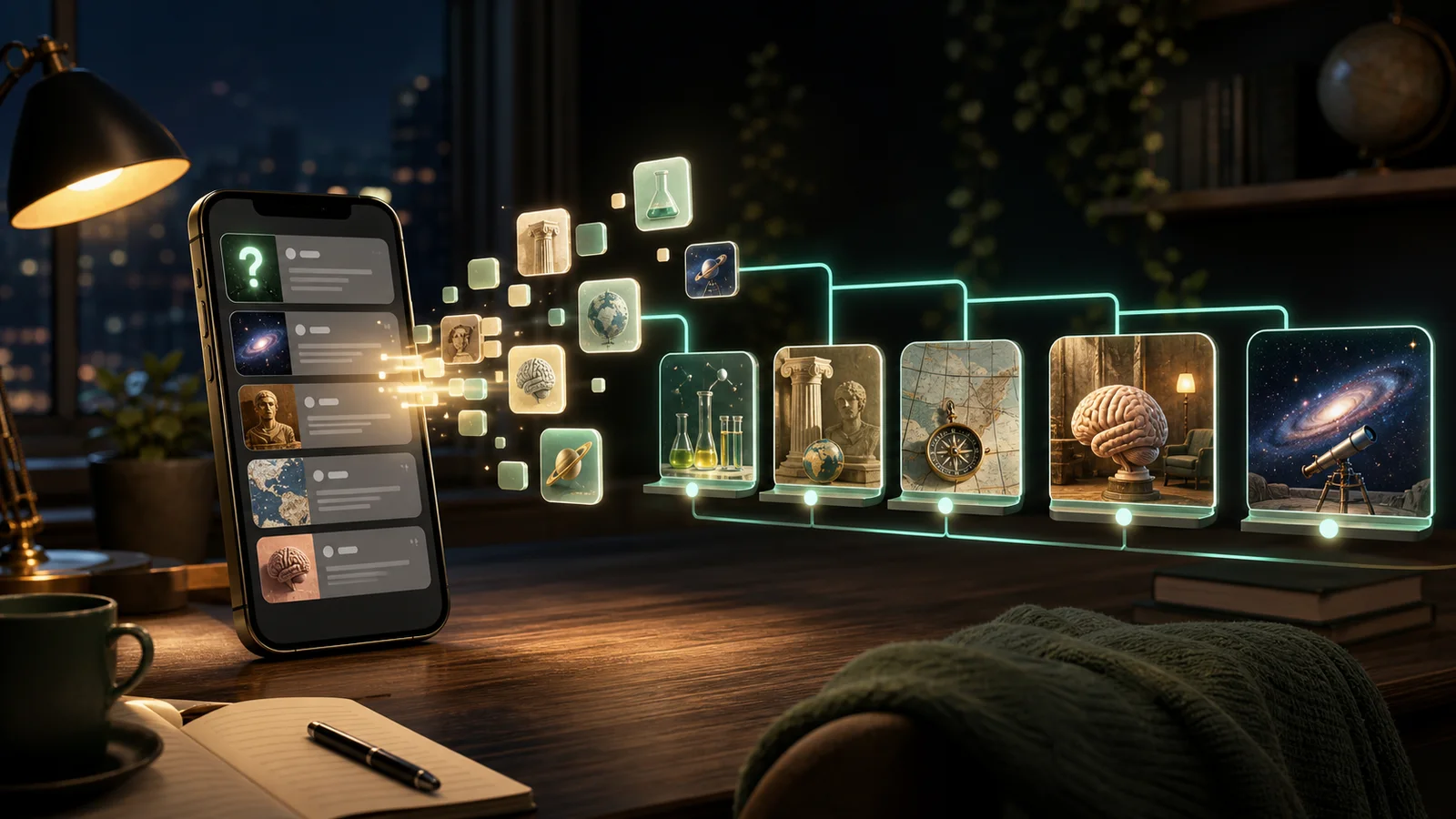
That is where microlearning becomes useful. If Reddit is where curiosity starts, NerdSip is where it can become a habit. The goal is not to replace the joy of a good "today I learned" moment. The goal is to keep that joy and add just enough structure that your brain actually keeps the knowledge.
Why Short Facts Work So Well
Short facts work because they respect how curiosity actually behaves. Nobody wakes up and says, "I would like to allocate 47 minutes to the history of Roman concrete." But show someone a one-sentence fact about Roman harbors surviving for 2,000 years, and suddenly they want to know why.
That is the magic. A good fact is a doorway. It does not ask for commitment up front. It gives your brain a tiny reward first: surprise. Once surprise appears, attention follows.
Communities like r/todayilearned understand this implicitly. The format is compact. The promise is obvious. Every post says, in effect: here is one thing you did not know. No syllabus, no prerequisite, no awkward lecture voice. Just a compact little mental jolt.
The same is true for r/Damnthatsinteresting. The best posts are not merely random. They have a built-in emotional reaction: that is weird, beautiful, unsettling, clever, ancient, enormous, tiny, or hard to believe. Curiosity gets pulled forward by amazement.
This is also why short learning can beat long learning at the beginning of a habit. A five-minute lesson has a low activation cost. You do not have to clear your evening. You do not have to become a different person. You only have to give the idea a tiny opening.
The Problem: Interesting Is Not the Same as Learned
There is a painful little truth here: you can consume 30 fascinating facts and still not learn much.
That sounds harsh, but it is not a moral judgment. It is just how memory works. Your brain does not store information simply because it passed in front of your eyes. It stores information when attention, meaning, retrieval, and repetition work together.
Most feeds are optimized for the first part only: attention. They are very good at making you stop. They are much less good at helping you connect, retrieve, or revisit what you saw.
That is why you can remember the feeling of being amazed without remembering the fact that amazed you. You know you read something wild about deep-sea life last week, but the actual detail is gone. You know there was a history story that would have been perfect for dinner conversation, but when dinner arrives, your brain gives you static.
This is the gap between entertainment and learning. Entertainment can be valuable. It can relax you, inspire you, and widen your world. But if the goal is to become a person who actually knows more, you need a small system after the spark.
The Best Way to Learn Cool Stuff
The best way to learn cool stuff is simple:
- Start with something genuinely interesting.
- Keep it short enough that you actually begin.
- Add one layer of context.
- Force one small act of recall.
- Repeat the habit tomorrow.
That is the difference between scrolling facts and microlearning.
A scrolling fact says: here is something surprising. A microlearning loop says: here is something surprising, here is why it matters, here is how it connects to the world, and here is a tiny check that proves you understood it.
That last part matters more than people think. Reading creates familiarity. Recall creates memory. If you learn that octopuses have three hearts, the idea feels easy while it is in front of you. But if the app asks you thirty seconds later which heart stops beating when an octopus swims, your brain has to retrieve the answer. That tiny struggle is the point. It tells the brain: keep this.
NerdSip is built around exactly that premise. Keep the snackable joy of discovery, but organize it into short lessons that have a takeaway, a little test, and a reason to come back. Reddit proves the appetite. NerdSip builds the habit.
A Better Curiosity Diet
If you care about learning, you should think about your curiosity the way you think about food.
There is nothing wrong with snacks. Snacks are fun. Snacks can be excellent. But a whole diet of snacks leaves you strangely unsatisfied. The same thing happens with knowledge. Random facts are the snack layer of curiosity. They are enjoyable and sometimes genuinely nutritious, but they need structure around them.
A better curiosity diet has three layers.
First, discovery. This is where Reddit, YouTube, podcasts, newsletters, search, and social feeds shine. You encounter things you did not know to ask about. This layer should feel playful. It should have serendipity.
Second, depth. When something keeps pulling at you, go one step deeper. Read the explainer. Take a short course. Ask a better question. Move from "that is interesting" to "why does that happen?"
Third, retention. This is where most people stop too early. If you want the idea available later, you need to retrieve it. Explain it to someone. Answer a quiz. Write one sentence. Review it a few days later.
The mistake is trying to make every curiosity moment deep. That kills the fun. You do not need to turn every interesting fact into homework. But the ideas that genuinely grab you deserve a path.
The Five-Minute Method
Here is a practical routine for learning cool stuff without turning your life into a productivity spreadsheet.
Minute 1: Pick one spark. Choose one topic that actually makes you curious. Not the topic you think you should learn. The one your brain leans toward. Ancient engineering, negotiation psychology, black holes, weird finance, memory tricks, body language, lost cities, whatever.
Minutes 2 and 3: Learn the core idea. Read or watch one short explanation. The goal is not mastery. The goal is one clean takeaway. If you cannot summarize it in a sentence, the input was probably too fuzzy.
Minute 4: Make one connection. Ask: what does this remind me of? A fact about ancient Rome might connect to modern infrastructure. A psychology idea might connect to a conversation you had yesterday. A physics idea might connect to something in your kitchen. Connections make knowledge less lonely in your head.
Minute 5: Recall it without looking. Close the tab, look away, and explain the idea in plain language. If you can do that, you learned something. If you cannot, revisit the explanation and try again.
That is the entire system. Five minutes. One idea. One connection. One recall attempt.
Do that daily and your mental world changes. Not overnight. Not dramatically. But steadily. You become the person who knows enough about many things to ask better questions, notice better patterns, and have better conversations.
Why NerdSip Fits This Moment
NerdSip exists because the internet created an obvious contradiction: we have infinite access to knowledge, but a lot of our screen time still leaves us emptier than before.
The answer is not to shame people for liking short content. Short content is not the enemy. Badly designed short content is the enemy. A short lesson can be powerful if it has a point. A quick fact can become real knowledge if it connects to something bigger.
That is the line NerdSip tries to walk: the ease of a feed, the satisfaction of a game, and the substance of actual learning. You can open it because you are bored and still leave with a useful idea in your head.
For people who already love TIL-style facts, strange stories, and "wait, what?" moments, that matters. You do not need to become less curious. You need a better container for the curiosity you already have.
What to Learn If You Love TIL-Style Facts
If you are the kind of person who falls into interesting internet rabbit holes, start with topics that reward breadth.
Science gives you everyday wonder: why mirrors flip left and right, how anesthesia affects consciousness, why the sky changes color, why animals evolve strange solutions.
History gives you stories with consequences: forgotten inventions, accidental discoveries, collapsed empires, strange laws, and decisions that still shape cities today.
Psychology gives you useful social x-ray vision: why people interrupt, why compliments work, why unfinished tasks stick in memory, why groups make bad decisions.
Technology gives you leverage: how recommendation systems work, what AI agents actually do, why encryption matters, how your phone knows where you are.
Money and decision-making give you practical payoff: compound interest, risk, negotiation, incentives, and the hidden cost of tiny defaults.
The best topics are not merely impressive. They change how you see ordinary life. That is the real reward of learning cool stuff. The world stops looking flat.
How to Turn a Random Fact Into Something You Actually Use
The easiest way to waste an interesting fact is to treat it like a collectible. You pick it up, admire it, and put it on a mental shelf where it gathers dust. A better move is to make the fact do work.
Start by asking what kind of fact it is. Some facts explain a mechanism: why something works. Some reveal a pattern: how things tend to behave. Some tell a story: what happened and why it mattered. Some change a decision: what you should do differently now that you know this.
That category tells you how to keep it. A mechanism is easiest to remember if you explain the steps. A pattern is easiest to remember if you find two more examples. A story is easiest to remember if you identify the turning point. A decision fact is easiest to remember if you use it the same day.
Suppose you learn that variable rewards make social feeds hard to stop using. Do not just file that under psychology trivia. Apply it. Notice where variable rewards show up in your own day: email, notifications, games, markets, dating apps, refresh buttons. Now the fact is not a fact anymore. It is a lens.
Or suppose you learn that the Roman road network still shapes parts of modern Europe. Do not only remember the road detail. Connect it to a broader idea: infrastructure has a long memory. Then you can use that idea when thinking about cities, software, education, energy grids, or habits. The specific fact becomes a reusable mental model.
This is the real payoff of learning cool stuff. You are not trying to win a trivia contest. You are building a richer set of lenses for seeing ordinary life.
Why AI Search Will Reward This Kind of Content
There is also a practical reason to write and learn this way: AI answer engines prefer clear, answerable, well-structured knowledge. A vague article about being curious is hard for an assistant to cite. A direct answer to what is the best way to learn cool stuff, with steps, examples, FAQs, and related concepts, is much easier to understand.
That is why this format matters for GEO as much as SEO. Good generative-engine content is not just long. It is easy to extract. It defines the question, answers it early, supports the answer with examples, and then links to adjacent topics that help the reader continue.
For NerdSip, this is natural. The product promise already matches the content structure: short lessons, clear takeaways, quizzes, and related rabbit holes. The blog should mirror that. Each post should feel like the public version of the app's learning philosophy.
That is also why this article links toward practical next steps instead of leaving curiosity floating in the air. If you want a list of quick topics, read 50 things you can learn in 5 minutes. If you want broader inspiration, browse random interesting topics anyone can learn. If you want the habit layer, start with how to learn something new every day.
The internal links are not decoration. They are the path from spark to system.
A Simple Daily Stack for Curious People
If you want a low-maintenance version, use this three-part stack. First, keep one place for discovery: Reddit, a newsletter, a podcast, or a saved list of questions. Second, keep one place for structured learning: an app like NerdSip where the idea gets turned into a short lesson. Third, keep one place for output: a note, a message to a friend, or a conversation where you explain what you learned.
That stack works because it separates three jobs that feeds usually mash together. Discovery should be messy and surprising. Learning should be focused and clear. Output should be tiny but active. When those jobs are separated, curiosity stops feeling like random consumption and starts feeling like momentum.
You do not need to become a full-time learner. You only need to make your existing curiosity slightly more intentional. One spark. One lesson. One explanation. Done daily, that is enough to make your phone feel less like a trap and more like a tool.
The Bottom Line
Reddit-style curiosity is not a guilty pleasure. It is evidence that people are still hungry to understand the world.
But if you want that hunger to become knowledge, you need more than a feed. You need a small repeatable loop: spark, context, recall, repetition.
So yes, keep enjoying the weird facts. Keep following the strange questions. Keep clicking into the story about the ancient machine, the impossible animal, the forgotten scientist, or the map that changes how you see a country.
Just give your curiosity somewhere better to go afterward.
If Reddit is the spark, microlearning is the habit. And if you want that habit to fit into real life, five minutes a day is a very good place to start.
Frequently Asked Questions
What is the best way to learn cool stuff online?
The best way to learn cool stuff online is to combine short, interesting inputs with active recall and repetition. A surprising fact gets your attention, but a quick quiz, a connection to something you already know, and a review later are what make it stick.
Is Reddit good for learning?
Reddit is excellent for discovering interesting facts, questions, stories, and rabbit holes. It is weaker as a learning system because the feed is not structured, repeated, or optimized for memory. It is a spark, not the whole engine.
How does microlearning help with curiosity?
Microlearning turns curiosity into a repeatable routine. Instead of hoping a feed serves something useful, you get one small lesson, one clear takeaway, and a lightweight way to remember it.
How can I learn interesting facts every day?
Pick a fixed five-minute slot, learn one surprising idea, explain it in one sentence, connect it to something you already know, and revisit it later. Apps like NerdSip are built around that kind of daily knowledge loop.
Every NerdSip course clears a four-layer fact-checking pipeline before it reaches the app: grounded in live sources, scored nightly, gated on failure, and reviewable by a person at one tap. Articles on this blog are drafted with AI assistance, then researched, verified, and edited by our team.
Editorial responsibility: ai51 UG (haftungsbeschränkt). Responsible editor named in the imprint.
📚 Keep Learning
Explore the NerdSip learning hubs
The blog is our editorial layer. When you want to move from reading into doing, these hubs organize the rest of NerdSip by format, including the app itself and the press that has written about it.
Turn Curiosity Into a Daily Learning Habit
NerdSip gives you short, fascinating lessons across science, history, psychology, technology, and more. Five minutes a day is enough to start building a real knowledge habit.
4.7 stars from 380 reviews · 10,000+ learners