Your body is constantly producing radioactive carbon-14 from cosmic rays hitting nitrogen atoms in your cells. Every living thing does this. It's why carbon dating works—we stop producing C-14 when we die, and scientists measure how much has decayed to determine age.
Also, the plastic tips on your shoelaces are called aglets. That weird fact has been rattling around in your brain since Phineas and Ferb, but did you know they were invented in 1790 by Harvey Kennedy, who made millions from this tiny invention?
And here's one that'll mess with your head: you've never actually touched anything in your life. Electromagnetic repulsion between atoms means there's always a microscopic gap. You're hovering above your chair right now. You've never truly touched another person.
Holy shit, right? These aren't random trivia. They're fundamental truths about reality that somehow never made it into common knowledge.
Here are 31 things literally everyone should know but somehow doesn't—facts about science, your body, history, and how the world actually works.
Your Body (It's Weirder Than You Think)
1. You've Never Actually Touched Anything
Atoms never touch. Electromagnetic repulsion between electron clouds creates a gap at the quantum level. When you "touch" something, you're feeling electromagnetic forces pushing back. You've been hovering your entire life.
2. Your Bones Are Stronger Than Steel (By Weight)
Pound for pound, bone is stronger than steel. A cubic inch of bone can handle 19,000 pounds of force. Steel of the same weight? Only 12,000 pounds. Your skeleton is an engineering marvel.
3. You Produce About 25 Million New Cells Every Second
That's 2.5 million cells created in the time it took you to read this sentence. Your body is constantly rebuilding itself. Most of your cells are younger than you are.
4. Your Brain Uses 20% of Your Body's Energy
Your brain is 2% of your body weight but consumes 20% of your oxygen and calories. Thinking is expensive. That's why learning exhausting things actually makes you physically tired.
5. You Have Mites Living on Your Face Right Now
Demodex mites live in your hair follicles and eyelashes. About half of adults have them. They're tiny (0.3mm) and mostly harmless. They come out at night to mate on your face. You're welcome for that image.
6. Stomach Acid Is Strong Enough to Dissolve Metal
Your stomach's hydrochloric acid (pH 1-2) can dissolve razor blades. It doesn't dissolve your stomach because the lining regenerates every 3-4 days. You're basically a controlled chemical reactor.
7. You're Bioluminescent (You Glow in the Dark)
Humans emit visible light in tiny amounts—about 1,000 times weaker than what our eyes can detect. Japanese researchers proved this with ultra-sensitive cameras. You literally glow, just not bright enough to see.
Science & Physics (Reality Is Strange)
8. Glass Isn't a Liquid (Medieval Glassmakers Just Sucked)
That myth about glass flowing slowly? False. Glass is an amorphous solid. Old windows are thicker at the bottom because medieval craftsmen were bad at making uniform panes, not because glass flowed down.
9. Hot Water Can Freeze Faster Than Cold Water
Under certain conditions, hot water freezes faster than cold (the Mpemba effect). Scientists still don't fully understand why. Physics breaks your intuition constantly.
10. Diamonds Aren't Rare (Marketing Made Them "Precious")
Diamonds are relatively common. De Beers created artificial scarcity through monopolistic control and the "A Diamond Is Forever" campaign (1947). The engagement ring tradition? Invented by an ad agency.
11. The Universe Is Beige
Johns Hopkins researchers averaged light from 200,000 galaxies. The universe's average color? Beige. They named it "cosmic latte." The universe is the most boring color possible.
12. Sharks Get Cancer (The Supplement Industry Lied)
Sharks absolutely get cancer. The "sharks don't get cancer" myth was pushed to sell worthless shark cartilage pills in the 1990s. Millions of sharks died for a fake cure.
13. You Can't Hum While Holding Your Nose
Try it right now. Seriously, try. Can't do it? Humming routes air through your nose. Block it, and no hum. Your body just taught you something about how it works.
History & Culture (What School Got Wrong)
14. Cleopatra Lived Closer to the Moon Landing Than the Pyramids
Cleopatra's reign: ~30 BC
Moon landing: 1969 (1,999 years later)
Great Pyramid built: ~2560 BC (2,530 years before Cleopatra)
Your sense of history is probably backwards.
15. Oxford University Predates the Aztec Empire
Oxford: Founded ~1096
Aztec Empire: Founded 1428
Oxford had been educating students for 300+ years before the Aztecs built Tenochtitlan.
16. Napoleon Wasn't Short
Napoleon was 5'7" (170cm), average height for French men at the time. The "short" myth came from British propaganda and confusion between French and English measurement units.
17. Vikings Never Wore Horned Helmets
Zero archaeological evidence. The horned helmet myth came from 19th-century romanticization and Wagner's operas. Real Viking helmets were practical and hornless. Horns would be terrible in combat.
18. Columbus Didn't Discover America or Prove Earth Is Round
- Indigenous peoples lived there for 15,000+ years
- Vikings reached North America around 1000 CE
- Ancient Greeks knew Earth was round 2,000+ years earlier
- Medieval scholars never believed in a flat Earth
Columbus was late to the party and got the credit anyway.
19. The Great Wall of China Isn't Visible from Space
Astronauts have confirmed this repeatedly. The Wall is too narrow to see from orbit with the naked eye. You can see cities and highways, but not the Wall. The myth won't die.
Language & Communication (Words Are Weird)
20. "OK" Has the Weirdest Origin Story
Multiple theories exist, but the most accepted: it came from "oll korrect," a misspelling joke from 1839 Boston newspapers that made fun of abbreviations. It became the most universally understood word by accident.
21. The Plastic Tips on Shoelaces Are Called Aglets
Harvey Kennedy invented them in 1790 and made millions. You probably learned this from Phineas and Ferb. A tiny invention made someone rich. Remember that.
22. "Queue" Is Pronounced the Same Without the Last 4 Letters
Q-u-e-u-e. Remove "ueue" and you still have "Q" pronounced exactly the same. English is drunk.
23. Literally Now Officially Means Figuratively Too
Dictionaries have updated to include the informal use of "literally" to mean "figuratively." Language evolves whether purists like it or not.
Food & Cooking (You're Doing It Wrong)
24. Bananas Are Berries But Strawberries Aren't
Botanically, berries are simple fruits from one flower with seeds embedded in the flesh. Bananas qualify. Strawberries don't—they're "aggregate accessory fruits." Science doesn't care about your feelings.
25. Honey Never Spoils
Archaeologists found 3,000-year-old honey in Egyptian tombs that was still edible. Honey's low moisture content and acidic pH prevent bacterial growth. It lasts forever.
26. Microwaving Food Doesn't Make It Less Nutritious
Microwaves cook with electromagnetic radiation that makes water molecules vibrate. They don't "irradiate" your food or destroy nutrients more than any other cooking method. Your mom was wrong. Microwaves are fine.
27. MSG Isn't Bad for You (Racist Panic Created That Myth)
The "MSG causes headaches" scare came from a racist 1968 letter about "Chinese Restaurant Syndrome." Scientific studies found no evidence MSG causes problems in normal amounts. Your body produces glutamate naturally. MSG is just salt + glutamate.
Technology & How Things Work
28. Airplane Mode Doesn't Protect the Plane (It Protects the Network)
Cell phones won't crash planes. Airplane mode exists because thousands of phones moving at 500mph would create network chaos, pinging between too many towers. It's about network management, not safety.
29. Incognito Mode Doesn't Make You Anonymous
It only stops your browser from saving history locally. Your ISP, employer, websites, and government can still see everything. Incognito = hiding from your roommate, not from Google.
30. Typing "www" Is Completely Unnecessary
Browsers automatically add it. You've been wasting time typing those extra letters for decades. Just type "google.com" not "www.google.com."
31. The Internet and World Wide Web Aren't the Same Thing
The Internet is the infrastructure (cables, routers, protocols). The World Wide Web is one service that runs on top of it (websites, HTTP). Email, streaming, gaming—they use the Internet but aren't part of the "Web."
Why You Should Know This Stuff
These aren't just fun facts for parties. Understanding how the world actually works changes how you interact with it.
Knowing your body is constantly rebuilding itself makes aging feel different. You're not the same physical matter you were 7 years ago. Knowing medieval glassmakers were just bad at their job stops you from spreading myths as facts. Knowing diamonds aren't rare might save you thousands on an engagement ring. Knowing MSG is safe expands your food options. Understanding the difference between the Internet and the Web helps you grasp how technology actually works.
Knowledge isn't power by itself. But knowing true things instead of common myths? That's an advantage most people don't have.
Where to Learn More Fascinating Truths
If these facts made your brain light up with "holy shit, what else don't I know?" moments, you should be learning something fascinating every single day.
Apps designed for curious people:
NerdSip - AI generates courses on literally any topic that fascinates you. Want to understand quantum physics? How evolution actually works? Why certain foods taste good together? Type it in, get accurate 5-10 minute lessons with real science. No myths. No outdated textbooks. Just interesting truths explained clearly. Every course is fact-checked against live search results, and one tap on any lesson sends it to a human reviewer.
YouTube science channels: Veritasium, Kurzgesagt, SciShow
Podcasts: Radiolab, Science Vs, Stuff You Should Know
Books: "What If?" by Randall Munroe, "The Disappearing Spoon" by Sam Kean
The key is learning from sources that update regularly and cite actual research, not sources repeating decade-old myths.
The Bottom Line: Question Common Knowledge
The scary part? These are just 31 things. How many other "facts" that "everyone knows" are actually wrong?
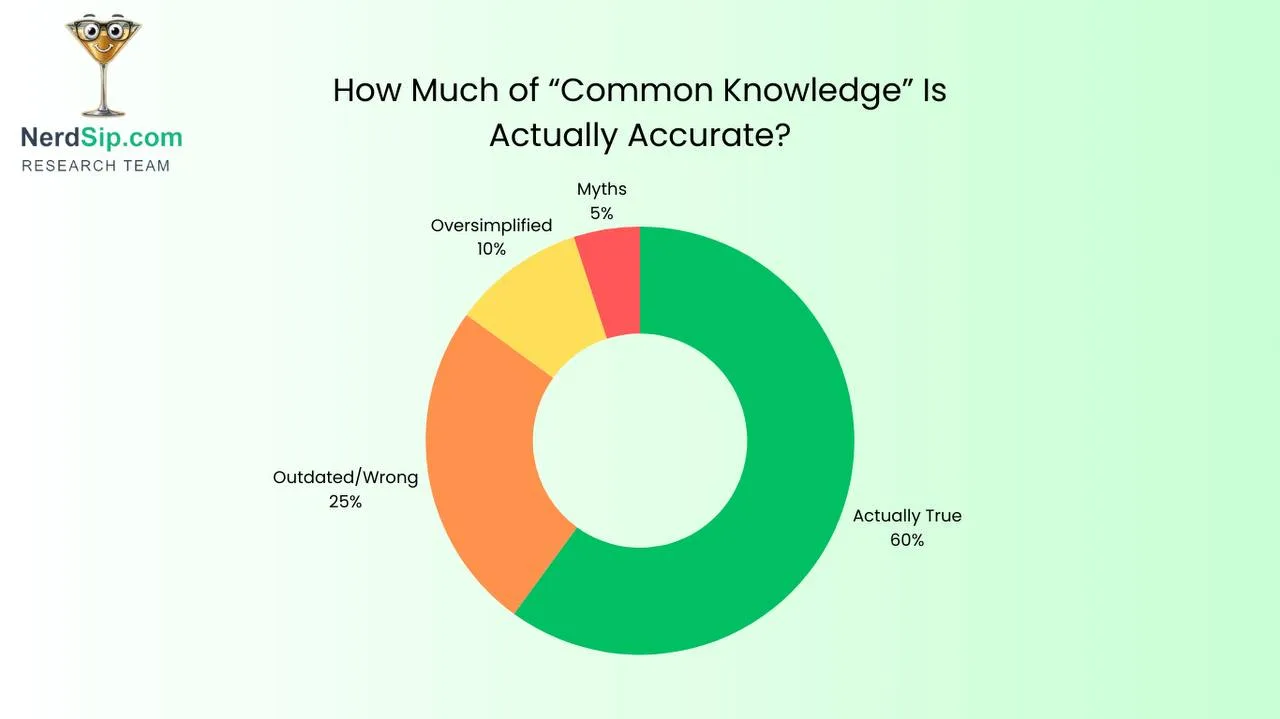
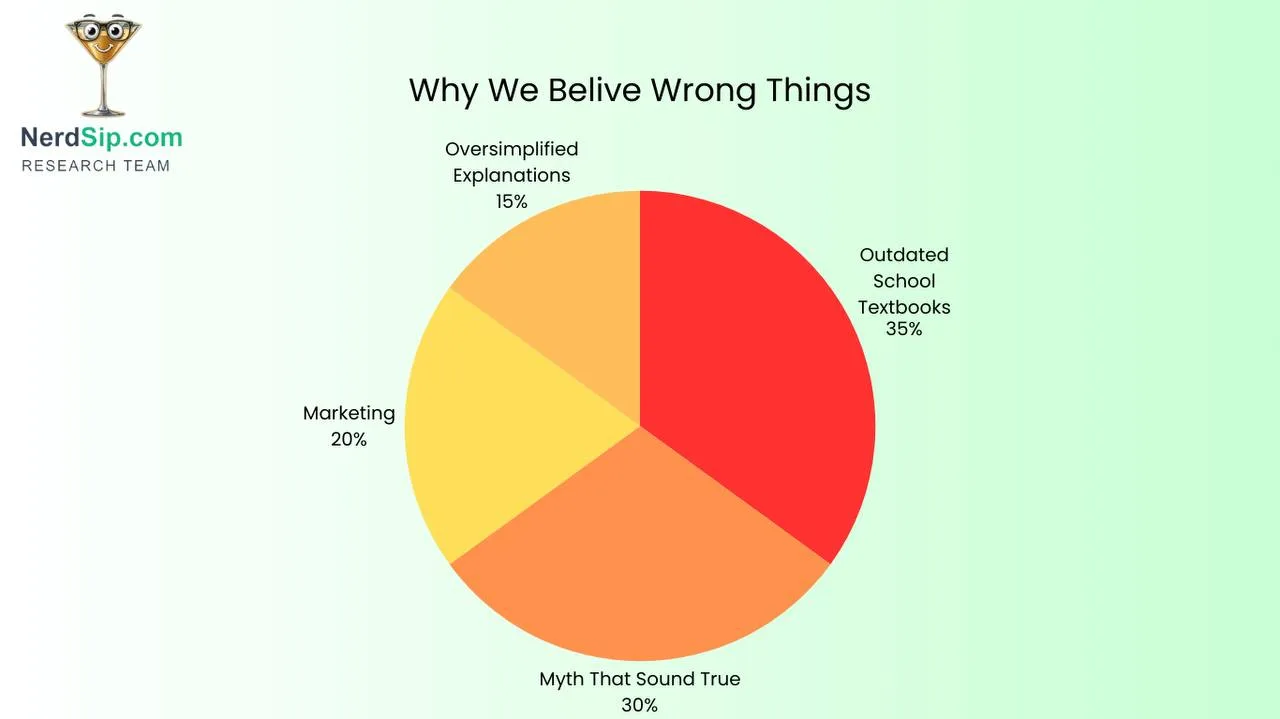
The lesson isn't to trust nothing. It's to verify interesting claims, especially ones that sound too neat to be true. Science advances. Common knowledge lags behind. What "everyone knows" might be outdated, oversimplified, or completely false.
Want to learn what's actually true?
Use apps like NerdSip to explore topics that fascinate you with accurate, up-to-date science. Learn about biology, physics, history, technology, or literally anything else that makes you curious. Because learning fascinating truths is way more interesting than believing comfortable myths.
Now go tell someone they've never actually touched anything and watch their brain implode.
Links you may find useful:
Every NerdSip course clears a four-layer fact-checking pipeline before it reaches the app: grounded in live sources, scored nightly, gated on failure, and reviewable by a person at one tap. Articles on this blog are drafted with AI assistance, then researched, verified, and edited by our team.
Editorial responsibility: ai51 UG (haftungsbeschränkt). Responsible editor named in the imprint.
📚 Keep Learning
Explore the NerdSip learning hubs
The blog is our editorial layer. When you want to move from reading into doing, these hubs organize the rest of NerdSip by format, including the app itself and the press that has written about it.
Ready to Level Up?
Turn your screen time into knowledge. Download NerdSip and start learning in just 5 minutes a day.
4.7 stars from 380 reviews · 10,000+ learners