Your brain named itself. Stop and think about that for a second. The organ responsible for all human thought, creativity, and self-awareness decided what to call itself. And it went with "brain."
Your brain also decides what you notice in the first place: the frequency illusion is why a word you just learned starts appearing everywhere.
Also, your brain is constantly producing new neurons—even as an adult. For decades, scientists believed you were born with all the brain cells you'd ever have. Wrong. Neurogenesis (birth of new neurons) happens throughout your life, especially in the hippocampus where memories form.
And here's one that'll mess with your perception of reality: your brain is showing you the past, not the present. It takes 80 milliseconds for your brain to process visual information. You're always seeing the world as it was a fraction of a second ago, not as it is now.
Your brain is the most complex object in the known universe—more intricate than any galaxy, more mysterious than any black hole. And it's sitting in your skull right now, reading this sentence while simultaneously breathing your body, digesting your food, and generating the consciousness experiencing these words.
Here are 27 brain facts that will completely change how you think about thinking.
Your Brain's Raw Specs (It's Insane)
1. 86 Billion Neurons, 100 Trillion Connections
Your brain contains approximately 86 billion neurons. Each neuron can connect to 10,000 other neurons.
That's about 100 trillion neural connections (synapses). If you counted one synapse per second, it would take you 3.2 million years to count them all.
For comparison, there are only 100-400 billion stars in the Milky Way. Your brain has more connections than our galaxy has stars.
2. Your Brain Uses 20% of Your Body's Energy
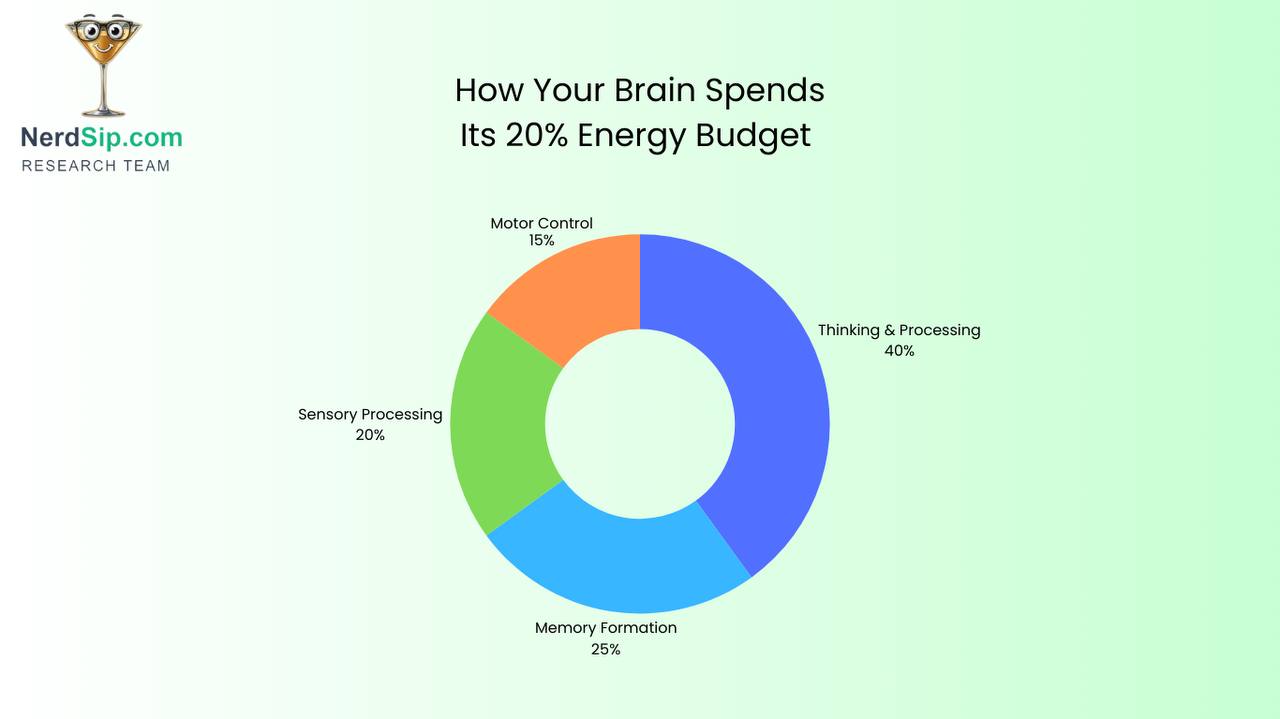
Your brain is about 2% of your body weight but consumes 20% of your oxygen and calories.
Thinking is expensive. That's why mentally exhausting work makes you physically tired—your brain is burning through glucose like crazy.
A chess grandmaster can burn 6,000 calories during a tournament day just from intense thinking.
3. Information Travels at 268 Miles Per Hour
Signals zip between neurons at speeds up to 268 mph (120 meters per second).
That's faster than a Formula 1 race car. Every thought, every movement, every sensation—electrical and chemical signals flying through your brain faster than you can consciously track.
4. Your Brain Generates 23 Watts of Power
When awake, your brain produces enough electricity to power a small LED light bulb.
All that neural activity generates detectable electrical signals. EEG machines measure these brainwaves—they're reading the literal electricity of your thoughts.
Memory & Learning (Your Brain Is Weird About This)
5. Your Brain Forgets Most Things on Purpose
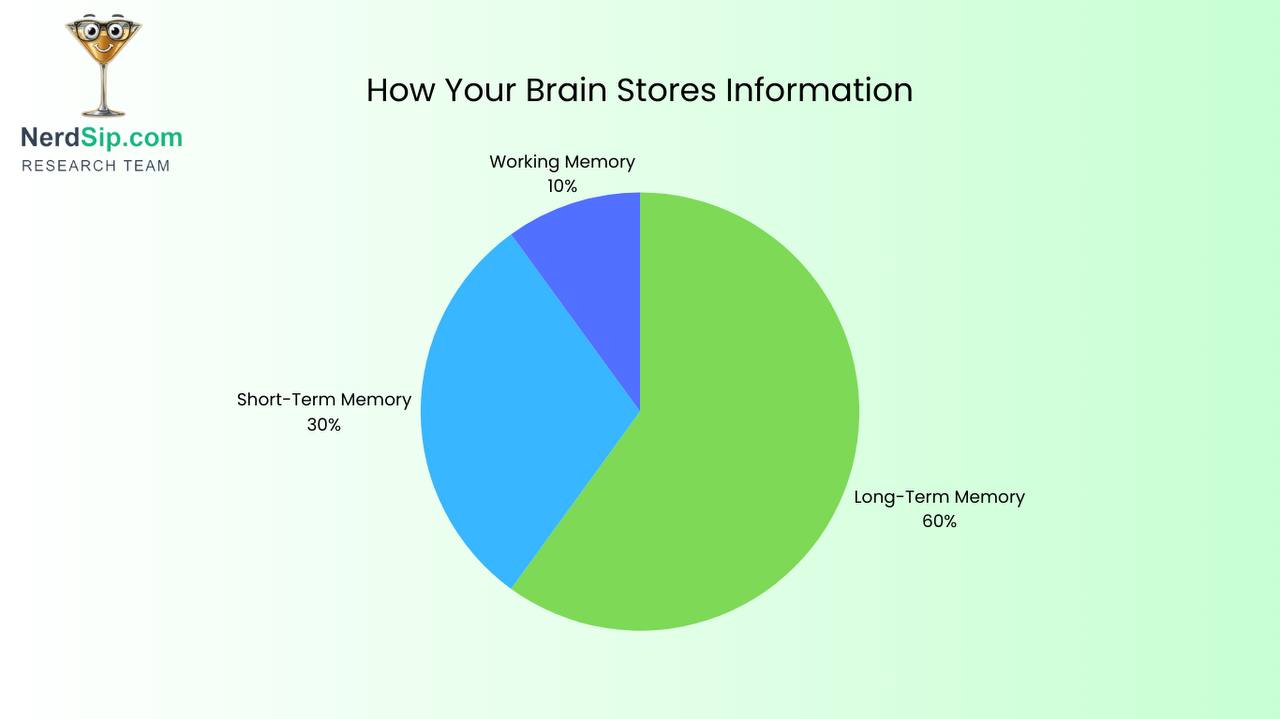
Forgetting isn't a bug—it's a feature. Your brain actively suppresses irrelevant information so you can focus on what matters.
If you remembered every conversation, every face you glimpsed, every word you read, you'd be paralyzed by useless data.
Forgetting is how your brain filters signal from noise.
6. False Memories Are Incredibly Easy to Create
Your brain doesn't store memories like a video recorder. It reconstructs them each time you recall them.
Research shows you can implant false childhood memories in about 30% of people just through suggestion and fake photos.
Every time you remember something, you slightly change that memory. Your past is constantly being rewritten by your present.
7. You Can Only Hold About 7 Items in Working Memory
Your working memory—the mental "scratch pad" you use for thinking—can only juggle 7±2 items at once.
This is why phone numbers used to be 7 digits. Why chunking information helps. Why multitasking is impossible (you're just rapidly switching between items in your limited working memory).
8. Sleep Is When Your Brain Takes Out the Trash
During deep sleep, your brain's glymphatic system flushes out metabolic waste and toxins that build up during the day.
This includes beta-amyloid proteins linked to Alzheimer's. Skip sleep regularly and that toxic waste accumulates.
Sleep isn't just rest. It's maintenance. Your brain literally cleans itself while you're unconscious.
9. Learning Changes Your Brain's Physical Structure
When you learn something new, your brain forms new neural connections and strengthens existing ones.
Brain scans of London taxi drivers (who memorize 25,000 streets) show an enlarged hippocampus compared to non-drivers.
Learning literally reshapes your brain. You're physically different after reading this article than before.
Senses & Perception (Reality Is a Hallucination)
10. Your Brain Fills In Your Blind Spot
Each eye has a blind spot where the optic nerve connects to the retina. No photoreceptors exist there.
You don't notice it because your brain fills in the missing information based on surrounding context. Your brain lies to you constantly to create a seamless experience of reality.
11. You're Seeing the Past, Not the Present
Visual processing takes about 80 milliseconds. Sound processing is even faster.
You're always experiencing a slightly delayed version of reality. Your brain is showing you the recent past, not the actual present.
12. Your Brain Edits Out Your Nose
Your nose is always in your field of vision. Right now. Look—there it is.
But your brain filters it out. It's "irrelevant" information, so your conscious awareness never notices it unless someone points it out.
13. Dreams Are Your Brain Testing Scenarios
During REM sleep, your brain simulates scenarios—often threatening or stressful ones.
This might be evolutionary preparation. Your brain practices handling danger in a safe environment (dreams) so you're ready for real threats.
14. You Have Taste Receptors in Your Intestines
Taste isn't just in your tongue. Your gut has taste receptors for sweet, bitter, and umami.
These help your digestive system prepare for incoming nutrients. Your gut is literally tasting your food and communicating with your brain about it.
Consciousness & Self (The Hard Problem)
15. Scientists Still Don't Know How Consciousness Works
We can map every neuron, track every signal, but we can't explain how physical processes create subjective experience.
How does electrical activity in neurons become the feeling of "you"? This is called the Hard Problem of Consciousness, and it's completely unsolved.
16. Your Brain Doesn't Distinguish Between Real and Imagined
Brain scans show similar activation patterns whether you're doing something or vividly imagining it.
Athletes use this—mental practice activates the same neural pathways as physical practice. Your brain treats detailed imagination like reality. Not everyone can do this: some brains produce no mental images at all, and a short aphantasia test reveals where yours sits on the spectrum.
17. You Have Two Separate Consciousness Systems
Your left and right brain hemispheres can function independently. People who've had their corpus callosum (the connection between hemispheres) severed sometimes display two different preferences.
One hemisphere might choose a red shirt while the other reaches for blue. Two separate decision-makers in one skull.
18. Most Decisions Happen Before You're Conscious of Them
Brain scans show your brain makes decisions up to 10 seconds before you become consciously aware of making them.
Your conscious "choice" is actually your brain rationalizing what it already decided unconsciously. Free will might be an illusion—or at least way more complicated than it feels.
Brain Chemistry & Emotions (You're a Meat Computer on Drugs)
19. Your Gut Bacteria Influence Your Mood
Your gut produces 90% of your body's serotonin. The bacteria living in your intestines (your microbiome) affect neurotransmitter production.
Changing your gut bacteria can literally change your mental state. You're not just you—you're you + trillions of bacteria working together.
20. Love Is Chemically Identical to OCD
The early stages of romantic love show similar brain patterns to obsessive-compulsive disorder.
The obsessive thoughts, the inability to focus on anything else, the compulsive checking—that's your brain flooding with dopamine, norepinephrine, and lowered serotonin. Love is a temporary brain malfunction.
21. Laughter Releases Endorphins Better Than Many Drugs
Genuine laughter triggers endorphin release throughout your brain, creating natural euphoria and pain relief.
This is why humor evolved—it's a social bonding mechanism that literally makes your brain reward you for connecting with others.
22. Stress Physically Shrinks Your Brain
Chronic stress floods your brain with cortisol, which can damage and kill neurons in the hippocampus.
Long-term stress literally makes your brain smaller. It also impairs memory formation and learning. Stress isn't just uncomfortable—it's neurotoxic.
Weird Brain Quirks (Evolution Is Drunk)
23. Your Brain Can't Actually Multitask
When you think you're multitasking, you're rapidly switching between tasks. Each switch costs mental energy and time.
Research shows multitasking reduces productivity by 40% and lowers your effective IQ by 10 points. You're literally making yourself dumber by trying to do two things at once.
24. Yawning Cools Your Brain
Nobody knows exactly why we yawn, but research suggests it helps regulate brain temperature.
Your brain heats up during intense mental activity. Yawning increases blood flow and brings cooler blood to your overheating brain.
This is why contagious yawning exists—seeing someone yawn makes you think about brain activity, which heats your brain, triggering a cooling yawn.
25. You're Blind for 40 Minutes Every Day
Every time you move your eyes (saccades), your brain shuts off visual processing to avoid motion blur.
You make about 3-4 eye movements per second. That adds up to roughly 40 minutes of blindness daily.
Your brain fills in the gaps, creating the illusion of continuous vision. You're seeing a edited version of reality.
26. Your Brain Prioritizes Bad News
Your brain has a negativity bias—it's more alert to threats than opportunities.
Negative experiences are processed more thoroughly and remembered more strongly than positive ones. This kept our ancestors alive (missing one threat = death) but makes modern life more stressful.
27. Brain Size Doesn't Correlate with Intelligence
Einstein's brain was average-sized. Neanderthals had bigger brains than modern humans.
What matters is neural density, connection patterns, and specific region development. More neurons doesn't mean smarter—better connections do.
Why Understanding Your Brain Matters
Knowing your brain forgets on purpose helps you use external systems (notes, apps) instead of feeling bad about forgetting. Knowing sleep cleans your brain makes prioritizing 7-9 hours non-negotiable. Knowing multitasking makes you dumber changes how you structure your work.
Your brain is plastic, adaptable, and constantly changing. You're not stuck with the brain you have. You can literally rewire it by using your 86 billion neurons to learn something fascinating every day.
If you want to know where in your head each of these facts is happening, we built an interactive map of the human brain. Click any region and it tells you what that part does, with the study behind it.
For the anatomy behind these, the interactive human brain hub maps the regions one by one. For facts on everything else, see fun facts.
Every NerdSip course clears a four-layer fact-checking pipeline before it reaches the app: grounded in live sources, scored nightly, gated on failure, and reviewable by a person at one tap. Articles on this blog are drafted with AI assistance, then researched, verified, and edited by our team.
Editorial responsibility: ai51 UG (haftungsbeschränkt). Responsible editor named in the imprint.
📚 Keep Learning
- 42 Facts That Will Blow Your Mind (2026)
- 100 Science Facts That Are Actually True
- How to Learn Something New Every Day (Without It Feeling Like Homework)
- How to Improve Memory: 10 Methods Backed by Science
- 47 Mind-Blowing Science Facts That Sound Fake But Are 100% Real
- Baader-Meinhof Phenomenon: Why You Suddenly See It Everywhere
- Dark Psychology Facts: What the Research Actually Says
Explore the NerdSip learning hubs
The blog is our editorial layer. When you want to move from reading into doing, these hubs organize the rest of NerdSip by format, including the app itself and the press that has written about it.
Keep going: five-minute courses on this
Pick one and finish it before your coffee cools. Every lesson ends with a quick question, so it sticks instead of scrolling past.
Courses on this topic
4.7 stars from 380 reviews · 10,000+ learners