Your phone battery is made from lithium mined by a massive brine operation in Chile that you can see from space. The holes in airplane windows aren't a design flaw—they're the only thing preventing the plane from exploding. And that "new car smell" everyone loves? It's literally toxic chemicals off-gassing from the materials.
Holy shit, right?
If reading those facts made you want to immediately Google more, fall down a Wikipedia rabbit hole, or text them to a friend—you're exactly who this article is for.
You're the person who reads ingredient labels for fun. Who clicks "Random Article" on Wikipedia at 2 AM. Who watches 3-hour video essays about topics you didn't even know existed an hour ago.
You're curious. And you're tired of your curiosity being fed garbage.
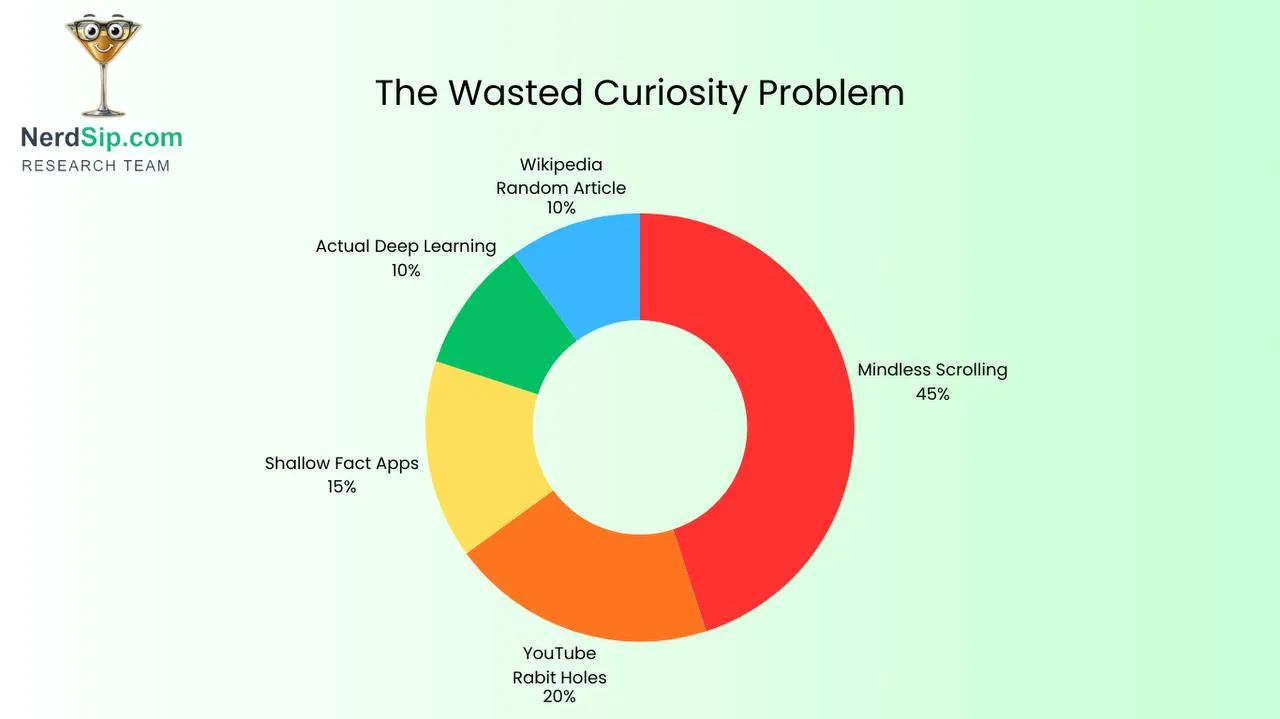
Here's the problem: your phone is designed to waste your curiosity on endless scroll feeds that give you nothing. You want to learn, but apps either bore you with academic lectures or drown you in useless trivia.
What if there was an app designed specifically for people like you—curious people who want to learn something new every day that actually makes them go "wait, WHAT?"
Let me show you what that looks like.
Why Most "Learn Something New" Apps Suck
You've probably tried the usual suspects: Duolingo for languages (solid, but limited), random fact apps (shallow trivia), educational podcasts (require too much time), or TED Talks (hit or miss).
Here's why they don't work for actually curious people:
They're Too Narrow
Duolingo is great for Spanish. Useless if you want to understand quantum mechanics, Roman history, or how cryptocurrency actually works.
You're curious about EVERYTHING. Why should you be locked into one topic?
They're Too Shallow
Random fact apps give you "Did you know? Bananas are berries!"
Cool. What does that actually mean? Why? How does botanical classification work? What else is weirdly classified?
You don't want trivia. You want to understand WHY things are the way they are.
They're Too Long
A 2-hour podcast about the fall of Rome is fascinating. But you don't have 2 hours. You have 10 minutes on the subway.
Most educational content assumes you have infinite time. You don't.
They're Not Designed for Rabbit Holes
The best learning happens when you discover something, get curious about a related thing, then another, then another. Wikipedia rabbit holes. YouTube recommendation spirals.
Most learning apps give you a linear path. That's boring for curious minds.
What Curious People Actually Need (The 5 Requirements)
1. Bite-Sized But Not Shallow
5-10 minute lessons that actually teach you something meaningful, not just factoids.
You should finish feeling like you understand a concept, not just memorized a random fact.
2. Unlimited Topics
Today you want to learn about black holes. Tomorrow, medieval siege weapons. Next week, how the stock market actually works.
You need an app that can teach you ANYTHING, not just what some curriculum designer decided was important.
3. "Holy Shit" Hooks
Every lesson should start with something that makes you go "wait, WHAT?"
The Eiffel Tower is taller in summer than winter (thermal expansion). Your stomach gets a new lining every 3 days (otherwise acid would digest it). There are more trees on Earth than stars in the Milky Way (3 trillion vs 400 billion).
Lead with the mind-blowing fact, then explain the science.
4. Designed for Your Actual Schedule
You have 5 minutes before a meeting. 10 minutes on the train. 15 minutes before bed.
The app needs to work in fragments, not require hour-long commitments.
5. Feels Like Discovery, Not School
School made learning feel like a chore. The best learning feels like you discovered something yourself.
The app should feel like falling down rabbit holes, not completing homework.
The App That Finalmente Gets It: NerdSip
It Uses AI to Generate Courses on Literally Anything
This is the killer feature.
Want to learn about:
- How anesthesia works (we still don't fully understand it)
- The fall of the Byzantine Empire
- How encryption keeps your data safe
- Why we yawn (surprisingly complex)
- The science of sourdough fermentation
- Medieval torture devices (morbid but fascinating)
- How your phone knows you're walking vs. driving
You type it in. The AI generates a structured course with 5-10 minute lessons. In seconds. With great visuals.
You're not limited to what course creators decided to make. If you're curious about it, you can learn it.
It Fact-Checks What It Generates
The obvious worry about generated courses is that the AI is just making things up.
Four layers sit between a generated course and you. Every course is written against live search results instead of from memory. An automated pass scores the whole library nightly for content integrity. Anything below the bar never reaches your deck. And one tap on any lesson sends it to a human reviewer. The full pipeline is here.
Every Lesson Leads With "Holy Shit"
Example opening from their quantum mechanics course:
"Particles can be in two places at once until you look at them. Then they 'choose' one location. This isn't philosophy—it's proven physics that Einstein called 'spooky' and hated his entire life."
You're immediately hooked. Now you WANT to understand quantum superposition.
It's Built Like Duolingo (But for Everything)
Remember how Duolingo made language learning addictive with streaks, XP, and gamification?
NerdSip does the same thing but for any topic.
- Daily streaks keep you coming back
- XP system makes progress tangible
- Leaderboards if you're competitive
- 5-10 minute lessons fit into any schedule
- Works fully on your phone
There's a Social Feed of Curious People
See what topics are trending. What others in the community are learning. Courses people are creating and sharing.
It's like Reddit for learning. You discover topics you didn't even know you were curious about.
"Oh, someone's learning about the Dyatlov Pass incident? That sounds interesting. Let me check it out."
Curiosity is contagious.
The AI Adapts to How You Learn
As you use it, the AI learns what kinds of explanations work for you. Visual? Analogies? Step-by-step breakdowns?
It adjusts to match your learning style instead of forcing you into one approach.
How It Actually Works (The User Experience)
Here's what using NerdSip looks like day-to-day:
Morning coffee (5 minutes): Open app. Daily lesson waiting. Today it's "Why Do Airplanes Have Ashtrays If Smoking Is Banned?" (Spoiler: FAA regulation requires them in case someone breaks the rules—safer to have a designated place than risk a fire in the trash).
Mind = blown. You learned something. Coffee tastes better when your brain is engaged.
Lunch break (10 minutes): Curious about something you heard in a meeting. "How does blockchain actually work?" Type it in. AI generates a 5-part course. You start Part 1.
Finally, you actually understand what people mean by "decentralized ledger."
Evening commute (15 minutes): Continue the blockchain course. Part 2 explains mining. Part 3 covers smart contracts.
By the end of the week, you actually understand crypto instead of just nodding along pretending.
Before bed (5 minutes): Check the social feed. Someone's learning about the Voynich Manuscript (mysterious book no one can decode). Looks fascinating. Add to your learning queue.
Total time: 35 minutes spread across the day. But you learned three completely different topics and discovered a fourth.
Real Topics People Are Learning on NerdSip Right Now
These are actual trending courses in the NerdSip community (yes, these are real):
Science & Nature:
- Why tardigrades (water bears) can survive in space
- How spider silk is stronger than steel
- The science behind why cats purr (it's not just happiness)
- Why we can't remember being babies (childhood amnesia explained)
- How trees communicate through fungal networks (the "wood wide web")
History & Culture:
- The Great Emu War of 1932 (Australia really lost to birds)
- Why the dollar sign is $ (surprisingly murky origins)
- How the French accidentally created the metric system during a revolution
- The dancing plague of 1518 (people literally danced until they died)
- Why QWERTY keyboards are designed terribly (it's intentional)
Technology & How Things Work:
- Why touch screens work (but only with fingers, not gloves)
- How noise-canceling headphones create silence
- Why your phone battery dies faster in the cold
- How AI image generators actually work
- Why you can't hum while holding your nose (try it)
Psychology & Human Behavior:
- The Dunning-Kruger effect (why incompetent people overestimate abilities)
- Why we remember song lyrics from high school but forget what we read yesterday
- The mere-exposure effect (seeing things more makes us like them)
- Why groups make worse decisions than individuals (groupthink)
- How placebos work even when you know they're placebos
Weird & Wonderful:
- Why bananas are radioactive (and how much radiation you're actually exposed to)
- How the inventor of Pringles is buried in a Pringles can (his request)
- Why bulls don't actually hate red (they're colorblind)
- The ship of Theseus paradox (if you replace every part, is it the same ship?)
- Why we say "OK" (weirdest origin story ever)
Every single one of these starts with a "holy shit" hook, then explains the actual science/history/mechanics behind it.
Why This Matters (Beyond Just Being Interesting)
Being curious isn't just fun—it's actually valuable:
At work: Curious people connect ideas others miss. That random fact about Roman concrete might inspire a solution to your current problem.
In conversations: You become the person who makes conversations interesting. "Wait, you know about that?"
For your brain: Lifelong learning literally keeps your brain young. Neuroplasticity is real.
For life satisfaction: Research shows curious people are happier. Novel information triggers dopamine. Learning feels good.
You're not wasting time being curious. You're investing in becoming a more interesting, creative, capable human.
Alternatives to NerdSip (For Different Curiosity Styles)
To be fair, NerdSip isn't the only option for curious people. Here's what else is out there:
For Visual Learners: YouTube
Channels like: Vsauce, Kurzgesagt, Veritasium, Tom Scott
Pros: Free, engaging, unlimited content. Cons: Long videos, easy to fall into unproductive rabbit holes.
For Readers: Wikipedia Random Article Feature
Pros: Unlimited topics, detailed, free. Cons: Hit or miss quality, not structured for learning.
For Listeners: Podcasts
Try: Stuff You Should Know, Radiolab, 99% Invisible, No Such Thing As A Fish
Pros: Great for commutes. Cons: Long episodes, can't easily jump between topics.
For Structured Learning: NerdSip
Pros: Bite-sized lessons, works on any topic, mobile-first, gamified, AI-generated courses. Cons: Newer platform.
The 30-Day Curiosity Challenge
Want to see if feeding your curiosity daily actually makes a difference?
The challenge: Spend 10 minutes daily for 30 days feeding your curiosity. Track what you learn and notice how it affects your mood and conversations.
The Bottom Line: Feed Your Curiosity or Starve It
Your brain is curious by nature. You can feed that curiosity with endless scrolling that leaves you empty, or intentional learning that makes you smarter.
NerdSip is built specifically for you.
Ready to actually use your screen time for something that makes you smarter?
Download NerdSip. Pick something you're genuinely curious about. Do one 5-minute lesson.
Every NerdSip course clears a four-layer fact-checking pipeline before it reaches the app: grounded in live sources, scored nightly, gated on failure, and reviewable by a person at one tap. Articles on this blog are drafted with AI assistance, then researched, verified, and edited by our team.
Editorial responsibility: ai51 UG (haftungsbeschränkt). Responsible editor named in the imprint.
📚 Keep Learning
Explore the NerdSip learning hubs
The blog is our editorial layer. When you want to move from reading into doing, these hubs organize the rest of NerdSip by format, including the app itself and the press that has written about it.
Ready to Level Up?
Turn your screen time into knowledge. Download NerdSip and start learning in just 5 minutes a day.
4.7 stars from 380 reviews · 10,000+ learners