Quick answer: The best learning apps for busy people are the ones with a unit you can finish in five to ten minutes. NerdSip is the best all-rounder, with five-minute courses on any topic. Duolingo wins for languages, Mimo for coding, Brilliant for maths and logic, and Blinkist for book ideas on the commute. Professionals who need a certificate should add LinkedIn Learning and accept that it wants half an hour at a time.
You want to learn. You do not have time. Between work, family and the basic maintenance of being a person, a course that wants three hours a week is a course you will abandon in week two.
The good news is that you do not need hours. You need an app whose smallest complete unit fits the gaps you already have: the commute, the queue, the ten minutes before a meeting starts. We tested more than 20 learning apps over several months with exactly that constraint and kept the eight that pass it.
What a Learning App Needs to Survive a Full Calendar
Four things separate the apps that busy people keep from the apps they delete.
A unit you can finish in the gap. Not a lesson you can pause, a lesson you can complete. Ten minutes between meetings is enough for a five-minute course and not enough for the first third of a forty-minute video.
Phone first. If the app needs a laptop, it needs a desk, and a desk means a block of time you do not have. The learning that actually happens for busy people happens standing up.
It asks you questions. Watching a video creates the feeling of learning. A quiz creates the memory. Every app that made this list tests you in some way, and the ones that only show you things are further down.
A reason to come back tomorrow. Streaks, leagues and progress bars get dismissed as gimmicks. They are the difference between an app you used in January and an app you are still using in June.
Offline mode is a bonus rather than a requirement. It matters on a train with no signal and nowhere else.
The Eight Apps at a Glance
| App | Best For | One Unit Takes | Tests You? | Offline | Price |
|---|---|---|---|---|---|
| NerdSip | Any topic, on demand | ~5 min course | Yes, every lesson | No | Free course daily; €7.99/mo or €49.99/yr |
| Duolingo | Languages | 3-5 min | Yes | Yes (paid) | Free with ads; Super $12.99/mo |
| Mimo | Coding on your phone | 3-5 min | Yes, you write code | Partial | Free tier; Pro ~$10/mo |
| Brilliant | Maths, logic, science | 10-15 min | Yes, every step | Yes | 1 lesson/day free; €25/mo or €13.75/mo annually |
| Blinkist | Book ideas on the commute | 15 min | No | Yes | 1 Blink/day free; €15.99/mo or €99.99/yr |
| Khan Academy | Free academic subjects | 5-15 min | Yes, exercises | Yes | Free |
| LinkedIn Learning | Certificates for your profile | 30+ min | Some quizzes | Yes | ~$39.99/mo, cheaper annually |
| DataCamp | Python, R, SQL | 10-20 min | Yes, you write code | No | Limited free tier; ~$25/mo annually |
Prices are standard consumer rates checked in 2026 and change often. Confirm on the store listing before you subscribe.
The Best Learning Apps for Busy People, Reviewed
NerdSip: Any Topic, Five Minutes
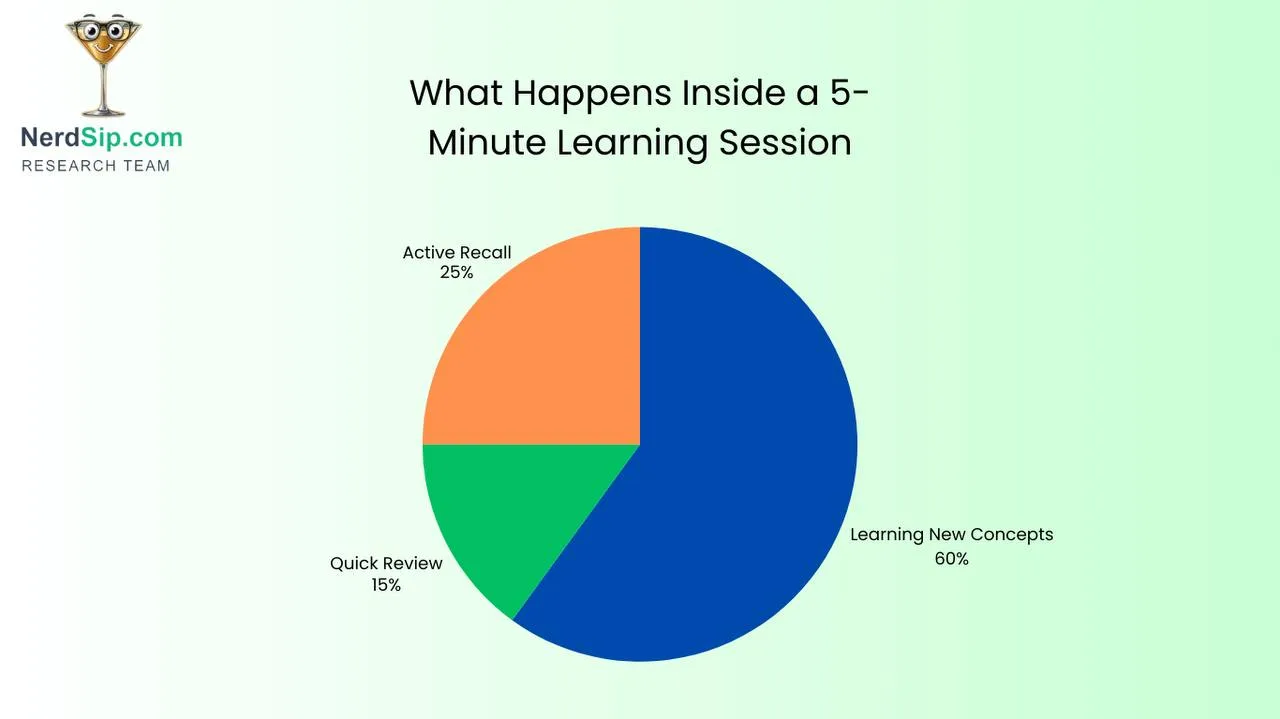
NerdSip is the only app here with no catalogue. You type a topic, negotiation, Roman history, prompt engineering, the economics of coffee, and it writes a course in seconds: three, five or ten lessons of about a minute each, every one ending in a question that explains why the right answer is right. A short course is done in five minutes and closes with a summary card you can keep. Podcast mode reads it aloud when your hands are busy.
For a busy person the swipe deck is the quiet advantage. There is no browsing. Swipe right to start, left to skip, and the deck learns what you like. Underneath sits a real progression system, with XP, streaks with freeze days for the weeks that go wrong, weekly leagues and a review round built from whatever you finished in the last 30 days. Generation runs against live search results, every course is scored for integrity before it reaches the deck, and one tap sends anything suspect to human review.
The honest limit: some lessons still read like a machine wrote them, and generating your own courses needs a subscription. Reading one full course a day is free with no account, which is enough to know within a week whether it fits your day.
Best for: curious people whose interests change, and professionals who need a specific skill no course creator has covered yet.
Price: one course a day free; €7.99 a month or €49.99 a year after a 7-day trial.
Duolingo: Languages, Nothing Else
Duolingo is still the gold standard for learning a language in the cracks of a day, and the reason is the streak. Lessons take three to five minutes, the owl nags you, and after 30 days you keep going because you cannot face breaking the chain. Offline mode on the paid plan handles the tunnel.
The limit is the menu. Duolingo teaches languages plus Math, Music and Chess, and that is the whole list. Intermediate lessons get repetitive, and the free version carries ads. If you want the same feel for a subject that is not a language, see the Duolingo alternatives that aren't language apps.
Best for: anyone learning a language who wants consistency without a time commitment.
Price: free with ads; Super is $12.99 a month or $83.99 a year.
Mimo: Coding on Your Phone
Mimo teaches programming in three-to-five-minute lessons where you write real code on your phone, which sounds impossible and works. The paths are clear (web development, Python, SQL), feedback is instant, and the interface is the best-looking of the coding apps.
The limit is depth. Micro-lessons get you to the point where you can read code and write simple programs. Past that, you need a keyboard and a bigger screen. The free tier is thin.
Best for: beginners who want to learn to code on the commute.
Price: free with limits; Pro is about $10 a month. SoloLearn is the broader but rougher alternative.
Brilliant: Maths and Logic, When You Can Sit Down
Brilliant teaches maths, physics, data and computer science by making you solve things. Every lesson is an interactive puzzle, and the understanding sticks because you built it rather than watched it. Lessons run ten to fifteen minutes and work offline.
The catch is attention. Brilliant needs all of it, so it fails the walking-to-the-station test and belongs in the sit-down slots of your day. It is also the most expensive app on this list. If the price stings, the best Brilliant alternatives cover cheaper routes.
Best for: people who want to understand STEM by doing, with a quiet ten minutes to spare.
Price: one lesson a day free; €25 a month, or €13.75 a month on an annual plan.
Blinkist: Book Ideas on the Commute
Blinkist compresses nonfiction books into fifteen-minute reads or listens. The audio is the point. A Blink on the drive in is the least painful way to get the argument of a business book you were never going to read in full.
The limit is that nothing tests you, so summaries fade fast. Use it for breadth, sampling many ideas, and not for mastering one. If you keep forgetting what you listened to, the best Blinkist alternatives for remembering what you read tackle that directly.
Best for: professionals who want to stay current on business and psychology books.
Price: one Blink a day free; €15.99 a month or €99.99 a year.
Khan Academy: Free Academic Depth
Completely free, no paid tier, no upsell. Structured courses in maths, science, economics and history, from school level to early university, in five-to-fifteen-minute videos with exercises after each one.
The limit is that it is built for students. The interface is dated, the videos are lectures at heart, and you learn their curriculum in their order. For a professional filling a gap in statistics before a new role, that is exactly right. For a curious ten minutes, it is heavy.
Best for: academic subjects, exam prep, and parents helping with homework.
Price: free.
LinkedIn Learning: Certificates, in 30-Minute Blocks
LinkedIn Learning has more than 16,000 video courses from working experts, and a finished course adds a certificate to your profile that recruiters recognise. Courses are split into short chapters, downloads work offline, and you can watch at double speed.
The limit is that it is not built for five-minute gaps. Most courses expect two hours or more, and chapters are meant to be watched in sequence. It earns its place for one reason: when the goal is a credential rather than a habit, nothing on this list beats it.
Best for: professionals who need a recognised certificate and can find half an hour at a time.
Price: about $39.99 a month, cheaper on an annual plan, with a free trial.
DataCamp: Data Skills, Best at a Desk
DataCamp teaches Python, R and SQL by making you write code against real datasets, with instant feedback and clear career tracks. Exercises are short, and the learning is active from the first minute.
The limit is the phone. The mobile app works, but the real product is the browser editor, and the free tier stops early. Treat it as a lunch-break-at-the-laptop app rather than a queue app.
Best for: anyone who needs Python, R or SQL for work.
Price: limited free tier; about $25 a month on an annual plan.
Apps That Look Right but Need Time You Do Not Have
Three families of apps get recommended to busy people constantly and fail them constantly.
Coursera, Udemy and edX are university courses on a phone. They expect three to five hours a week for four to eight weeks, with assignments and deadlines. You cannot do five minutes and leave. They are excellent if you can protect a weekly block, and useless if you cannot.
MasterClass is beautifully filmed and entirely passive. Lessons run ten to thirty minutes with nothing to do but watch. Save it for a Sunday afternoon.
Codecademy is a desktop product. Lessons take thirty to sixty minutes and the mobile experience is an afterthought. If you have a computer and an hour, it is good. If you have a phone and ten minutes, Mimo.
How to Make It Stick When You Are Busy
The right app is half the job. The other half is a system that does not rely on motivation, because motivation is the first thing a busy week takes.
Attach the lesson to something you already do. Coffee brewing means Duolingo. The train means a NerdSip course. The walk from the car park means a Blink. When learning is welded to a moment that already happens every day, you stop deciding whether to do it.
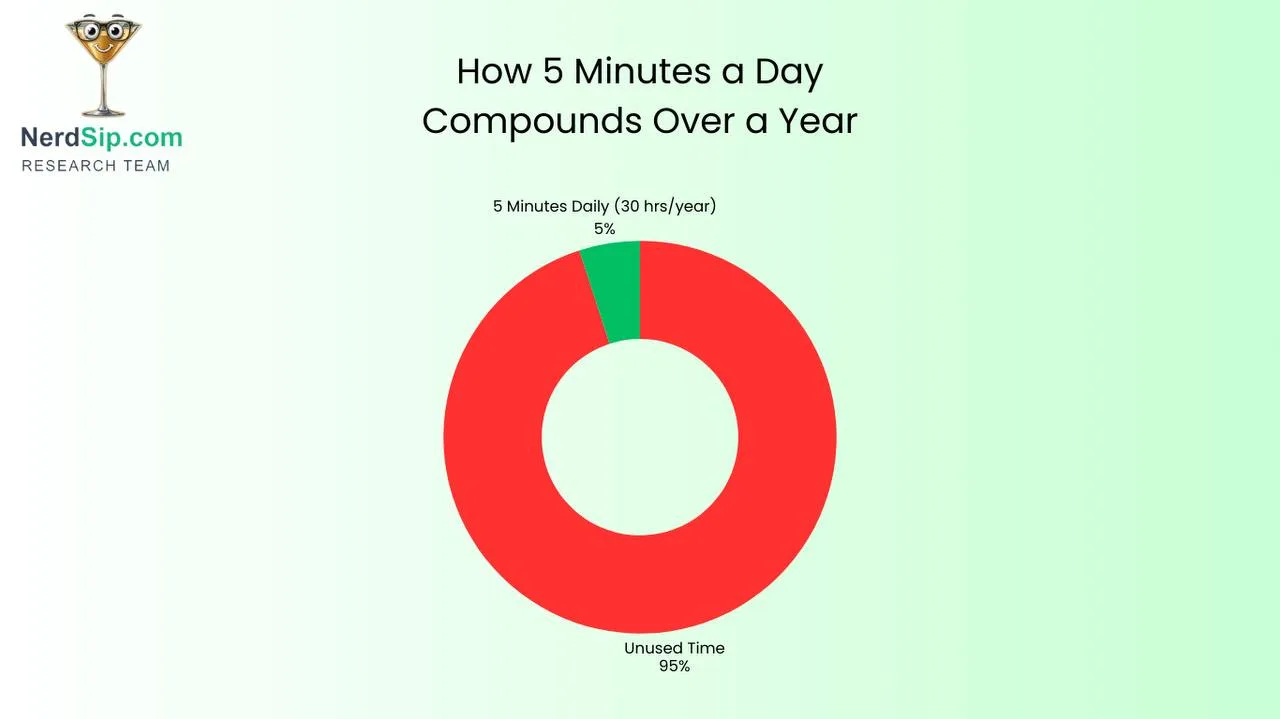
Spend the dead minutes. Waiting rooms, queues, the first five minutes of lunch, the kettle. Three five-minute sessions a day is fifteen minutes, which is more than 90 hours a year, and none of it came out of your calendar.
One app, thirty days. Switching apps every week resets the habit and the streak. Pick one for one goal and stay with it for a month before you judge it. That is roughly how long a daily learning habit takes to stop feeling like effort.
Five minutes counts. Skipping a day because "five minutes is not enough" is how habits die. Five focused minutes beats thirty distracted ones, and it keeps the chain alive for the day you have more.
Use what you learned within the week. Speak the sentence, run the code, try the framework in a meeting, explain the idea to someone. Application turns knowledge into a skill, and it is the step most apps cannot do for you.
Which App Should You Choose?
- Any topic, or a rotating set of interests: NerdSip.
- A language: Duolingo.
- Coding from zero: Mimo on the phone, DataCamp once you are at a desk.
- Maths and science: Brilliant if you can sit down, Khan Academy if you want it free.
- Business ideas on the commute: Blinkist.
- A certificate for your profile: LinkedIn Learning.
The best learning app for a busy person is the one still on your phone in June. Install one today, finish one unit, and do it again tomorrow. For the full ranking of apps built around short lessons, see the best microlearning apps in 2026. If most of your spare minutes happen in transit, we have separate picks for learning on your commute. And if price decides it, the best free learning apps list separates the truly free ones from free trials.
Frequently Asked Questions
What is the best learning app for busy people?
The best learning apps for busy people share one trait: a unit you can finish in five to ten minutes. NerdSip writes a five-minute course on any topic and tests you after every lesson, Duolingo does the same for languages, and Blinkist condenses books into fifteen-minute listens for the commute. Pick one app and use it daily rather than juggling several.
How can I learn something new when I have no time?
Use the gaps you already have. A commute, a queue or the first five minutes of lunch is enough for one short lesson, and five to fifteen minutes done daily beats an occasional long session. Attach the lesson to something you already do every day, keep one app for at least 30 days, and use what you learned within the week.
Do short-lesson learning apps actually work?
Yes, when they test you and bring you back. Short sessions keep the material within what working memory can hold, a quiz after each lesson moves it into long-term memory, and spacing sessions over days beats one long block. Apps that only show you videos create the feeling of learning without the memory.
How much time per day do I need to learn with these apps?
Five minutes a day is enough to make steady progress if it happens every day. Three five-minute sessions a day add up to more than 90 hours a year. The goal is daily repetition, not marathon sessions.
What is the best learning app for busy professionals?
NerdSip is the best fit for professionals who want a range of job-relevant topics, such as negotiation, communication, AI or leadership, in five-minute courses that test you. If you specifically need a recognised certificate for your career, add LinkedIn Learning, which breaks expert-led courses into short chapters you can watch at double speed, and accept that it wants half an hour at a time.
What is the best learning app for busy adults?
For busy adults, the best learning app has short, finishable lessons and a habit loop that survives a packed week. NerdSip fits most adults because it writes a course on any topic and a short course takes five minutes. Duolingo is best if the goal is a language, and Blinkist is best for absorbing book ideas on a commute.
Every NerdSip course clears a four-layer fact-checking pipeline before it reaches the app: grounded in live sources, scored nightly, gated on failure, and reviewable by a person at one tap. Articles on this blog are drafted with AI assistance, then researched, verified, and edited by our team.
Editorial responsibility: ai51 UG (haftungsbeschränkt). Responsible editor named in the imprint.
📚 Keep Learning
Explore the NerdSip learning hubs
The blog is our editorial layer. When you want to move from reading into doing, these hubs organize the rest of NerdSip by format, including the app itself and the press that has written about it.
Keep going: five-minute courses on this
Pick one and finish it before your coffee cools. Every lesson ends with a quick question, so it sticks instead of scrolling past.
Courses on this topic
4.7 stars from 380 reviews · 10,000+ learners