Why do $10,000 routers still crash in a stadium?
Prompted by A NerdSip Learner
Master the protocol-level physics of wireless gridlock.
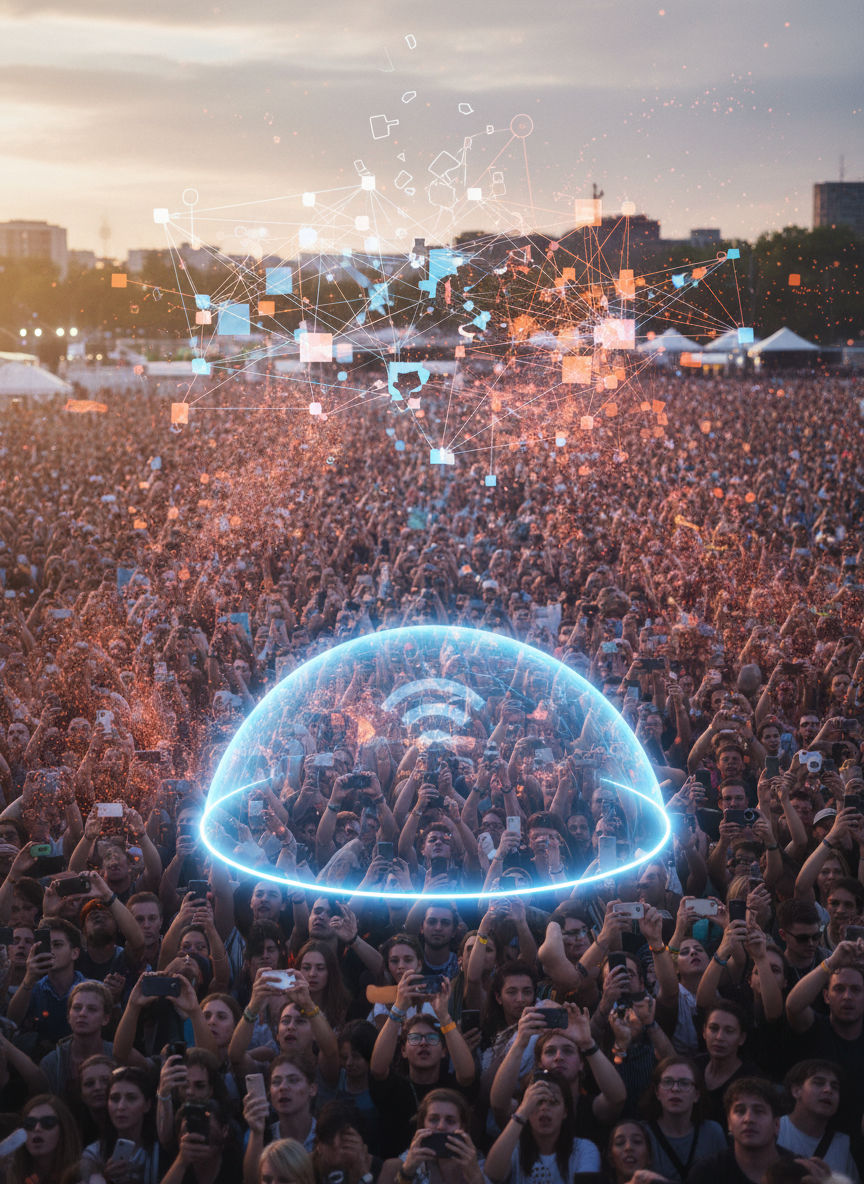
WiFi devices follow a protocol called CSMA/CA: "Listen before you speak." In a massive crowd, the Hidden Node Problem ruins this rule. If two people on opposite sides of a stadium send data to the same router, they often can’t "hear" each other due to distance.
Because they can't detect each other, they both assume the airwaves are empty and transmit at the same time. Their data packets collide at the router, turning into unreadable digital noise. Since the router can't decode the mess, it never sends an acknowledgment (ACK).\n Both devices then wait for a random interval—a backoff timer—and blindly try again. In a sea of thousands of smartphones, these collisions escalate exponentially. The network doesn't die from too much data, but because these micro-collisions destroy the available Airtime.
This cycle of interference leaves no room for actual communication. Even if the hardware is top-tier, the protocol itself becomes the bottleneck when users are physically separated yet connected to the same central hub.
Key Takeaway
When devices can't "hear" each other, they clash, killing the router's airtime with collisions.
Test Your Knowledge
What exactly is the Hidden Node Problem?
WiFi standards are dynamic. With a perfect signal, your phone uses high-speed tricks like 1024-QAM, packing massive amounts of data into every wave. It’s ultra-efficient, moving data in milliseconds.
But when the Signal-to-Noise Ratio (SNR) drops in a dense crowd, the router forces a "fallback." Devices switch to ultra-robust but incredibly slow modulations like BPSK. Instead of a data torrent, the device sends just one single bit per symbol.
Here’s the killer: a device downgraded to BPSK takes much longer to send even a tiny text message. This hogs the shared channel, stealing Airtime from every other device in the vicinity, regardless of their signal quality.
Even if you’re standing right next to the router with a perfect signal, you must wait for that struggling, slow-motion device to finish. Airtime utilization hits 100%, and the entire network grinds to a halt for everyone.
Key Takeaway
One device with a poor connection can hog the airwaves, slowing down the entire network.
Test Your Knowledge
Why does switching to BPSK (slow modulation) drag down the whole network?
To fix crowd chaos, high-end gear uses MU-MIMO and Beamforming. The router calculates tiny phase shifts in its antennas to fire a focused "data laser" directly at your device, rather than broadcasting in all directions.
It sounds like the perfect solution, but there's a massive catch: to aim these beams, the router must constantly send Sounding Frames. It’s essentially "pinging" the physical environment to map every obstacle and reflection in the room.
In a crowd, thousands of bodies are moving constantly. The physical layout changes faster than the router can update its math. The environment is never static for more than a few milliseconds, rendering the previous "map" useless.
The overhead for these constant measurements explodes. The system becomes so busy asking "Where are you now?" and recalculating paths that the network chokes on control data before any actual internet traffic can flow.
Key Takeaway
Constant movement in crowds overwhelms beamforming tech with excessive environment scanning.
Test Your Knowledge
Why does beamforming often fail in dynamic, crowded environments?
Track your progress, earn XP, and compete on leaderboards. Download NerdSip to start learning.